Home » Posts tagged 'women'
Tag Archives: women

Chocolate & Grace: Succeed in the face of adversity
Back in 2017, in The Clink restaurant in HMP Brixton, I had lunch with Chris Moore, the then Chief Executive of The Clink Charity, and a lady from Scotland. We listened carefully as she shared her vision of helping women caught up in the justice system, with chocolate. Her vision was realised later that year, but we lost touch.
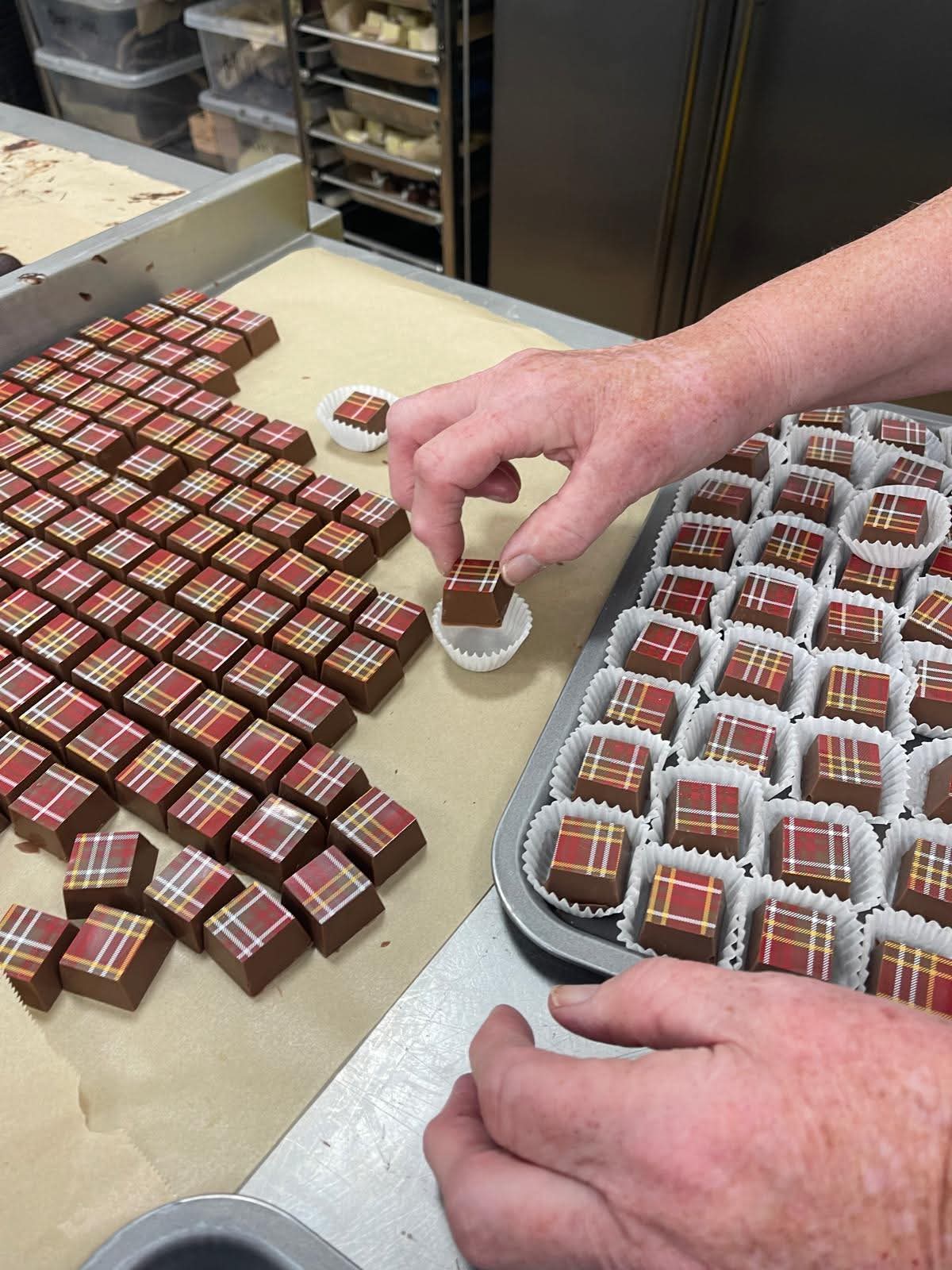
Last week, eight years later at Lady Val Corbett’s Professional Women’s networking lunch, I met Louise Humpington, CEO of Positive Changes, a CIC trading as Chocolate and Grace. The very same initiative that I had heard about all those years earlier. Louise became involved in July 2024.
This is the story of Chocolate & Grace, kindly written by Louise:

In a bustling kitchen in Stirling where the aroma of melting cocoa lingers, something more profound than chocolate is being crafted. Chocolate & Grace is not simply about indulgence; it is about empowerment, dignity, and rewriting futures.
At its heart, this initiative provides women who have lived experience of the justice system, with a safe, supportive space to heal, connect, and grow. Women describe the empowerment they feel when they are truly valued, treated with respect, and given the agency to rebuild their lives. Here, they are not defined by past mistakes but celebrated for their resilience, strength, and capacity for transformation.
Isolation is one of the silent challenges faced by many women leaving the justice system. Chocolate & Grace breaks that cycle by fostering community, reducing loneliness, and encouraging meaningful relationships. In doing so, it helps rebuild lives and, crucially, reduces reoffending—creating a positive ripple effect across society. The impact is not only personal but economic: lives rebuilt mean less strain on the public purse and a healthier, more connected community.

Every chocolate made is infused with purpose. Behind each truffle or bar is a story of hope, courage, and determination. Alongside training and employment opportunities, the program offers trauma-informed support and a platform for women’s voices to be heard, acknowledged, and amplified. The women are credited not as passive recipients of help, but as active changemakers who demonstrate extraordinary commitment to transformation.
Chocolate & Grace is proof that with compassion, respect, and opportunity, cycles can be broken. It is a movement that blends social impact with sweet creativity—reminding us that true empowerment is not given but cultivated, one act of grace, one piece of chocolate, one woman at a time.
But this approach isn’t just important for the women being supported by Chocolate & Grace, it also represents a critical redefining of what leadership and success look like.
This change matters not only because it corrects decades of narrow norms, but because it unlocks better outcomes for organisations, teams, and society. One in four people in the UK will have had been subjected to Adverse Childhood Experiences or some other trauma. Better recognising how marginalised groups and disenfranchised people can contribute because of their lived experience and not in spite of it, is not, therefore a nice to have, it’s a fundamental shift that society needs.
When we value difference, leadership becomes more human. It shows the value of connection, trust, and authenticity as strengths, not liabilities.
It shifts the metrics by creating a space where success isn’t defined solely by outcomes like profit, efficiency or hierarchy. Wellbeing, purpose, sustainability, inclusion are finding a space and making leadership more holistic and resilient in turbulent times.
When the rules are reworked, it opens up space for diverse voices that have been traditionally marginalised or excluded. It empowers people, amplifies their voices and revers the value of their perspective.

There is no question that challenges remain, but as we continue to push boundaries and challenges status quo, momentum builds. Systemic obstacles (bias, unequal expectations, lack of access) still create barriers. But as more women lead by new norms, those norms themselves become harder to ignore or dismiss. We are changing the normative landscape in leading by example, and in amplifying the voices of those who have the most to teach us about what it is really like to succeed in the face of adversity.
The chocolates are delicious, if you would like to support this inspiring organisation have a look at their shop and treat yourself (and others) https://www.chocolateandgrace.co.uk/collections

A conversation with: Lady Val Corbett, passionate about prison reform, empowerment of women and kindness in business
Lady Val Corbett, a feisty woman, with determination to rival most, striking red hair and a penchant for wearing bright scarves, is one way of introducing my latest “A conversation with…” Having known Lady Val for 6 years, I have found her to be compassionate, hilarious, focused and above all, a friend.

Her career in journalism started in Cape Town but with moving to the UK it was impossible to continue without being a member of the National Union of Journalists. Eventually she worked for the Sunday Express as a weekend reporter; a Features Editor of a noteworthy Furnishing Magazine; Editor of a magazine Woman’s Chronicle for the Spar customers and grocers which then led to becoming the consumer columnist on The Sun. With the birth of her daughter, Polly, she invented herself several times!
“I wrote a column for Cosmopolitan and for national papers and magazines plus scriptwriter for BBC TV then became one of the founder directors of an independent TV production company which sold programmes for major broadcasters – highlight was a six-part BBC1 series called Living with the Enemy on teenagers as I was struggling with mine at the time. I was a volunteer at the Hoxton Apprentice, a training restaurant for long term unemployed and saw how people could change direction. After that I co-wrote six novels with two friends and in between was an MP’s wife and later the PA for Lord Corbett of Castle Vale, when I regularly gave notice or got fired.”
That’s quite a résumé.
Val had a chance encounter on her first day as a features writer, which led to 42 years of happy marriage.
“On my first day I was having second thoughts about a new dress I had bought. Going to the canteen for lunch I paused at the door and asked my colleague: “Does this dress make me look dumpy?” To which an amused male voice said: “Yes it does.” I looked up – my 5ft 2” to his 6ft 3” – and thought he was the rudest man I’d ever met. He called me Dumpy for ages.”
Her husband, Lord Corbett of Castle Vale, sadly died on 19th February 2012.
Did you personally have an interest in politics?
Not for party politics. I knew apartheid was wrong, unfair, and cruel. My first time voting as a British citizen was in Fulham when I put my cross next to Major Wilmot-Seale whom I believed was the Liberal candidate (party allegiances were not then on ballot papers). He was the National Front candidate and garnered 45 votes of which mine was one. Robin never let me forget this. Over the years he became my political mentor because he thought going into politics was because you wanted to change the world. And goodness how he tried!
When Robin decided a cause was just, he was not swayed from the path, do you feel you have taken on that mantle?
I could have chosen from several of his crusades – his Private Members Bill which became law, granting lifetime anonymity for rape victims in courts and media was one but he was also active in prison reform during his 34-year parliamentary career. Chairing the All-Party Penal Affairs Group for 10 years until his death made him realist how much there was to do in the criminal justice system.
He used to say: “Prison isn’t full of bad people; it’s full of people who’ve done bad things and most need a chance to change direction.”
Was it a mantle you were willing to take on?
Yes, when I heard a man say on TV “All men die but some men live on.” I wanted Robin’s legacy in prison reform to live on. Though a novice in prison reform I immersed myself in prison reform in 2013 and though I am still learning now feel I am no longer a novice.
What makes you laugh?
I laugh a lot particularly at short jokes and always tell one or two at my professional women’s network events.
What makes you cry?
Anything concerning cruelty to children.

Since 2016, I have been part of Lady Val’s Professional Women’s Network consisting of female entrepreneurs, senior women in business, the arts, government, investment, HR, and many more diverse professions.

It’s a forum for women in business looking to further their careers by focusing on leadership skills, self-confidence, and other key areas of personal development. Meeting five times per year for lunch, each event starts with an icebreaker “How can I help you and how can you help me”, a simple formula which encourages meaningful connections. This is followed by an inspirational speaker, a leader in their field sharing business knowledge and expertise.
The professional networking lunches are all about business and not entertainment, how do you reflect that in your choice of speakers?
I choose keynote speakers with care. Most speakers have been leaders in their field of business: marketing, fin tech, green economy, Lloyds of London, Abbey Road Studios etc. We had Michael Palin and Jon Snow, both prison reform campaigners, also Prue Leith and Jeffrey Archer. They attracted large audiences, but the Network is a business one, not an entertainment one… So, we are going back to basics, with speakers appealing to businesswomen. I’m happy that through the contacts not only have networkers gained business contacts but also friends.
We are all in this together and if women don’t help each other, who will?
What in your opinion are some of the barriers for women to advance in their professional lives?
The main barrier is a lack of confidence. The glass ceiling is there to be smashed but few women want to. This is changing though not fast enough for me! I count myself not as a feminist but as an equalist and am proud that the wearethecity.com network voted me one of their 50 Trailblazers in gender equality.
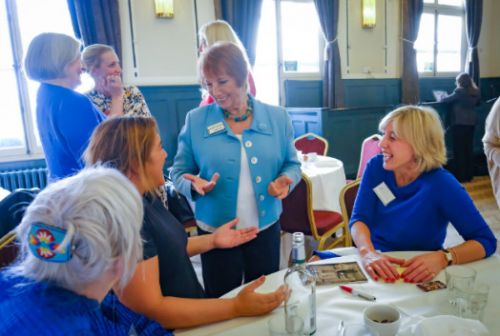
Face to face events are planned from April, are we all zoomed out after 2 years?
Zoom has become increasingly unpopular, and I hope we can go back to somewhere near our normal lives. I am worried that although the stats of Covid are decreasing, they are still worryingly high. On April 21st we are going back to Browns Courtrooms to restart our lunches with keynote speaker James Timpson who’ll be talking about kindness in business.
This network is not for ladies who lunch but ladies who work.
A donation comes from each booking going to our work on prison reform.
How did the Robin Corbett Award come about?
After a loved one dies, people gather around giving you sympathy and many cups of tea. A few weeks after the funeral they seem to think you will be able to manage but it is then that you are at your lowest. It was at this point that inspiration struck. As I mentioned before, the sentence I heard on TV: “All men die but some men live on.” was a eureka moment making me decide that I wanted Robin’s legacy to live on.

The Robin Corbett Award celebrates, supports, and rewards the best in prisoner re-integration programmes. Each year we donate funds to three charities, social enterprises or CICs whose mission is centred around giving returning citizens a chance to reintegrate back into society. The presentation is at the House of Lords.
The Robin Corbett Award for Prisoner Re-Integration was established by members of Lord Corbett’s family in conjunction with the Prison Reform Trust in 2013. It is now administered by The Corbett Foundation, a not-for-profit social enterprise.
What are the criteria to being a member of the Corbett Network?
The Corbett Network is a coalition of charities, social enterprises, community interest companies, non-profit organisations and businesses with a social mission who work with those in prison and after release. (Individuals are not eligible). These decision makers are dedicated to reducing re-offending by helping returning citizens find and keep a job. Some members offer mentoring, coaching, training or education.

How many members are there?
Currently there are 108 with four waiting to be introduced to their fellow members.
This network has expanded rapidly over the last few years, is this due to prison reform taking a greater platform?
Once the Robin Corbett Award was established, I kept on meeting people working in their own small pond, so to speak. I thought we could crusade better in a sea and invited them to join us. Since then, together we have created a powerful lobbying voice heard at the highest levels of government and recognized by those in the criminal justice sector as a force for change. I do sense that the media tend to focus on the problems.
Where do you see the Corbett Network positioned in the justice arena?
Peter Dawson, Director of the Prison Reform Trust told me that The Corbett Network is the only one of its kind in the UK. It sits alongside the Criminal Justice Alliance and Clinks which concentrate mainly on policing, courts, prisons, probation, and human rights. The Corbett Network are members of both these organisations.
What are your hopes for the future of this network?
To crusade effectively. To effect changes desperately needed in our prison system. To change public perception of people who have been inside – they are not sub- human. Since the Network started in 2017, we now have over 108 members, holding both face-to-face, virtual meetings, conferences and, crucially, encouraging greater collaboration across the work we collectively do. Together, we have created a powerful lobbying voice, heard at the highest levels of government, and recognised by those in the criminal justice sector as a force for change.
“Prisons should not be society’s revenge but a chance to change direction.” Robin Corbett
This interview was published to mark International Women’s Day 2022.
All photos courtesy of Lady Val Corbett. Used with permission.

An interview on a Summer’s day
How/why did your involvement in the CJS come about?
I turned down a place to study for a degree and instead moved from Lincolnshire to Essex at the age of 19. My first “proper” job was in admin with NACRO in Colchester. I worked primarily in wages and finance. At that point NACRO provided 6 months work placements in painting and decorating or in gardening teams etc for those who had just come out of prison. I heard amazing stories from those men and some brought newspaper cuttings to show me of their various escapades, including a headline “Most wanted man in Britain” They made me laugh and some made me shed a few tears. But for me I had many questions that were never answered.
What happens after 6 months?
What about their families, how can they support them financially?
Was this really a way for integration back into society?
Why is only manual labour available?
I helped set up and train staff for a new branch of NACRO and then moved on to work in Finance for the NHS. However, I believe a seed was planted all those years ago.
Fast forward 25 years, I was accepted into University. I became a full-time student studying Criminology with 2 kids at school, 1 at college, a part time job and my husband working full time and studying also, I embarked on a very busy 3 years of multi-tasking!
For my first presentation I chose to speak on Women in prison and the Corston report, I researched thoroughly but was marked down because no one was interested in prisons and especially not women in prison, it was deemed not an exciting enough subject. Great start. My next presentation was about Restorative Justice and yet again I was questioned as to why I was interested, one lecturer even said, “What’s that?”. A pattern was emerging of my interest into those within the CJS and those that had been released increased. I was not put off and in my 3rd year the title for my dissertation was: Restorative Justice: Is it delivering strategic change in England and Wales or just a cost cutting exercise by the Government?
To understand the significance of Restorative Justice I arranged interviews with experts in the UK, NZ and USA, even Howard Zehr widely regarded as the Grandfather of RJ agreed to help. I consumed document after document on RJ and was a frequent visitor at the Cambridge University Library, floor 6 (those stairs almost killed me!) and the Institute of Criminology Library.
I graduated with an honours degree in Criminology and looked for my next step.
I joined the Independent Monitoring Board (IMB) at HMP/YOI Hollesley Bay and in just three years became the Chair.
I wrote about the things I saw and heard but what I didn’t expect was what happened next. I was confronted with a prejudicial character assassination brought against me, a fight to clear my name, being investigated twice by the Ministry of Justice, called in front of a disciplinary hearing in Petty France and the involvement of not one but two Prison Ministers. I felt that I was on my own against a bastion of chauvinism. Not the last bastion of their kind I would come across. Welcome to the IMB!
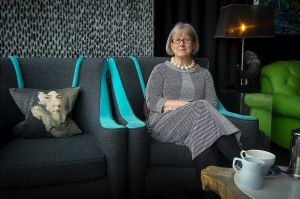
My continuing journey can be found in my blog: The Criminal Justice Blog www.faithspear.wordpress.com
Because my story is fairly unique it has been covered by BBC News, Channel 4 News, BBC Radio Oxford, BBC Radio Suffolk, 5Live, LBC as well as National and Local newspapers, law journals and online publications etc.
Religion is clearly important to you, what role does God play in your life?
I remember going to Chapel with my grandparents as a young child and hearing my Dad and Grandfather sing the old hymns with deep sincerity. Christianity has always been part of my life. My faith in God has often been tested.
How do you balance work and life responsibilities?
I often say I’m a Mum first, always have been always will be. My husband and my kids are the most important people in my life, I have a great relationship with them all. They understand who I am and what motivates me to do what I do. They understand the bigger picture and that for me it is a cause and not merely a job. That in itself I realise is exceptional and I find I am continually grateful because I know that the level of family support I have is sadly not available to everyone. I can’t do this stuff on my own. They are also aware of the work I do behind the scenes and the many hours of support I give freely.
What role, if any, has luck played in your life?
Things happens for a reason, we don’t always know or understand the reason why. We all have issues to face and hurdles to climb and times of joy and celebration. Luck doesn’t fit in my life at all.
Not only have you been a source of inspiration to me in certain areas, I have also seen you inspire others and would like to know who inspired, or inspires you and why?

A few years ago, I wrote a journal article with a friend of mine, Dr David Scott about a remarkable woman, Lady Constance Lytton, commemorating 100 years since her book Prisons and Prisoners was published. In it she presented one of the most significant challenges to 20th Century anti-suffrage politics. Her book is a harrowing personal account of her four prison sentences as a militant suffragette. It is also a compelling insight into the mind of a young woman consumed by a cause which would prove to be instrumental in prison reform and votes for women, as well as tragically being a contributory factor to her death. My inspiration, which comes from her being consumed by a cause, makes me wonder if that is still possible. This wasn’t a phase she was going through or a pastime, it was a lifestyle.
I admire her courage and determination. I see this in so few people but when I find it, it is unmistakable. Let me give you an example, Tracy Edwards MBE. At the age of 26 she was the skipper for the first all-female crew for the Whitbread Round the World Race. It is not so much the fact that she sailed around the world, although that in itself is remarkable, but it is the reason why that I find compelling. She said “First time in my life I stood up for something I believed in” I have met and chatted with Tracy, she is an inspiration to me without a doubt.
What would you say is your greatest accomplishment and/or achievement is?
I think that my greatest accomplishment is staying true to myself, maintaining integrity and not bowing to pressure to conform.
In terms of my greatest achievement let me give you a couple of examples. First, being nominated for the Contrarian prize 2017 especially when you realise the key criteria that the judges look for are Independence, Courage and Sacrifice.

Ali Miraj and Faith Spear
Second, last year I was deeply moved and excited to learn that I had been counted as one of the 100 inspirational Suffolk women alongside people such as Dame Millicent Fawcett.


As a female leader, what has been the most significant barrier in your career?
On one of my visits to the House of Parliament I took time to seek out one of the most outspoken MP’s known for saying it as it is. I sat down next to Dennis Skinner and asked him a very simple question. I asked, “How do you get heard in this place?”. Mr Skinner looked me straight in the eye and offered me advice I will never forget. With his characteristic directness, he said, “You have to be seen to be heard”. I’ve taken his advice and applied it to all I do. This has not come naturally to me as people who know me will tell you.
Everybody wants to have their say and everyone has an opinion. But there is a big difference between those who say their piece ad nauseum and those who have something to say.
In one sense all that people have heard from me so far is simply learning to overcome the barriers of not being heard. When I have learned enough then I am sure I will have gained the clarity with what I have to say.
If you were given the prisons and probation ministers role, what changes would you make?
I would scrap the titan prison building programme and instead invest in smaller local units, making families more accessible and start to break down the barriers between those in prison and those on the outside.
I would encourage industry to step out of their comfort zone and give more people with convictions a second chance. To remove the stigma of a criminal record so that it is not forever hanging around people’s necks. We are a deeply divided and hurt society that is full of prejudices.
I would ban all industries within prisons that do not provide purposeful activities and a decent wage. People need to be work ready on release with housing and job options already in place. Families should be able to stay together and be supported, children should be prioritised.
I would make sure everyone working within the CJS were trained sufficiently for their roles and supported in their jobs.
As a prisons minister you can only change what is in your field of influence to change. In other words, you need to be precise, you need be pragmatic and you need to learn whose advice you can trust. Then act on it.
One of my priorities as Prisons Minister would be to take advice to demonstrate better things to invest in. Diversion, or Restorative Justice or Community.
Put money into early years, into youth etc.
We have to stop this madness of believing that we can change people and their behaviour by banging them up in warehouse conditions with little to do and not enough to eat and sanitation from a previous century.
As Prisons Minister I would initiate change that would lead to every prison Governor carrying personal accountability for the way they run the prisons they are responsible for. It’s not their prison, its ours and they must run it properly, giving people in their care decent conditions and personal dignity regardless of what crime the courts have sent them to prison for. The moment Governors carry that personal accountability is the moment you will see astonishing changes in HMPPS.
I will ensure under performing Governors leave the service and are not continually rotated around the prison estate or promoted to more senior positions. They have to know the weight of the accountability they carry.
Finally, what are you hopes and aspirations for the future of the criminal justice, and also for you?
Transparency and Accountability should underline every decision made. No more carpets where issues are swept under. No more excuses for the crisis within the system. We talk too much, we deliberate too much and have too many committees. There are too many roundtable events, conferences, discussions where everyone is saying they are experts yet so much remains the same. We produce too many reports, reviews and paperwork that gets filed away. Now is the time for action, for investment in people and for priorities to change. Lets just get on with it and stop competing and instead work toward a common objective, such as drastically reducing the prison population
In the next five years, I will continue to speak up truthfully and will add my voice to the very many voices calling for change. I will support policies introduced by the current Prisons and Probation Minister or by their successor where those policies do bring about real change. However, I shall not hesitate in bringing a strong critique where those policies gloss over the hard questions or where they shirk the implementation of measures for real reform. I will finish on this:
Vision is often personal, but a cause is bigger than any one individual
People don’t generally die for a vision, but they will die for a cause
Vision is something you possess, a cause possess you
Vision doesn’t eliminate the options; a cause leaves you without any options
A good vision may out live you, but a cause is eternal
Vision will generate excitement, but a cause generates power
[Adapted from Houston (2001)]

Whistle while you work
Is whistleblowing a band wagon to jump onto?
Usually you don’t suddenly wake up in the morning and say, “Today I’m going to be a whistle-blower”. The negative connotations surrounding whistleblowing such as being an informant, betrayer, or even a backstabber is not something to aspire to.
Yet, these descriptions cannot truly explain why there are those in the minority that will put their head above the parapet, will risk their reputation and often lose their job through speaking out.
So, have we become largely a society that will cower rather than stand up, do we lack courage or integrity or both?
Fear of reprisals can cause us to retreat, to stay silent but in so doing are we not being true to ourselves. It takes more than just determination to be vocal about issues you are passionate about. Unfortunately, when living in such a punitive society, the norm is to shut people down rather than to listen.
Having sat at an employment tribunal with an experienced Prison Officer listening to their case of dismissal, my thoughts were not that they wanted revenge, not at all. I saw passion, I heard a very determined individual with a story that has affected not only their work, their life but possibly their health too.
It’s too easy for society to ignore the reality in our prisons in England and Wales, where violence, instability and a lack of investment over decades has reduced them to warehouses of the vulnerable. Numerous are inhumane and on the point of crisis.
Equally, let’s not point the finger at those that want transparency in the Criminal Justice System, instead we should push for accountability and not lose sight that one day those in prison may be a loved one or will become our neighbour.
Time to stop shooting the messenger
Recently I met Michael Woodford, the inaugural winner of the Contrarian Prize and former CEO of Olympus who exposed a $1.7 billion fraud at the heart of Olympus and was sacked for doing so. He had more than most to lose by speaking out.

Faith Spear and Michael Woodford
According to: https://www.gov.uk/whistleblowing
“As a whistleblower you’re protected by law – you should not be treated unfairly or lose your job because you ‘blow the whistle’.
You can raise your concern at any time about an incident that happened in the past, is happening now, or you believe will happen in the near future”
But is this really so?
It also states:
“You’re a whistleblower if you’re a worker and you report certain types of wrongdoing”
But what if you are a volunteer?
Yes, you work and often very hard, but where is the protection mechanism?
In my experience, being a volunteer for many years offers little protection especially when dealing with the Ministry of Justice. Even going through the “normal” channels produces little response. Suddenly people become hard of hearing, blind to what is happening all around them and stick their heads in the sand.
I’m not like that, I am very aware of many untold stories and issues within the justice system.
I put my head above the parapet once, I have no regrets even now still living with the consequences.
I would do it again.
And plan to do shortly!

Now it’s my turn to ask what’s acceptable online
Only those who know me know who I am and what I do, often away from the public eye.
On top of my commitments this week I want to talk about this. I have seen a barrage of messages on Twitter, sent to me and about me; messages which are good, bad and certainly ugly, sent mainly from those who don’t know me and have never met me.
Why? Online abuse is unacceptable. I am calling it out and people don’t like it.
To put things in context, I myself have received a fair amount of online abuse over the last few years but last summer it reached a new level because the online abuse included a death threat from an individual who I had never met, but who was going through a very unstable time. This was totally unacceptable, so I reported it to Twitter. Twitter said they had broken Twitter rules and consequently Twitter suspended the account they were using.
I had a short period of relative peace until the Autumn. The snide remarks started up again primarily from an individual, then a small group emerged, tweeting in agreement with them. I decided to inquire who these people were, but not on open social media. I contacted people I knew and trusted and asked for their advice, questioning the reasons behind this unacceptable attack on me, but even in asking questions it seemed I opened a can of worms. I learned there were those hiding behind Twitter accounts who had other professional accounts. It seems I hit a raw nerve; I’ve done that before and it will probably happen again!
Never once did I try to get any ex-offenders fired from their jobs. This is pure fabrication.
Over the last fortnight, I have seen tweets primarily from one individual with relentless bombardment on a daily basis. How is this acceptable behaviour and especially from someone who, yet again, I don’t know and have never met?
Starting rumours, planting seeds of doubt into the minds of others, and propagating things which are blatantly untrue: the tweets by that individual are being proliferated by others. They talk about what I wear, what I eat, who I associate with, what events I have attended, and even have the audacity to want to know what is in my diary. Their remarks and exchanges place me in false light.
Why the obsession?
Seriously why?
The stories they invent are worth a Bafta.
Why am I constantly seeing tweets by those who want me to confirm or deny certain issues, that I allegedly did or said or even thought? And why am I accused of being the bully and generating a climate of fear and frightening people into silence? Utter nonsense.
In an example of online abuse unrelated to previous examples I have given above, here is a tweet I saw recently:
“If it’s covered in sugar it’ll ruin your teeth. If covered in salt, it’ll affect your blood pressure. Spear is a withering insipid excuse for a woman. And I’ve little time for bullshit and her version of victim hood”
Really is this acceptable?
This is from an individual who works in the criminal justice system. Astonishing.
Turning to yet another separate example of online abuse, I remember being at an academic round table event a couple of years ago. The person sat beside me, who I knew of but had never met before, started to cry so I reached into my bag and gave them a tissue. I had a few online conversations with them before and afterward, but didn’t know their full story and didn’t get involved in their life. Yet, allegations were made online against me, by a third party, of lifting them up, carrying them then dropping them. All I did was give them a tissue for goodness sake and for my trouble they themselves later sent messages to me on Twitter including disgusting photos with increasingly nasty comments.
And the stories started to circulate.
Is the online abuse I receive a form of deflection?
Am I regarded as a legitimate target for people to offload their frustrations?
Are the people sending online abuse themselves hurt and damaged?
When the majority state that they are there for others, to support them, how ironic they tweet things so unsupportive such as:
“Wow – if this is true it is despicable, but not surprising…”
“Allegedly you caused…”
“I personally fear for all those connected to you…”
What does this smear campaign hope to achieve? Remember when you point the finger at someone there are three pointing back at you.
If this is how you treat me when all I work for is positive change within the prison sector, then how can others trust you? In smearing me you are making yourselves less credible, ruining your own reputation and doing yourself and the cause you fight for a disservice.
I’m not perfect, I make mistakes. Who doesn’t?
But I will not stand by and put up with this online abuse orchestrated against me. Piling on is the online equivalent to dishing out a pad beating in a prison. Anyone who has served time and who now uses social media will understand the devastating effect I am talking about.
Unlike those who level allegations against me, I have chosen not to name anyone, they know who they are and should reflect upon what they do and say online.
I’m upset, feel bruised, frustrated, bewildered and many other emotions. But I will not shut up and will not go away.
What I saw and heard visiting many prisons (every category including women’s prisons) gives me motivation to work with others to restore decency for those in prison and for their families.
I will do all I can to help bring positive change, to speak the truth and face the consequences. I may not be everyone’s cup of tea, but I am me.
~
Everything on this blog has been out on social media; I just collated it.
~
Updated 20 March:
13th paragraph has been modified following a request on Twitter that I associated the person who issued the online abuse in 12th paragraph with the person who issued the death threat against me cited in 4th paragraph. Therefore, the 13th paragraph now starts with new words to make it abundantly clear the two individual examples on online abuse originated from separate individuals and in order to resolve any misinterpretation this may have caused.
16th paragraph has been modified following a request issued on Twitter that in some way I identified the person who issued the online abuse cited verbatim in the 12th paragraph. Therefore, certain wording about the individual’s background has been removed as this was regarded to be pejorative and reference to the nature of their work has also been removed in order to resolve any misinterpretation this may have caused.
17th paragraph has been modified following a request issued on Twitter that in some way I identified the person who issued the online abuse covered in this paragraph. Therefore, certain wording about the individual’s gender has been removed as this was regarded to be the identifier and in order to resolve any misinterpretation this may have caused.
~

Courage for the year ahead

Faith Spear
Introduction
The year 2018 was historic for many reasons not least because it saw the first statue of a woman placed in Parliament Square, London.
More so its message, marking a pivotal moment in social history, with “Courage calls to courage everywhere”
And for me personally, I can look back on a year of Exploration, Celebration and Collaboration.
Exploration
I traveled many miles in 2018 including two trips to Wales.
I was delighted to be invited to the Welsh Assembly, the Synedd, Cardiff in January to sit on a panel after the screening of the Injustice Documentary.

Faith with Claire Melville
The whole subject of injustice was brought home though an introduction to Michael O’Brien jailed for 11 years for a murder he did not commit.
One woman at that event stood out for me, Claire Melville, who has since become a source of great encouragement.
My second trip to Wales took me north to Wrexham where, at the beginning of August, I visited HMP Berwyn on the invitation of the Governing Governor, Russell Trent. I have already written about my experience in a previous blog.
However, my visit and subsequent write-up caused quite a stir as within a week Russell was suspended from his duties and not just the media but trolls on Twitter had a field day.
The BBC and Channel 4 contacted me to ask if what I wrote was “the cause”. I raised some important points concerning the design and build of this “Titan prison” a flagship of the Ministry of Justice, which I sincerely hoped would be the last.
I made the most of my time whilst in the area and met with Erwin James (InsideTimes), had dinner with Arfon Jones (Police and Crime Commission for North Wales) and a working lunch with Keith Fraser, (retired Police Superintendent and Clean Sheet Ambassador). It was an enlightening few days to say the least.
Celebration
I have had many reasons to celebrate in 2018, let me share some of them with you.
As the two-year anniversary of my article ‘Whistle-blower without a whistle‘ published in the Prisons Handbook 2016, approached, I was informed that the 2018 edition had been dedicated to me.
That was quite something as my original article upset those who walk the corridors of power in the Ministry of Justice, challenged the Independence of the Independent Monitoring Board and involved not one but two Prisons Ministers.
But the celebrations didn’t end there.
2018 has been a celebration of women; 100 years since women were given the vote and 100 years since the first women MP.

Womens Voices Womens Votes
In July I was named one of the 100 Inspirational Suffolk women from the past and present day alongside many amazing women including Dame Millicent Garrett Fawcett GBE campaigner for women’s suffrage. It is the statue of Millicent Fawcett which can be found in Parliament Square.
What an honour and a privilege to be recognised alongside women like that. And yes, I did make a big song and dance about it, why not. Who wouldn’t?
Then in September I received an email out of the blue from Brad Jones, Editor, EADT and Ipswich Star (Archant), which said:
Dear Faith,
It is 100 years since women won the right to vote, and to mark this anniversary Archant Suffolk, which publishes the East Anglian Daily Times and Ipswich Star, launched a very special project.
We asked the public to help us choose Inspiring Women of Suffolk…
I am delighted to say that you have been nominated and chosen as one of our Inspiring Women of Suffolk…
It was the public that chose me, and I am so grateful for everyone that voted.
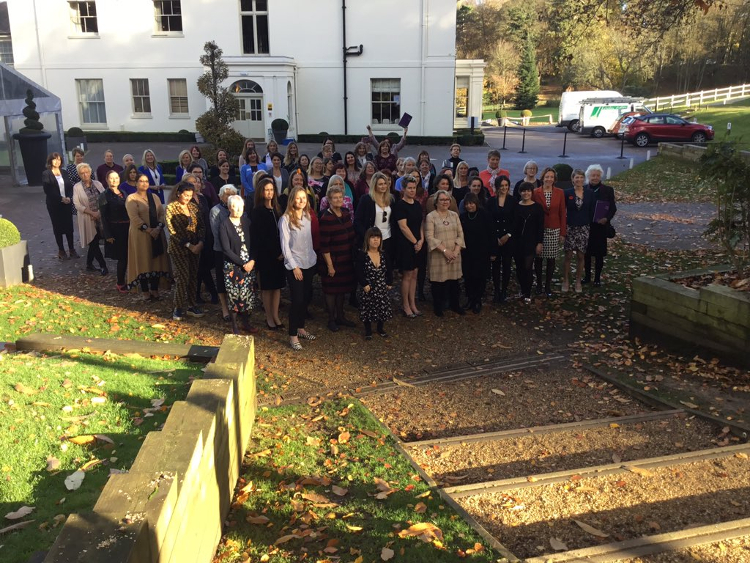
Suffolk’s Inspiring Women
I even celebrated the birthday of HM the Queen with members and guests of the National Liberal Club at a champagne reception on the invitation of my friend Trevor Peel.
What a highlight to discuss the criminal justice system with MP’s, an Ambassador and even a Royal Navy Admiral.
Isn’t it strange how talking about celebrations brings out the good, the bad and the ugly in people.
Social media is no exception.
Consequently, I have had to put up with a barrage of abuse from people. They have never met me, don’t know me but time after time they target their rancour at me. I know I’m not the only one under fire.
In November, I was invited by the Fawcett Society to Portcullis House for an All Party Parliamentary Group (APPG) to celebrate 100 years of Women MP’s. How appropriate then that during the question and answer slot the main topic was abuse on social media and how women should not expect it, or accept it.
Collaboration
For many years I have been concerned about the lack of opportunities within prisons to educate, train and equip individuals on release.
People with a criminal record are immediately penalised in the job market regardless of whether they have the relevant skills; it’s an uphill battle.
So, you can imagine my delight when in March I was invited on to the Board of trustees of Clean Sheet, a charity with one simple purpose – to offer people with convictions the hope of a better future by finding real, permanent employment.
Clean Sheet’s Annual Review took place at the House of Lords attended by Rory Stewart MP OBE.
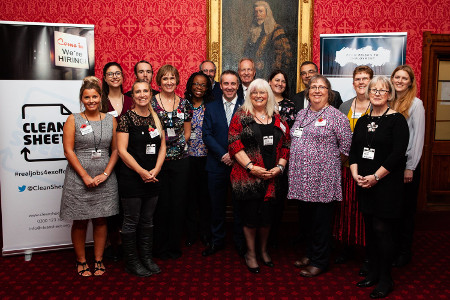
Clean Sheet team
In April, I took up my usual seat behind people giving evidence at the Justice Select Committee.
Once the formalities of the meetings finish, the room usually empties very quickly and ministers hurry back into the corridors and disappear. But not this time.
After giving evidence, just weeks into his new job as Prisons and Probation Minister, Rory Stewart hung back, so I stood up and shook his hand.
“I thought I would introduce myself, I am Faith, Faith Spear”
“Yes, hello Faith, I follow you on Twitter,” he said
“It would be good to meet sometime,” I added
“Let’s do it now,” he replied
Slightly gobsmacked, I followed him out of the room where he was met by his entourage and those wanting to ‘have a quick word’.
“I’m with Faith” he said as we started walking down the corridor. He gave me his full attention.
We went into the atrium of Portcullis House, found a table and talked together. It was a productive conversation and we agreed to keep in touch.
Invitations
As a year celebrating women, my list would have to include Sarah Burrows (Children Heard and Seen). In March, I attended an event in Oxford at Sarah’s invitation ‘What would it be like to have a parent in prison?’
The event displayed incredible art work from their competition judged by Daniel Lee and Korky Paul, who wrote and illustrated the book ‘Finding Dad’, and Sir Trevor McDonald OBE, newsreader and journalist.

Faith with Sir Trevor McDonald
A moving short film was screened made by a young man Luke and his mentor about having his father in prison, including an interview with, Ralph Lubkowski, then Deputy Governor of HMP Leicester.
I had the pleasure of having dinner at ‘Malmaison’ Oxford with Ralph, Sarah and all the judges. Sarah seated me next to Sir Trevor and we exchanged thoughts and experiences with each other about prisons.
A week later, I was discussing women in the Criminal Justice System at the House of Lords at the invitation of the Rt Revd Rachel Treweek Bishop of Gloucester and the Rt Hon the Baroness Jean Corston.
Women’s voices
I remember a time a couple of years ago, when I was sat in the Central Lobby at the Houses of Parliament talking to Dennis Skinner MP. I asked him:
“How do you get heard in this place?”
He looked me in the face.
“You have to be seen to be heard,” he said.
This is one of the reasons why you have seen me in so many diverse places:
In Westminster Hall listening to David Lammy, at the RSA listening to David Gauke, taking part in panels such as at Warwick University with SafeGround and Sheffield Hallam Uni, having discussions with leading Professors, Criminologists, PCC’s, at Police HQ’s, at roundtable events with the Criminal Justice Alliance, in Westminster for the Children’s Inquiry Report launch with Volteface, at the Parmoor and Longford Lectures and why I accept invitations to Prison Reform Trust wine receptions and listening to Lady Hale at the Fawcett Society lecture at the Royal Society.
I’m told some of my critics accuse me of being a ‘social climber’. Nothing could be futher from the truth.
If you don’t understand the issues, and unknown to the very people who can change things, how can you play a part in the solutions?
My part is: I ask questions
Tough questions
Some find that uncomfortable
I will continue to ask questions
In the last year I have seen first-hand how our Criminal Justice System can be an unjust system, I have seen how it breaks people, distresses children and separates families. I have seen inhumane conditions in prisons, I have spoken about it on the radio and television and I have written about it.
I have also spent time with victims and, yes, shed many a tear for them and with them.
Yet in 2018 I have also seen some good practice in purposeful activity, having sat in prisons at award ceremonies, having had guided tours of prisons by Governors, having eaten at restaurants within Prisons.
In all these places I have sensed optimism, hope and met those that believe in doing all they can to help with rehabilitation and re-integration.
Among the most inspiring women I have met is Khatuna Tsintsadze, Prison Programme Director for the Zahid Mubarek Trust. We worked together again this year and I have learnt so much from her, including human rights, equality and discrimination.
Unpicking myths
And finally, in this blog I wanted the last words to come from three people who have met me for the first time in 2018. I hope this will unpick some of the myths as to who I am and what matters to me.
“I first got to know Faith following her visit to HMP Berwyn, and the tour of our Prison Industries operation.
My first impression was one of her passion and conviction for getting to the real core of how we were working with the men to deliver real life work and training opportunities and asking specific questions – really emphasising that she had the best interests of the prisoners at heart. We rarely meet people that spend time engaging at this level whilst on a ‘guided tour’.
Subsequently I have had the opportunity to engage with Faith on a number of levels and have found her to always be absolutely trustworthy, insightful and generous with her network and her time.
She is not afraid to challenge the status quo, often attracting those that criticise her belief in wanting to make the CJS a better environment for its employees and those in its care”
Kelly Coombs, Co-founder Census Group
“I am drawn to people who are prepared to push boundaries in order to achieve change. Not rule breakers, but rule questioners. People who are not afraid to ask difficult questions but who are also prepared to help with the hard work needed to address the answers they might find. With this in mind, it was with no little amount of excitement that I met Faith Spear last year. Our areas of interest sit alongside each other yet might be a million miles from one another. Both feed each other in a continuous loop, creating demand and have long term impact on the people who become part of the Criminal Justice System.
Faith has stood her ground where many others have feared to tread and of course I admire this characteristic immensely but more than that, she has survived and continued her quest with renewed vigour.
When I met with Faith, I was contemplating a new step in my own quest but was still uncertain whether I would go ahead. Faith inspired me and left me believing not only that I ‘could’ do it, but that I really ‘should’ do it!
In a world full of naysayers, spending time with Faith is like finding water in a desert. ‘What would Faith do?’ has become my mantra”
Cate Moore, Independent Chair of Lincolnshire Police Ethics Panel
“I first met Faith Spear at a Corbett Network meeting in April 2018. I was hugely impressed by her warm-hearted nature, incredible knowledge and clear passion to make a positive difference in people’s lives.
We immediately clicked, in part due to our involvement with the award-winning charity Clean Sheet – Faith is a trustee, I am an ambassador – and also our shared vision to tackle the immense barriers that people with convictions face moving forward with their lives.
We both play very different roles in this hugely important agenda, but since my first meeting Faith she has become a great support to me, and I, in turn, have become a massive fan of her work and her brilliant thought-provoking blog. I look forward to continuing to collaborate with Faith for many years to come”
Dominic Headley, Director of Dominic Headley & Associates
In the context of a blog like this, it’s possible to only mention a fraction of the workload, time and miles covered. For obvious reasons you will appreciate I’m unable to share the full extent of everyone I have met or all that has been done.
Featured Photo: Faith with Michael Woodfood, Contrarian Prize 2013 winner and former CEO Olympus. To learn about Michael’s story please visit the Contrarian Prize website.
~

On this day the only April fools are my critics
Today marks a year since my life was turned upside down.
On this day, one year ago, I accepted an invitation from the editor of The Prisons Handbook to write an article on my personal experiences of being a member of the Independent Monitoring Board (IMB) for the Prisons Handbook 2016.

Door of opportunity: University Library, Cambridge
If I wrote it, he promised to publish it, and he did! You can find it on pages 20-23, after Michael Gove’s Foreward and just before the transcript of David Cameron’s speech on prisons.
Little did either of us realise the scale of interest from that one article.
Even before the book went to press I was catapulted into the media both local and National.
The local IMB board, IMB Secretariat, President of the National Council and National Council itself all decided that I needed to be shut up and shut up quickly.
The bullying started, then the intimidation, then the lies and then the prejudicial character assassination.
One Hollesley Bay IMB member who is still a member had the audacity to tell me that it would have helped if I had cried in front of the board whilst apologising for writing the article.
Call me contrary, but I make no apologies for having written the article. It was well grounded and factually correct, corroborated by the contents of the report by Karen Page Associates which the Ministry of Justice itself commissioned.
I did apologise for any offence caused as that was not my intention. The issues I raised are as important now as they were a year ago, I haven’t seen enough progress in any of the points I carefully considered and wrote about.
Those who truly know me can understand why I spoke out so passionately and continue to do so. I was given a platform which I took eagerly but never expected the venom, backlash, and dirty tactics by the IMB and MoJ in trying to destroy me my reputation and my working life.
But I have remained and will continue to remain steadfast in the knowledge that I spoke the truth and ultimately that’s all that matters.
My life has been turned upside down but I’m in some way I’m grateful for that. I have had the privilege to meet some of the most extraordinary people both in and out of prison and I have no regrets.
So, I’m not shutting up and I’m not going away
I’m #justgettingstarted
Join the conversation on Twitter: @fmspear #justgettingstarted
~

Never be afraid to speak the truth to those in power*
A letter from the Ministry of Justice landed on my doormat yesterday morning. I was expecting it and with trepidation it was opened and carefully read.
To download and read, please click here.

I shed a few tears. And then I replied!
To download and read, please click here.
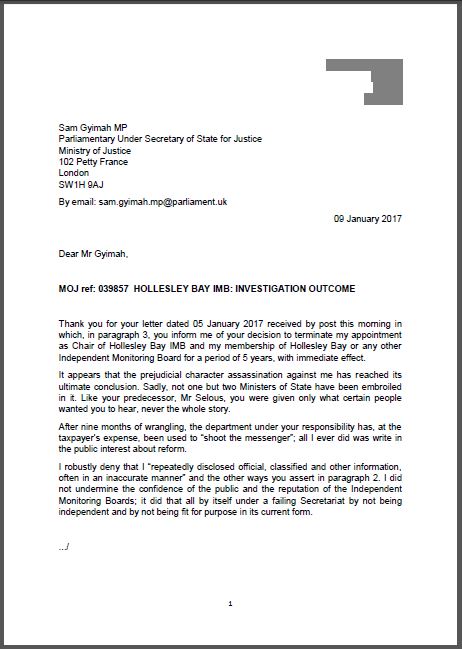
9 months after I wrote an article in The Prisons Handbook 2016 the curtain has fallen on my time in the Independent Monitoring Board (IMB). I am dismissed with immediate effect for a period of 5 years.
I kept my word and saw this sorry episode through to the end. There are no winners or losers.
What I now know through personal experience is that if you level criticism about the Criminal Justice System you can guarantee the weight of the system will be upon you. In my case I faced an investigation by the MoJ that was biased to begin with and full of lies.
Paperwork from the start shows this was a deliberate and prejudicial character assassination designed to shut me up in the hope I would give up go away and to discredit me. I have the evidence and so does the MoJ but they have been selective with it.
But I am stronger than that and I have done my best to stand up to everything that has been thrown at me. Reports that I have read about myself written by the MoJ bear no resemblance to me and yet they have been used against me and yes, the Prisons Minister Sam Gyimah has taken them on board and made his decision.
I cannot change this decision. I have appealed and my voice may have been ignored by him but my voice has traveled far.
So, what now?
I am already on the record as saying “The Ministry of Justice has left me with no alternative than to take more robust action in the public interest” and that is exactly what I will do.
This doesn’t mean I will retaliate and seek retribution. However, since I am not gagged anymore I could reveal considerably more information about dishonesty and real misconduct I have encountered.
The IMB Secretariat, current and former IMB members, MoJ wonks and HMP/YOI Hollesley Bay staff including Governors should reflect carefully on their own behaviour before shouting down a volunteer monitor who decides to write about what they have seen and heard.
They chose to make it personal whereas I wrote about the issues.
Throughout this last year, I have kept my integrity and I have been truthful about what happened. I have never sought to elevate myself.
I am passionate about the issues I have raised for prison reform and I have no intention on being quiet or giving up, no not for one moment.
As many readers will know my motto has become #notshuttingup #notgoingaway and that is how it will continue.
Our prisons are in crisis and reform is taking too long.
~
* acknowledgements to Sir Ivan Rogers‘ email

My statement today outside Petty France

Today, the Ministry of Justice has left me with no alternative than to take more robust action in the public interest.
Officials in Petty France have brought a disciplinary hearing against me. They accuse me of misconduct as a result of speaking out for prison reform.
An investigation into my behaviour was conducted at tax payers’ expense and brings into question my independence and my integrity. I am woman volunteering with the Independent Monitoring Board and I hold a public office.
The Ministry of Justice has chosen to disregard the evidence I provided of real misconduct including leaked emails between others in the Independent Monitoring Board.
This just scratches the surface and is a matter of substantial public interest.
Therefore, in front of the disciplinary panel and without permission for legal representation, I will disclose why the decision of the then prisons minister Andrew Selous MP six months ago was based on a prejudicial character assassination of me by those who want me to shut up and go away.
I am not shutting up.
I am not going away.
Our prisons are in crisis and prison reform is taking too long.

MOJ draws battle lines against prisons reformer
And she just happens to be a woman.
Guest blog by Joseph Spear.
 Earlier this week, my remarkable wife Faith Spear received an email from the Ministry of Justice.
Attached was a letter on IMB letterhead notifying her that she is now to face a disciplinary hearing.
Has it really come to this?
Those of you who’ve been kind enough to follow Faiths’s unfolding situation will no doubt agree this represents quite a turn of events.
The spoken word
The written word is powerful, which is why we blog – right, but there are times when even that cannot replace the spoken word.
Over dinner, I took out my mobile phone to record my conversation with Faith.
Afterwards, I played it back to her. Twice.
She listened to it. Carefully. Twice.
We sat in silence for a while. Then she said: “That’s the real me. People who think I want to abolish the IMB have totally misjudged me and the situation. The people doing this at MOJ have never even met me. They’ve no idea who I am or what I stand for.”
This blog site doesn’t support playing an audio file but if you want to listen to what she said just email me [joseph dot spear at gmail dot com] and I’ll send you over a copy.
The audio lasts 14 mins 25 secs. I’ve not edited it. It’s just her and I as we are. There are some gaps but it’s best if you play it to the end.
Thank you.
 The Criminal Justice Blog