
Home » Posts tagged 'prisoners' (Page 5)
Tag Archives: prisoners

Prison reform: paying the price
Well D-Day is rapidly approaching for me, the day the Ministry of Justice and the Independent Monitoring Board decide on my future not just as a Chairman but as a member of the IMB as I have to attend a Disciplinary Hearing.
 How it got to this is a long story.
In a nutshell, I spoke out for Prison Reform and IMB reform in an article in the Prisons Handbook 2016 entitled “Whistleblower without a whistle” and suffered reprisals for it.
Have you seen the state of prisons lately?
Have you heard about the state of prisons lately?
Too much is swept under the carpet pretending it’s not there.
But I put my head above the parapet, I made a personal stand.
The President of the IMB National Council, John Thornhill obtained a copy of my article “Whistle blower without a whistle” without permission before it went to print and sent it to the whole of the IMB organisation with his comments.
That action meant that any investigation would be prejudicial and it was!
I have had Prison Governors, prison staff, prisoners, ex-prisoners, prison reformers, those working in the justice sector, those working in the legal profession, leading academics, criminologists both here and abroad, friends and family standing up for me.
Are we all wrong?
Of course not!
But its like I have opened a can of worms which can’t be closed.
As I complete my final preparations for tomorrow I decided to bake a cake. It was my Nanna’s answer to everything as a child, comforting home-made cake.
I have upset the status-quo, I have revealed devious behaviour of other IMB members, I have spoken out about the nonsense in two MoJ investigations. I have had to endure bullying, intimidation, being ostracised, I have lost sleep and haven’t eaten properly, and I have been suspended from a role I loved. I have battled for over six months to clear my name and show what really is going on behind the scenes.
It has of course affected my family, yet my husband Joseph has been my rock.
I have a good idea of the outcome tomorrow at the Disciplinary Hearing, I’m not naive or stupid. But I think the MoJ and the IMB need to take a long hard look at their behaviour.
But whatever the outcome I will not be silenced and I will not go away.
If you are passionate enough about something then that cause which owns you can never be taken away from you.
The MoJ and the IMB can never say “Faith Spear who is she?”
This is not the end, it is the beginning…
P.S.
Even at the last-minute a former IMB member has sent in a pathetic plea to discredit me, obviously he is worried as now I have my chance to talk. Well DS your bullying, intimidation and manipulation I have endured for a couple of years is over!
And DH, your worries that I would let people know what you have said, haha now its my turn. You said you were on my side until I read out my statement and you told me it would have helped if I had cried. How dare you, as a woman I will not be intimidated by you. The fact you said you don’t deal in black and white only grey areas is perfect for the role as an IMB monitor in a prison, yet again an example of the farcical recruitment process.
CS, we worked well together but you followed your head and not your heart. You listened to a manipulative member and along with BM who I had much respect for started a damning campaign against me. Your friendship is a loss to me.
GR, you are a man with integrity and heart
Its time to build new bridges
We don’t just need a vision, we need a cause!

“She’s no rebel and she’s got a cause”
In the space of 6 weeks I have written an article which has been published in The Prisons Handbook 2016, just before the Prime Ministers speech. I have been interviewed by Ian Dunt with an article put on politics.co.uk, been in my local paper with a 2 page spread, had a front page article in Converse prison newspaper, had an interview with another newspaper with an article ready for the next months edition… If I can achieve all this in just 6 weeks, just imagine what could be achieved in 6 months or a year?. It’s all about going at pace.
It’s not always about what you have achieved in the past, although it does help. But it’s about what you can/will/want to do in the future.
Can’t abide being held back because of what I haven’t done yet. Especially when I’m at the start of something significant and have plenty of passion, energy and drive for what is to come.
And despite the knock backs, to keep a sense of humour.
Yes I have mainly worked with vulnerable adults and children before, but we all have a vulnerable side to us. Some are able to reveal it, others not, some it leads to being a victim and others it leads them into criminal activity.
Have you noticed how quick some people are to judge others, put you into boxes and to categorise? I hope you won’t judge my life by the chapter you just walked in on.
Prisons are no different.
Many problems arise when people enter the prison system and then leave in a worse state than when they arrived.
Why after all the money pumped into prisons is this happening?
Profits are made out of prisoners, we all know that.
How many reviews, reports can you count over the last say 10 years that involve prisoners?
There have been countless
How many organisations do you know that work hard to bring reform to prisons and prisoners?
There are countless
How much money has been spent on prison reform?
Countless
On 8th February, the Prime Minister set out a vision for prison reform. Mr Cameron said:
This system will be hard to change because it is, in some ways, still stuck in the dark ages – with old buildings, old thinking and old ways of doing things.
So I don’t want to go slow here – I want us to get on with proper, full-on prison reform.
Today, 27th May the Public Accounts Committee report warns that the criminal justice system is close to breaking point:
Report summary
- The criminal justice system is close to breaking point.
- Lack of shared accountability and resource pressures mean that costs are being shunted from one part of the system to another and the system suffers from too many delays and inefficiencies.
- There is insufficient focus on victims, who face a postcode lottery in their access to justice due to the significant variations in performance in different areas of the country.
Criminal justice system “already overstretched”
- The system is already overstretched and we consider that the Ministry of Justice has exhausted the scope to make more cuts without further detriment to performance.
- The Government is implementing reforms to improve the system but we are concerned that users of the system won’t see the full benefit for another four years.
- There are opportunities for the Ministry to make improvements before then, including better sharing of good practice and making sure that everyone is getting things right first time.
But what is the answer?
(If I had the answer I would be a very rich woman!)
Over the last few years I have visited every category of prison, YOI and Women’s. I have sat behind the Right hon. Michael Gove MP whilst he has been in front of the Justice Select Committee twice. I have attended meeting after meeting in Westminster, attended conferences, training courses, lectures, seminars etc. at my own cost.
Why?
I want to learn, I want to understand but most of all I want answers to the questions I have posed.
I also want to be a part of the change that is so desperately needed in our prisons.
We don’t just need a vision, we need a cause!
Vision is often personal, but a cause is bigger than any one individual
People don’t generally die for a vision, but they will die for a cause
Vision is something you possess, a cause possess you
Vision doesn’t eliminate the options; a cause leaves you without any options
A good vision may out live you, but a cause is eternal
Vision will generate excitement, but a cause generates power
[Adapted from Houston (2001)]
Houston, B. (2001) For this Cause: Finding the meaning of life and living a life of meaning. Castle Hill: Maximised Leadership Inc.
Justice Select Committee part 3
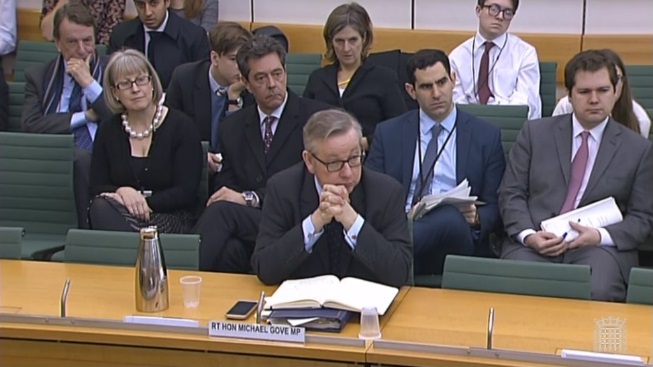
I seem to be making a habit of this; on Wednesday 16th March I attended the Justice Select Committee for the third time, again listening to the Rt Hon Michael Gove MP being questioned by a team of MP’s.
I sat behind Mr Gove and watched as he interacted with the committee. The meeting can be accessed from this link: http://parliamentlive.tv/Event/Index/e67772ca-8c75-4112-853a-0fbd80688389
The first question he was asked was “How would you encapsulate the overall purpose of the thrust of the Government’s prison policy”? Michael Gove replied “In a sentence, it is about turning prisoners from liabilities into assets”. Interesting use of language I thought.
He continued by stating that…”the critical thing is to make sure that during their time in prison there is purposeful activity…” I have come across some excellent forms of purposeful activity but to be honest there just isn’t enough going on. Is it all down to money? If millions can be found to build new prisons then surely purposeful activity has to be included.
The stories coming out of many of the prisons in England and Wales are appalling, locked up at least 22 hours a day, rat infested are but a few I have read this week.
When will we see real progress?
The most successful custodial establishment according to Nick Hardwick former chief inspector of prisons was the Military Corrective Training Centre (MCTC) in Colchester. However, in October 2015 there were 35 being held at the MCTC, hardly an example to compare. The ratio of staff to detainees is far higher than within the prison estate which is surely a factor along with greater governor autonomy that contributes to its success. I have visited it and was impressed by the order, cleanliness and regime. https://www.gov.uk/government/uploads/system/uploads/attachment_data/file/484448/Detainees_Military_Corrective_Training_Centre_Colchester.pdf
But how do you really measure success?
Michael Gove gave an example of Bronzefield prison as being a very successful female prison, yet this week one of the main stories I have read is about staff giving out sleeping bags to women released with no accommodation. It doesn’t add up!
I want to read more success stories, see real progress and watch as these “liabilities are turned into assets”
Volunteering in the Justice Sector
Today I read volunteering is good for your health as you tend to visit the doctor less!
This may be the case and I should know, I have worked as a volunteer for over 20 years and in the Justice sector for over 3 years
A big misconception is that a volunteer just makes tea!
After going to University as a mature student I received a BSc (Hons) in Criminology in Nov 2011. I then spent a year working with my local CAB and completed the course to become a Gateway Assessor as I was told you need to have voluntary work on your CV especially if you have changed direction. This was a real eye opener to the needs of people. After answering an advert in the paper to join the Independent Monitoring Board at HMP/YOI Hollesley Bay in 2013, I started on a very interesting journey. I am now the Chairman.
Apart from the IMB, I have been a group leader for Prison Fellowship England and Wales since 2012 involving managing a small team, all volunteers that deliver the Sycamore Tree victim awareness course in prisons. Meeting monthly and also speaking at various clubs, groups and churches on Restorative Justice and the work I do in prison. I have also been on the Steering Group for the Reclaim Justice Network for over 3 years, attending meetings, AGM’s and supporting events when I am able.
In addition I am a member of the Centre for Crime and Justice Studies (CCJS) and the Howard League. I have been invited to visit many prisons and events in the Justice sector and have been an observer at the Justice Select Committee. I have lost count of the number of conferences, lectures, wine receptions and exhibitions I have attended as I try and keep informed. I write a blog and am known on twitter!
I am passionate about wanting change within the prisons, purposeful activity and education are but a few of changes needed. I try to encourage those in prison and those that have been released.
But all of this is as a volunteer.
I have applied for many jobs since graduating but there have been two main problems. The first being the idea that volunteers make the tea and don’t have real input and so can be a bit clueless. The second being I cannot find a more interesting and at times rewarding line of work. I’m not someone to sit in front of a computer on a daily basis. My work is varied and I enjoy the interaction with prisoners, Governors, staff, my team and my many contacts. I like to be organised and punctual. I like tea, but don’t sit around drinking it all day.
Volunteering is rewarding, I recommend it as it’s an essential part of society but I’m ready for a change…!
Purposeful activity in Prisons!
Why is it that so many prisoners have very little to do whilst serving their custodial sentence?
Surely it cannot help their mental health that is often quite fragile anyway when they spend hours upon hours in their cells with nothing to do. With access to workshops, education and the library dependent on the number of staff on duty, prisoners are just locked away.
Prisoners need meaningful activities that serve a purpose not a mind numbing repetitive exercise. I remember having a tour of HMP Whitemoor after a meeting, one of the workshops was dismantling CD’s. Talk about repetitive. Prisoners removed the plastic film, took apart the case, removed the paper inside, and took out the CD for hours and hours on end. Come on I’m sure the prison service can do better than that. Recently I visited HMP Norwich; here they have a fantastic facility for training prisoners in sewing skills using industrial machines. They made prison issue towels and wash bags, however, all the material used was bland off-white no pattern no bright colour. Now I like sewing but staring at the same colour days on end would drive me potty! Why these machines can’t be used for something more stimulating I wonder? The equipment is available, the workforce is trained so…!
In society there are those that are not particularly academic but are very creative, it’s the same in prison.
Many prisoners seem to be placed in prison then spat out at the end of their sentence with not much to show for the time inside. This needs to change, how can prisoners be rehabilitated and not reoffend if they have often no job or education to go to afterward? It’s then a spiral downwards, what a waste of time, money and more importantly the lives of those that have been incarcerated.
There is so much un-tapped potential in prison!
Last weekend I travelled to Tymperley’s in Colchester to see an exhibition and sale of textiles such as cushions, bed-runners and Christmas decorations all produced by prisoners trained through Fine Cell work.
 There I met I met a very enthusiastic Lucy Baile, fundraising and administrative assistant.
It was so refreshing to see work produced to such a high standard and it certainly was one of the best examples of purposeful activity I have seen.
Lucy explained that there were around 270 volunteers giving up their time to teach needlework skills both to male and female prisoners so that the many hours spent in their cells are not time wasted.
Why can’t there be more schemes like this?

Buying a piece is an investment not just in a beautiful object but in people’s lives, to me worth every penny
This is what they say on their website:
OUR MISSION
STITCHING A FUTURE
Fine Cell Work trains prisoners in paid, skilled, creative needlework undertaken in the long hours spent in their cells to foster hope, discipline and self esteem. This helps them to connect to society and to leave prison with the confidence and financial means to stop offending.
OUR VISION
We wish to build Fine Cell Work as a sustainable charity with the prisoners as stakeholders in the enterprise. We are aiming to become more embedded in the prison system and to guide prisoners towards formal work training and qualifications and to match them up with organisations that can provide support or employment on release.
OUR VALUES
- Listening and Respect: Inclusiveness, equality and empathy with each other. We are non judgemental and accepting of our difference.
- Creating Opportunites: We believe in second chances and people’s ability to unlock their potential in a safe, creative environment.
- Giving back to Society: Not just us, but prisoners and volunteers too.
- Collaboration: We have a “can do approach”, we believe in clear boundaries, open, honest communication and in staff, volunteers and prisoners working together to create solutions.
- Creativity and Enterprise: We take pride in creating products of high value.
Justice Select Committee…Part two
This morning I was pleased to attend the Justice Select Committee meeting. It was the first one with Rt Hon Michael Gove MP being called as a witness in his new role as Lord Chancellor and Secretary of State for Justice.
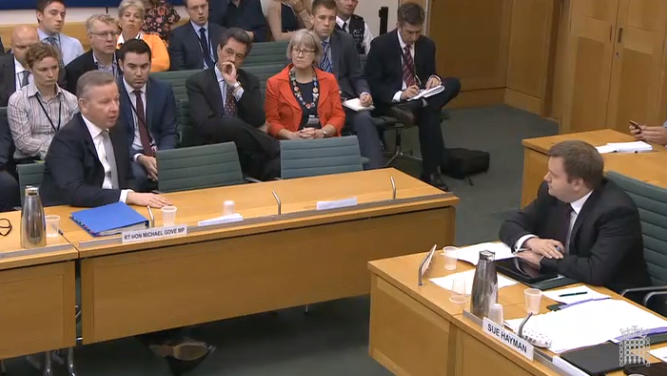
Pantomime – She’s behind you.
The session was recorded on video. Watch it here.
Getting down to business
After an exchange of pleasantries and mutual congratulations on appointment, the committee set about putting forward questions on important issues such as safety in prisons, rehabilitation, absconds from Open Prisons, court closures, and court and tribunal fees. This was good to see; Select Committees sit to scrutinise Government policy and progress.

This Justice Select Committee meeting came just a few days after the publication by the HM Chief Inspector of Prisons for England and Wales’ Annual Report 2014-15, in which Open Prisons have been highlighted once again.
On the same day as the HMIP Annual Report, Nick Harwick also published the unredacted version of the report on Release on Temporary Licence (ROTL) featuring three high profile cases of prisoners who each committed awful crimes whilst out on ROTL has challenged the current risk assessment within prisons.
The cases of Ian McLoughlin, HMP Springhill, Al-Foday Fofanah, HMP Ford and Alan Wilmot, HMP North Sea Camp were highlighted by Hardwick of where those on ROTL committed the same offence as they were sent to prison for in the first place, giving rise to questioning on whether there is ‘Rehabilitation’ in prison.
You can read the report here.
This was raised by Philip Davies MP when asking Mr Gove “what are you doing to protect the public from these future awful consequences?”
His reply was “…transfer to open prison should only follow an appropriate risk assessment.” He then added …”there will always be cases where there are individuals even if they have committed very serious offences may be suitable for a transfer to an open prison. Each case has to be judged on its own individual merits”. However, the underlying message was that public safety is paramount.
It was clear that Mr Gove was new to the job, there were many err and ums in his answers, but he did assure the committee that he would be happy to return when he had reviewed various aspects within the justice system.
So will I.
Ministry of Justice priorities…?
At the beginning of the month (5th – 7th Feb 2015) I attended the IMB conference. It was my first after over 2 years serving on the board at HMP/YOI Hollesley Bay, 14 months as Vice-chair.
After the formalities of opening the conference by IMB President, John Thornhill, we were introduced to one of the key speakers Mr Andrew Selous MP, Minister for Prisons, Probation and Rehabilitation.
And then it got very interesting!
He told us that, according to the Ministry of Justice, these were the priorities:
- Education
- Family relationships
- Work and time out of cells
The following day, to a guest panel (Frances Crook, Chief Exec of The Howard League for Penal Reform; Paul Baker, Deputy Director of Custody East Midlands, HMPS; Ben Gunn, former long serving prisoner and Clare Checksfield, Director of Returns in the Home Office), I put the following question:
“Firstly I would like to congratulate The Howard League on the books for prisoner’s campaign. Secondly the Minister yesterday explained the MOJ’s priorities were Education, Family relationships and Work including time out of cells. Do you agree and do you see them implemented?”
Education

Let’s start with Education. On this priority, Frances Crook responded by saying that “MoJ priorities are fiction”. She went on to say,
“Don’t send people to prison to get an education, send them to college. Prison education budgets have been realigned so they focus on basic skills, which is all very well but what about the 30,000 adult men who are serving long sentences and who now get little education beyond the three Rs”.
I still come across prisoners that have served many years in prison and still struggle with basic reading and writing. But should we be blaming the prison system, what happened for them to enter prison without these skills, not a straightforward issue?
Well I’m sure many of us have heard about Jonathan Robinson and his experience when he was trained to teach other in-mates to read yet, when in an open prison, was prevented by the then head of Education.
However, four years later and with new staff this same prison has just been awarded ‘Outstanding’ from Ofsted. Change does happen!
Family relationships
On this priority, Frances Crook shared that desistance is about relationships, engagement, commitment, consistency. Prisons cannot fulfil this.
One of the workshops I attended was overseen by two very enthusiastic women from HMP/YOI Parc entitled ‘Family Interventions, Supporting Positive Family Involvement. They work with the whole family and look at their needs in order to reduce offending, reduce inter-generational offending and encourage community inclusion. In the Family Intervention wing Safe Ground runs a couple of courses, Fathers Inside and Family Man aimed at teaching essential fathering skills.
Work and time out of cells
On this priority, Frances Crook said,
“Time out of cell is disappearing as staff cuts are so swingeing. Latest figures show in the last six months of last year the big city prisons were still losing staff. Morale is at an all time low, MoJ survey showed that, and sickness rates sky high.”
There are many stories that prisoners spend up to 22 or 23 hours locked in their cells but with the shortage of staff very little can be done.
Work is an essential element to prepare for release and what is needed is more companies willing to take on those with a criminal record.
A couple of months ago I spoke to a group of people about ex-offenders being re-integrated back in society, all were for it and all thought it was an important step… until I asked
“what about your society?”
NIMBY!
Where’s Mum?…she’s in prison with an author and an actor off Eastenders!
Daughter: Did you just say Mum’s visiting a prison in London with an author and an actor off Eastenders ?
Son 1: If I stop someone from killing someone else and in so doing I kill them, am I a bad person or is it just what I have done bad?
Son 2: Did you really sit in a room with prisoners, what if they were murderers?
Boyfriend of daughter: Wow, you were in the audience and sat with prisoners?
Are these the kind of conversations you have with your family?

Over the past four years I have met many prisoners who all had one thing in common: they just needed someone to believe in them, to listen to them and to help them whilst in prison and once their sentence had ended.
I’ve found that, for some of them, criminal activity had become a way of life; they knew nothing else and would most likely continue in the same way after release. For others, falling into crime was a result of a stupid decision or action, often spontaneous, which had got them in to trouble with the law, convicted and sent to prison; they felt a debilitating remorse and that they had let themselves and their families down.
Crisis – what crisis?
We read that the prison population continues to rise, overcrowding in prison seems to be the norm rather than the exception and violence, suicides and self-harm are weekly occurrences. There is tragedy after tragedy yet we are told that there is no crisis in our prison system.
So what should we do? One solution is to accept the status quo and keep our heads in the sand. Another is to actually address the issues. But, as I keep hearing, this has to be a coherent team effort.
Not settling for the status quo
In January, I visited a London prison and was accompanied by NoOffence! Patron, actor Derek Martin (Eastenders’ Charlie Slater) and author Jonathan Robinson (@IN_IT_THE_BOOK) from their Advisory Board. I’ve already blogged about the visit and the lessons I took away from that experience.
At a peer mentoring conference last year, I met with Rob Owen OBE the chief executive of St Giles Trust, an Ambassador for NoOffence!
St Giles Trust aims to help break the cycle of prison, crime and disadvantage and create safer communities by supporting people to change their lives.
Next week, I will be meeting Geoff Baxter OBE the CEO of Prison Fellowship who is also an Ambassador of NoOffence!
This is just a small sample of the organisations that work to improve the lives of offenders, there are many more.
I’d dearly like to explore how these organisations can find more ways to work together; these plus leaders such as Howard League perform outstanding work as organisations in their own right. Just imagine what could be achieved if new ways of working could be agreed to improve the Criminal Justice System.
In December 2012 I was accepted by the Secretary of State to the Independent Monitoring Board (IMB) of an open prison. To carry out my duties effectively, the role provide the right of access to every prisoner and every part of the prison I monitor, and also to the prison’s records. Independent monitoring ensures people in custody are treated fairly and humanely; I take this work very seriously.
When I started working in prisons it was as a group facilitator for Sycamore Tree, a victim awareness programme teaching the principles of restorative justice. For many offenders on Sycamore Tree one of the most powerful element of the programme is when a victim of crime visits to talk with the group how crime has impacted their lives. In week 6 of the programme, participants have an opportunity to express their remorse – some write letters, poems or create works of art or craft. Members of the local community are invited to the course to observe the many varied symbolic acts of restitution.
I’ve seen some remarkable lives turned around among offenders who make it to this stage of the programme. Okay, you argue, there is no way these outcomes can be achieved in 100% of cases. I agree.
But programmes that provide education and encouragement have to be a more purposeful activity and more effective towards increasing the chances of better outcomes with more offenders than them simply being banged up for 23 hours a day with the TV.
But all it takes is a bit of coherent team work.
I like what NoOffence! says in their mission statement and vision:
Mission Statement: NoOffence! will encourage, promote and facilitate the collaboration of organisations from the voluntary, public and private sectors to address the issue of reducing crime and reoffending.
Vision: To be the leading online criminal justice communication, information exchange and networking community in the world. Our vision for NoOffence! has always been to bring justice people together to overcome barriers to rehabilitation. We believe the solution to complex justice problems lie with the people…
They have got a point, haven’t they?
I for one would be open to try to forge more collaboration than we see today. And I know I’m not alone in that view; many others are prepared to voice a similar willingness and appetite for supporting each other.
Actions speak louder than words. Let’s get on with it.
Continue the conversation on Twitter #rehabilitation
Cat B visited
Well I have now visited Cat A, B, C, D and a YOI just leaving women’s estate which is on the agenda and an IRC.
Cat B yesterday, I must say it was not what I expected, Razor wire yes, heightened security yes, but not what I would call a “typical” prison environment.
I accompanied an actor and an ex-prisoner who campaigns for prison reform; Derek Martin an Eastenders actor and Jonathan Robinson, who I nick-named the “Dynamic Duo”.

From left: Jonathan Robinson and Derek Martin.
Photo: Faith Spear
My reason for visiting this prison was that after hearing good things about staff and their attitude towards prisoners with encouragement and motivation, I wanted to see for myself and not rely on the accounts of others.
This planned event started around 12.30, where the three of us met in the prison car park. I had met Jonathan before at various events but it was a first with Derek who came across as such a likeable character I was sure it was going to be a memorable afternoon!
On the inside
Fast tracked through security we waited in a through room for our host the Librarian and Learning Leader. Wow was he tall (well most people are tall to me)
Our first port of call was the library, what a vibrant organised room, a place where you would just want to learn in. Education was encouraged. There were colourful posters covering the walls, some of which showed previous guest appearances and reading schemes. You might say “a library is a library” what’s so special about a library?
But this was in a Cat B prison! I would have been quite happy to curl up on their sofa with a good book for a couple of hours.
I then expected just to go to the room for the talk given by Derek, instead we had a cuppa in the visits hall, a large bright modern room, laid out in small seating areas, well stocked kids play area and a purpose built coffee bar. Although I didn’t see it, the staff raved about the new baby unit just off the main hall.
It was good to chat with staff about the ways that families are supported with one member in prison. There was such a relaxed atmosphere which reflected the staff’s willingness to engage with the inmates. I believe maintaining family ties are such an important element in the rehabilitation programme. They even had incentives to enable inmates to earn extra time with their loved ones.
Our visit included Tesco express well the store for prisoner’s canteen, a wing, cell, laundry and the impressive gym. I started talking with a very enthusiastic member of staff who I immediately warmed to. Her determination to work with the prisoners to achieve was remarkable. As with my work, I meet many in prison that have never achieved anything positive in their lives. This was not something that this staff member was going to accept, she explained when faced with barriers there was always a solution even to the point of condensing courses, providing material in Braille and help with dyslexia.
Yet again education was encouraged at what ever age and what ever ability.
Oi, Charlie!
Sure, the celebrity guest was Derek, but we all were treated so well. Walking towards the multi-faith room. cheers went up from inmates and staff alike as they recognised Charlie (Derek).
On finally reaching the room, Derek and Jonathan sat at the front and Derek addressed the audience. Then the entertainment began with Derek’s sense of humour being displayed as he recounted story after story. Then it was time for the questions from “where can you buy pie and mash?” to “how can you be an extra on a television show?”
I enjoyed the chatting afterwards with the inmates; many wanted a signed poster from Derek or a copy of Jonathan’s book IN_IT.
Key takeaways
So what effect did the day have on me?
Today I have been going over and over in my mind the experiences of yesterday:
- I met inspirational staff who enjoyed their job
- I saw respect from staff and inmates
- There was no heaviness in the air that I have experienced at other prisons
- There was a hunger to learn
- At no point did I feel vulnerable
- There was a sense that the staff were all singing from the same hymn sheet
- Rehabilitation in prison can and should start from day one
- Even short sentences can be filled with purposeful activity
- Prisoners taking responsibility
- Education is a key to rehabilitation
Now I’m not saying this prison is perfect, there are issues facing the whole of the prison estate. But good practice needs to be shared.
We cannot sit by and see wasted lives within a prison environment, rehabilitation is the key to breaking the cycle of reoffending and yet its not about money, its more about attitude.
Westminster: Justice Select Committee
Tuesday 9th September 2014
Entering into Westminster Hall with its stone floor, places where famous people have stood and given speeches and seeing police with weapons can make you wonder where on earth you are. But walking up the steps at the back you enter a statue lined corridor and then you enter the lobby, beautiful architecture which never ceases to amaze me. I half expected to see Nick Robinson conducting an interview, instead I met Jonathan Robinson, an ex-prisoner, now author and prison reform campaigner.
Jonathan Robinson along with Paula Harriott, Head of Programme, User Voice, Angela Levin, former Chair of HMP Wormwood Scrubs Independent Monitoring Board, and Deborah Russo, Prisoners’ Advice Service were witnesses giving evidence on Prisons: Planning and Policies in front of the Justice Select Committee. The complete oral evidence is available from the following link:
I decided to sit in the public area and hear each witness in order to gain insight into what is actually happening in prisons. It is important that prisoners are rehabilitated whilst inside and one way is through using the skills that are present within the prison population itself.

Courtesy of Parliamentlive.tv
The Toe by Toe project run by the Shannon Trust is an excellent example of this, where literate prisoners help those that are illiterate. This is a peer-to-peer mentoring program. Not being able to read has a negative impact on job prospects and also self-esteem. It’s quite shocking when prisoners that have been in the prison estate many years face release unable to read!
Jonathan Robinson has spent the last three years pushing for prison reform, he has written on his own personal prison experience and is a voice for those inside. He champions mentoring and is on the Advisory Board for NoOffence CIC!
http://www.jonathanrobinson.org/
 The Criminal Justice Blog