Home » Posts tagged 'prison' (Page 3)
Tag Archives: prison

Should inmates be given phones?
Offenders who maintain family ties are nearly 40% less likely to turn back to crime, according to the Ministry of Justice. With secure mobiles being rolled out in prisons we ask…
Should inmates be given phones?
This was a question posed to me back in November 2021 by Jenny Ackland, Senior Writer/Content Commissioner, Future for a “Real life debate” to be published in Woman’s Own January 10th 2022 edition.
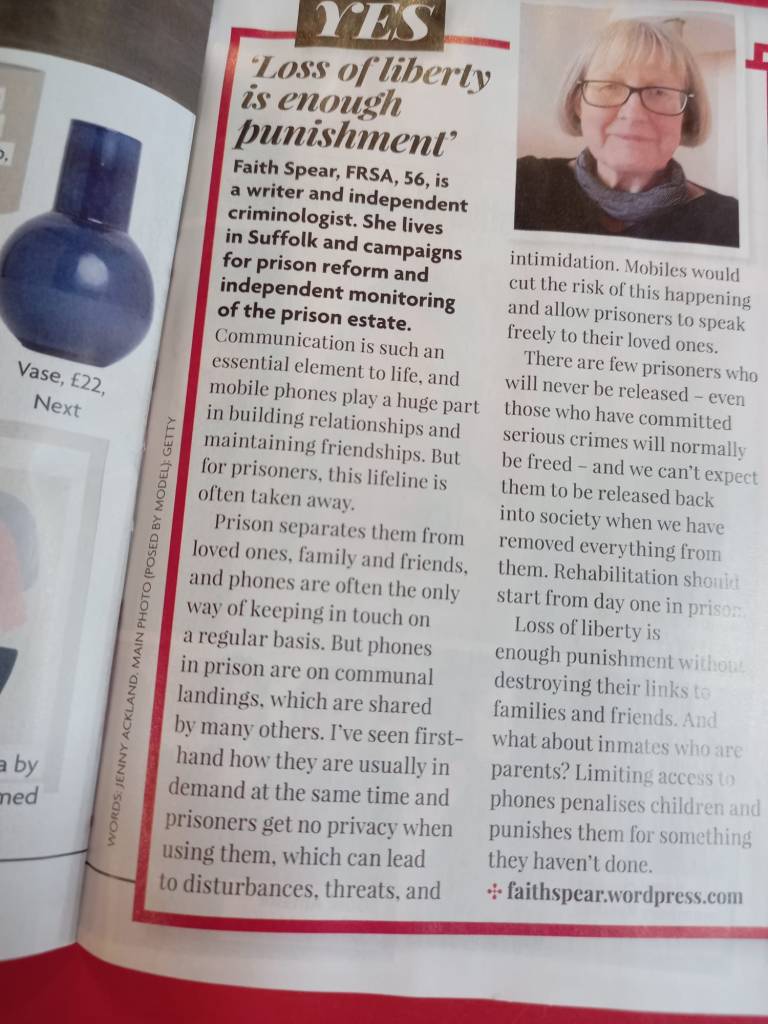

Below is the complete article, my comments were cut down slightly, as there was a limited word count and reworked into the magazine style.
Communication is an essential element to all our lives, but when it comes to those incarcerated in our prisons, there is suddenly a blockage.
Why is communication limited?
It is no surprise that mobile phones can serve as a means of continuing criminal activity with the outside world, as a weapon of manipulation, a bargaining tool, a means of bullying or intimidation.
But what many forget is that prison removes an individual from society as they know it, with high brick walls and barbed wire separating them from loved ones, family, and friends.
There is a PIN phone system where prisoners can speak with a limited number of pre-approved and validated contacts, but these phones are on the landings, are shared by many, usually in demand at the same time and where confidentiality is non-existent. This is when friction can lead to disturbances, threats, and intimidation.
Some prisons (approx 66%) do have in-cell telephony, with prescribed numbers, monitored calls and with no in-coming calls.
Why do some have a problem with this?
We live in an age of technology, and even now phones are seen as rewarding those in prison.
If we believe that communication is a vital element in maintaining relationships, why is there such opposition for prisoners?
In HM Chief Inspector of prisons Annual report for 2020, 71% of women and 47% of men reported they had mental health issues.
Phones are used as a coping mechanism to the harsh regimes, can assist in reducing stress, allay anxiety and prevent depression.
Let’s not punish further those in prison, prison should be the loss of liberty.
Even within a prison environment parents want to be able to make an active contribution to their children’s lives. Limiting access to phones penalises children and in so doing punishes them for something they haven’t done. They are still parents.

Art for arts sake/prison for prisons sake: Part 2
Emerging from the Westminster tube station, the blue sky is a welcome sight. Trees shedding their leaves by the chilly winter winds. Wrapped up against the elements I hastily head along Victoria Embankment and climb the steps to cross the Thames toward my chosen destination – The Southbank Centre and Koestler Arts exhibition. A celebration of Art, Music and Writing.
The ‘I and the We’, curated by Camille Walala and Sarah Ihler Meyer.
With the strapline: ‘Unlocking the talent inside the criminal justice system’
It’s a strapline I have often read, but how many truly believe it is possible?
Unlocking: who is unlocking and who is being unlocked?
Unlocked, unlock, unlocking…its endless, often words chosen by cjs charities and organisations.
But to unlock you need a key.
A key can be a person or an opportunity. Here it is both.
We write off so many due to their circumstances, but a bit of creative encouragement can achieve much.
I try not to over-analyse each exhibit, but it is tempting, with titles such as ‘Too Late‘ and ‘Perspective‘ it is a little hard not to be intrigued.
Talent: is there really talent within the criminal justice system?
This question is easy for me to answer, a resounding yes.
Others may think differently, usually from a position of ignorance in my view. The average person still knows so little about what is happening behind prison walls.
Art is a form of expressing what is happening within or without. In a nutshell a way of communicating to others in an illustrative way.
Art is not judgmental like right or wrong, nor is it binary like black or white.
I was attracted to a striking entry from HMP Garth called ‘God’s Words’. A simple graphic featuring biblical words applied using rudimentary materials; a marker pen and cardboard. Definitely makes you think.
Slowly moving through the room, many exhibits caught my eye, some making me feel rather sad and others bringing a smile to my face and even a laugh. But that is the beauty of Art.
Bold statements
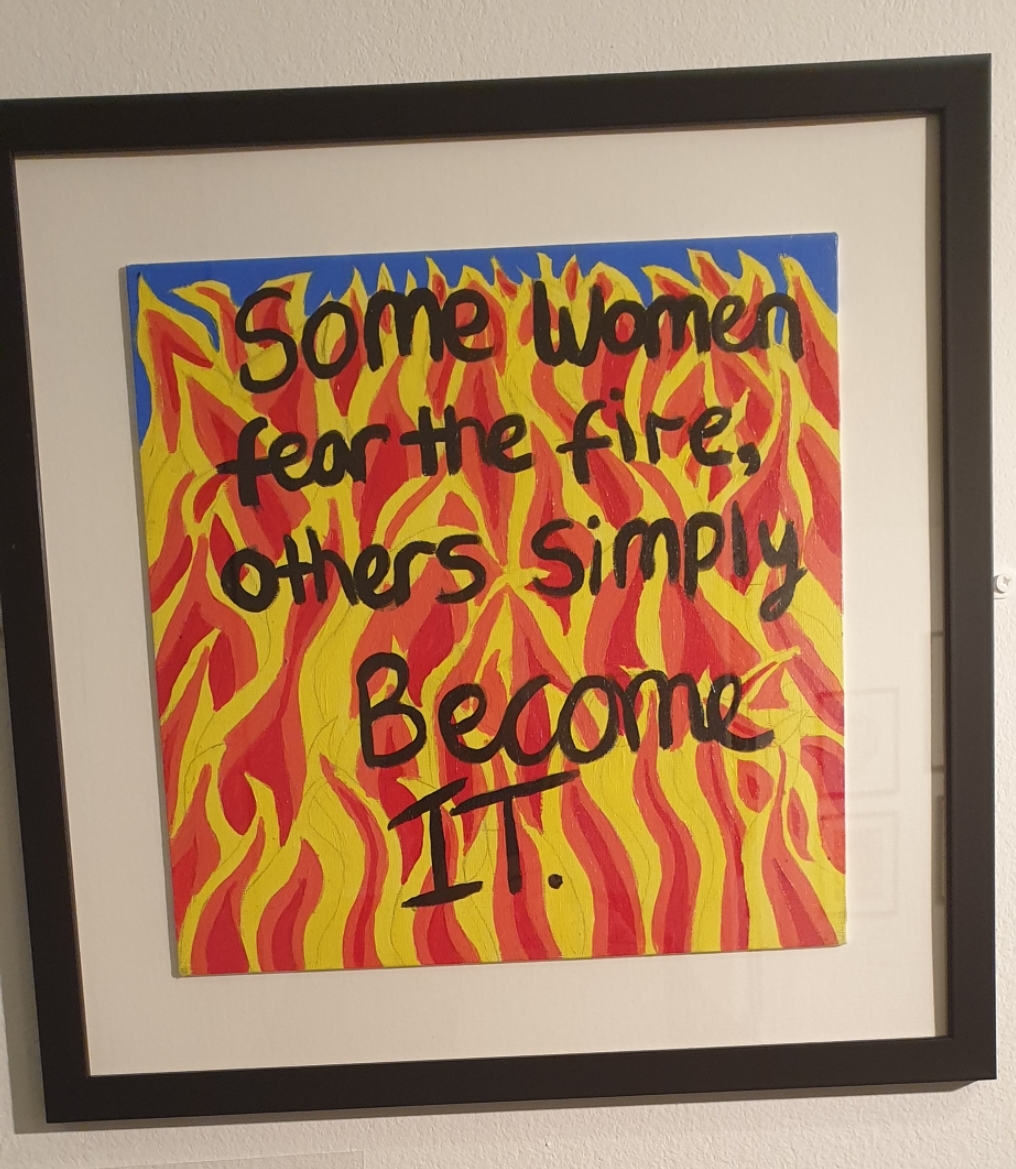
“Some Women fear the fire, others simply Become It” such poignant yet powerful words. I wonder what the story is behind it. All I know is someone called Jacqueline painted this acrylic on board from HMP Eastwood Park. No other words are really needed.
Wise words
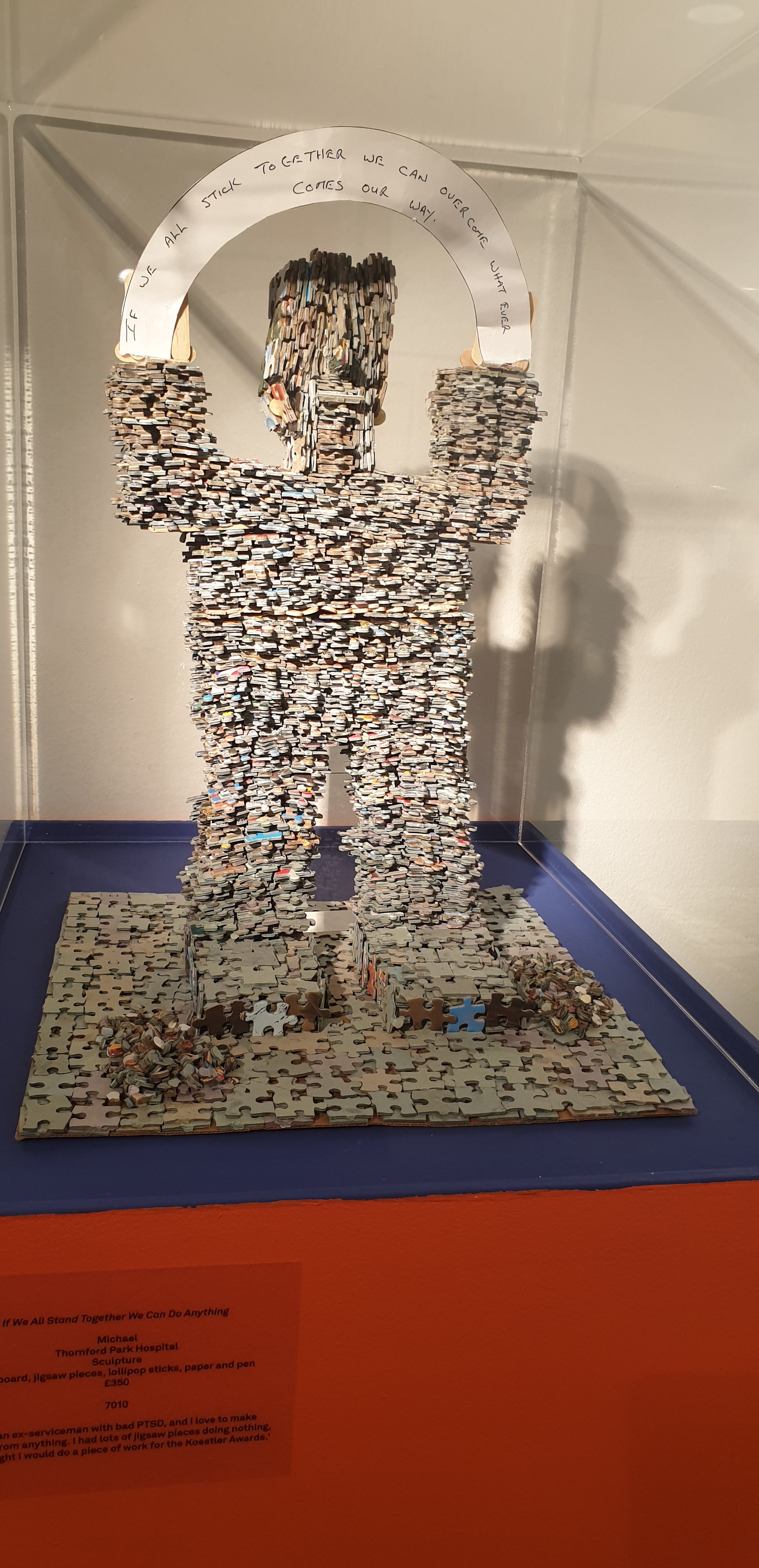
As I considered the work called ‘If We All Stand Together We Can Do Anything’ there is a sense of togetherness within this exhibition, maybe we can all learn from this simple sculpture. Thank you Michael.
Poetry

Walls
beyond these grilles
behind this door
and walls within my view
I’ve fought my demons
and done my time
ready to start anew.
I’ve used these bricks
to build new walls
and found something true
I’ll rise to freedom
And find my voice
Well beyond this view.
I sat on a bench in silent contemplation of these four verses, unmissable alongside other poems on the wall ahead of me.
It was well worth taking the time to read every carefully chosen word.
Here is talent. It has been unlocked.
~
‘The I and the We’ 2021 UK exhibition at Southbank Centre
Curated by Camille Walala and Sarah Ihler-Meyer
29 October – 5 December 2021. Mon – Wed 10am – 6pm, Thu – Sun 10am – 9pm*
Exhibition Space, Level 1, Royal Festival Hall, London
~

Who watches the Watchdog?
The website for the Independent Monitoring Board (IMB) states:
“Inside every prison, there is an Independent Monitoring Board (IMB) made up of members of the public from all walks of life doing an extraordinary job!
You’ll work as part of a team of IMB volunteers, who are the eyes and ears of the public, appointed by Ministers to perform a vital task: independent monitoring of prisons and places of immigration detention. It’s an opportunity to help make sure that prisoners are being treated fairly and given the opportunity and support to stop reoffending and rebuild their lives.”
Anyone can see this is a huge remit for a group of volunteers.
IMB’s about us page also states:
“Their role is to monitor the day-to-day life in their local prison or removal centre and ensure that prisoners and detainees are treated fairly and humanely”
Another huge remit.
For those who believe they can make a difference, and I have met a few who have, the joining process is quite lengthy.
Once you have completed the online application form, bearing in mind you can only apply to prisons which are running a recruiting campaign (that doesn’t mean to say there are no vacancies in others) the applicant is then invited for an interview and a tour of the prison.
So, what is wrong with that you may ask?
At this point NO security checks have been done, so literally anyone can get a tour of a prison, ask questions, and meet staff and prisoners.
This is surely a red flag.
And then there is the ‘interview’.
Two IMB members from the prison you have applied to and one from another prison take it turn in asking questions. It is basically a ‘tick box exercise’; I know this because I have been involved myself, sitting on both sides of the table.
It is based on scores, so if you are competent in interviews, you will do well. With IMB boards desperate for members it means that as long as your security check comes through as okay, you will have made it on to the IMB board.
However, no references are required to become a prison monitor. NONE.
A red flag too?
One of the main problems I encountered was that if the IMB board member comes from a managerial background they will want to manage. But the IMB role is about monitoring a prison and not managing it. I have seen where members and staff have clashed over this.
Well done, you made it on to the board, what next?
Back to the IMB website:
“You do not need any particular qualifications or experience, as we will provide all necessary training and support you need during a 12-month training and mentoring period”
The first year is the probationary year where you are mentored, accompanied, and trained. To be accompanied for this period is unrealistic, there are insufficient members having neither the time nor resources to get new members up to speed before they start monitoring.
In addition, induction training can be between 3-6 months after joining and can be said it is at best haphazard.
As reported Tuesday by Charles Hymas and others in The Telegraph newspaper, and citing a set-piece statement from the MOJ press office, “a spokesman said that although they had unrestricted access, they were given a comprehensive induction…”
I beg to differ; the induction for IMB board members is hardly comprehensive.
I believe this needs to change.
For such an essential role, basic training must take place before stepping into a prison. Yes, you can learn on the job but as we have seen recently, IMB members are not infallible.
Membership of the IMB is for up to 15 years which leads to culture of “we’ve always done it this way”, a phrase all too often heard, preventing new members from introducing fresh ideas.

What if something goes wrong?
Not all IMB members have a radio or even a whistle or any means of alerting others to a difficult situation or security risk. If for any reason you need support from the IMB Secretariat, don’t hold your breath.
The secretariat is composed of civil servants, MOJ employees, a fluctuating workforce, frequently with no monitoring experience themselves who offer little or no assistance. I know, I’ve been in that place of needing advice and support.
What support I received was pathetic. Even when I was required to attend an inquest in my capacity as a IMB board member no tangible help was provided and I was told that IMB’s so-called ‘care team’ had been disbanded.
From the moment you pick up your keys, you enter a prison environment that is unpredictable, volatile and changeable.
As we have seen this week, an IMB member at HMP Liverpool has been arrested and suspended after a police investigation where they were accused of smuggling drugs and phones into prison.
This is not surprising to me and may be the tip of the iceberg. IMB board members have unrestricted access to prisons and prisoners. As unpaid volunteers they are as susceptible to coercion as paid prison officers.
Radical change needs to be put in place to tighten up scrutiny of, and checks on, members of the IMB when they visit prisons either for their board meetings or their rota visits.
In 4 years of monitoring at HMP/YOI Hollesley Bay I was never searched, and neither was any bag I carried. In over 10 years of visiting prisons, I can count on one hand, with fingers to spare, the number of times I have been searched. When visiting a large scale prison such as HMP Berwyn I only had to show my driving licence and the barriers were opened.
Whilst the situation at HMP Liverpool is an ongoing investigation and whilst the outcome of the investigation is not yet known, I do urge Dame Anne Owers, the IMB’s national Chair, to look urgently at the IMB recruitment process, at the IMB training and at the provision of on-going support for IMB board members.
Complacency has no part in prisons monitoring.
~

Hidden Heroes: Why are they hidden and why are they heroes?
Today, 29 September 2021, is the second Hidden Heroes Day. An initiative of The Butler Trust it aims be “a National Day of Thanks for our #HiddenHeroes across the UK”. As well as Hidden Heroes Day, there is a dedicated website http://www.hiddenheroes.uk and social media account.
“While most media coverage of the sector focuses on the negative, the @HiddenHeroes_uk Twitter account is used to share positive stories about prisons, IRCs, probation and youth justice services, and the #HiddenHeroes who work in them.”
Why is it that our prisons, IRCs, probation, and youth justice services is apparently full of hidden heroes?
It is one thing calling them heroes, but why are they hidden?
Who has made them hidden and what is keeping them hidden?
Are they hiding and if so what from?
Are they hiding something or from something?
Are they hidden because they don’t want a fuss or hidden because they don’t want people to know?
In this day and age, why is the harsh reality of prisons so well hidden?
How can it be that the average person still knows so little about what is happening behind prison walls?
Direct experience
It has been more than 10 years since I first stepped into a prison. The unfamiliar surroundings can quickly intimidate and unsettle you, and the smell can be nauseating.

Back then, I had to hide my job role. Some of my thoughts on my way to do my monitoring rota at a prison once were: “I need to get petrol for the journey to work, so I had better put my belt and key chain in my bag this morning as I don’t think I am supposed to let anyone see it. No one has said anything, and I haven’t read any rules about it, but I’ve got a feeling that it should stay hidden until I get to the prison car park. That’s the thing about being a prison monitor, there seems to be so many unwritten rules and regulations.”
How many paid staff feel that they too must hide the job they do from others?
I remember visiting a high security prison, for an Independent Monitoring Board (IMB) tour of the prison. We walked together as a small group and headed into a workshop. It was an example of one of those mind-numbingly boring workshops found in nearly every prison where they perform so-called “purposeful activity”.
As we entered escorted by IMB volunteers I was told by a member of staff that within that large room there were two blind spots. In a hushed voice they said:
“We are not responsible for your safety if you walk into a blind spot.”
The problem was that they avoided telling us where the blind spots were, for fear of being overheard.
Is that what is meant by hidden?
Yes, it can be a dangerous for staff but so too for those living inside.
Prisoner-on-staff attacks are counted, and stats reported. And they should be. Prisoner-on-prisoner attacks are also counted, and stats reported and they should be too. But have you ever tried to get stats for staff-on-prisoner attacks?
Along with others, perhaps yourself included, I took the time to review the HM Chief Inspector of Prisons report in August 2021 on HMP Chelmsford. The report said:
“Almost half of the prisoners said they had been victimised by staff, and those with disabilities and mental health problems were significantly more negative.”
How can you call them hidden heroes when reading something like this?
Should that be hidden too?
Can those who do such things really be heroes?
Opinions differ
Whilst preparing this blog, I decided to ask people for their views on Hidden Heroes.
Dita Saliuka told me:
“Prison staff get the good coverage in the media most of the time anyway and the public praise them for ‘doing a difficult job’. It’s more the prisoners that are labelled all sorts whether they committed a horrendous crime or not people just say all sorts just because they are a prisoner. I hate the word ‘hidden heroes’ so much as PPO (Prison and Probation Ombudsman) and Inquest clearly state that most deaths are due to staff failures so how is that a heroic thing? It’s disrespectful to us families that have lost a loved one in prison due to their neglect, failures and staff abuse.”
Phil O’Brien, who has a 40-year career in the Prison system, told me:
“I think it’s an excellent initiative. It quite rightly concentrates on the positives. But sometimes doing the dirty stuff can be equally effective and necessary but can’t be ‘celebrated’ because it’s not as easy to explain, not as attractive or appealing.”
Tough at the top
We have probably all read in the media this past week that there is a new Secretary of State for Justice, Dominic Raab MP, appointed on 15 September in the reshuffle. But did you also see that he has been quite vocal on what he really thinks about prisons.
Mr. Raab has said: “We are not ashamed to say that prisons should be tough, unpleasant and uncomfortable places. That’s the point of them”
Compare that with the official line that Ministry of Justice takes: “We work to protect and advance the principles of justice. Our vision is to deliver a world-class justice system that works for everyone in society.” And, according to its 4 strategic priorities, “a prison and probation service that reforms offenders”
https://www.gov.uk/government/organisations/ministry-of-justice/about
We are yet to learn the full extent of who is hiding what from whom at Petty France.
Mr. Raab will have to confront a few bastions of power there which prefer things to be properly hidden.
End of the day
#HiddenHeroesDay will come and go. Some people burst with enthusiasm for it, raising lots of money for great causes and all that is, of course, to be commended.
But at the end of the day the fact remains that the enduring problem of the criminal justice system, and daily for frontline workers in particular, is the pervading culture which dictates that everything remains hidden.
If we are to celebrate anything, wouldn’t it be better to celebrate openness rather than that which is hidden?
But within the justice arena so many tragedies stay hidden. Too many lives ruined, too many suicides, too many people suffering with mental health issues. And it is worsening by the day. That is the stark reality. And the reason things are hidden.
The Butler Trust, in creating the initiative, no doubt has the best of intentions.
In celebrating Hidden Heroes Day are we not in fact perpetuating the very problem it is trying to solve?
~ ends ~

Guest blog: Being visible: Phil O’Brien
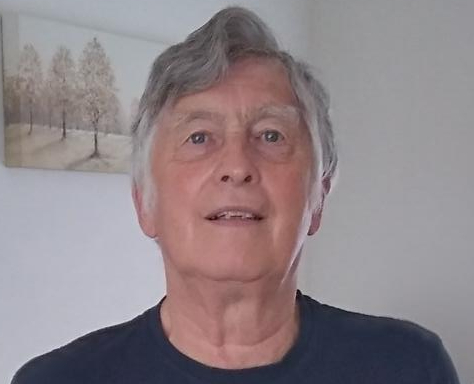
An interview with Phil O’Brien by John O’Brien
Phil O’Brien started his prison officer training in January 1970. His first posting, at HMDC Kirklevington, in April 1970. In a forty-year career, he also served at HMP Brixton, HMP Wakefield, HMYOI Castington, HMP Full Sutton, HMRC Low Newton and HMP Frankland. He moved through the ranks and finished his public sector career as Head of Operations at Frankland. In 2006, he moved into the private sector, where he worked for two years at HMP Forest Bank before taking up consultancy roles at Harmondsworth IRC, HMP Addiewell and HMP Bronzefield, where he carried out investigations and advised on training issues. Phil retired in 2011. In September 2018, he published Can I Have a Word, Boss?, a memoir of his time in the prison service.
John O’Brien holds a doctorate in English literature from the University of Leeds, where he specialised in autobiography studies.

You deal in the first two chapters of the book with training. How do you reflect upon your training now, and how do you feel it prepared you for a career in the service?
I believe that the training I received set me up for any success I might have had. I never forgot the basics I was taught on that initial course. On one level, we’re talking about practical things like conducting searches, monitoring visits, keeping keys out of the sight of prisoners. On another level, we’re talking about the development of more subtle skills like observing patterns of behaviour and developing an intimate knowledge of the prisoners in your charge, that is, getting to know them so well that you can predict what they are going to do before they do it. Put simply, we were taught how best to protect the public, which includes both prisoners and staff. Those basics were a constant for me.
Tell me about the importance of the provision of education and training for prisoners. Your book seems to suggest that Low Newton was particularly successful in this regard.
Many prisoners lack basic skills in reading, writing and arithmetic. For anyone leaving the prison system, reading and writing are crucial in terms of functioning effectively in society, even if it’s only in order to access the benefits available on release.
At Low Newton, a largely juvenile population, the education side of the regime was championed by two governing governors, Mitch Egan and Mike Kirby. In addition, we had a well-resourced and extremely committed set of teachers. I was Head of Inmate Activities at Low Newton and therefore had direct responsibility for education.
The importance of education and training is twofold:
Firstly, it gives people skills and better fits them for release.
Secondly, a regime that fully engages prisoners leaves less time for the nonsense often associated with jails: bullying, drug-dealing, escaping.
To what extent do you believe that the requirements of security, control and justice can be kept in balance?
Security, control, and justice are crucial to the health of any prison. If you keep these factors in balance, afford them equal attention and respect, you can’t be accused of bias one way or the other.
Security refers to your duty to have measures in place that prevent escapes – your duty to protect the public.
Control refers to your duty to create and maintain a safe environment for all.
Justice is about treating people with respect and providing them with the opportunities to address their offending behaviour. You can keep them in balance. It’s one of the fundamentals of the job. But you have to maintain an objective and informed view of how these factors interact and overlap. It comes with experience.

What changed most about the prison service in your time?
One of the major changes was Fresh Start in 1987/88, which got rid of overtime and the Chief Officer rank. Fresh Start made prison governors more budget aware and responsible. It was implemented more effectively at some places than others, so it wasn’t without its wrinkles.
Another was the Woolf report, which looked at the causes of the Strangeways riot. The Woolf report concentrated on refurbishment, decent living and working conditions, and full regimes for prisoners with all activities starting and ending on time. It also sought to enlarge the Cat D estate, which would allow prisoners to work in outside industry prior to release. Unfortunately, the latter hasn’t yet come to pass sufficiently. It’s an opportunity missed.
What about in terms of security?
When drugs replaced snout and hooch as currency in the 1980s, my security priorities changed in order to meet the new threat. I had to develop ways of disrupting drug networks, both inside and outside prison, and to find ways to mitigate targeted subversion of staff by drug gangs.
In my later years, in the high security estate, there was a real fear and expectation of organised criminals breaking into jails to affect someone’s escape, so we had to organise anti-helicopter defences.
The twenty-first century also brought a changed, and probably increased, threat of terrorism, which itself introduced new security challenges.
You worked in prisons of different categories. What differences and similarities did you find in terms of management in these different environments?
Right from becoming a senior officer, a first line manager at Wakefield, I adopted a modus operandi I never changed. I called it ‘managing by walking about’. It was about talking and listening, making sure I was there for staff when things got difficult. It’s crucial for a manager to be visible to prisoners and staff on a daily basis. It shows intent and respect.
I distinctly remember Phil Copple, when he was governor at Frankland, saying one day: “How do you find time to get around your areas of responsibility every day when other managers seem tied to their chairs?” I found that if I talked to all the staff, I was responsible for every day, it would prevent problems coming to my office later when I might be pushed for time. Really, it was a means of saving time.
The job is the same wherever you are. Whichever category of prison you are working in, you must get the basics right, be fair and face the task head on.
The concept of intelligence features prominently in the book. Can you talk a bit about intelligence, both in terms of security and management?
Successful intelligence has always depended on the collection of information.
The four stages in the intelligence cycle are: collation, analysis, dissemination and action. If you talk to people in the right way, they respond. I discovered this as soon as I joined the service, and it was particularly noticeable at Brixton.
Prisoners expect to be treated fairly, to get what they’re entitled to and to be included in the conversation. When this happens, they have a vested interest in keeping the peace. It’s easy to forget that prisoners are also members of the community, and they have the same problems as everyone else. That is, thinking about kids, schools, marriages, finances. Many are loyal and conservative. The majority don’t like seeing other people being treated unfairly, and this includes prisoner on prisoner interaction, bullying etc. If you tap into this facet of their character, they’ll often help you right the wrongs. That was my experience.
Intelligence used properly can be a lifesaver.
You refer to Kirklevington as an example of how prisons should work. What was so positive about their regime at the time?
It had vision and purpose and it delivered.
It was one of the few jails where I worked that consistently delivered what it was contracted to deliver. Every prisoner was given paid work opportunities prior to release, ensuring he could compete on equal terms when he got out. The regime had in place effective monitoring, robust assessments of risk, regular testing for substance abuse and sentence-planning meetings that included input from family and home probation officers.
Once passed out to work, each prisoner completed a period of unpaid work for the benefit of the local community – painting, decorating, gardening etc.
There was excellent communication.
The system just worked.
The right processes were in place.
To what extent do you feel you were good at your job because you understood the prisoners? That you were, in some way, the same?
I come from Ripleyville, in Bradford, a slum cleared in the 1950s. Though the majority of people were honest and hardworking, the area had its minority of ne’er-do-wells. I never pretended that I was any better than anyone else coming from this background.
Whilst a prisoner officer under training at Leeds, I came across a prisoner I’d known from childhood on my first day. When I went to Brixton, a prisoner from Bradford came up to me and said he recognised me and introduced himself. I’d only been there a couple of weeks. I don’t know if it was because of my background, but I took an interest in individual prisoners, trying to understand what made them tick, as soon as I joined the job.
I found that if I was fair and communicated with them, the vast majority would come half way and meet me on those terms. Obviously, my working in so many different kinds of establishments undoubtedly helped. It gave me a wide experience of different regimes and how prisoners react in those regimes.
How important was humour in the job? And, therefore, in the book?
Humour is crucial. Often black humour. If you note, a number of my ex-colleagues who have reviewed the book mention the importance of humour. It helps calm situations. Both staff and prisoners appreciate it. It can help normalise situations – potentially tense situations. Of course, if you use it, you’ve got to be able to take it, too.
What are the challenges, as you see them, for graduate management staff in prisons?
Credibility, possibly, at least at the beginning of their career. This was definitely a feature of my earlier years, where those in the junior governor ranks were seen as nobodies. The junior governors were usually attached to a wing with a PO, and the staff tended to look towards the PO for guidance. The department took steps to address this with the introduction of the accelerated promotion scheme, which saw graduate entrants spending time on the landing in junior uniform ranks before being fast-tracked to PO. They would be really tested in that rank.
There will always be criticism of management by uniform staff – it goes with the territory. A small minority of graduate staff failed to make sufficient progress at this stage and remained in the uniform ranks. This tended to cement the system’s credibility in the eyes of uniform staff.
Were there any other differences between graduate governors and governors who had come through the ranks?
The accelerated promotion grades tended to have a clearer career path and were closely mentored by a governor grade at HQ and by governing governors at their home establishments and had regular training. However, I lost count of the number of phone calls I received from people who were struggling with being newly promoted from the ranks to the governor grades. They often felt that they hadn’t been properly trained for their new role, particularly in relation to paperwork, which is a staple of governor grade jobs.
From the point of view of the early 21stC, what were the main differences between prisons in the public and private sectors?
There’s little difference now between public and private sector prisons. Initially, the public sector had a massive advantage in terms of the experience of staff across the ranks. Now, retention of staff seems to be a problem in both sectors. The conditions of service were better in the public sector in my time, but this advantage has been eroded. Wages are similar, retirement age is similar. The retirement age has risen substantially since I finished.
In my experience, private sector managers were better at managing budgets. As regards staff, basic grade staff in both sectors were equally keen and willing to learn. All that staff in either sector really needed was purpose, a coherent vision and support.
A couple of times towards the end of your book, you hint at the idea that your time might have passed. Does your approach belong to a particular historical moment?
I felt that all careers have to come to an end at some point and I could see that increasing administrative control would deprive my work of some of its pleasures. It was time to go before bitterness set in. Having said that, when I came back, I still found that the same old-fashioned skills were needed to deal with what I had been contracted to do. So, maybe I was a bit premature.
My approaches and methods were developed historically, over the entire period of my forty-year career. Everywhere I went, I tried to refine the basics that I had learned on that initial training course.
Thank you to John O’Brien for enabling Phil to share his experiences.

~

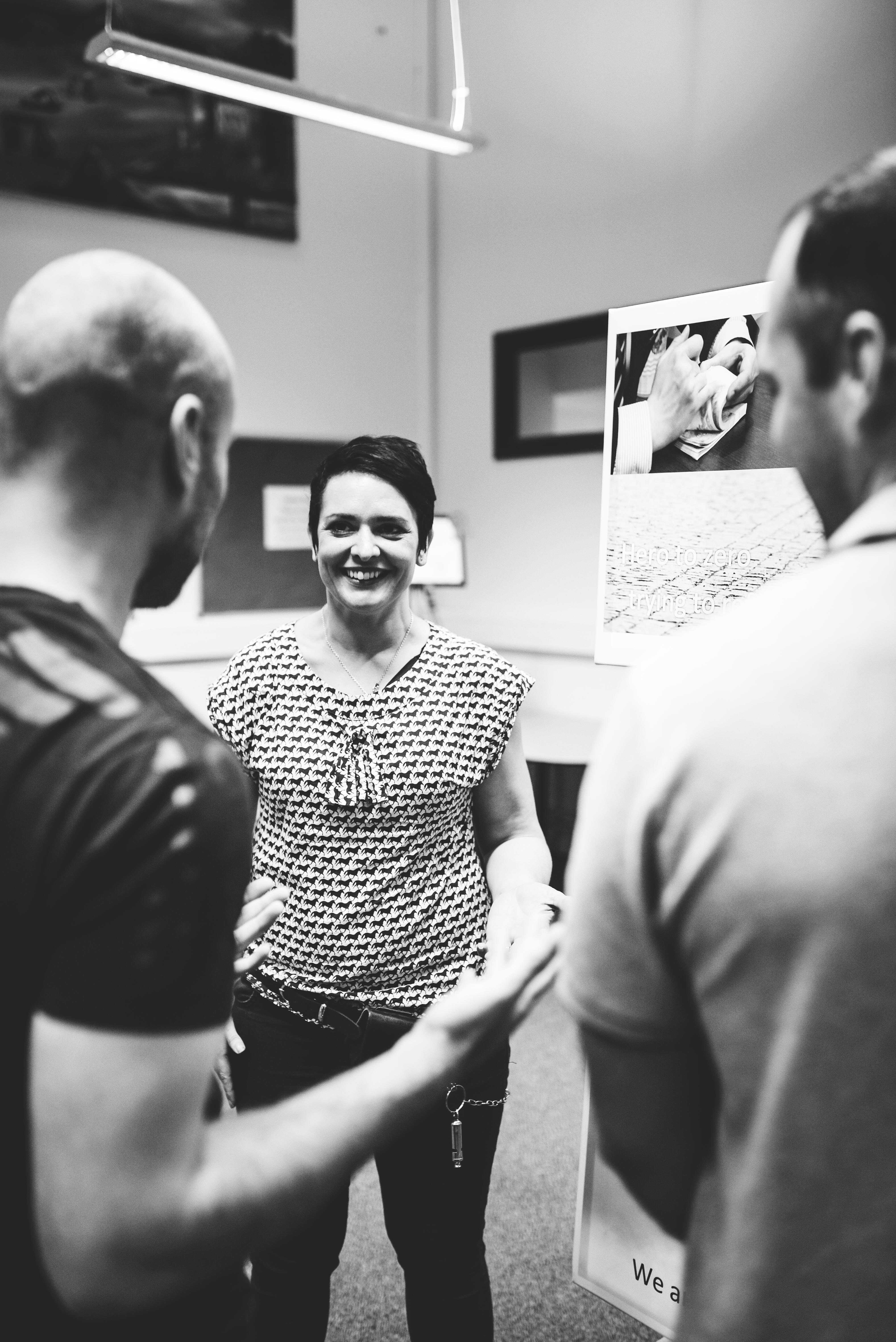
A Conversation with: Dr Sarah Lewis, Director of Penal Reform Solutions
In her Twitter bio it states: A passionate prison reformer. Interests: collaborative research, personal growth, creative action research, relationships, Nordic prisons, prison reform.
Just reading this I knew we would have a connection and a great conversation together.
What does it mean to you to be a prison reformer?
What I do has meaning, consumes me, its a purpose that is constantly in my blood and mind.
Collaboration matters to me, so does inclusion and having an unconditional regard for people. My inspiration comes from Elizabeth Fry, however, there are many with her passion. We need to work together to make a collective impact, not rely on one individual to drive change in prisons. I also believe that reform is not only situated in prisons, but in the community at large.
I don’t want to consistently bash the Criminal Justice System, but we need to be realistic about the problems whilst instilling hope. We need to meet people where they are at.
Prison reform needs to be a social movement in order to create a climate outside of raising awareness and drawing people together for a common purpose.
Prisons can be a transformative place.

Do we need any more research on prisons, are there gaps or do we just need to push for changes based on existing knowledge?
Yes to both.
We know enough to know what works. The difficulty is how we apply that knowledge. Academia needs to move out of its ivory tower and on to the shop floor. There’s plenty of research, you need to create a growth environment (climate) and capture this impact with understanding. Research takes so long, from ethics approval to peer review to publication. More creativity is needed with research, capture stories, motivate staff.
Academic research needs creativity, inclusion, and we must learn from our mistakes.
Do you see yourself as an academic?
Yes, but I’m a bit of an odd ball in academia, being an academic is part of my identity, but it doesn’t define me.
You mention personal growth, can you elaborate on this?
Growth for me is inclusion, growth in the community and families. People can reform, but you need to create hope and invest in unconditional relationships.
Growth, which includes love, acceptance and trust is also about unconditional support, nurturing and building relationships.
How important is it to establish relationships with prisoners/prison staff?
It’s everything
From determing the level of trust, to how people talk about their feeings, their fears and trauma. It’s the key to prison reform, desistance, cleanliness, safe environment, trust and many more…
What are some of the elements from the Nordic prisons that can be easily incorporated into prisons in England and Wales?
To never enter a prison and think people are broken with no hope.
Would you describe yourself as resilient?
I’m strong through stubbornness, but I am focused on what I want to achieve. Resilience means you bounce back, I’m susceptible to tiredness and pain due to health conditions, but this won’t stop me. I refuse to give in, so by overcoming obstacles I adapt to my environment.
Where does your strength come from?
My husband is my rock, my team, friends and importantly my sense of direction.
In an article in the InsideTime newspaper, June 2020, Sarah stated:
“My lifelong mission is to create a more humane system, which provides conditions where people can find meaning, have hope in the future and be happy”
In relation to this statement where do you see the prisons in England and Wales?
We are far away from that, further than we think. We have the ability to change, yet we underestimate the collaborative abilty of staff and prisoners alike. Culture and climate are important. A more humane system will not happen on its own, we need investment and training.
I have 100% hope in the future, that’s my logic.
We want people to live and not just survive.
With your work in schools, do you believe it is possible to instil meaning, hope and happiness into children’s lives?
Absolutely
From my experience it is easier to teach children than adults. The idea of the “Growth Project” at Guys Marsh was one of nurture, principle of growing and a purpose and peace in children. Divert them from prison by focusing on these building blocks around relationships, in order to protect them in later life.
You mentioned the “Growth Project”, how did this come about and how do you see it progressing?
The Norway Project took place in 3 Norwegian prisons and started as a photographic exhibition about how I captured collaboration. I spent 3 years researching Norwegian prisons and during the fieldwork I created a research team to understand their exceptional prison practices and priciples of growth. Out of this the Growth Project was born in England and Wales. We now have a collection of passionate people forming a steering group with prisoners and their families involved. We discuss issues such as diversity and inclusion in both prisons and society alike.
The aim of the “Connection Campaign” is to bring the inside and outside together, how are you managing to break down the walls to achieve this?
We are looking at where there is disconnection and the needs of young people. We magnify a voice that is quiet from various criminal justice areas. But we are not about blaming or shaming prisons. We wanted senior management to have conversations with prisoners families. Our strategy is to meet people where they are at and how to be a bit more compassionate, a critical friend.
Is rehabilitation possible within the current prison set up?
They need to be habilitated in the first place. Rehabilitation is a managerialistic term which often sets people up to fail. Like a game of trying to catch people out which is not conducive to change and no growth can happen. It can be harmful as no one wins.
Do we need radical reforms, if so what are the possibilities, if not, why not?
We need an authentic meaningful longterm investment in those principles that are encouraged in the Nordic model, applying the principles of growth in a meaningful way within our own context.
Irrespective of ideology, we want to strive for a just and humane system. This needs to happen, we need to change the narrative around prisons, prisoners and prison staff. But it must be sensitively executed. It’s not just about success stories.
Working within the prison estate can be rewarding but also can be disappointing, exhausting and demoralising. How do you deal personally with the complexities you face?
I see and hear a lot of stuff. However, I have such a strong mission.
Yes it is. Absolutely.
We have lost 2 growth members, 1 person through suicide after prison and 1 whilst he was in prison. It was a painful experience, I knew their families and the ripple effect was hard because their lives matter.
The question I really wanted to ask Sarah was: Is your underlying message of hope?
I believe in people.
I dont quite believe in the system yet.
I have hope in individuals.
I believe in them.
We need to be actively hopeful in people. Let them know “I believe in you”
I have hope in people.

An interview on a Summer’s day
How/why did your involvement in the CJS come about?
I turned down a place to study for a degree and instead moved from Lincolnshire to Essex at the age of 19. My first “proper” job was in admin with NACRO in Colchester. I worked primarily in wages and finance. At that point NACRO provided 6 months work placements in painting and decorating or in gardening teams etc for those who had just come out of prison. I heard amazing stories from those men and some brought newspaper cuttings to show me of their various escapades, including a headline “Most wanted man in Britain” They made me laugh and some made me shed a few tears. But for me I had many questions that were never answered.
What happens after 6 months?
What about their families, how can they support them financially?
Was this really a way for integration back into society?
Why is only manual labour available?
I helped set up and train staff for a new branch of NACRO and then moved on to work in Finance for the NHS. However, I believe a seed was planted all those years ago.
Fast forward 25 years, I was accepted into University. I became a full-time student studying Criminology with 2 kids at school, 1 at college, a part time job and my husband working full time and studying also, I embarked on a very busy 3 years of multi-tasking!
For my first presentation I chose to speak on Women in prison and the Corston report, I researched thoroughly but was marked down because no one was interested in prisons and especially not women in prison, it was deemed not an exciting enough subject. Great start. My next presentation was about Restorative Justice and yet again I was questioned as to why I was interested, one lecturer even said, “What’s that?”. A pattern was emerging of my interest into those within the CJS and those that had been released increased. I was not put off and in my 3rd year the title for my dissertation was: Restorative Justice: Is it delivering strategic change in England and Wales or just a cost cutting exercise by the Government?
To understand the significance of Restorative Justice I arranged interviews with experts in the UK, NZ and USA, even Howard Zehr widely regarded as the Grandfather of RJ agreed to help. I consumed document after document on RJ and was a frequent visitor at the Cambridge University Library, floor 6 (those stairs almost killed me!) and the Institute of Criminology Library.
I graduated with an honours degree in Criminology and looked for my next step.
I joined the Independent Monitoring Board (IMB) at HMP/YOI Hollesley Bay and in just three years became the Chair.
I wrote about the things I saw and heard but what I didn’t expect was what happened next. I was confronted with a prejudicial character assassination brought against me, a fight to clear my name, being investigated twice by the Ministry of Justice, called in front of a disciplinary hearing in Petty France and the involvement of not one but two Prison Ministers. I felt that I was on my own against a bastion of chauvinism. Not the last bastion of their kind I would come across. Welcome to the IMB!
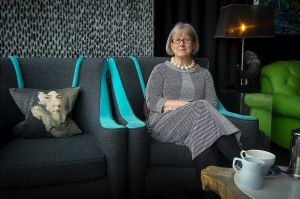
My continuing journey can be found in my blog: The Criminal Justice Blog www.faithspear.wordpress.com
Because my story is fairly unique it has been covered by BBC News, Channel 4 News, BBC Radio Oxford, BBC Radio Suffolk, 5Live, LBC as well as National and Local newspapers, law journals and online publications etc.
Religion is clearly important to you, what role does God play in your life?
I remember going to Chapel with my grandparents as a young child and hearing my Dad and Grandfather sing the old hymns with deep sincerity. Christianity has always been part of my life. My faith in God has often been tested.
How do you balance work and life responsibilities?
I often say I’m a Mum first, always have been always will be. My husband and my kids are the most important people in my life, I have a great relationship with them all. They understand who I am and what motivates me to do what I do. They understand the bigger picture and that for me it is a cause and not merely a job. That in itself I realise is exceptional and I find I am continually grateful because I know that the level of family support I have is sadly not available to everyone. I can’t do this stuff on my own. They are also aware of the work I do behind the scenes and the many hours of support I give freely.
What role, if any, has luck played in your life?
Things happens for a reason, we don’t always know or understand the reason why. We all have issues to face and hurdles to climb and times of joy and celebration. Luck doesn’t fit in my life at all.
Not only have you been a source of inspiration to me in certain areas, I have also seen you inspire others and would like to know who inspired, or inspires you and why?

A few years ago, I wrote a journal article with a friend of mine, Dr David Scott about a remarkable woman, Lady Constance Lytton, commemorating 100 years since her book Prisons and Prisoners was published. In it she presented one of the most significant challenges to 20th Century anti-suffrage politics. Her book is a harrowing personal account of her four prison sentences as a militant suffragette. It is also a compelling insight into the mind of a young woman consumed by a cause which would prove to be instrumental in prison reform and votes for women, as well as tragically being a contributory factor to her death. My inspiration, which comes from her being consumed by a cause, makes me wonder if that is still possible. This wasn’t a phase she was going through or a pastime, it was a lifestyle.
I admire her courage and determination. I see this in so few people but when I find it, it is unmistakable. Let me give you an example, Tracy Edwards MBE. At the age of 26 she was the skipper for the first all-female crew for the Whitbread Round the World Race. It is not so much the fact that she sailed around the world, although that in itself is remarkable, but it is the reason why that I find compelling. She said “First time in my life I stood up for something I believed in” I have met and chatted with Tracy, she is an inspiration to me without a doubt.
What would you say is your greatest accomplishment and/or achievement is?
I think that my greatest accomplishment is staying true to myself, maintaining integrity and not bowing to pressure to conform.
In terms of my greatest achievement let me give you a couple of examples. First, being nominated for the Contrarian prize 2017 especially when you realise the key criteria that the judges look for are Independence, Courage and Sacrifice.

Ali Miraj and Faith Spear
Second, last year I was deeply moved and excited to learn that I had been counted as one of the 100 inspirational Suffolk women alongside people such as Dame Millicent Fawcett.


As a female leader, what has been the most significant barrier in your career?
On one of my visits to the House of Parliament I took time to seek out one of the most outspoken MP’s known for saying it as it is. I sat down next to Dennis Skinner and asked him a very simple question. I asked, “How do you get heard in this place?”. Mr Skinner looked me straight in the eye and offered me advice I will never forget. With his characteristic directness, he said, “You have to be seen to be heard”. I’ve taken his advice and applied it to all I do. This has not come naturally to me as people who know me will tell you.
Everybody wants to have their say and everyone has an opinion. But there is a big difference between those who say their piece ad nauseum and those who have something to say.
In one sense all that people have heard from me so far is simply learning to overcome the barriers of not being heard. When I have learned enough then I am sure I will have gained the clarity with what I have to say.
If you were given the prisons and probation ministers role, what changes would you make?
I would scrap the titan prison building programme and instead invest in smaller local units, making families more accessible and start to break down the barriers between those in prison and those on the outside.
I would encourage industry to step out of their comfort zone and give more people with convictions a second chance. To remove the stigma of a criminal record so that it is not forever hanging around people’s necks. We are a deeply divided and hurt society that is full of prejudices.
I would ban all industries within prisons that do not provide purposeful activities and a decent wage. People need to be work ready on release with housing and job options already in place. Families should be able to stay together and be supported, children should be prioritised.
I would make sure everyone working within the CJS were trained sufficiently for their roles and supported in their jobs.
As a prisons minister you can only change what is in your field of influence to change. In other words, you need to be precise, you need be pragmatic and you need to learn whose advice you can trust. Then act on it.
One of my priorities as Prisons Minister would be to take advice to demonstrate better things to invest in. Diversion, or Restorative Justice or Community.
Put money into early years, into youth etc.
We have to stop this madness of believing that we can change people and their behaviour by banging them up in warehouse conditions with little to do and not enough to eat and sanitation from a previous century.
As Prisons Minister I would initiate change that would lead to every prison Governor carrying personal accountability for the way they run the prisons they are responsible for. It’s not their prison, its ours and they must run it properly, giving people in their care decent conditions and personal dignity regardless of what crime the courts have sent them to prison for. The moment Governors carry that personal accountability is the moment you will see astonishing changes in HMPPS.
I will ensure under performing Governors leave the service and are not continually rotated around the prison estate or promoted to more senior positions. They have to know the weight of the accountability they carry.
Finally, what are you hopes and aspirations for the future of the criminal justice, and also for you?
Transparency and Accountability should underline every decision made. No more carpets where issues are swept under. No more excuses for the crisis within the system. We talk too much, we deliberate too much and have too many committees. There are too many roundtable events, conferences, discussions where everyone is saying they are experts yet so much remains the same. We produce too many reports, reviews and paperwork that gets filed away. Now is the time for action, for investment in people and for priorities to change. Lets just get on with it and stop competing and instead work toward a common objective, such as drastically reducing the prison population
In the next five years, I will continue to speak up truthfully and will add my voice to the very many voices calling for change. I will support policies introduced by the current Prisons and Probation Minister or by their successor where those policies do bring about real change. However, I shall not hesitate in bringing a strong critique where those policies gloss over the hard questions or where they shirk the implementation of measures for real reform. I will finish on this:
Vision is often personal, but a cause is bigger than any one individual
People don’t generally die for a vision, but they will die for a cause
Vision is something you possess, a cause possess you
Vision doesn’t eliminate the options; a cause leaves you without any options
A good vision may out live you, but a cause is eternal
Vision will generate excitement, but a cause generates power
[Adapted from Houston (2001)]

Whistle while you work
Is whistleblowing a band wagon to jump onto?
Usually you don’t suddenly wake up in the morning and say, “Today I’m going to be a whistle-blower”. The negative connotations surrounding whistleblowing such as being an informant, betrayer, or even a backstabber is not something to aspire to.
Yet, these descriptions cannot truly explain why there are those in the minority that will put their head above the parapet, will risk their reputation and often lose their job through speaking out.
So, have we become largely a society that will cower rather than stand up, do we lack courage or integrity or both?
Fear of reprisals can cause us to retreat, to stay silent but in so doing are we not being true to ourselves. It takes more than just determination to be vocal about issues you are passionate about. Unfortunately, when living in such a punitive society, the norm is to shut people down rather than to listen.
Having sat at an employment tribunal with an experienced Prison Officer listening to their case of dismissal, my thoughts were not that they wanted revenge, not at all. I saw passion, I heard a very determined individual with a story that has affected not only their work, their life but possibly their health too.
It’s too easy for society to ignore the reality in our prisons in England and Wales, where violence, instability and a lack of investment over decades has reduced them to warehouses of the vulnerable. Numerous are inhumane and on the point of crisis.
Equally, let’s not point the finger at those that want transparency in the Criminal Justice System, instead we should push for accountability and not lose sight that one day those in prison may be a loved one or will become our neighbour.
Time to stop shooting the messenger
Recently I met Michael Woodford, the inaugural winner of the Contrarian Prize and former CEO of Olympus who exposed a $1.7 billion fraud at the heart of Olympus and was sacked for doing so. He had more than most to lose by speaking out.

Faith Spear and Michael Woodford
According to: https://www.gov.uk/whistleblowing
“As a whistleblower you’re protected by law – you should not be treated unfairly or lose your job because you ‘blow the whistle’.
You can raise your concern at any time about an incident that happened in the past, is happening now, or you believe will happen in the near future”
But is this really so?
It also states:
“You’re a whistleblower if you’re a worker and you report certain types of wrongdoing”
But what if you are a volunteer?
Yes, you work and often very hard, but where is the protection mechanism?
In my experience, being a volunteer for many years offers little protection especially when dealing with the Ministry of Justice. Even going through the “normal” channels produces little response. Suddenly people become hard of hearing, blind to what is happening all around them and stick their heads in the sand.
I’m not like that, I am very aware of many untold stories and issues within the justice system.
I put my head above the parapet once, I have no regrets even now still living with the consequences.
I would do it again.
And plan to do shortly!

Now it’s my turn to ask what’s acceptable online
Only those who know me know who I am and what I do, often away from the public eye.
On top of my commitments this week I want to talk about this. I have seen a barrage of messages on Twitter, sent to me and about me; messages which are good, bad and certainly ugly, sent mainly from those who don’t know me and have never met me.
Why? Online abuse is unacceptable. I am calling it out and people don’t like it.
To put things in context, I myself have received a fair amount of online abuse over the last few years but last summer it reached a new level because the online abuse included a death threat from an individual who I had never met, but who was going through a very unstable time. This was totally unacceptable, so I reported it to Twitter. Twitter said they had broken Twitter rules and consequently Twitter suspended the account they were using.
I had a short period of relative peace until the Autumn. The snide remarks started up again primarily from an individual, then a small group emerged, tweeting in agreement with them. I decided to inquire who these people were, but not on open social media. I contacted people I knew and trusted and asked for their advice, questioning the reasons behind this unacceptable attack on me, but even in asking questions it seemed I opened a can of worms. I learned there were those hiding behind Twitter accounts who had other professional accounts. It seems I hit a raw nerve; I’ve done that before and it will probably happen again!
Never once did I try to get any ex-offenders fired from their jobs. This is pure fabrication.
Over the last fortnight, I have seen tweets primarily from one individual with relentless bombardment on a daily basis. How is this acceptable behaviour and especially from someone who, yet again, I don’t know and have never met?
Starting rumours, planting seeds of doubt into the minds of others, and propagating things which are blatantly untrue: the tweets by that individual are being proliferated by others. They talk about what I wear, what I eat, who I associate with, what events I have attended, and even have the audacity to want to know what is in my diary. Their remarks and exchanges place me in false light.
Why the obsession?
Seriously why?
The stories they invent are worth a Bafta.
Why am I constantly seeing tweets by those who want me to confirm or deny certain issues, that I allegedly did or said or even thought? And why am I accused of being the bully and generating a climate of fear and frightening people into silence? Utter nonsense.
In an example of online abuse unrelated to previous examples I have given above, here is a tweet I saw recently:
“If it’s covered in sugar it’ll ruin your teeth. If covered in salt, it’ll affect your blood pressure. Spear is a withering insipid excuse for a woman. And I’ve little time for bullshit and her version of victim hood”
Really is this acceptable?
This is from an individual who works in the criminal justice system. Astonishing.
Turning to yet another separate example of online abuse, I remember being at an academic round table event a couple of years ago. The person sat beside me, who I knew of but had never met before, started to cry so I reached into my bag and gave them a tissue. I had a few online conversations with them before and afterward, but didn’t know their full story and didn’t get involved in their life. Yet, allegations were made online against me, by a third party, of lifting them up, carrying them then dropping them. All I did was give them a tissue for goodness sake and for my trouble they themselves later sent messages to me on Twitter including disgusting photos with increasingly nasty comments.
And the stories started to circulate.
Is the online abuse I receive a form of deflection?
Am I regarded as a legitimate target for people to offload their frustrations?
Are the people sending online abuse themselves hurt and damaged?
When the majority state that they are there for others, to support them, how ironic they tweet things so unsupportive such as:
“Wow – if this is true it is despicable, but not surprising…”
“Allegedly you caused…”
“I personally fear for all those connected to you…”
What does this smear campaign hope to achieve? Remember when you point the finger at someone there are three pointing back at you.
If this is how you treat me when all I work for is positive change within the prison sector, then how can others trust you? In smearing me you are making yourselves less credible, ruining your own reputation and doing yourself and the cause you fight for a disservice.
I’m not perfect, I make mistakes. Who doesn’t?
But I will not stand by and put up with this online abuse orchestrated against me. Piling on is the online equivalent to dishing out a pad beating in a prison. Anyone who has served time and who now uses social media will understand the devastating effect I am talking about.
Unlike those who level allegations against me, I have chosen not to name anyone, they know who they are and should reflect upon what they do and say online.
I’m upset, feel bruised, frustrated, bewildered and many other emotions. But I will not shut up and will not go away.
What I saw and heard visiting many prisons (every category including women’s prisons) gives me motivation to work with others to restore decency for those in prison and for their families.
I will do all I can to help bring positive change, to speak the truth and face the consequences. I may not be everyone’s cup of tea, but I am me.
~
Everything on this blog has been out on social media; I just collated it.
~
Updated 20 March:
13th paragraph has been modified following a request on Twitter that I associated the person who issued the online abuse in 12th paragraph with the person who issued the death threat against me cited in 4th paragraph. Therefore, the 13th paragraph now starts with new words to make it abundantly clear the two individual examples on online abuse originated from separate individuals and in order to resolve any misinterpretation this may have caused.
16th paragraph has been modified following a request issued on Twitter that in some way I identified the person who issued the online abuse cited verbatim in the 12th paragraph. Therefore, certain wording about the individual’s background has been removed as this was regarded to be pejorative and reference to the nature of their work has also been removed in order to resolve any misinterpretation this may have caused.
17th paragraph has been modified following a request issued on Twitter that in some way I identified the person who issued the online abuse covered in this paragraph. Therefore, certain wording about the individual’s gender has been removed as this was regarded to be the identifier and in order to resolve any misinterpretation this may have caused.
~

HMP/YOI Hollesley Bay: should alarm bells be ringing?
We have heard from the Secretary of State for Justice, David Gauke and the Prisons Minister, Rory Stewart that we need to get back to basics where prisons are concerned. HMP/YOI Hollesley Bay is no exception.
Reading through the latest Inspectorate report shows clearly that only 15 of the 30 recommendations from the previous inspection in 2014 have been carried out.
Should alarm bells be ringing?

There are four tests for a healthy prison
- Safety
- Respect
- Purposeful Activity
- Rehabilitation and release planning (previously Resettlement)
Comparing the two latest reports, I noticed that some aspects once regarded as a safety issue are now a respect issue such as basic living conditions and making available a court video link. Probably why the recommendations in that category has fallen from 9 to 4. Looks good on paper but you have to read between the lines.
Four years ago, there were no recommendations for purposeful activity yet this time there are 5. From making sure prisoners get impartial careers advice, to providing detailed and constructive feedback on practical work to help prisoners improve, to ensuring that those engaged in prison industries are able to study and achieve qualifications related to their job. The answer is in the name “Purposeful” activity not just something to pass the long often monotonous days.
Surely these are basics of an open Cat D prison and is HMP/YOI Hollesley Bay failing?
It is worrying that there are many arriving at the prison without an up to date risk and needs assessment. Likewise, is the number of prisoners sent back to closed conditions, approx. 15 per month with some decisions not clearly evidenced.
And yet there are those that are released with little or no sustainable accommodation and this isn’t sufficiently monitored by the CRC’s.
With only one mental health staff, weak public protection procedures and with already 10% presented as medium or high risk to children there needs to be some serious changes before the planned arrival of those convicted of sex offences.
“New prisoners who potentially posed a risk to children were not always promptly assessed, and contact restrictions were not always applied in the interim”
There are so many issues to flag up:
“The anti-bullying representatives’ role was unclear, poorly advertised and lacked formal training”
“The strategic management of equality was less well developed than at the time of the previous inspection. There was no local equality and diversity strategy and the equality action plan was limited. There were no specific consultation groups running for prisoners with protected characteristics, other than the equality action team meeting”
The latest report shows increase in drug misuse with prisoners moving away from new psychoactive substances (NPS) and that cannabis was now the preferred drug. In addition the use of cocaine and steroids was an emerging problem.
Can HMP/YOI Hollesley Bay adapt to the changing needs and problems?
Let’s hope we are not seeing the gradual demise of this prison.
Recommendations 2018 inspection
Safety
- All use of force incidents should be scrutinised by senior staff to ensure that force is only used as a last resort.
- Body-worn cameras should be used during all use of force incidents.
- Risk assessments to determine if a return to closed conditions is necessary should be multidisciplinary and should show sufficient exploration of all relevant factors relating to the risks presented.
- Decisions to use handcuffs should be based on an individual risk assessment. (Repeated recommendation 45)
Respect
- The negative perceptions expressed by some prisoners that a small number of staff were punitive in their approach towards them should be explored and addressed.
- Basic living conditions on the Bosmere unit should be improved to ensure decency, including refurbished and well-maintained showers.
- Prisoners’ views about the quality of the food should be explored in greater depth and, where possible, changes should be made to increase their level of satisfaction.
- The issues with the prison shop should be resolved, so that prisoners receive their correct order.
- A court video link should be available. (Repeated recommendation 3)
- The prison should routinely consult prisoners in the protected groups to ensure that their concerns and needs are identified and, where possible, addressed. (Repeated recommendation 25)
- Managers should consider both local and national equality monitoring data, and address inequitable outcomes.
- Reasonable adjustments for prisoners with disabilities should be swiftly completed. These prisoners should have access to practical support, such as a buddy scheme, which supports them in their day-to-day life at the prison
- There should be a regular health care representative forum to inform service developments and enable collective concerns to be addressed.
- There should be regular, systematic health promotion campaigns delivered in conjunction with the prison.
- Prisoners should have timely access to optician and dental services. (Repeated recommendation 68)
- There should be a memorandum of understanding and information sharing agreement between agencies, to outline appropriate joint service working on social care.
Purposeful Activity
- Prison managers should ensure that they have accurate information on the education, training or employment that prisoners enter following their release, so that they can evaluate and monitor fully the impact of the curriculum on offer.
- Prison managers should ensure that prisoners receive impartial careers advice and guidance when they arrive at the establishment and throughout their time in custody, so that they can plan their future after release more effectively.
- Prison and People Plus managers should ensure that vocational tutors provide detailed and constructive feedback on practical work, to help prisoners to improve.
- Prison and People Plus managers should ensure that vocational tutors challenge prisoners to achieve high standards of professional workmanship that meets commercial expectations.
- Prison managers should ensure that prisoners engaged in prison industries have an opportunity to study and achieve a qualification related to their job.
Rehabilitation and release planning
- Visits provision should meet demand.
- Prisoners on resettlement day release to maintain family ties should not be required to be collected and returned by family members in a car unless the risk assessment suggests that this is necessary.
- The prison’s needs analysis should make full use of offender assessment system (OASys) and P-NOMIS data, in order to identify and address gaps in provision.
- Prisoners should only transfer to open conditions once a full and up-to-date assessment of their risk and needs has been carried out.
- There should be sufficient places available in Bail Accommodation and Support Service accommodation to allow prisoners to be released on home detention curfew on their eligibility date.
- Meetings to discuss a prisoner’s suitability for open conditions should be multidisciplinary. Decisions to return prisoners to closed conditions should be clearly evidenced and defensible.
- For prisoners returning to closed conditions, recategorisation to C should be supported by clear evidence.
- The prison should undertake a comprehensive analysis of needs, to establish the range of offence-focused interventions required.
- The community rehabilitation company (CRC) should monitor the number of prisoners released to sustainable accommodation (12 weeks after release), to understand the effectiveness of provision.
- The CRC should ensure that interviews to review resettlement plans are conducted by a trained member of staff.
Recommendations 2014 inspection
Safety
- Recommendation: The Bosmere unit should be upgraded or replaced with permanent accommodation
- Recommendation: OASYs and ROTL procedures should be sufficiently rigorous to ensure risks to the public are effectively managed.
- A court video link should be available.
- Prisoners should receive a private first night interview with a member of staff.
- The prison should investigate prisoners’ perceptions about safety and address any concerns raised.
- The safeguarding adults framework document should be finalised and staff should understand safeguarding procedures for adults at risk.
- Decisions to use handcuffs should be based on an individual risk assessment.
- The drug strategy action plan should be updated, inform developments and detail lines of accountability.
- The controlled drugs administration room should be more welcoming and security arrangements should be in line with what is required in open conditions.
Respect
- The shower areas in the Stow unit should be refurbished.
- Staff and personal officers in the Bosmere unit should check on and interact with prisoners in their care.
- The EAT should investigate when monitoring data consistently suggests inequitable outcomes for minority groups.
- The prison should routinely consult prisoners in the protected groups to ensure their concerns and needs are identified, and where possible, addressed.
- Suitable adapted accommodation should be available for prisoners with disabilities.
- All staff should have regular managerial and clinical supervision, as well as appropriate continuing professional development underpinned by a current performance appraisal.
- There should be sufficient clinical rooms to provide a comprehensive service and all areas, including the dental suite, should comply with infection control guidelines.
- Triage algorithms should be available to ensure decisions made are consistent and appropriate.
- Prisoners should have timely access to optician and dental services.
- Prisoners should have access to pharmacist-led counselling sessions, clinics and medication reviews.
- The dental service should be informed by an up-to-date needs assessment.
- Custodial staff should receive regular mental health awareness training.
- Self-catering facilities should be improved, particularly for prisoners on long or indeterminate sentences.
- There should be no administration charge for catalogue orders.
Resettlement
- Formal supervision should be provided to all OSs.
- Sentence planning objectives should be specific and focused on outcomes.
- All prisoners should have planned case management meetings with their OS proportionate to their risk and needs. Meetings should be recorded.
- When prisoners are returned to closed conditions there should be a clear record of who made the decision and the rationale for it; re-categorisation from D to C should only take place if there is clear evidence that this is required.
- The content and information on the virtual campus should be reviewed to ensure it is relevant for prisoners looking for work on release.
- There should be robust discharge planning processes in place to ensure continuity of care.
- The prison should develop a strategic action plan that aims to ensure all prisoners have the opportunity to stay in contact with family and friends.
 The Criminal Justice Blog