
Home » Posts tagged 'prison population' (Page 2)
Tag Archives: prison population
Cat B visited
Well I have now visited Cat A, B, C, D and a YOI just leaving women’s estate which is on the agenda and an IRC.
Cat B yesterday, I must say it was not what I expected, Razor wire yes, heightened security yes, but not what I would call a “typical” prison environment.
I accompanied an actor and an ex-prisoner who campaigns for prison reform; Derek Martin an Eastenders actor and Jonathan Robinson, who I nick-named the “Dynamic Duo”.

From left: Jonathan Robinson and Derek Martin.
Photo: Faith Spear
My reason for visiting this prison was that after hearing good things about staff and their attitude towards prisoners with encouragement and motivation, I wanted to see for myself and not rely on the accounts of others.
This planned event started around 12.30, where the three of us met in the prison car park. I had met Jonathan before at various events but it was a first with Derek who came across as such a likeable character I was sure it was going to be a memorable afternoon!
On the inside
Fast tracked through security we waited in a through room for our host the Librarian and Learning Leader. Wow was he tall (well most people are tall to me)
Our first port of call was the library, what a vibrant organised room, a place where you would just want to learn in. Education was encouraged. There were colourful posters covering the walls, some of which showed previous guest appearances and reading schemes. You might say “a library is a library” what’s so special about a library?
But this was in a Cat B prison! I would have been quite happy to curl up on their sofa with a good book for a couple of hours.
I then expected just to go to the room for the talk given by Derek, instead we had a cuppa in the visits hall, a large bright modern room, laid out in small seating areas, well stocked kids play area and a purpose built coffee bar. Although I didn’t see it, the staff raved about the new baby unit just off the main hall.
It was good to chat with staff about the ways that families are supported with one member in prison. There was such a relaxed atmosphere which reflected the staff’s willingness to engage with the inmates. I believe maintaining family ties are such an important element in the rehabilitation programme. They even had incentives to enable inmates to earn extra time with their loved ones.
Our visit included Tesco express well the store for prisoner’s canteen, a wing, cell, laundry and the impressive gym. I started talking with a very enthusiastic member of staff who I immediately warmed to. Her determination to work with the prisoners to achieve was remarkable. As with my work, I meet many in prison that have never achieved anything positive in their lives. This was not something that this staff member was going to accept, she explained when faced with barriers there was always a solution even to the point of condensing courses, providing material in Braille and help with dyslexia.
Yet again education was encouraged at what ever age and what ever ability.
Oi, Charlie!
Sure, the celebrity guest was Derek, but we all were treated so well. Walking towards the multi-faith room. cheers went up from inmates and staff alike as they recognised Charlie (Derek).
On finally reaching the room, Derek and Jonathan sat at the front and Derek addressed the audience. Then the entertainment began with Derek’s sense of humour being displayed as he recounted story after story. Then it was time for the questions from “where can you buy pie and mash?” to “how can you be an extra on a television show?”
I enjoyed the chatting afterwards with the inmates; many wanted a signed poster from Derek or a copy of Jonathan’s book IN_IT.
Key takeaways
So what effect did the day have on me?
Today I have been going over and over in my mind the experiences of yesterday:
- I met inspirational staff who enjoyed their job
- I saw respect from staff and inmates
- There was no heaviness in the air that I have experienced at other prisons
- There was a hunger to learn
- At no point did I feel vulnerable
- There was a sense that the staff were all singing from the same hymn sheet
- Rehabilitation in prison can and should start from day one
- Even short sentences can be filled with purposeful activity
- Prisoners taking responsibility
- Education is a key to rehabilitation
Now I’m not saying this prison is perfect, there are issues facing the whole of the prison estate. But good practice needs to be shared.
We cannot sit by and see wasted lives within a prison environment, rehabilitation is the key to breaking the cycle of reoffending and yet its not about money, its more about attitude.
Westminster: Justice Select Committee
Tuesday 9th September 2014
Entering into Westminster Hall with its stone floor, places where famous people have stood and given speeches and seeing police with weapons can make you wonder where on earth you are. But walking up the steps at the back you enter a statue lined corridor and then you enter the lobby, beautiful architecture which never ceases to amaze me. I half expected to see Nick Robinson conducting an interview, instead I met Jonathan Robinson, an ex-prisoner, now author and prison reform campaigner.
Jonathan Robinson along with Paula Harriott, Head of Programme, User Voice, Angela Levin, former Chair of HMP Wormwood Scrubs Independent Monitoring Board, and Deborah Russo, Prisoners’ Advice Service were witnesses giving evidence on Prisons: Planning and Policies in front of the Justice Select Committee. The complete oral evidence is available from the following link:
I decided to sit in the public area and hear each witness in order to gain insight into what is actually happening in prisons. It is important that prisoners are rehabilitated whilst inside and one way is through using the skills that are present within the prison population itself.

Courtesy of Parliamentlive.tv
The Toe by Toe project run by the Shannon Trust is an excellent example of this, where literate prisoners help those that are illiterate. This is a peer-to-peer mentoring program. Not being able to read has a negative impact on job prospects and also self-esteem. It’s quite shocking when prisoners that have been in the prison estate many years face release unable to read!
Jonathan Robinson has spent the last three years pushing for prison reform, he has written on his own personal prison experience and is a voice for those inside. He champions mentoring and is on the Advisory Board for NoOffence CIC!
http://www.jonathanrobinson.org/
G4S AGM shambles
It is always good to reflect back on experiences.
Well here goes
Yesterday I attended the G4S AGM at the Excel Centre in London, I was not prepared for what I saw and experienced. I felt oppression as soon as I entered the building; it was as though I was being ‘kettled’ into an area to be contained. Security was very tight and uncomfortable, my every movement was watched, and it was intimidating! Before being allowed into the actual room for the AGM, G4S security eye-balled you, the atmosphere was heavy and everyone remained silent!
I sat down 5 rows from the front on the left and quickly the seats were filled around me. I felt nervous, apprehensive and uneasy. A G4S security guard sat beside me and another guard that was lined up along the wall had his eyes focused on me. I had dressed smartly in a suit, was polite, yet I seemed to be targeted by the staff. Within minutes of the start of the meeting I saw the heavy-handedness of the G4S security staff and after only 20 minutes or so 3 shareholders had been pulled and dragged from beside me. One man was dragged over my legs pinning me to my seat and I was unable to move away. I was horrified as the staff showed no respect and no due care and attention. The majority of the board of 12 members in front of us remained silent. To be honest I felt rather scared and wondered if for my own safety I should leave at that moment. I was visibly shaken by the whole experience, but I was determined that I would put my question to the board so I pulled myself together and prepared for my opportunity.
When the Chairman John Connolly finally noticed my hand I took the microphone, stood up and addressed the board by saying “I would like to go back to the subject of caring for prisoners…
One year ago (10–21June 2013) the Report on an unannounced inspection of HMP Oakwood by HM Chief Inspector of Prisons stated that…
“Against all four of our healthy prison tests, safety, respect, activity and resettlement, the outcomes we observed were either insufficient or poor”
Why is it that after a year, there are still major issues within that prison? An example is that the Government released figures in April revealing that more than 600 incidents of self-harm had been recorded in HMP Oakwood in 2013, yet the web site for HMP Oakwood states: we aim to inspire, motivate and guide prisoners to become the best they can be.
My question was not answered, the CEO said that he was aware of the recommendations of the report and that it was normal to have teething problems with a new jail. In reference to the alarmingly high levels of self harm all that was said was there are self harm issues in all prisons.
I was closed down and unable to respond to his feeble answer, twice!
There was no remorse for what was happening in this prison, the CEO didn’t seem to be that concerned even though we are talking about lives.
On the train heading home I re-lived the afternoon and was still shocked at what I experienced. I am not put off, I plan to follow through my genuine concern for how G4S runs prisons in this country and I will be better prepared for next year’s AGM.
Corston review revisited
It’s about time the Corston review was revisited.
Baroness Corston was commissioned in 2006 by the then Home Office Minister Patricia Scotland, to examine the issue of vulnerable women within the criminal justice system (Ministry of Justice, 2007 p. 2). This was not the first time that the Government had sought to assess the specific needs of women.
In 2004, the ‘Women’s Offending Reduction programme’ was launched; this project was for three years to deal with women’s offending rates and to help reduce the number of women in prison. Also in 2005 the ‘Together Women Programme’ of many diverse agencies came together to look into the various needs of women offenders. This was launched with a government funding of £9.15 million (Government Equalities Office, 2008 p.44).
The Corston Review was conducted as a result of 6 deaths of women prisoners in HMP Styal between August 2002 and August 2003. The classification for all these deaths was self-inflicted. The cause of death for 4 prisoners was hanging and for the remaining 2 was overdose. The youngest was Sarah Campbell aged 18 who had drug problems and overdosed on prescription tablets the day after she had been sentenced and returned to HMP Styal.
These deaths highlighted the problem of vulnerable women with a history of mental health problems, drug misuse or violent and sexual abuse within the criminal justice system and the risk of self-harm. In the case of Sarah Campbell, the coroner at the inquest Nicholas Rheinberg issued recommendations to ensure that similar situations would not occur again. This included a review of the use of segregation units within prisons and training in suicide and self-harm should be available to all prison staff.
According to INQUEST, a non-governmental organisation in England and Wales working directly with the families of those who die in custody, in 2003 there were 14 self-inflicting deaths of women in prison and 13 in 2004. This showed that the system in some way had failed these offenders (INQUEST, 2005)
Deaths of Women in HMP Styal August 2002-August 2003
| Name | Classification | Establishment | Ethnicity | Age | Status | Cause | Date of Death |
| Julie Walsh | Self-inflicted | HMP Styal | UK white | 39 | Convicted | Overdose | 12/08/2003 |
| Hayley Williams | Self-inflicted | HMP Styal | UK white | 41 | Convicted | Hanging | 04/06/2003
|
| Jolene Willis | Self-inflicted | HMP Styal | UK white | 25 | Convicted | Hanging | 20/04/03 |
| Sarah Campbell | Self-inflicted | HMP Styal | UK white | 18 | Convicted | Overdose | 18/01/03 |
| Anna Baker | Self-inflicted | HMP Styal | UK black | 29 | Remanded | Hanging | 26/11/2002 |
| Nissa Smith | Self-inflicted | HMP Styal | UK white | 20 | Remanded | Hanging | 10/08/2002 |
Source: INQUEST Casework and Monitoring
The report was welcomed by Juliet Lyon, Director of the Prison Reform Trust who saw it as a blueprint for reform and stated “The Corston Review gives government the chance at long last to join up its social policy with its criminal justice policy” (Prison Reform Trust, 2007).
Baroness Corston examined each stage of the criminal justice system from arrest to sentencing to resettlement in order to ‘address the multiple and complex needs of women’ over a time scale of 9 months. The subsequent report was published on 13th March 2007 (Ministry of Justice, 2007 p.4).
The recommendations were divided into 5 areas, Governance, Sentencing, Community provision, Prison and Health which the Government pledged its commitment.
Fast forward now to what has arisen since the May 2010 election. A commitment was made in March 2012 to set out strategic priorities for women in the penal system but as of January 2013 no such document had materialised. In written evidence to the Justice Select Committee in September 2012 the Ministry of Justice pledged this document would be published in the New Year.
In September’s government reshuffle Helen Grant MP was appointed Minister with particular responsibility for women in the justice system. This was short lived after yet another reshuffle in the summer of 2013.
In January 2013 Chris Grayling, Secretary of State at the Ministry of Justice said in a written Ministerial statement:
“I am conscious that women offenders have particular needs and that the custodial female estate should be organised as effectively as possible to meet gender specific requirements whilst also delivering best value for the public. I have therefore asked officials to undertake a review of custodial arrangements for women. I expect this review to be completed by the summer.”
An All Party Parliamentary Group (APPG) on women in the penal system was set up in July 2009 with Baroness Corston as the chair and with administrative support from the Howard League for Penal Reform. Its purpose was to publicise issues around women in the penal system and push for implementation of the Corston Reforms. In March this year there was a meeting of the All Party Parliamentary Group on Women in the Penal System entitled “Community interventions for women: lessons from the frontline” (All Party Parliamentary Group on Women in the Penal System, 2013).
Let’s go to the present day what do we know about the Government’s attitude to women prisoners, what has Chris Grayling got lined up for them?
It has been announced that Mother and baby units are to close. Separation of infants from their mothers is cruel and is likely to cause bonding problems later. When you have a baby why should a man in Whitehall insist that your baby is taken from you just because you are in prison? I’m sure there are plenty of other ideas we could give Mr Grayling on how to save money!
I recommend you read Frances Crook’s blog; its enlightening nothing seems to be as it first appears.
…“Holloway prison’s mother and baby unit is to close. This means that London women prisoners or those from the South East who have babies will be faced with a choice: go hundreds of miles to Cheshire or the Welsh borders to a mother and baby unit, or, separate from your baby so that you can stay in a London prison so you can be near your other children. Askham Grange was the only open prison that had a mother and baby unit and that is to close down. With the closure of two mother and baby units there are now only five units.” (Frances Crook, 2013)
A child should not have to pay for a woman’s crime; a woman should pay for her crime! Moreover, if you speak to people like Frances Crook, the woman should never have been put in prison in the first place, especially if she is a teenage mother.
But let’s not forget “Gender appears to be the single most crucial variable associated with criminality. Put more bluntly, most crime is committed by men; relatively little crime is committed by women” (Heidensohn, 1987 in Carlen and Worrell, 2004 p. 119).
All Party Parliamentary Group on Women in the Penal System (2013) ‘Community interventions for women: lessons from the frontline’, Minutes of committee meeting 6 March 2013, All Party Parliamentary Group on Women in the Penal System, Committee Room 4, House of Lords.
Carlen, P. and Worrall, A. (2004) Analysing Women’s Imprisonment. Cullompton, Willan Publishing.
Frances Crook (2013) Don’t be fooled by the government’s deceit over women’s prisons, Frances Crook’s blog, 1 November. Available at: <http://www.howardleague.org/francescrookblog/> [accessed 3 November 2013]
Great Britain. Government Equalities Office (2008) Women’s Changing Lives Priorities for the Ministers for Women One Year On Progress Report. London, The Stationery Office [Online]. Available at <http://www.official-documents.gov.uk/document/cm74/7455/7455.pdf> [accessed 10 November 2009].
Great Britain. Ministry of Justice (2007) The Government’s Response to the Report by Baroness Corston of a Review of Women with Particular Vulnerabilities in the Criminal Justice System. London, The Stationery Office [Online]. Available at <http://www.official-documents.gov.uk/document/cm72/7261/7261.pdf> [accessed 10 November].
INQUEST (2005) Verdict in Sarah Campbell inquest – 18-year-old woman who died in HMP Styal. [Online] at <http://inquest.gn.apc.org/pdf/2005/Sarah%20Campbell%20Inquest%20verdict%202005.pdf> [accessed 11November 2009].
Prison Reform Trust (2007) Women’s Imprisonment: Corston review provides blueprint for reform. [Online] at <http://www.prisonreformtrust.org.uk/subscription.asp?id=866> [accessed 9 November 2009].
Grayling’s latest crackdown
From 1st November there has been a change in the Incentives, Earnings and Privileges (IEP) system within the prison estate (Ministry of Justice, 2013a; 2013b). How individual prisons will be able to make sure all prisoners comply will be interesting to follow. The 3 categories of basic, standard and enhanced will from now on be stricter and for those not on enhanced ROTL will not be possible. Therefore, for open prisons where rehabilitation through outside work is the norm, if those on enhanced do not fulfil the criteria they will likely be downgraded to standard.
This potentially will leave many prisoners with nothing to do during the day and bored prisoners are not good for any prison. If there are large quantities of prisoners which should under the new rules be moved to standard then how can they be managed? Likewise if prisoners are downgraded to basic, suddenly they will not only have to wear prison clothing which believe me is something to be desired but will have their TV’s taken away.
Grayling has said that under the new policy, the lack of bad behaviour would not be enough to earn privileges; instead inmates would have to work actively towards rehabilitation and help other prisoners (No Offence, 2013)
But then some say why should they have a television? But where do you draw the line on punishment? Each prisoner is still a person and there should be a measure of consideration placed on each one. What has wearing a uniform, well jogging trousers and sweatshirts, got anything to do with punishment for an offence. It’s not like the city where suits are the normal attire. Next prisoners will be wearing striped outfits or ones with arrows on. Time for a change surely! Let’s stop wasting time money and energy in making prisoners look uniform and get down to addressing real issues such as reducing the prison population.
The Maidstone Prison incident this weekend (BBC, 2013; BSkyB 2013) shows that there is unrest within; let’s hope this will be the exception rather than the norm in the future. Can this be linked to the regime changes introduced by Mr Grayling?
No Offence (2013) Male prisoners to wear uniforms and be banned from watching television. [Online]. Available at <http://www.no-offence.org/entry.php/533-Male-prisoners-to-wear-uniforms-and-be-banned-from-watching-television> [accessed 02 November 2013].
To build or not to build the ongoing titan prison saga
When the crime rate is falling and the prison population is falling month by month, why has the titan prison building programme re-emerged. Yes it will bring much-needed jobs into an area, but are these prisons really necessary or is a punitive game that the Government is playing. Lets knock down an old one and build a bigger better one!
Andrew Neilson, director of campaigns at the Howard League for Penal Reform, said: “The idea that big is beautiful with prisons is wrong. Not our words, but those of David Cameron before he became Prime Minister. http://www.walesonline.co.uk/news/wales-news/north-wales-new-250m-super-4725395#.Uc1K5cuJ5h4.twitter
If prison is so ineffective when looking at re-offending statistics, then why build more? There are alternatives to prison so why not use this money to invest in methods that give more positive results?
According to Juliet Lyon, director of the Prison Reform Trust ” There is scope to close some outdated prisons and reinvest the money saved into effective community solutions to crime,”
http://www.ft.com/cms/s/0/d6e013c8-d65c-11e2-b03f-00144feab7de.html#axzz2Y15sn3Dy
Do prisons help to break the cycle of re-offending?
On Monday, 17 June 2013 a report was published by the Policy Exchange entitled “Future Prisons: A radical plan to reform the prison estate”
The report recommended:
- Closing more than 30 run down and dilapidated prisons and constructing 10-12 state of the art Hub Prisons.
- Locating the prisons on brownfield sites near to main transport routes and to hold more prisoners as close to home as possible.
- Constructing the prisons using cutting-edge architecture, with technologies such as biometric security systems. Halfway houses would be located inside the prison estate and the sites would include courts to cut the cost of transferring prisoners for trial.
- Allowing private providers to compete on a level playing field with the public sector to manage and run the new establishments.
This is reminiscent of Jeremy Bentham’s panopticon, could Foucault’s comment be translated to the idea of a “Hub” prison, would they be seen as a “mechanism of power”. We will have to wait and see!
The rise and fall of the prison population!
Prison population figures continue to fluctuate. The latest figures show an increase of 80 in the last week, an increase of almost 800 since the beginning of the year yet a decrease of 3,159 in the last 12 months.
I have just read an interesting report recently published in France on ways to fight against prison overcrowding. Two important points mentioned were:
- Consider imprisonment as ultima ratio in criminal matters
- Use, if necessary, a system of numerus clausus to solve prison overcrowding until 2017, then prevent its reappearance
I wonder if Chris Grayling has any thoughts on this?
Raimbourg, D and Huyghe, S (2013) Ways to fight against prison overcrowding. Report of 23 January 2013. [Online]. Available at
http://www.cepprobation.org/uploaded_files/France_Report-on-Prison-Overcrowding-2013.pdf [accessed] 26 February 2013
How much longer will this continue? Children detained in UK immigration removal centres
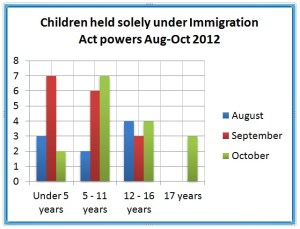
Table 1. (Home Office, 2012)
Every month, I receive the immigration statistics from the Home Office and am repeatedly drawn to the statistics on children detained under Immigration Act powers in immigration removal centres (IRC) such as Tinsley House a facility located on the perimeter road facing the main runway of Gatwick Airport.
These children are not in accommodation geared up for families. Some are detained in locations that originally were built to the same specification as Category B prison; cells as bedrooms and concrete yards as gardens are not environments for children.
I am reminded of the illustrations drawn by children who had experienced life in an immigration removal centre (Burnett, 2010).
The Coalition government had pledged to bring an end to the detention of children for immigration purposes back in May 2010 but clearly this has not been treated with any degree of priority.
How much longer will this continue?
References
Burnett, J. (2010) ‘Repatriation medicine’ Criminal Justice Matters. 82. December. pp. 26-28.
Home Office (2012) Immigration Statistics July – September. [Online]. Available at < http://www.homeoffice.gov.uk/publications/science-research-statistics/research-statistics/immigration-asylum-research/immigration-q3-2012/> [accessed 29 November 2012].
Why should we concentrate on making the prison system cheaper not smaller, Mr Grayling?
A theme that is close to my heart is the reduction of the prison population, unfortunately the Government has other ideas. Chris Grayling MP in his speech to the Centre for Social Justice on 20th November stated the five priorities that he has given to the Ministry of Justice for the remainder of this Parliament, priority three included
“We have to focus on making the prison system cheaper not smaller”.
In addition Jeremy Wright MP at the AGM for the Howard League for Penal Reform on Wednesday 21st November 2012 said that the Government has no plans to reduce the prison population and it is the sentencers not the Government who are responsible for the prison population as it stands today.
Maybe we should look at simplifying the Criminal Justice System by reviewing historical scholars. In On Crimes and Punishment and Other Writings (1764), Cesare Beccaria critically challenges the current thinking of the 18th Century by putting forward his theory of Criminal Justice from an enlightened perspective as he himself searched for truth (Bellamy, 1995). He concluded that:
“In order that punishment should not be an act of violence perpetrated by one or many upon a private citizen, it is essential that it should be public, speedy, necessary, the minimum possible in the given circumstances, proportionate to the crime, and determined by the law”
What is clear is that the objectives of sentencing have changed over time, with different priorities being given by different policy makers. The criminal justice system has been reduced to a managerial system rather than improving on a punitive system. In other words, policy makers are more interested in assuring that the system works than assuring that the punishment works, which totally misses the point of crime and punishment as Beccaria saw it.
References
Bellamy, R. (ed.) (1995) Beccaria: On Crimes and Punishments and Other Writings. Cambridge: Cambridge University Press.
Related Links
‘Prisons: cheaper not smaller’ by Richard Garside. UK Justice Policy Review. 20 Nov 2012. click here
‘An open letter to Chris Grayling from an ‘old lag’ ‘Downsizing Criminal Justice. 28 Nov 2012. click here
 The Criminal Justice Blog