Home » Posts tagged 'IMB'
Tag Archives: IMB

Never be afraid to speak the truth to those in power*
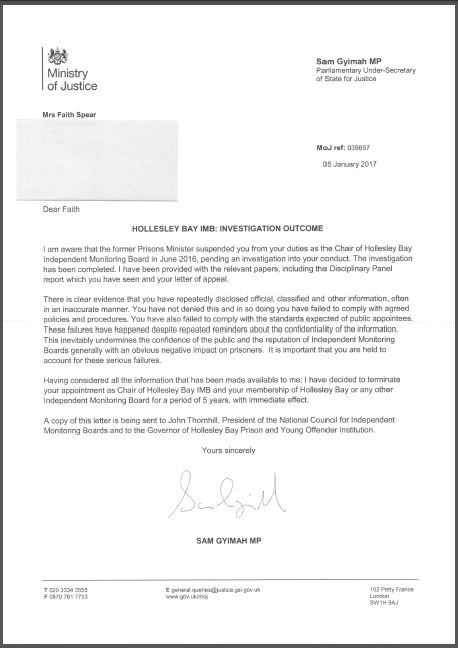
A letter from the Ministry of Justice landed on my doormat yesterday morning. I was expecting it and with trepidation it was opened and carefully read.
To download and read, please click here.
I shed a few tears. And then I replied!
To download and read, please click here.

9 months after I wrote an article in The Prisons Handbook 2016 the curtain has fallen on my time in the Independent Monitoring Board (IMB). I am dismissed with immediate effect for a period of 5 years.
I kept my word and saw this sorry episode through to the end. There are no winners or losers.
What I now know through personal experience is that if you level criticism about the Criminal Justice System you can guarantee the weight of the system will be upon you. In my case I faced an investigation by the MoJ that was biased to begin with and full of lies.
Paperwork from the start shows this was a deliberate and prejudicial character assassination designed to shut me up in the hope I would give up go away and to discredit me. I have the evidence and so does the MoJ but they have been selective with it.
But I am stronger than that and I have done my best to stand up to everything that has been thrown at me. Reports that I have read about myself written by the MoJ bear no resemblance to me and yet they have been used against me and yes, the Prisons Minister Sam Gyimah has taken them on board and made his decision.
I cannot change this decision. I have appealed and my voice may have been ignored by him but my voice has traveled far.
So, what now?
I am already on the record as saying “The Ministry of Justice has left me with no alternative than to take more robust action in the public interest” and that is exactly what I will do.
This doesn’t mean I will retaliate and seek retribution. However, since I am not gagged anymore I could reveal considerably more information about dishonesty and real misconduct I have encountered.
The IMB Secretariat, current and former IMB members, MoJ wonks and HMP/YOI Hollesley Bay staff including Governors should reflect carefully on their own behaviour before shouting down a volunteer monitor who decides to write about what they have seen and heard.
They chose to make it personal whereas I wrote about the issues.
Throughout this last year, I have kept my integrity and I have been truthful about what happened. I have never sought to elevate myself.
I am passionate about the issues I have raised for prison reform and I have no intention on being quiet or giving up, no not for one moment.
As many readers will know my motto has become #notshuttingup #notgoingaway and that is how it will continue.
Our prisons are in crisis and reform is taking too long.
~
* acknowledgements to Sir Ivan Rogers‘ email

Prison reform: paying the price
Well D-Day is rapidly approaching for me, the day the Ministry of Justice and the Independent Monitoring Board decide on my future not just as a Chairman but as a member of the IMB as I have to attend a Disciplinary Hearing.
 How it got to this is a long story.
In a nutshell, I spoke out for Prison Reform and IMB reform in an article in the Prisons Handbook 2016 entitled “Whistleblower without a whistle” and suffered reprisals for it.
Have you seen the state of prisons lately?
Have you heard about the state of prisons lately?
Too much is swept under the carpet pretending it’s not there.
But I put my head above the parapet, I made a personal stand.
The President of the IMB National Council, John Thornhill obtained a copy of my article “Whistle blower without a whistle” without permission before it went to print and sent it to the whole of the IMB organisation with his comments.
That action meant that any investigation would be prejudicial and it was!
I have had Prison Governors, prison staff, prisoners, ex-prisoners, prison reformers, those working in the justice sector, those working in the legal profession, leading academics, criminologists both here and abroad, friends and family standing up for me.
Are we all wrong?
Of course not!
But its like I have opened a can of worms which can’t be closed.
As I complete my final preparations for tomorrow I decided to bake a cake. It was my Nanna’s answer to everything as a child, comforting home-made cake.
I have upset the status-quo, I have revealed devious behaviour of other IMB members, I have spoken out about the nonsense in two MoJ investigations. I have had to endure bullying, intimidation, being ostracised, I have lost sleep and haven’t eaten properly, and I have been suspended from a role I loved. I have battled for over six months to clear my name and show what really is going on behind the scenes.
It has of course affected my family, yet my husband Joseph has been my rock.
I have a good idea of the outcome tomorrow at the Disciplinary Hearing, I’m not naive or stupid. But I think the MoJ and the IMB need to take a long hard look at their behaviour.
But whatever the outcome I will not be silenced and I will not go away.
If you are passionate enough about something then that cause which owns you can never be taken away from you.
The MoJ and the IMB can never say “Faith Spear who is she?”
This is not the end, it is the beginning…
P.S.
Even at the last-minute a former IMB member has sent in a pathetic plea to discredit me, obviously he is worried as now I have my chance to talk. Well DS your bullying, intimidation and manipulation I have endured for a couple of years is over!
And DH, your worries that I would let people know what you have said, haha now its my turn. You said you were on my side until I read out my statement and you told me it would have helped if I had cried. How dare you, as a woman I will not be intimidated by you. The fact you said you don’t deal in black and white only grey areas is perfect for the role as an IMB monitor in a prison, yet again an example of the farcical recruitment process.
CS, we worked well together but you followed your head and not your heart. You listened to a manipulative member and along with BM who I had much respect for started a damning campaign against me. Your friendship is a loss to me.
GR, you are a man with integrity and heart
Its time to build new bridges

The paralysis of too many priorities.
Sat immediately behind the new Secretary of State at the Justice Select Committee (@CommonsJustice) on 07 September, I registered a lot of awkwardness that was beyond mere nervousness felt by many a new joiner.
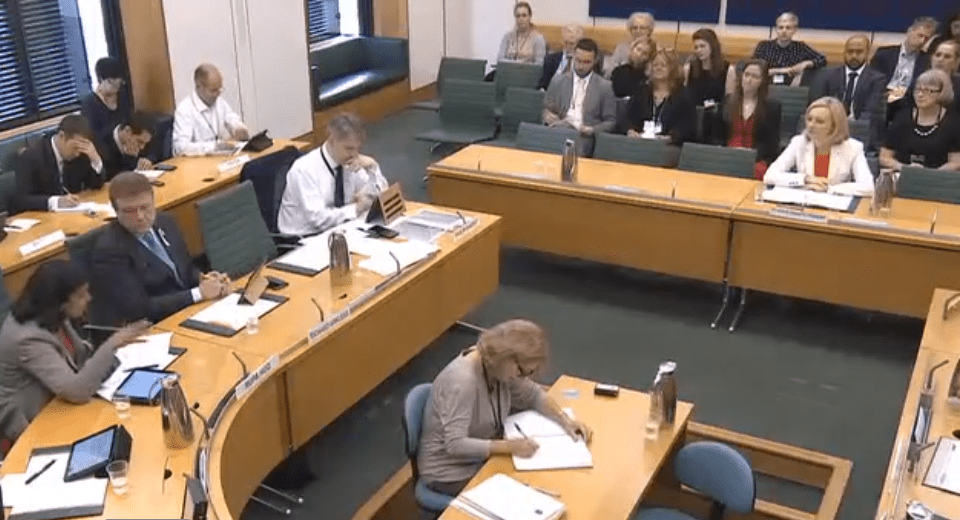
Thatcher Room, 07 Sept 2016
Just like Gove’s debut in front of the same Committee where he rattled on about “we’re reviewing it” (yes, I was there for that one too), Liz Truss (@trussliz) talked largely about the formulating of “plans” but on the day said nothing about tangible actions she will take.
How many more reviews do we need?
Has Truss inherited a poisoned chalice passed from one SoS to the next? Her department has a huge accumulated mess to sort out and doesn’t know what to do about it. Is she wondering what to tackle first? The paralysis of too many priorities?
Her critics say she’s doing things wrong. Look at it for yourself and you’ll see some of the priorities she is confronted with:
- Extremism and radicalisation in prison
- Violence against other offenders and against prison staff
- Over population
- Under staffing of prisons
- Death in custody
- Drugs and drones
- Education and purposeful activity
- Resettlement and homelessness on release
You would think her advisors would know what the order of priorities are. They don’t, or if they do, they obviously prefer the relative safety of “talking shop” over the tough task of taking concrete action on these priorities.
The key question people are asking is has she actually got the shoulders for the job; she has the high office and gilded robe of the Lord Chancellor but does she have the support of those working within the criminal justice system?
Soon after her appointment from Defra to Ministry of Justice, Liz Truss paid token visits to two prisons but cannot be expected to become an instant expert on the prison system.
What other mess does the SoS need to deal with?
The system of prison monitoring is in a mess. The IMB Secretariat is in utter disarray. They say they have policies and procedures but don’t always follow them themselves. For the most part, IMBs are doing their own thing. There’s no real accountability anymore. It’s a disgrace and it’s deplorable that it’s been allowed to get as bad as it has.

Faith Spear
For my critique of prison reform and Independent Monitor Boards, I’ve been put through two MOJ investigations. Each one takes away a little piece of me. But for me it’s always been about the issues. That’s why they can’t and won’t shut me up.
The message of prison reform has become urgent and has to get to the top. If no one else will step up and if it falls to me to take it then so be it.
No accountability anymore? Give me an example.
You want an example? Here’s one of many: At HMP Garth, the IMB Chair issued a Notice To Prisoners 048/2016 dated May 2016 without the authority to do so, and apparently without the Board agreeing it. The Chair acted unilaterally outside of governance. I found out about it because a copy of that prison notice was sent to me as it happened to be about the article “Whistle Blower Without a Whistle” that I’d written for The Prison Handbook 2016 that the IMB Garth Chair was pin-pointing, (accusing me of a “rant” whilst both his prison notice and covering letter were dripping with distain).
I’m still standing by all I said in my Whistleblower article even though writing it has been at a high personal cost. In all candour, any pride I may have had in writing it has been completely sucked away from me. It’s back to the bare metal. The inconvenient truth of what I wrote remains. Readers will find that my main themes also feature prominently in the findings of the report by Karen Page Associates, commissioned by the MOJ at a cost to the taxpayer of £18,500.
An invite I received from Brian Guthrie to the forthcoming AGM of Association of Members of IMB says it all. It read:
“From the Chair Christopher Padfield
AMIMB – the immediate future
IMB needs a voice. We believe that without AMIMB this voice will not be heard. AMIMB intends to raise its voice, but needs the support of our members.
An outline plan for the immediate future of AMIMB will be put up for discussion at the forthcoming AGM (11 October 2016 at 2 Temple Place). It aims to respond both to the main needs and opportunities, and to the practicalities of the current situation.The greatest need, as the executive committee of the AMIMB sees it, is to achieve a public voice for Independent Monitoring Boards – to let the British public know what we, as monitors, think about prison and immigration detention policy and practice in England and Wales and the impact this has on the men, women and children detained; to achieve some public recognition for the role of IMBs; in short to speak out about what we hear and see. We have urged the National Council to do this itself, but to no avail. In character, the NC propose as their contribution to the Parliamentary Justice Select Committee’s current consultation on Prison Reform, a response to a procedural question: ‘are existing mechanisms for … independent scrutiny of prisons fit for purpose?’ If the NC cannot or will not speak out, AMIMB should.”
Mr Padfield has served as IMB Chairman at HMP Bedford but to my knowledge has never been suspended pending investigation by the Prisons Minister like I was for speaking out on such things.
And therein lays the dilemma: whereas the official line is to encourage monitors to speak out, the reprisals levelled at you when you actually do are still shocking.
Is this what happens to women who use their voice?
People want you to get back in the box.
To shut up.
To go away.
The IMB doesn’t need a makeover; that would only hide most of the systemic problems behind filler and veneer. So rebranding clearly isn’t going to be the answer any more than putting lipstick on a pig.
People who think I want to abolish the IMB have totally misjudged me and the situation. I don’t want to abolish it. Far from it. I want the IMB to perform like it was set up to under OPCAT and to be all it should be as part of our NPM.
The clue is in the name: Independent. Monitoring. Board.
Have you noticed that the MOJ is haemorrhaging people at the moment?
Maybe Liz Truss could use that as an opportunity to enlist the help of those who do give a damn about the conditions in which people are held in custody and who do have a clue about strategies to stem radicalisation in prison, minimise violence, reduce prison over population, have the right staff and staffing levels, reduce death in custody, counter drones and drug misuse, revitalise education and purposeful activity, and last but not least, resettle and house people after their time in custody.
Join the conversation on Twitter @fmspear @trussliz @CommonsJustice #prisons #reform #IMB #AMIMB #SpeakUp
First published 17 Sept 2016.
Edited 18 Sept 2016.
~

More chance of finding a PokemonGO than finding transparency at IMB and MOJ ?
Yesterday, Friday 15 July, I was emailed by Saffron Clackson, Head of the IMB Secretariat with a letter from her to me explaining my right to information under two separate requests: the Data Protection Act 1998 (DPA) and the Freedom of Information Act 2000 (FOIA). She explained what was being made available to me today was under the Data Protection Act.
Attached were 4 separate pdfs containing the “submission” by her department, the IMB Secretariat, to the Prisons Minister Andrew Selous, subject: Conduct of Chair at Hollesley Bay IMB, which resulted in Mr Selous signing a letter (dated 26 May 2016) to suspend me as Chair of IMB Hollesley Bay pending investigation.
Initially I felt encouraged by this trickle of information after my countless requests for it. That was until I opened each pdf in turn only to discover HEAVILY REDACTED pages.
DOWNLOAD THE COMBINED PDF Faith Spear DPA response 15 July 2016 pp.1-4

![Faith Spear DPA response 15 July 2016 page 2 [screenshot]](https://i0.wp.com/thecriminaljusticeblog.com/wp-content/uploads/2016/07/faith-spear-dpa-response-15-july-2016-page-2-screenshot.png?w=476&h=476&crop=1&ssl=1 "Faith Spear DPA response 15 July 2016 page 2 [screenshot]")
![Faith Spear DPA response 15 July 2016 page 3 [screenshot]](https://i0.wp.com/thecriminaljusticeblog.com/wp-content/uploads/2016/07/faith-spear-dpa-response-15-july-2016-page-3-screenshot.png?w=476&h=476&crop=1&ssl=1 "Faith Spear DPA response 15 July 2016 page 3 [screenshot]")
![Faith Spear DPA response 15 July 2016 page 4 [screenshot]](https://i0.wp.com/thecriminaljusticeblog.com/wp-content/uploads/2016/07/faith-spear-dpa-response-15-july-2016-page-4-screenshot.png?w=476&h=476&crop=1&ssl=1 "Faith Spear DPA response 15 July 2016 page 4 [screenshot]")
I have little commentary to make at this time other than to say that I’ve been kept waiting six weeks for this. It could have been made available in under 48 hours unredacted.
Those who have been following this situation will appreciate how pathetic a response this truly is. Barristers may take a different view.
Those unfamiliar with this situation will find all this equally bizarre.
What possible use can be made of documents such as these which have been, at the taxpayer’s expense, so heavily redacted by expensive lawyers working as salaried civil servants at the MOJ.
At a time when our prisons are under so many challenges, why on earth don’t they reinstate Faith Spear and let her get back to her work as a monitor whilst all this gets sorted out?
Tend to agree. I do want to be reinstated. I’ve said so several times. Based on my direct experience, Hollesley Bay is very likely not being properly monitored at this time. The next Board meeting is scheduled to take place next Tuesday, 19 July but it currently hasn’t sufficient numbers of inducted and trained Board members to even make a quorum let alone to chair a Board meeting.
I wrote to Dr Thérèse Coffey, MP for Suffolk Coastal (in whose constituency Hollesley Bay is located) about these serious concerns; she’s been kind enough to acknowledge and to suggest I next contact my own MP.
Smokescreen
For me, being sent heavily redacted pages simply represents yet another example of how the MOJ play for time and try to grind you down in the hope you will shut up, lose interest and go away.
And because I’ve learned the MOJ is logging all my social media content, please note, for the record, I have absolutely no intention of shutting up, of losing interest or of going away.
The suspension, obstructions and kerfuffle serves as a very convenient smokescreen for the IMB Secret-ariat (sic), trying desperately to insulate itself from the critique I included in my article “Whistleblower Without a Whistle” published in The Prisons Handbook 2016.
As for the MOJ, it has totally lost sight of the issues I raised in that article because the Secretariat has done such an neat little stitch-up job on me and had obviously bamboozled the Prisons Minister into “shooting the messenger”; I doubt very much he even knows my name let alone why he suspended me from HBIMB.
Honey, I’ve shrunk the facts
Turning to the heavily redacted pages, I can just about recognise the words from my past colleagues at HBIMB whose venom towards me knows no bounds. For example, on the the top of page 3 it states:
“Overall, there are reasonable grounds to suspect that Faith may have committed “gross misconduct” according IMB complaints policy.”
Really, what do they hope to gain in claiming that? Could it be they wanted to deflect the public’s attention and the press’ scrutiny away from their own dishonesty?
Most of them resigned soon afterwards anyway, thinking that in so doing they would be absolving themselves of responsibility for their own complicity whilst in public office.
That’s where any gross misconduct is to be found, right there.
Unlike them, I have done nothing wrong, and certainly did nothing wrong in writing that Whistleblower article; the MOJ conceded that much to the editor of The Prisons Handbook 2016, Mark Leech (@prisonsorguk), in their response to a FOIA request he submitted off his own back.
Bullying
It is very clear now to everyone that neither the IMB Secretariat nor the MOJ takes workplace bullying seriously enough, or at all.
I still haven’t been sent the unredacted report written by MOJ investigator Sandra Marcantonio to the IMB Secretariat.
And I still haven’t been advised of the deliberations of the panel appointed to decide on that report, or the date they meet, or what their names are.
Is it because they feel that I don’t count or I’m not important? Or is it because they don’t want to recognise that workplace bullying occurred for fear of setting a precedent and opening the floodgates to other complaints?
Either way, bullying in prison remains a big issue. A really big issue.
Remember, the bullying I encountered on 19th April 2016 took place inside a prison, in HMP & YOI Hollesley Bay, at an IMB Board Meeting.
Oh and whilst we’re on that subject, unlike every board meeting I chaired, nobody can find any minutes of that meeting.
Independence Day?
Nigel Newcomen CBE, the Prisons and Probations Ombudsman, is well aware of who I am and needs no prompting. On 05 July after he gave oral evidence [watch] to the Justice Select Committee, he spoke with me about a meeting he had with John Thornhill, President of IMB, back in February 2016 questioning whether the IMB monitors if recommendations from the Ombudsman are being followed by prisons (refer to Official record, Q62 from Marie Rimmer MP).
He said he has even perceived a lack of independence in his own department (Official record, Q87 from Chris Elmore MP), underlining once again in my opinion that perhaps the biggest issue confronting the in-coming Secretary of State for Justice, Elizabeth Truss (@trussliz), is that the MOJ has everyone involved in prisons in a tight headlock, resisting reforms.
So what hope do I have of changing anything, or of being reinstated, or of my call for prisons reform even being heard?
Watch this space.
The situation continues.
Photo: Ministry of Justice MOJ 102 Petty France by Steph Gray via flickr
Pokémon Go is a free-to-play location-based augmented reality mobile game developed by Niantic and published by The Pokémon Company. It was released in July 2016 for iOS and Android devices.
~

I used to be ‘IN’ but now I’m ‘OUT’
An antidote to the EU Referendum.
The nation goes to the polls today to determine whether we Leave or Remain, but that’s all I’m saying about the European Referendum. You can think of this post as an antidote to all the drivel you’ve heard, from both sides of the debate it has to be said. The claims, the counterclaims and the half-truths we’ve all heard uttered sometimes with spectacular bravado.
There’s a micro- In or Out conundrum going on over here in the East of England, coincidentally not far from the most easterly geographical point of the UK to continental Europe.
Let’s talk about In or Out of prison.

“I will not stop. I will not be silenced. I want to be reinstated”
I used to be ‘IN’
There’s truth in the well-used idiom “with power comes responsibility”. The right of access all areas within a prison is one of those situations to which this applies. I never took it lightly. Having keys to the prison seems to be a thoroughly abstract concept for many, but as a public official appointed by the Secretary of State for Justice to monitor that’s exactly what you have. You’re appointed to be the eyes and the ears. And to record what you see and what you hear around the prison you monitor.
This isn’t some fanciful hobby for those with a lot of time on their hands. Long the brunt of jibes about beige Volvos, tweed twin set and pearls, being an independent monitor should not be a country club. This is the sharp end of monitoring how a nation treats those in its custody. And it requires people who have the big picture as well as an eagle eye for the detail. I’ve seen a lot and I’ve heard a lot. And as a monitor I only write what I see and what I hear. No spin and no opinion. Just the facts.
Remembering how thrilled I was to be accepted onto the Independent Monitoring Board (IMB) when I first started. I absorbed the training, passed induction and quickly found my feet performing monitoring visits as part of the team rota. As a member, I derived considerable satisfaction from thinking that what I was doing was making a difference. It had to make a difference; there was no salary for the work so the only payback was the job satisfaction. And make no mistake, monitoring done properly is real work.
As a Vice-Chair, I served a frequently absent Chairman as if I were their very own personal assistant. It felt like it at times, especially the Saturday evening calls to my home number or the Sunday-for-Monday interruptions. My network became the area Chairs in other prisons. My responsibilities expanded and I took it all on board, in part relishing the challenge. Yet there were some niggles creeping in, as I was required to shoulder the thick end of the workload without being empowered with the authority to do much about any of it.
On one occasion I recall being put firmly back on my box by the then Chairman. “How dare you say you’re the acting Chair. You’re my Vice-Chair, not the acting Chair” they said, speaking down at me like an intolerant owner upbraiding a truanting cocker spaniel. Bit rich really, given that the then Chairman was the one for whom I had covered no less than 162 days absence in a single calendar year. Yes I kept a record! (as I told you, monitors record exactly what they see and what they hear, and tend to notice when the Chair is away for 44% of the time).
Believing the best and hoping it wouldn’t last, I went along with it. I wouldn’t go along with it now. Nor will I ever again in the future. I don’t recall many, if any, occasions I felt truly supported by them.
In retrospect, it’s a bit sad really, don’t you think?
When the time came, I embraced the opportunity to serve the Board as Chairman only after I was sure I was ready to fulfil the role and could gather dependable people around me. These positions are never ones to grasp at.
A colleague agreed that if I was willing to serve as Chairman then they would step up as Vice-Chair. Despite commitments running their own business the Vice-Chair was incredibly supportive in every way the past Chair wasn’t able to be. Or didn’t wish to be. And so it was from January 2016, following nominations the previous October, we set to work and gelled like dream team.
And together we worked hard to build the team around us. Sacrificing time from other priorities to come in to the prison often when it was inconvenient, why, because it just had to be done. These are the sort of things they don’t tell you about when they pitch volunteering to you. But we did it anyway, and cheerfully for the most part; it’s what you make if it.
Mentoring volunteers was very enjoyable but it took on dimensions I never thought would be part of the remit, for example, teaching an IMB member how to use a computer mouse for the first time in their lives, let alone the depths of Quantum, the NOMS secure intranet (Gawd bless it) or the CJSM email system (don’t get me started on that one).
More than matching time volunteered on monitoring with time volunteered on Chairman’s responsibilities (yes, even Chairs should perform monitoring visits), I expanded on my knowledge of the criminal justice system through taking up invitations to visit other prisons. I wanted to learn as much as I could about every category of prison and see for myself the conditions for those held in custody in those places, and better understand what monitoring looked like for them.

Grimond Room, 16 March 2016
Additionally, to learn more on policy, I became a frequent visitor at the House of Commons Select Committee on Justice (Twitter @CommonsJustice) where I could see, hear and meet those giving oral evidence. I learned to fine tune my own sense of scrutiny, making less hasty judgements and leaping to conclusions without having first studied the facts.
I read widely on the subject of justice, even calling into The Institute of Criminology and the Cambridge University Library on occasions to check for myself the validity of references being cited in some of the material I was consuming. (The Tea Room there is as much an eye opener as the Rare Books section; you get to talk and make friends with rather influential and interesting people over a cuppa).
In short, I was fortunate to gain a well-informed view of the big picture and a well-grounded understanding of how that applied to specific areas, including monitoring.
As my understanding grew, very obvious holes in the system began to make themselves clear to me, making them compelling enough for me not to look the other way.
As I monitored, I looked and listened. As I worked, I saw. As I visited, I heard. As I studied, I realised. And as I realised, I knew – I knew that what I was seeing and hearing and learning was not all it is cracked up to be.
So I wrote, firstly about topics that caught my attention and my responses to them and then about good practice and about areas for improvement. Whereas these first appeared only in blog format now my opinions have been published in The Prisons Handbook 2016, the definitive guide to prisons in England and Wales for over 18 years.
Just imagine my amazement when, having gone beyond the call of duty and having delivered all this into a Board I thought I had alongside me, an ambush was set for me on 19 April 2016 for which nothing could have prepared me.
I’ve written before about this awful episode and yes, regardless of what may have been claimed by others, I have had to call it what it was, workplace bullying (remember, as a monitor I only write what I see and what I hear, no spin). Suffice to say it has become a tipping point in more ways than anyone would have anticipated.
But now I’m ‘OUT’
Suspending me pending an MOJ investigation is what the Prisons Minister decided to do when he received a report from The IMB Secretariat about me. I’ve no idea what was in that report; I’ve not been given sight of it and although I’ve asked for a copy, nothing has been forthcoming. Despite what the Minister himself wrote, I have now been told it is not a report, but a submission from The IMB Secretariat, and legislation has been quoted to try and prevent me from seeing it.
Barred from stepping foot on the prison estate without prior appointment and vetting, the system has spat me out. Where once there was free movement anywhere inside, now I’m bouncing off the perimeter unable to enter let alone monitor.
The story is not quite finished and I’m not leaving it there.
There now seems to a “war of attrition” but I’m not playing those games. Information about me is being withheld despite my requesting unredacted copies of it from the Minister and the MOJ, and they are trying to keep me in the dark.
I want to be reinstated.
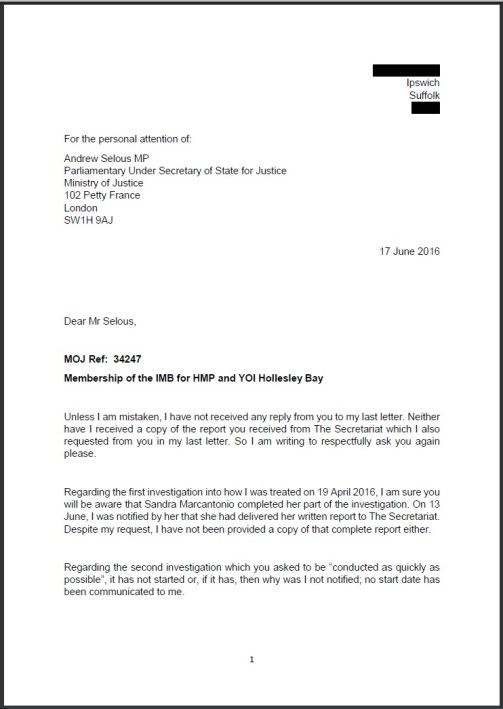
The second letter went in to the Prisons Minister on 17 June. I’ve asked the Minister to reinstate me.
But I’ve also asked the Prisons Minister eleven questions which you the public have a right to hear from him on. Refer to page 2 and page 3. If he doesn’t reply to me, perhaps he will reply to you. Write to him and press him for answers on what’s happening with Hollesley Bay monitoring. Don’t accept “stock answers” copied and pasted into pre-templated letters; demand the facts in a personal letter from the Minister not his staff.
DOWNLOAD : Letter Spear to Selous 17 Jun 2016 public
It’s not about me. It’s always been about the issues
And the issues I raised in my original article published in The Prisons Handbook 2016 have never been disputed by the Minister or by the Secretary of State, yet seem to be enough to turn my fellow board members hard-fast against me, to raise the hackles in the IMB Secret-ariat (sic) and to cause a thunder storm inside the MOJ.
Of course I do want the personal cost I’ve paid, and that my family has paid with me since 19 April, to amount to something.
I don’t want to be a name that meant something to a handful of people once then was quickly forgotten or surreptitiously ‘air-brushed’ from record.
Being reinstated would mean the Board can get on with the vital job of monitoring, becoming a watchdog again, and being in the heart of the action to realise prison reform.
IN CASE OF EMERGENCY
BREAK GLASS
In all candour, I’m so fearful that the net result of my speaking out in good faith will leave me at a massive disadvantage and consequently damage any prospects I might have had to find employment in anything related to the justice sector. Outside again, with a reputation on a par with the zika virus and with my self-esteem around my ankles tripping me up when trying to move forwards from here.
But my biggest fear of all is that nothing will change for those already in the sector.
Not calling out issues means no change for salaried civil servants spending immensely valuable time just going through the motions at taxpayers’ expense.
Keeping quiet on issues means no change for prison Governors with the Inspectorate breathing down their neck every so often without monitors there to provide real checks and balances.
Not calling out issues means no change for members of IMBs everywhere whose well-meaning sense of duty and willingness to volunteer is privately despised and whose voice is muffled by a dysfunctional Secretariat which is anything but independent.
Keeping quiet on issues means no changes to a pointless National Council whose nameless and faceless structure smacks more of a secret society with a presidency that’s widely regarded as irrelevant and a President even the public regard as yesterday’s man.
And whilst all that turbulence goes on inside the MOJ, not calling out issues means there’s no change for people in custody. In paying their “debt to society” through loss of liberty they also pay perhaps a higher price than most people imagine, banged up for 23 hours a day in institutions which for the most part are understaffed, unfunded and underperforming.
Penal facilities which neither correct, rehabilitate nor reduce reoffending are, in my considered opinion, facilities that should be the most closely monitored facilities of all.
I believe in monitoring.
And I want to be reinstated.
I want to be ‘IN’ all over again.
IEP regime and books for prisoners
The latest debate is focused on the stopping of prisoners from receiving books from outside the prison estate. This is all part of the Incentives, Earnings and Privileges scheme which was revised in November 2013.
An on-line petition, through twitter has been initiated to call on the justice minister Chris Grayling to immediately reexamine the latest rules which restrict access to material possessions that are sent to prisoners.
This can be seen as a backward looking retributive action and far removed from the rehabilitation revolution.
Frances Crook, chief executive of the Howard League for Penal Reform, communicated that this is “… part of an increasingly irrational punishment regime orchestrated by Chris Grayling that grabs headlines but restricts education or rehabilitation”.
Surely books play a vital role in the education of prisoners and the rehabilitation process, there should be an increase not decrease in prisoners access to items that will aid rehabilitation. This debate leads to the problem of too much non-purposeful activity in prison and too much time locked up in cells. Even the Home Affairs Committee (2005) picked up on this many years ago and the inconsistency of provision from prison to prison. At this rate we will be looking at the rehabilitation of prisoners from the effects of imprisonment!
Prisoners are allowed up to 12 books in their cell; however access to prison libraries can be varied depending on prison, sentence and behaviour. Being locked up in a cell most of the day having a television is not always the best way to pass the time. However, due to the IEP scheme, books are seen as a privilege and are restricted, only books outside of the prison library have to be bought from their meagre wages. With all the cuts, prison libraries are not exempt and stock can be limited. But books are important when you realise that many prisoners have low literacy skills, so can the ban on books be justified? Education is not the same throughout the prison estate and access on online courses even more inconsistent.
According to Haywood (2006), “…lifelong education slows down the revolving door of incarceration and reincarceration”, so why bring in any reforms that will counteract this?
This is a form of punishment, but where is the proportionality or is that old hat?
The effects of the changes in the IEP’s are being tracked by the Independent Monitoring Board (IMB), but these may not be seen for some months to come.
There has to be a justification for the decisions made where prisoners are concerned and quite frankly they don’t seem to add up, is this going beyond punishment?
Haywood, D. (2006) ‘Higher barriers: ex-prisoners and university admissions’, in S. Taylor (ed) Prison (er) Education (2nd edn). London: Forum on Prisoner Education.
Home Affairs Committee (2005) Rehabilitation of Prisoners First Report of Session, 2004-5. Volume I. London: HMSO.
http://downsizingcriminaljustice.files.wordpress.com/2014/02/rjn-iep-feb-2014.pdf
 The Criminal Justice Blog