
Authors
 faithspear
Let’s talk
New measures are being put in place by the government to support separating couples at the time of year when the number of people considering separation and divorce is at its peak.
The Government plans to spend an additional £10 million this year on legal aid for mediation, taking the total spent to £25 million, and want to ensure that couples who decide to separate give consideration to using the process. In recent years a greater number of people have been successfully using mediation – where they are helped to agree the issues between themselves rather than argue it out through lawyers with a judge taking the final decisions http://www.justice.gov.uk/news/features/extra-10-million-for-mediation
According to the Ministry of Justice the average cost of resolving property and financial disputes as a result of separation is in the region of £500 through mediation for a publicly funded client. This can be compared to £4,000 for issues settled through the court system In addition; the average time for a mediated case is 110 days compared to 435 days for non-mediated cases. What a difference!
Family Justice Minister Lord McNally said:
‘The benefits of mediation are clear – it is quicker, cheaper and leads to better outcomes. That is why we are introducing new laws – which will require couples to attend a mediation information assessment meeting first – to find out more and consider whether it is suitable for them.”
https://www.gov.uk/government/news/new-mediation-laws-to-help-separating-couples
Prisoners Huhne and Pryce: does vengeance pay?
We have been bombarded with a daily dose of this pair; I almost feel I know them. The media have whipped up this case to such a crescendo and then finally we got a verdict, a sentence and ultimately a tragedy. To keep a lie for ten years then to have it splattered over the front pages as your ex tries to get revenge, then an attempt to get the case thrown out, but in so doing both parties are convicted of perverting the course of justice.
This is not just about a family torn apart or the demise of an MP, but a battle with the justice system. Do we think justice has been done? I believe justice should restore and not just criminalize, it will be interesting to see what happens here.
According to Prime Minister David Cameron: “It’s a reminder that no-one, however high and mighty, is out of the reach of the justice system.”
The rise and fall of the prison population!
Prison population figures continue to fluctuate. The latest figures show an increase of 80 in the last week, an increase of almost 800 since the beginning of the year yet a decrease of 3,159 in the last 12 months.
I have just read an interesting report recently published in France on ways to fight against prison overcrowding. Two important points mentioned were:
- Consider imprisonment as ultima ratio in criminal matters
- Use, if necessary, a system of numerus clausus to solve prison overcrowding until 2017, then prevent its reappearance
I wonder if Chris Grayling has any thoughts on this?
Raimbourg, D and Huyghe, S (2013) Ways to fight against prison overcrowding. Report of 23 January 2013. [Online]. Available at
http://www.cepprobation.org/uploaded_files/France_Report-on-Prison-Overcrowding-2013.pdf [accessed] 26 February 2013
Prison a holiday camp?
There is a lot of talk about prison being like a holiday camp. Working within a prison for the last year I can honestly say it is certainly not a holiday camp that I would like to stay at. Holiday evokes images of relaxing, happy smiling faces without a care in the world. I certainly do not get that picture when I am talking to any of the prisoners. Many are resigned to their custodial sentence, but others are angry or frustrated. Nonetheless the main concern I hear is what will happen to them after release; a few pounds in their pocket and off they go. So what’s happening with mentoring? Well according to the Guardian:
“The justice secretary said he could not simply continue with the existing pilot schemes at Peterborough and Doncaster prisons, which are testing the private and voluntary sector provision of “through the gate” rehabilitation and mentoring services. He argued that it would take “much of the rest of the decade” before they would provide a definitive conclusion”
Released prisoners to be banned from moving around country (2013) The Guardian 27 February 2013. [Online]. Available at
http://www.guardian.co.uk/society/2013/feb/27/released-prisoners-banned-moving-country?CMP=twt_gu [accessed 27 February 2013].
Retribution or Restitution
Now that shamed MP Chris Huhne has submitted a guilty plea it is up to the judge to decide on sentencing appropriate to the charge Huhne faces of perverting the course of justice. Speculation is rife that he faces prison for certain, not the first MP to do so; MP’s were handed down prison terms for their part in the expenses scandal. But what do you think the judge should go for? Does Huhne necessarily deserve a custodial sentence or could the judge opt for some form of community sentencing combined perhaps with a restorative justice element?
According to the Telegraph, Mr Justice Sweeney told Huhne he should “have no illusions whatsoever” about the type of sentence he is likely to receive. The maximum penalty for the offence is life imprisonment.
Mr Justice Sweeney faces a perfect illustration of the pressure that many judges come under – a sentence that benefits the crime, in proportion and as short as possible verses all of the above plus an element of deterrent or setting an example for others.
In my opinion Chris Huhe should not be made an example just by virtue of the fact he is an MP and has held a high profile position in the Government. Surely the judge should disregard is job title in the same way that people not in the public eye. Otherwise we are descending into the “court of public opinion”.
This of course begs the question of the role that restorative justice could play if adopted into the mainstream of the criminal justice system of England and Wales. Time will only tell if members of the judiciary will have the courage to use it as part of their toolbox when determining appropriate sentencing.
Retribution or restitution what are we really seeking here?
Chris Huhne quits as he faces jail after pleading guilty to perverting course of justice (2013) The Telegraph 05 February 2013. [Online]. Available at http://www.telegraph.co.uk/news/politics/liberaldemocrats/9847152/Chris-Huhne-quits-as-he-faces-jail-after-pleading-guilty-to-perverting-course-of-justice.html [accessed] 05 February 2013.
Photo: The Telegraph
Managing offenders?
Managing seems to be a very popular word at the moment, especially where offenders are concerned. A clear example is the latest Transforming Rehabilitation: A revolution in the way we manage offenders, a consultation paper detailing the Government’s proposals for reforming the delivery of offender services. This paper is available to download at: https://consult.justice.gov.uk/digital-communications/transforming-rehabilitation. The period of consultation runs from 9th Jan to 22nd Feb 2013.
Page 13 is very apt:
“Successful bidders will be responsible for delivering requirements of community orders or licence conditions. They will also be incentivised through payment by results to tackle offenders’ life management problems and reduce reoffending. For offenders leaving prison, providers should work with them ‘through the prison gate’, engaging them before their release into the community and maintaining continuous support. This should be linked with the important role that prisons play in the rehabilitation of offenders and in reducing their risk of harm, including efforts to increase the number of prisoners working while in custody.”
To achieve this successfully will involve an incredible amount of resources not just in terms of money but would need an army of volunteers. In a period of cut backs voluntary organisations are already stretched whilst private companies are focused on making money!
According to the East Anglian Daily Times up to 20% of prisoners in HMP Highpoint are underemployed. This amounts to around 260 prisoners. However, Andrew Neilson, Howard League for Penal Reform, stated “It is important that prisoners are engaged in purposeful activity, but too many at Highpoint are underemployed, meaning they are unlikely to develop skills that will be useful after their release”. And the cycle continues!
http://www.eadt.co.uk/news/suffolk_fears_raised_over_hmp_highpoint_inspection_1_1793976
Steady on!
According to the Guardian, the justice secretary, Chris Grayling, has admitted his plans for the wholesale outsourcing of the probation service will not lead to an overnight reduction in stubbornly high reoffending rates but said he hoped it would lead to a “steady year-by-year decline”. Is he implying that the problem lies with the Probation Service, or is he throwing out the baby with the bath water? If private companies and voluntary sector organisations are invited to bid for these services then would it be a free for all, or would it be a post code lottery? http://www.guardian.co.uk/society/2013/jan/09/chris-grayling-probation-privatisation-reoffending
Helpful or satisfying: What will victims of crime make of the new Restorative Justice Action Plan?
 In 2001 Lord Justice Auld recommended: ‘The development and implementation of a national strategy to ensure consistent, appropriate and effective use of restorative justice techniques across England and Wales’ (Auld, 2001, p. 391 para.69).
Last month the ‘Restorative Justice Action Plan for the Criminal Justice System’ was launched. “This action plan is a joint commitment to develop a more strategic and coherent approach to the use of restorative justice in England and Wales. It sets out the steps that will be taken to achieve this aim”.
This is an important step, but I have been reflecting on why it has taken more than a decade from Auld’s original recommendation to publication of the action plan itself.
In his ministerial forward Jeremy Wright MP states, “Restorative justice has the potential to break the destructive pattern of behaviour of those that offend by forcing them [italics mine] to confront the full extent of the emotional and physical damage they have caused to their victims”.
True. But why does Wright use the term “forcing them”?
Contrast this with the definition of Restorative Justice taken from Marshall (1999, p. 5) which is one of the most widely quoted. It states:
“A process whereby all the parties with a stake in a particular offence come together to resolve collectively how to deal with the aftermath of the offence and its implications for the future”
Earlier in his ministerial forward, Wright says “The benefits of restorative justice are well known by those working within the sector. 85% of victims who go through restorative justice conferences find it helpful [italics mine]”.
Is the best criteria to evaluate restorative justice as to whether it was “helpful” or not? I guess it depends of what is meant by helpful.
This reminds me of Andrew von Hirsh’s comments (Von Hirsh et al, 2003) when he observed participant satisfaction [italics mine] as being a criteria used to evaluate Restorative Justice, yet there was no explanation as to why “satisfaction” was an appropriate and meaningful criteria.
References:
Auld, Rt. Hon. Lord Justice (2001) Review of the criminal courts in England and Wales: Report. London: The Stationery Office.
Marshall, T. (1999) Restorative Justice: An Overview. London: Home Office Research, Development & Statistics Directorate.
Von Hirsch, A., Ashworth, A. and Shearing, C. (2003) ‘Specifying aims and limits for restorative justice: a “making amends” model?, in Von Hirsch, A. Roberts, J., Bottoms, A. E., Roach, K. and Schiff, M. (eds.) Restorative Justice and Criminal Justice: Competing of Reconcilable Paradigms? Oxford: Hart.
How much longer will this continue? Children detained in UK immigration removal centres
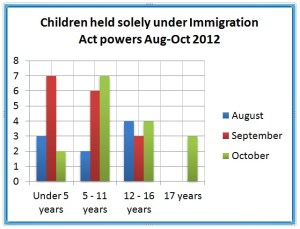
Table 1. (Home Office, 2012)
Every month, I receive the immigration statistics from the Home Office and am repeatedly drawn to the statistics on children detained under Immigration Act powers in immigration removal centres (IRC) such as Tinsley House a facility located on the perimeter road facing the main runway of Gatwick Airport.
These children are not in accommodation geared up for families. Some are detained in locations that originally were built to the same specification as Category B prison; cells as bedrooms and concrete yards as gardens are not environments for children.
I am reminded of the illustrations drawn by children who had experienced life in an immigration removal centre (Burnett, 2010).
The Coalition government had pledged to bring an end to the detention of children for immigration purposes back in May 2010 but clearly this has not been treated with any degree of priority.
How much longer will this continue?
References
Burnett, J. (2010) ‘Repatriation medicine’ Criminal Justice Matters. 82. December. pp. 26-28.
Home Office (2012) Immigration Statistics July – September. [Online]. Available at < http://www.homeoffice.gov.uk/publications/science-research-statistics/research-statistics/immigration-asylum-research/immigration-q3-2012/> [accessed 29 November 2012].
Why should we concentrate on making the prison system cheaper not smaller, Mr Grayling?
A theme that is close to my heart is the reduction of the prison population, unfortunately the Government has other ideas. Chris Grayling MP in his speech to the Centre for Social Justice on 20th November stated the five priorities that he has given to the Ministry of Justice for the remainder of this Parliament, priority three included
“We have to focus on making the prison system cheaper not smaller”.
In addition Jeremy Wright MP at the AGM for the Howard League for Penal Reform on Wednesday 21st November 2012 said that the Government has no plans to reduce the prison population and it is the sentencers not the Government who are responsible for the prison population as it stands today.
Maybe we should look at simplifying the Criminal Justice System by reviewing historical scholars. In On Crimes and Punishment and Other Writings (1764), Cesare Beccaria critically challenges the current thinking of the 18th Century by putting forward his theory of Criminal Justice from an enlightened perspective as he himself searched for truth (Bellamy, 1995). He concluded that:
“In order that punishment should not be an act of violence perpetrated by one or many upon a private citizen, it is essential that it should be public, speedy, necessary, the minimum possible in the given circumstances, proportionate to the crime, and determined by the law”
What is clear is that the objectives of sentencing have changed over time, with different priorities being given by different policy makers. The criminal justice system has been reduced to a managerial system rather than improving on a punitive system. In other words, policy makers are more interested in assuring that the system works than assuring that the punishment works, which totally misses the point of crime and punishment as Beccaria saw it.
References
Bellamy, R. (ed.) (1995) Beccaria: On Crimes and Punishments and Other Writings. Cambridge: Cambridge University Press.
Related Links
‘Prisons: cheaper not smaller’ by Richard Garside. UK Justice Policy Review. 20 Nov 2012. click here
‘An open letter to Chris Grayling from an ‘old lag’ ‘Downsizing Criminal Justice. 28 Nov 2012. click here
Latest Posts
-

VIDEO OF LABOUR’S BROKEN PROMISES TO NUCLEAR VETERANS HITS 10M VIEWS
Peter Stefanovic, lawyer and CEO of CAMPAIGN FOR SOCIAL JUSTICE, has produced a shocking video, supporting the nuclear test veterans’ campaign, LABRATS (Legacy of the…
-

Chocolate & Grace: Succeed in the face of adversity
Back in 2017, in The Clink restaurant in HMP Brixton, I had lunch with Chris Moore, the then Chief Executive of The Clink Charity, and…
-

Dichotomy of Lived v Learned Experience
I first stepped foot in a prison in 2010; I was invited to be a community witness for a victim awareness course at HMP/YOI Hollesley…
-

Campaigning Lawyer Calls On Prime Minister To Back Plan Drawn Up By Lord Thomas To End Shocking IPP Scandal In Viral Video
Campaigning Lawyer and CEO of CAMPAIGN FOR SOCIAL JUSTICE Peter Stefanovic – who’s films have been watched hundreds of millions of times online – has…
 The Criminal Justice Blog