
Home » Rory Stewart
Category Archives: Rory Stewart

HMP/YOI Hollesley Bay: should alarm bells be ringing?
We have heard from the Secretary of State for Justice, David Gauke and the Prisons Minister, Rory Stewart that we need to get back to basics where prisons are concerned. HMP/YOI Hollesley Bay is no exception.
Reading through the latest Inspectorate report shows clearly that only 15 of the 30 recommendations from the previous inspection in 2014 have been carried out.
Should alarm bells be ringing?

There are four tests for a healthy prison
- Safety
- Respect
- Purposeful Activity
- Rehabilitation and release planning (previously Resettlement)
Comparing the two latest reports, I noticed that some aspects once regarded as a safety issue are now a respect issue such as basic living conditions and making available a court video link. Probably why the recommendations in that category has fallen from 9 to 4. Looks good on paper but you have to read between the lines.
Four years ago, there were no recommendations for purposeful activity yet this time there are 5. From making sure prisoners get impartial careers advice, to providing detailed and constructive feedback on practical work to help prisoners improve, to ensuring that those engaged in prison industries are able to study and achieve qualifications related to their job. The answer is in the name “Purposeful” activity not just something to pass the long often monotonous days.
Surely these are basics of an open Cat D prison and is HMP/YOI Hollesley Bay failing?
It is worrying that there are many arriving at the prison without an up to date risk and needs assessment. Likewise, is the number of prisoners sent back to closed conditions, approx. 15 per month with some decisions not clearly evidenced.
And yet there are those that are released with little or no sustainable accommodation and this isn’t sufficiently monitored by the CRC’s.
With only one mental health staff, weak public protection procedures and with already 10% presented as medium or high risk to children there needs to be some serious changes before the planned arrival of those convicted of sex offences.
“New prisoners who potentially posed a risk to children were not always promptly assessed, and contact restrictions were not always applied in the interim”
There are so many issues to flag up:
“The anti-bullying representatives’ role was unclear, poorly advertised and lacked formal training”
“The strategic management of equality was less well developed than at the time of the previous inspection. There was no local equality and diversity strategy and the equality action plan was limited. There were no specific consultation groups running for prisoners with protected characteristics, other than the equality action team meeting”
The latest report shows increase in drug misuse with prisoners moving away from new psychoactive substances (NPS) and that cannabis was now the preferred drug. In addition the use of cocaine and steroids was an emerging problem.
Can HMP/YOI Hollesley Bay adapt to the changing needs and problems?
Let’s hope we are not seeing the gradual demise of this prison.
Recommendations 2018 inspection
Safety
- All use of force incidents should be scrutinised by senior staff to ensure that force is only used as a last resort.
- Body-worn cameras should be used during all use of force incidents.
- Risk assessments to determine if a return to closed conditions is necessary should be multidisciplinary and should show sufficient exploration of all relevant factors relating to the risks presented.
- Decisions to use handcuffs should be based on an individual risk assessment. (Repeated recommendation 45)
Respect
- The negative perceptions expressed by some prisoners that a small number of staff were punitive in their approach towards them should be explored and addressed.
- Basic living conditions on the Bosmere unit should be improved to ensure decency, including refurbished and well-maintained showers.
- Prisoners’ views about the quality of the food should be explored in greater depth and, where possible, changes should be made to increase their level of satisfaction.
- The issues with the prison shop should be resolved, so that prisoners receive their correct order.
- A court video link should be available. (Repeated recommendation 3)
- The prison should routinely consult prisoners in the protected groups to ensure that their concerns and needs are identified and, where possible, addressed. (Repeated recommendation 25)
- Managers should consider both local and national equality monitoring data, and address inequitable outcomes.
- Reasonable adjustments for prisoners with disabilities should be swiftly completed. These prisoners should have access to practical support, such as a buddy scheme, which supports them in their day-to-day life at the prison
- There should be a regular health care representative forum to inform service developments and enable collective concerns to be addressed.
- There should be regular, systematic health promotion campaigns delivered in conjunction with the prison.
- Prisoners should have timely access to optician and dental services. (Repeated recommendation 68)
- There should be a memorandum of understanding and information sharing agreement between agencies, to outline appropriate joint service working on social care.
Purposeful Activity
- Prison managers should ensure that they have accurate information on the education, training or employment that prisoners enter following their release, so that they can evaluate and monitor fully the impact of the curriculum on offer.
- Prison managers should ensure that prisoners receive impartial careers advice and guidance when they arrive at the establishment and throughout their time in custody, so that they can plan their future after release more effectively.
- Prison and People Plus managers should ensure that vocational tutors provide detailed and constructive feedback on practical work, to help prisoners to improve.
- Prison and People Plus managers should ensure that vocational tutors challenge prisoners to achieve high standards of professional workmanship that meets commercial expectations.
- Prison managers should ensure that prisoners engaged in prison industries have an opportunity to study and achieve a qualification related to their job.
Rehabilitation and release planning
- Visits provision should meet demand.
- Prisoners on resettlement day release to maintain family ties should not be required to be collected and returned by family members in a car unless the risk assessment suggests that this is necessary.
- The prison’s needs analysis should make full use of offender assessment system (OASys) and P-NOMIS data, in order to identify and address gaps in provision.
- Prisoners should only transfer to open conditions once a full and up-to-date assessment of their risk and needs has been carried out.
- There should be sufficient places available in Bail Accommodation and Support Service accommodation to allow prisoners to be released on home detention curfew on their eligibility date.
- Meetings to discuss a prisoner’s suitability for open conditions should be multidisciplinary. Decisions to return prisoners to closed conditions should be clearly evidenced and defensible.
- For prisoners returning to closed conditions, recategorisation to C should be supported by clear evidence.
- The prison should undertake a comprehensive analysis of needs, to establish the range of offence-focused interventions required.
- The community rehabilitation company (CRC) should monitor the number of prisoners released to sustainable accommodation (12 weeks after release), to understand the effectiveness of provision.
- The CRC should ensure that interviews to review resettlement plans are conducted by a trained member of staff.
Recommendations 2014 inspection
Safety
- Recommendation: The Bosmere unit should be upgraded or replaced with permanent accommodation
- Recommendation: OASYs and ROTL procedures should be sufficiently rigorous to ensure risks to the public are effectively managed.
- A court video link should be available.
- Prisoners should receive a private first night interview with a member of staff.
- The prison should investigate prisoners’ perceptions about safety and address any concerns raised.
- The safeguarding adults framework document should be finalised and staff should understand safeguarding procedures for adults at risk.
- Decisions to use handcuffs should be based on an individual risk assessment.
- The drug strategy action plan should be updated, inform developments and detail lines of accountability.
- The controlled drugs administration room should be more welcoming and security arrangements should be in line with what is required in open conditions.
Respect
- The shower areas in the Stow unit should be refurbished.
- Staff and personal officers in the Bosmere unit should check on and interact with prisoners in their care.
- The EAT should investigate when monitoring data consistently suggests inequitable outcomes for minority groups.
- The prison should routinely consult prisoners in the protected groups to ensure their concerns and needs are identified, and where possible, addressed.
- Suitable adapted accommodation should be available for prisoners with disabilities.
- All staff should have regular managerial and clinical supervision, as well as appropriate continuing professional development underpinned by a current performance appraisal.
- There should be sufficient clinical rooms to provide a comprehensive service and all areas, including the dental suite, should comply with infection control guidelines.
- Triage algorithms should be available to ensure decisions made are consistent and appropriate.
- Prisoners should have timely access to optician and dental services.
- Prisoners should have access to pharmacist-led counselling sessions, clinics and medication reviews.
- The dental service should be informed by an up-to-date needs assessment.
- Custodial staff should receive regular mental health awareness training.
- Self-catering facilities should be improved, particularly for prisoners on long or indeterminate sentences.
- There should be no administration charge for catalogue orders.
Resettlement
- Formal supervision should be provided to all OSs.
- Sentence planning objectives should be specific and focused on outcomes.
- All prisoners should have planned case management meetings with their OS proportionate to their risk and needs. Meetings should be recorded.
- When prisoners are returned to closed conditions there should be a clear record of who made the decision and the rationale for it; re-categorisation from D to C should only take place if there is clear evidence that this is required.
- The content and information on the virtual campus should be reviewed to ensure it is relevant for prisoners looking for work on release.
- There should be robust discharge planning processes in place to ensure continuity of care.
- The prison should develop a strategic action plan that aims to ensure all prisoners have the opportunity to stay in contact with family and friends.

Courage for the year ahead

Faith Spear
Introduction
The year 2018 was historic for many reasons not least because it saw the first statue of a woman placed in Parliament Square, London.
More so its message, marking a pivotal moment in social history, with “Courage calls to courage everywhere”
And for me personally, I can look back on a year of Exploration, Celebration and Collaboration.
Exploration
I traveled many miles in 2018 including two trips to Wales.
I was delighted to be invited to the Welsh Assembly, the Synedd, Cardiff in January to sit on a panel after the screening of the Injustice Documentary.

Faith with Claire Melville
The whole subject of injustice was brought home though an introduction to Michael O’Brien jailed for 11 years for a murder he did not commit.
One woman at that event stood out for me, Claire Melville, who has since become a source of great encouragement.
My second trip to Wales took me north to Wrexham where, at the beginning of August, I visited HMP Berwyn on the invitation of the Governing Governor, Russell Trent. I have already written about my experience in a previous blog.
However, my visit and subsequent write-up caused quite a stir as within a week Russell was suspended from his duties and not just the media but trolls on Twitter had a field day.
The BBC and Channel 4 contacted me to ask if what I wrote was “the cause”. I raised some important points concerning the design and build of this “Titan prison” a flagship of the Ministry of Justice, which I sincerely hoped would be the last.
I made the most of my time whilst in the area and met with Erwin James (InsideTimes), had dinner with Arfon Jones (Police and Crime Commission for North Wales) and a working lunch with Keith Fraser, (retired Police Superintendent and Clean Sheet Ambassador). It was an enlightening few days to say the least.
Celebration
I have had many reasons to celebrate in 2018, let me share some of them with you.
As the two-year anniversary of my article ‘Whistle-blower without a whistle‘ published in the Prisons Handbook 2016, approached, I was informed that the 2018 edition had been dedicated to me.
That was quite something as my original article upset those who walk the corridors of power in the Ministry of Justice, challenged the Independence of the Independent Monitoring Board and involved not one but two Prisons Ministers.
But the celebrations didn’t end there.
2018 has been a celebration of women; 100 years since women were given the vote and 100 years since the first women MP.

Womens Voices Womens Votes
In July I was named one of the 100 Inspirational Suffolk women from the past and present day alongside many amazing women including Dame Millicent Garrett Fawcett GBE campaigner for women’s suffrage. It is the statue of Millicent Fawcett which can be found in Parliament Square.
What an honour and a privilege to be recognised alongside women like that. And yes, I did make a big song and dance about it, why not. Who wouldn’t?
Then in September I received an email out of the blue from Brad Jones, Editor, EADT and Ipswich Star (Archant), which said:
Dear Faith,
It is 100 years since women won the right to vote, and to mark this anniversary Archant Suffolk, which publishes the East Anglian Daily Times and Ipswich Star, launched a very special project.
We asked the public to help us choose Inspiring Women of Suffolk…
I am delighted to say that you have been nominated and chosen as one of our Inspiring Women of Suffolk…
It was the public that chose me, and I am so grateful for everyone that voted.
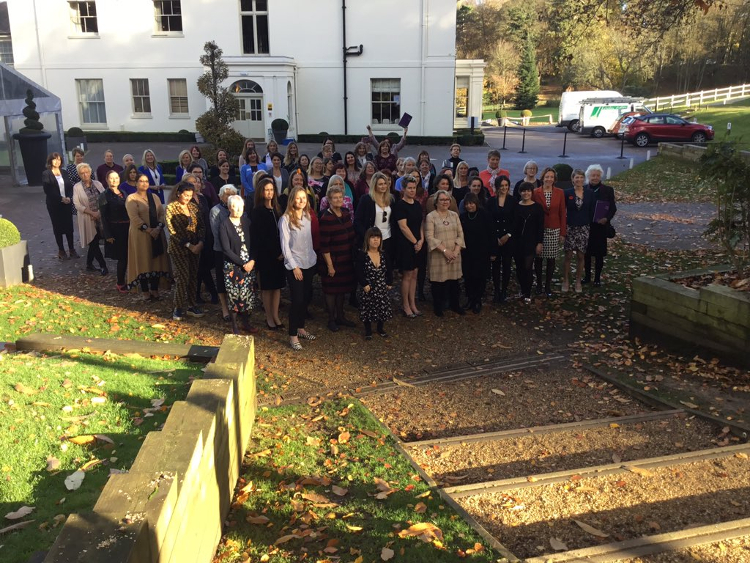
Suffolk’s Inspiring Women
I even celebrated the birthday of HM the Queen with members and guests of the National Liberal Club at a champagne reception on the invitation of my friend Trevor Peel.
What a highlight to discuss the criminal justice system with MP’s, an Ambassador and even a Royal Navy Admiral.
Isn’t it strange how talking about celebrations brings out the good, the bad and the ugly in people.
Social media is no exception.
Consequently, I have had to put up with a barrage of abuse from people. They have never met me, don’t know me but time after time they target their rancour at me. I know I’m not the only one under fire.
In November, I was invited by the Fawcett Society to Portcullis House for an All Party Parliamentary Group (APPG) to celebrate 100 years of Women MP’s. How appropriate then that during the question and answer slot the main topic was abuse on social media and how women should not expect it, or accept it.
Collaboration
For many years I have been concerned about the lack of opportunities within prisons to educate, train and equip individuals on release.
People with a criminal record are immediately penalised in the job market regardless of whether they have the relevant skills; it’s an uphill battle.
So, you can imagine my delight when in March I was invited on to the Board of trustees of Clean Sheet, a charity with one simple purpose – to offer people with convictions the hope of a better future by finding real, permanent employment.
Clean Sheet’s Annual Review took place at the House of Lords attended by Rory Stewart MP OBE.
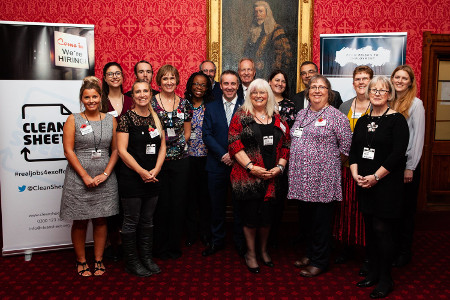
Clean Sheet team
In April, I took up my usual seat behind people giving evidence at the Justice Select Committee.
Once the formalities of the meetings finish, the room usually empties very quickly and ministers hurry back into the corridors and disappear. But not this time.
After giving evidence, just weeks into his new job as Prisons and Probation Minister, Rory Stewart hung back, so I stood up and shook his hand.
“I thought I would introduce myself, I am Faith, Faith Spear”
“Yes, hello Faith, I follow you on Twitter,” he said
“It would be good to meet sometime,” I added
“Let’s do it now,” he replied
Slightly gobsmacked, I followed him out of the room where he was met by his entourage and those wanting to ‘have a quick word’.
“I’m with Faith” he said as we started walking down the corridor. He gave me his full attention.
We went into the atrium of Portcullis House, found a table and talked together. It was a productive conversation and we agreed to keep in touch.
Invitations
As a year celebrating women, my list would have to include Sarah Burrows (Children Heard and Seen). In March, I attended an event in Oxford at Sarah’s invitation ‘What would it be like to have a parent in prison?’
The event displayed incredible art work from their competition judged by Daniel Lee and Korky Paul, who wrote and illustrated the book ‘Finding Dad’, and Sir Trevor McDonald OBE, newsreader and journalist.

Faith with Sir Trevor McDonald
A moving short film was screened made by a young man Luke and his mentor about having his father in prison, including an interview with, Ralph Lubkowski, then Deputy Governor of HMP Leicester.
I had the pleasure of having dinner at ‘Malmaison’ Oxford with Ralph, Sarah and all the judges. Sarah seated me next to Sir Trevor and we exchanged thoughts and experiences with each other about prisons.
A week later, I was discussing women in the Criminal Justice System at the House of Lords at the invitation of the Rt Revd Rachel Treweek Bishop of Gloucester and the Rt Hon the Baroness Jean Corston.
Women’s voices
I remember a time a couple of years ago, when I was sat in the Central Lobby at the Houses of Parliament talking to Dennis Skinner MP. I asked him:
“How do you get heard in this place?”
He looked me in the face.
“You have to be seen to be heard,” he said.
This is one of the reasons why you have seen me in so many diverse places:
In Westminster Hall listening to David Lammy, at the RSA listening to David Gauke, taking part in panels such as at Warwick University with SafeGround and Sheffield Hallam Uni, having discussions with leading Professors, Criminologists, PCC’s, at Police HQ’s, at roundtable events with the Criminal Justice Alliance, in Westminster for the Children’s Inquiry Report launch with Volteface, at the Parmoor and Longford Lectures and why I accept invitations to Prison Reform Trust wine receptions and listening to Lady Hale at the Fawcett Society lecture at the Royal Society.
I’m told some of my critics accuse me of being a ‘social climber’. Nothing could be futher from the truth.
If you don’t understand the issues, and unknown to the very people who can change things, how can you play a part in the solutions?
My part is: I ask questions
Tough questions
Some find that uncomfortable
I will continue to ask questions
In the last year I have seen first-hand how our Criminal Justice System can be an unjust system, I have seen how it breaks people, distresses children and separates families. I have seen inhumane conditions in prisons, I have spoken about it on the radio and television and I have written about it.
I have also spent time with victims and, yes, shed many a tear for them and with them.
Yet in 2018 I have also seen some good practice in purposeful activity, having sat in prisons at award ceremonies, having had guided tours of prisons by Governors, having eaten at restaurants within Prisons.
In all these places I have sensed optimism, hope and met those that believe in doing all they can to help with rehabilitation and re-integration.
Among the most inspiring women I have met is Khatuna Tsintsadze, Prison Programme Director for the Zahid Mubarek Trust. We worked together again this year and I have learnt so much from her, including human rights, equality and discrimination.
Unpicking myths
And finally, in this blog I wanted the last words to come from three people who have met me for the first time in 2018. I hope this will unpick some of the myths as to who I am and what matters to me.
“I first got to know Faith following her visit to HMP Berwyn, and the tour of our Prison Industries operation.
My first impression was one of her passion and conviction for getting to the real core of how we were working with the men to deliver real life work and training opportunities and asking specific questions – really emphasising that she had the best interests of the prisoners at heart. We rarely meet people that spend time engaging at this level whilst on a ‘guided tour’.
Subsequently I have had the opportunity to engage with Faith on a number of levels and have found her to always be absolutely trustworthy, insightful and generous with her network and her time.
She is not afraid to challenge the status quo, often attracting those that criticise her belief in wanting to make the CJS a better environment for its employees and those in its care”
Kelly Coombs, Co-founder Census Group
“I am drawn to people who are prepared to push boundaries in order to achieve change. Not rule breakers, but rule questioners. People who are not afraid to ask difficult questions but who are also prepared to help with the hard work needed to address the answers they might find. With this in mind, it was with no little amount of excitement that I met Faith Spear last year. Our areas of interest sit alongside each other yet might be a million miles from one another. Both feed each other in a continuous loop, creating demand and have long term impact on the people who become part of the Criminal Justice System.
Faith has stood her ground where many others have feared to tread and of course I admire this characteristic immensely but more than that, she has survived and continued her quest with renewed vigour.
When I met with Faith, I was contemplating a new step in my own quest but was still uncertain whether I would go ahead. Faith inspired me and left me believing not only that I ‘could’ do it, but that I really ‘should’ do it!
In a world full of naysayers, spending time with Faith is like finding water in a desert. ‘What would Faith do?’ has become my mantra”
Cate Moore, Independent Chair of Lincolnshire Police Ethics Panel
“I first met Faith Spear at a Corbett Network meeting in April 2018. I was hugely impressed by her warm-hearted nature, incredible knowledge and clear passion to make a positive difference in people’s lives.
We immediately clicked, in part due to our involvement with the award-winning charity Clean Sheet – Faith is a trustee, I am an ambassador – and also our shared vision to tackle the immense barriers that people with convictions face moving forward with their lives.
We both play very different roles in this hugely important agenda, but since my first meeting Faith she has become a great support to me, and I, in turn, have become a massive fan of her work and her brilliant thought-provoking blog. I look forward to continuing to collaborate with Faith for many years to come”
Dominic Headley, Director of Dominic Headley & Associates
In the context of a blog like this, it’s possible to only mention a fraction of the workload, time and miles covered. For obvious reasons you will appreciate I’m unable to share the full extent of everyone I have met or all that has been done.
Featured Photo: Faith with Michael Woodfood, Contrarian Prize 2013 winner and former CEO Olympus. To learn about Michael’s story please visit the Contrarian Prize website.
~
 The Criminal Justice Blog