Home » rehabilitation
Category Archives: rehabilitation

Chocolate & Grace: Succeed in the face of adversity
Back in 2017, in The Clink restaurant in HMP Brixton, I had lunch with Chris Moore, the then Chief Executive of The Clink Charity, and a lady from Scotland. We listened carefully as she shared her vision of helping women caught up in the justice system, with chocolate. Her vision was realised later that year, but we lost touch.
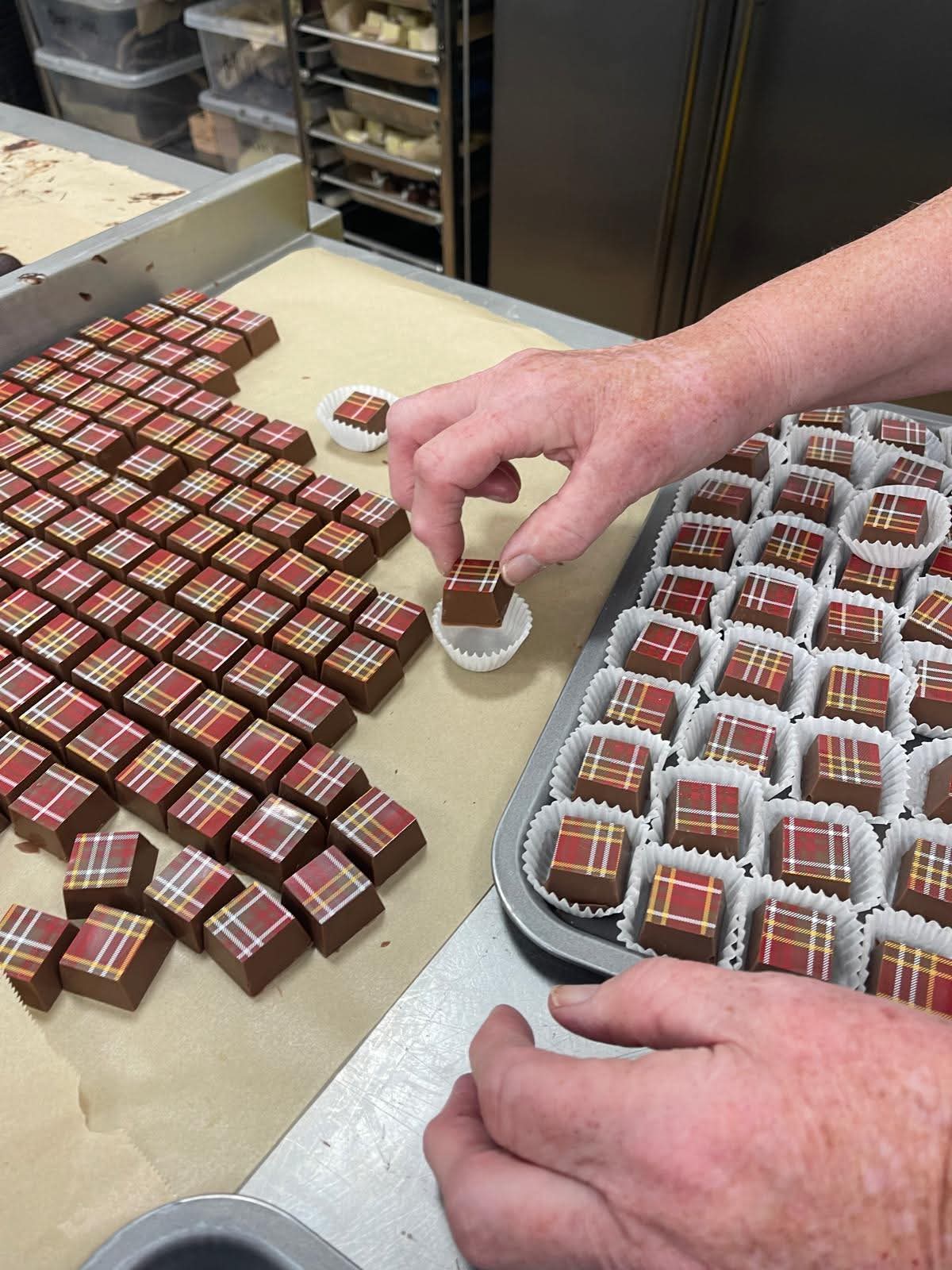
Last week, eight years later at Lady Val Corbett’s Professional Women’s networking lunch, I met Louise Humpington, CEO of Positive Changes, a CIC trading as Chocolate and Grace. The very same initiative that I had heard about all those years earlier. Louise became involved in July 2024.
This is the story of Chocolate & Grace, kindly written by Louise:

In a bustling kitchen in Stirling where the aroma of melting cocoa lingers, something more profound than chocolate is being crafted. Chocolate & Grace is not simply about indulgence; it is about empowerment, dignity, and rewriting futures.
At its heart, this initiative provides women who have lived experience of the justice system, with a safe, supportive space to heal, connect, and grow. Women describe the empowerment they feel when they are truly valued, treated with respect, and given the agency to rebuild their lives. Here, they are not defined by past mistakes but celebrated for their resilience, strength, and capacity for transformation.
Isolation is one of the silent challenges faced by many women leaving the justice system. Chocolate & Grace breaks that cycle by fostering community, reducing loneliness, and encouraging meaningful relationships. In doing so, it helps rebuild lives and, crucially, reduces reoffending—creating a positive ripple effect across society. The impact is not only personal but economic: lives rebuilt mean less strain on the public purse and a healthier, more connected community.

Every chocolate made is infused with purpose. Behind each truffle or bar is a story of hope, courage, and determination. Alongside training and employment opportunities, the program offers trauma-informed support and a platform for women’s voices to be heard, acknowledged, and amplified. The women are credited not as passive recipients of help, but as active changemakers who demonstrate extraordinary commitment to transformation.
Chocolate & Grace is proof that with compassion, respect, and opportunity, cycles can be broken. It is a movement that blends social impact with sweet creativity—reminding us that true empowerment is not given but cultivated, one act of grace, one piece of chocolate, one woman at a time.
But this approach isn’t just important for the women being supported by Chocolate & Grace, it also represents a critical redefining of what leadership and success look like.
This change matters not only because it corrects decades of narrow norms, but because it unlocks better outcomes for organisations, teams, and society. One in four people in the UK will have had been subjected to Adverse Childhood Experiences or some other trauma. Better recognising how marginalised groups and disenfranchised people can contribute because of their lived experience and not in spite of it, is not, therefore a nice to have, it’s a fundamental shift that society needs.
When we value difference, leadership becomes more human. It shows the value of connection, trust, and authenticity as strengths, not liabilities.
It shifts the metrics by creating a space where success isn’t defined solely by outcomes like profit, efficiency or hierarchy. Wellbeing, purpose, sustainability, inclusion are finding a space and making leadership more holistic and resilient in turbulent times.
When the rules are reworked, it opens up space for diverse voices that have been traditionally marginalised or excluded. It empowers people, amplifies their voices and revers the value of their perspective.

There is no question that challenges remain, but as we continue to push boundaries and challenges status quo, momentum builds. Systemic obstacles (bias, unequal expectations, lack of access) still create barriers. But as more women lead by new norms, those norms themselves become harder to ignore or dismiss. We are changing the normative landscape in leading by example, and in amplifying the voices of those who have the most to teach us about what it is really like to succeed in the face of adversity.
The chocolates are delicious, if you would like to support this inspiring organisation have a look at their shop and treat yourself (and others) https://www.chocolateandgrace.co.uk/collections

Should inmates be given phones?
Offenders who maintain family ties are nearly 40% less likely to turn back to crime, according to the Ministry of Justice. With secure mobiles being rolled out in prisons we ask…
Should inmates be given phones?
This was a question posed to me back in November 2021 by Jenny Ackland, Senior Writer/Content Commissioner, Future for a “Real life debate” to be published in Woman’s Own January 10th 2022 edition.
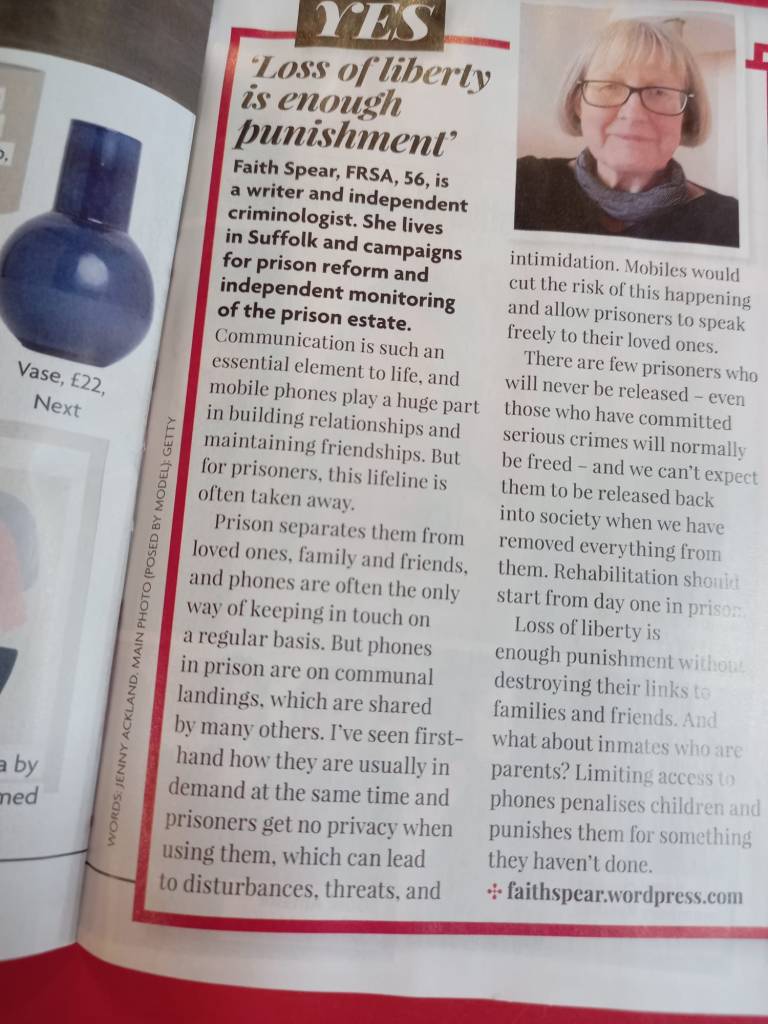

Below is the complete article, my comments were cut down slightly, as there was a limited word count and reworked into the magazine style.
Communication is an essential element to all our lives, but when it comes to those incarcerated in our prisons, there is suddenly a blockage.
Why is communication limited?
It is no surprise that mobile phones can serve as a means of continuing criminal activity with the outside world, as a weapon of manipulation, a bargaining tool, a means of bullying or intimidation.
But what many forget is that prison removes an individual from society as they know it, with high brick walls and barbed wire separating them from loved ones, family, and friends.
There is a PIN phone system where prisoners can speak with a limited number of pre-approved and validated contacts, but these phones are on the landings, are shared by many, usually in demand at the same time and where confidentiality is non-existent. This is when friction can lead to disturbances, threats, and intimidation.
Some prisons (approx 66%) do have in-cell telephony, with prescribed numbers, monitored calls and with no in-coming calls.
Why do some have a problem with this?
We live in an age of technology, and even now phones are seen as rewarding those in prison.
If we believe that communication is a vital element in maintaining relationships, why is there such opposition for prisoners?
In HM Chief Inspector of prisons Annual report for 2020, 71% of women and 47% of men reported they had mental health issues.
Phones are used as a coping mechanism to the harsh regimes, can assist in reducing stress, allay anxiety and prevent depression.
Let’s not punish further those in prison, prison should be the loss of liberty.
Even within a prison environment parents want to be able to make an active contribution to their children’s lives. Limiting access to phones penalises children and in so doing punishes them for something they haven’t done. They are still parents.

Art for arts sake/prison for prisons sake: Part 2
Emerging from the Westminster tube station, the blue sky is a welcome sight. Trees shedding their leaves by the chilly winter winds. Wrapped up against the elements I hastily head along Victoria Embankment and climb the steps to cross the Thames toward my chosen destination – The Southbank Centre and Koestler Arts exhibition. A celebration of Art, Music and Writing.
The ‘I and the We’, curated by Camille Walala and Sarah Ihler Meyer.
With the strapline: ‘Unlocking the talent inside the criminal justice system’
It’s a strapline I have often read, but how many truly believe it is possible?
Unlocking: who is unlocking and who is being unlocked?
Unlocked, unlock, unlocking…its endless, often words chosen by cjs charities and organisations.
But to unlock you need a key.
A key can be a person or an opportunity. Here it is both.
We write off so many due to their circumstances, but a bit of creative encouragement can achieve much.
I try not to over-analyse each exhibit, but it is tempting, with titles such as ‘Too Late‘ and ‘Perspective‘ it is a little hard not to be intrigued.
Talent: is there really talent within the criminal justice system?
This question is easy for me to answer, a resounding yes.
Others may think differently, usually from a position of ignorance in my view. The average person still knows so little about what is happening behind prison walls.
Art is a form of expressing what is happening within or without. In a nutshell a way of communicating to others in an illustrative way.
Art is not judgmental like right or wrong, nor is it binary like black or white.
I was attracted to a striking entry from HMP Garth called ‘God’s Words’. A simple graphic featuring biblical words applied using rudimentary materials; a marker pen and cardboard. Definitely makes you think.
Slowly moving through the room, many exhibits caught my eye, some making me feel rather sad and others bringing a smile to my face and even a laugh. But that is the beauty of Art.
Bold statements
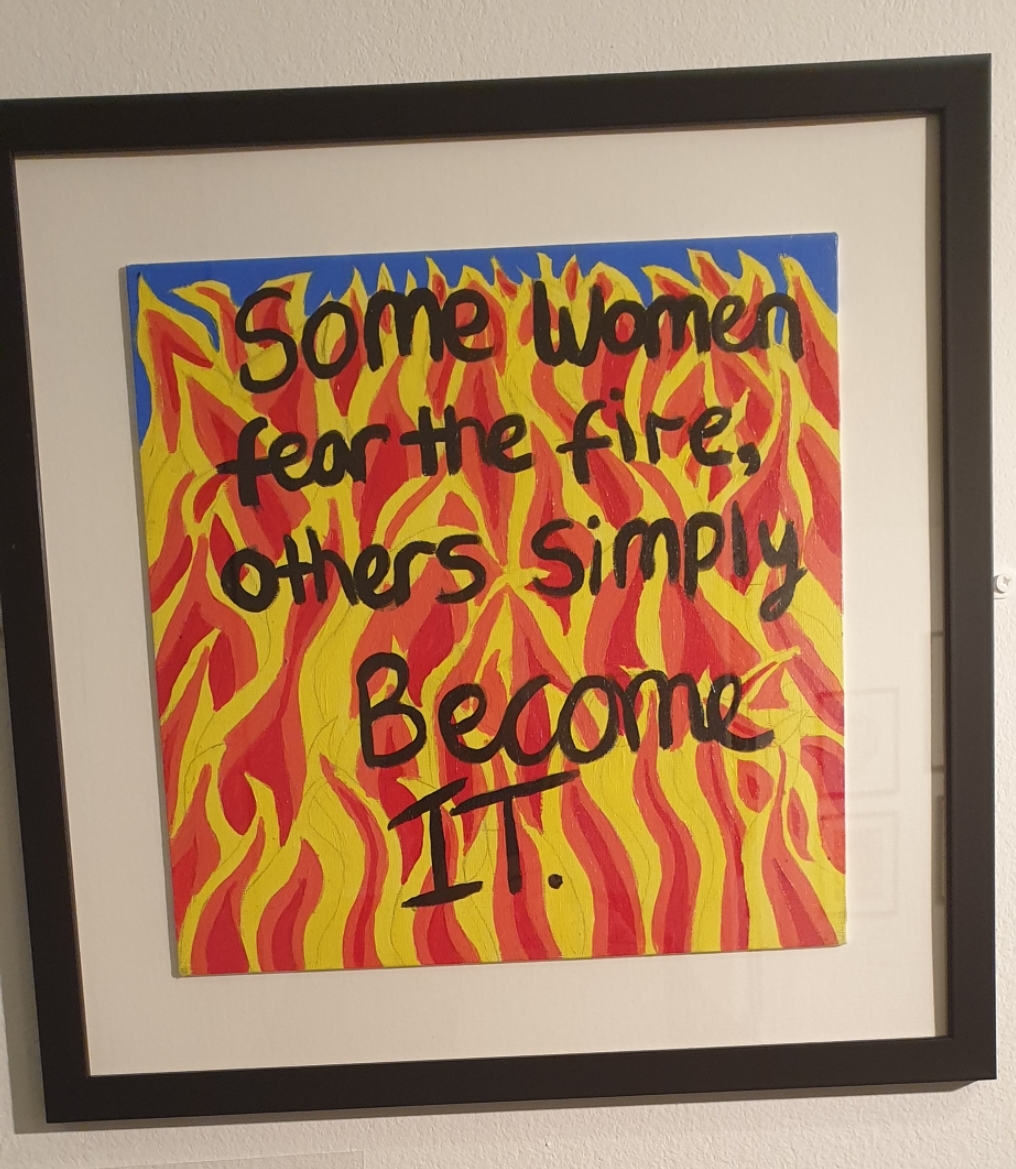
“Some Women fear the fire, others simply Become It” such poignant yet powerful words. I wonder what the story is behind it. All I know is someone called Jacqueline painted this acrylic on board from HMP Eastwood Park. No other words are really needed.
Wise words
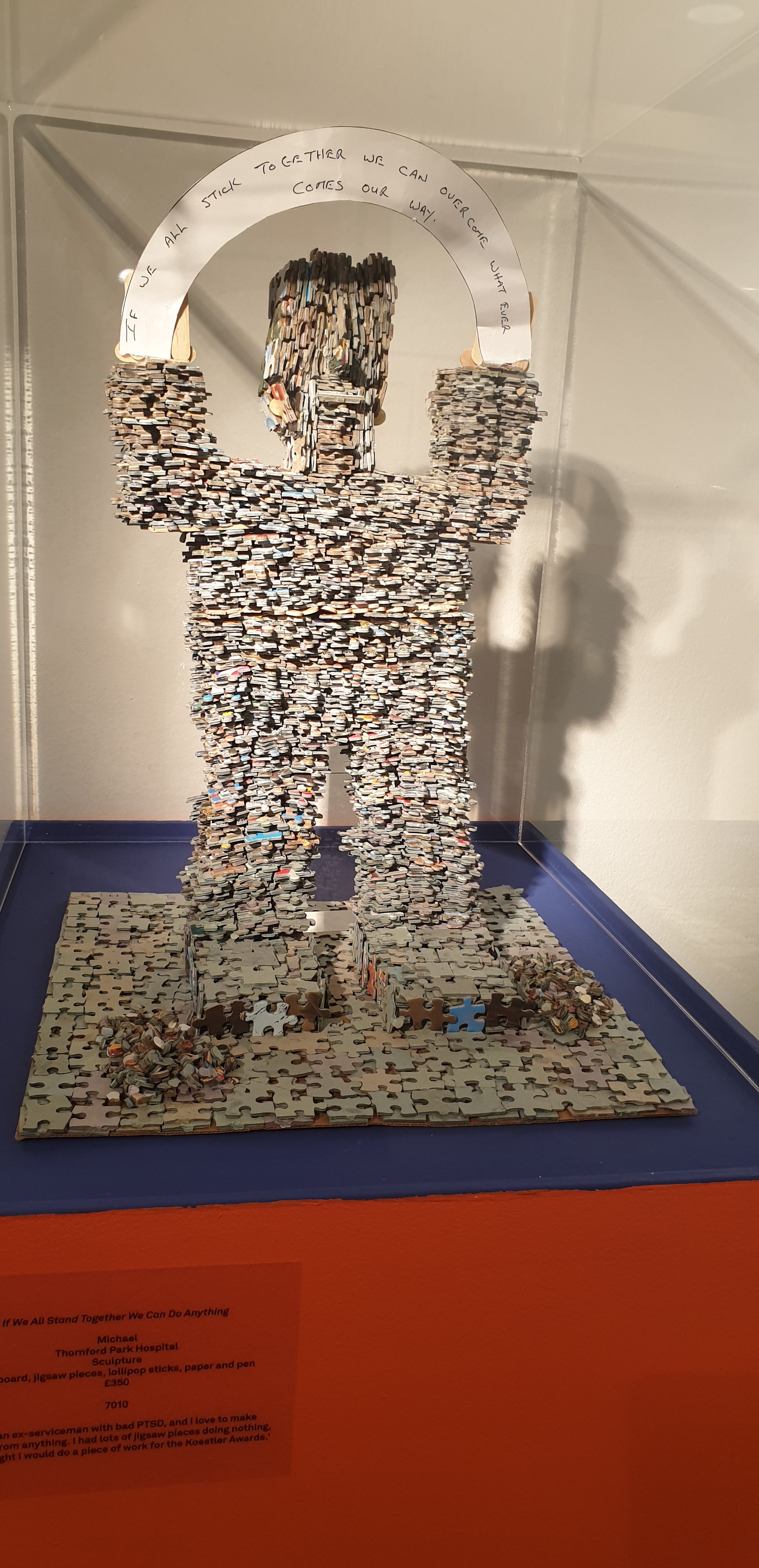
As I considered the work called ‘If We All Stand Together We Can Do Anything’ there is a sense of togetherness within this exhibition, maybe we can all learn from this simple sculpture. Thank you Michael.
Poetry

Walls
beyond these grilles
behind this door
and walls within my view
I’ve fought my demons
and done my time
ready to start anew.
I’ve used these bricks
to build new walls
and found something true
I’ll rise to freedom
And find my voice
Well beyond this view.
I sat on a bench in silent contemplation of these four verses, unmissable alongside other poems on the wall ahead of me.
It was well worth taking the time to read every carefully chosen word.
Here is talent. It has been unlocked.
~
‘The I and the We’ 2021 UK exhibition at Southbank Centre
Curated by Camille Walala and Sarah Ihler-Meyer
29 October – 5 December 2021. Mon – Wed 10am – 6pm, Thu – Sun 10am – 9pm*
Exhibition Space, Level 1, Royal Festival Hall, London
~

2020 need I say more…
A retrospective of 2020
The author Peter Mayle once wrote “The year began with lunch…” which pretty much mirrored mine, although for me it started on Aldeburgh beach in the freezing cold, eating chips, and surrounded by family celebrating my birthday.
Cambridge is a favourite place of mine, having spent hours in libraries, museums and taking in the splendour of the architecture. So in February when I was invited to a seminar in the Institute of Criminology (IoC), I immediately responded. I have entered that building many times, studied in their library, attended seminars and even had tea in Professor Bottom’s office.
The subject was ‘Can Prisons Rehabilitate?’, delivered by Yvonne Jewkes. Rehabilitation is a subject I have thought long and hard about. Whilst awaiting the start, I received a very warm welcome from Rebecca L. Greene, Artist in Residence at IoC. It was good to catch up with those I hadn’t seen for a while, chat to Ben Crewe and have some interesting conversations with students who were keen to engage with me.
Months later Rebecca kindly invited me to take part in the digital exhibition Drawing Connections at the edges, Arts in Prison at the Museum of Cambridge following on from the Festival Of Ideas: Arts in Prisons, what changes can they bring? in 2019. The title to consider was “How did lockdown make you feel?” drawing on experiences of lockdown relating to the perception of my work with people within the Criminal Justice System. For my contribution I decided to write a poem:
Dare I compare my lockdown to theirs?
Can I not reach out to those in prison to manage my isolation and to draw on their resources to get through this challenging time?
Perhaps this has been a way to understand their hopes, fears and feelings too, leading to a breakdown of mental and spiritual barriers between us.
No longer is it just about reaching out to those in prison, instead it is an opportunity for us to be reached out to, from those within the prison walls.
Their voices illuminating
Their voices resonating
Their voices compelling
Are we not all part of society?
Has lockdown reinforced this?
Can freedom come from within and can freedom come from without?

I invited Rebecca to say a few words for inclusion in this retrospective and this is what she wrote:
“I was honoured to be asked by Faith Spear to write a short piece on how we met for her blog: as the year which has proved challenging and complex for everyone in myriad ways draws to a close, it seems hard to believe it was only in February of 2020. We met, when I welcomed her to a Public Seminar presented by Professor Yvonne Jewkes’ Can Prisons Rehabilitate?, hosted by the Institute of Criminology, my place of work. Faith’s ability to speak clearly and concisely has meant her work is something I have taken an interest in since my first engagement with the CJS through Learning Together in 2016. The material Faith shares on Justice and Social matters is done so, I feel, with fairness and truth and since our meeting this has been further enhanced through a shared love of the Arts and their restorative qualities.” (Rebecca L. Greene)
Poetry played a major role in my activities this last year. After being approached by Gerry Hamill, @FirstTimeInside, I became a panel member and part of a community for a Hidden Voices project with HMP Edinburgh. This was a poetry competition open to men and women entitled ‘Saughton Sonnets‘. The prisoners were asked to express their feelings on lockdown and Covid-19 and how they have been affected by this crisis. For 5 weeks a new batch of poems were sent to us to judge, score and comment on. Each weeks winners were then scored to find an overall winner. It was brilliant to work alongside other community members and to discover the amazing potential in those that are so often overlooked. The finale was to see these sonnets in print and to hear how those that had taken part had been encouraged to continue to write.
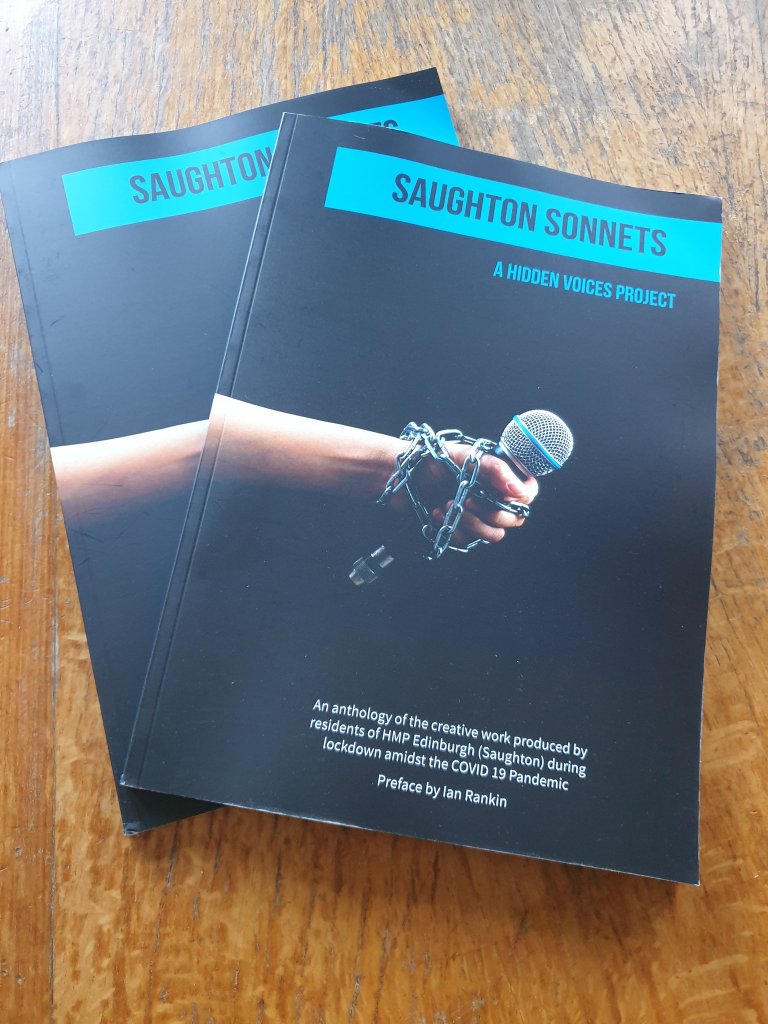
Writing is steadily becoming a passion for me, and I have been fortunate enough to have two book reviews printed in the InsideTime newspaper:
In June 2020 edition: ‘Can I have a word Boss’ written by Phil O’Brian after 40 years within Her Majesty’s Prison Service. His passion and drive come across in every chapter. Sadly, this kind of experience is now fading as his calibre is being replaced by those with little experience in the world, let alone within the justice arena. Is this a good thing? Only time will tell.
In November 2020 edition: ‘The Grass Arena‘ written by John Healy is a book centred round a world I thankfully have never ventured into – either by choice or circumstance. Drink, drugs, vagrancy, death, prostitution and money – the somewhat graphic portrayal of a life I can only describe as ‘brutal’. This book was recommended to me by Charlie Ryder after having read a blog I wrote the previous year “A Conversation with: Erwin James“.
Erwin kindly sent that review to John Healy and days later I received a supportive and positive response from John inviting me to keep in touch.
Sadly many conversations have not been face to face, with numerous events cancelled, meetings postponed and travelling almost non existent. Instead we have all embraced/tolerated/accepted, zoom, video calls and the old fashioned just picking up the phone to communicate. For example, I had a zoom call with Chris Daw QC, quizzing him on his new book ‘Justice on Trial‘ and trying to find the answers to so many questions I had.
During the year, I have written about two conversations with amazing individuals and their enthralling journeys in life.
The first was “A Conversation with: Phil Forder“, we chatted for hours, a remarkable man. When I asked “Who is Phil Forder?” the response was brilliant:
“My job title is community engagement manager at HMP Parc but as you so rightly said previously. ‘There is more to an individual than their job.’ I’m also a painter writer and woodcarver. LGBT rights supporter. Environmentalist Nature lover. Lecturer, etc.

But in a nutshell
“Just a bloke doing what I think is right and enjoy doing”
I asked Phil if he would like to say a few words for inclusion in this retrospective. This is Phil’s contribution:
“Over the years I had read so much about conditions in prisons on social media, most of it not good, that as a person who works in one I decided to launch my own account in 2017. Although a lot of what was being written about was true, I also knew there was another side to it where positive initiatives and positive people were striving to make a difference under increasingly difficult circumstances. So I put my head above the parapet, using my own name, and began to try and show another side to prison life, of which examples were daily. Twitter can be a pretty ugly place as I soon found out. There were times aplenty I was disheartened and tempted to stop as I began to receive flack from all directions but then I noticed it wasn’t all bad as a lady called Faith was following me and what’s more she had started retweeting my work and making constructive comments too. Although not alone in doing so, as there were others, that constant support was, and still is, invaluable in putting out the work that I do. As anyone who follows Faith will know, she is pretty fearless in her pursuit of Truth and not someone to take lightly. But what is so refreshing, especially on social media, is to hear a voice that is not only honest and always well-thought out but one that is objective and well-balanced too. Through her insights, Faith has proved herself, again and again, a valuable member of the prison community that we are lucky to have in such a complex prison system. And as for me personally, she continues to be a constant source of inspiration and support”
My second “A Conversation with Dr Sarah Lewis, Director of Penal Reform Solutions” was equally inspiring. I felt that her overall message was one of HOPE:
Sarah said: I believe in people
I don’t quite believe in the system yet.
I have hope in individuals.
I believe in them.
We need to be actively hopeful in people. Let them know “I believe in you”
I have hope in people.
We talked about rehabilitation, complexities within the prison estate, radical reforms and so much more. But the question to her that I received the most feedback on was: “Do we need more research on prisons, are there gaps or do we need to push for changes based on existing knowledge?”
Sarah’s reply:
“Yes to both. We know enough to know what works. The difficulty is how we apply that knowledge. Academia needs to move out of its ivory tower and on to the shop floor. There’s plenty of research, you need to create a growth environment (climate) and capture this impact with understanding. Research takes so long, from ethics approval to peer review to publication. More creativity is needed with research, capture stories, motivate staff.
Academic research needs creativity, inclusion, and we must learn from our mistakes”
As I have mentioned before, we all know the saying ‘action speaks louder than words’ yet often you have to speak before any action can take place. So this year I was pleased to work together with a number of charities in the justice sector to write a consultation submission to the Ministry of Justice. In addition, I have offered advice and encouragement, assisted in media articles, proof read books, edited web sites and also shared a bit more of my story for Female Leaders At 50 – Women Behind the Network Series.
But the cherry on the cake for me was to be invited to write the forward for a book. Phil Martin published in November ‘The People in Prison and their Potential: Insights into imprisonment and true stories of rehabilitation’. As I have discovered for myself, the potential in prisons is vast and this book highlights what can be achieved. We appeared to be on the same wavelength here. Those with convictions do have potential, deserve to be given opportunities and can be valuable members of society. Many are willing to change but are we willing to accept them?
This is just a snippet of what became a challenging year both personally and professionally. Yet I enter this new year 2021 with anticipation, a renewal of energy and a continued determination in speaking truth to power. I will not be on mute.
In the context of a blog like this, it’s possible to only mention a fraction of the workload, time and miles covered. For obvious reasons you will appreciate I’m unable to share the full extent of everyone I have met or all that has been done.
~

A Conversation with: Dr Sarah Lewis, Director of Penal Reform Solutions
In her Twitter bio it states: A passionate prison reformer. Interests: collaborative research, personal growth, creative action research, relationships, Nordic prisons, prison reform.
Just reading this I knew we would have a connection and a great conversation together.
What does it mean to you to be a prison reformer?
What I do has meaning, consumes me, its a purpose that is constantly in my blood and mind.
Collaboration matters to me, so does inclusion and having an unconditional regard for people. My inspiration comes from Elizabeth Fry, however, there are many with her passion. We need to work together to make a collective impact, not rely on one individual to drive change in prisons. I also believe that reform is not only situated in prisons, but in the community at large.
I don’t want to consistently bash the Criminal Justice System, but we need to be realistic about the problems whilst instilling hope. We need to meet people where they are at.
Prison reform needs to be a social movement in order to create a climate outside of raising awareness and drawing people together for a common purpose.
Prisons can be a transformative place.

Do we need any more research on prisons, are there gaps or do we just need to push for changes based on existing knowledge?
Yes to both.
We know enough to know what works. The difficulty is how we apply that knowledge. Academia needs to move out of its ivory tower and on to the shop floor. There’s plenty of research, you need to create a growth environment (climate) and capture this impact with understanding. Research takes so long, from ethics approval to peer review to publication. More creativity is needed with research, capture stories, motivate staff.
Academic research needs creativity, inclusion, and we must learn from our mistakes.
Do you see yourself as an academic?
Yes, but I’m a bit of an odd ball in academia, being an academic is part of my identity, but it doesn’t define me.
You mention personal growth, can you elaborate on this?
Growth for me is inclusion, growth in the community and families. People can reform, but you need to create hope and invest in unconditional relationships.
Growth, which includes love, acceptance and trust is also about unconditional support, nurturing and building relationships.
How important is it to establish relationships with prisoners/prison staff?
It’s everything
From determing the level of trust, to how people talk about their feeings, their fears and trauma. It’s the key to prison reform, desistance, cleanliness, safe environment, trust and many more…
What are some of the elements from the Nordic prisons that can be easily incorporated into prisons in England and Wales?
To never enter a prison and think people are broken with no hope.
Would you describe yourself as resilient?
I’m strong through stubbornness, but I am focused on what I want to achieve. Resilience means you bounce back, I’m susceptible to tiredness and pain due to health conditions, but this won’t stop me. I refuse to give in, so by overcoming obstacles I adapt to my environment.
Where does your strength come from?
My husband is my rock, my team, friends and importantly my sense of direction.
In an article in the InsideTime newspaper, June 2020, Sarah stated:
“My lifelong mission is to create a more humane system, which provides conditions where people can find meaning, have hope in the future and be happy”
In relation to this statement where do you see the prisons in England and Wales?
We are far away from that, further than we think. We have the ability to change, yet we underestimate the collaborative abilty of staff and prisoners alike. Culture and climate are important. A more humane system will not happen on its own, we need investment and training.
I have 100% hope in the future, that’s my logic.
We want people to live and not just survive.
With your work in schools, do you believe it is possible to instil meaning, hope and happiness into children’s lives?
Absolutely
From my experience it is easier to teach children than adults. The idea of the “Growth Project” at Guys Marsh was one of nurture, principle of growing and a purpose and peace in children. Divert them from prison by focusing on these building blocks around relationships, in order to protect them in later life.
You mentioned the “Growth Project”, how did this come about and how do you see it progressing?
The Norway Project took place in 3 Norwegian prisons and started as a photographic exhibition about how I captured collaboration. I spent 3 years researching Norwegian prisons and during the fieldwork I created a research team to understand their exceptional prison practices and priciples of growth. Out of this the Growth Project was born in England and Wales. We now have a collection of passionate people forming a steering group with prisoners and their families involved. We discuss issues such as diversity and inclusion in both prisons and society alike.
The aim of the “Connection Campaign” is to bring the inside and outside together, how are you managing to break down the walls to achieve this?
We are looking at where there is disconnection and the needs of young people. We magnify a voice that is quiet from various criminal justice areas. But we are not about blaming or shaming prisons. We wanted senior management to have conversations with prisoners families. Our strategy is to meet people where they are at and how to be a bit more compassionate, a critical friend.
Is rehabilitation possible within the current prison set up?
They need to be habilitated in the first place. Rehabilitation is a managerialistic term which often sets people up to fail. Like a game of trying to catch people out which is not conducive to change and no growth can happen. It can be harmful as no one wins.
Do we need radical reforms, if so what are the possibilities, if not, why not?
We need an authentic meaningful longterm investment in those principles that are encouraged in the Nordic model, applying the principles of growth in a meaningful way within our own context.
Irrespective of ideology, we want to strive for a just and humane system. This needs to happen, we need to change the narrative around prisons, prisoners and prison staff. But it must be sensitively executed. It’s not just about success stories.
Working within the prison estate can be rewarding but also can be disappointing, exhausting and demoralising. How do you deal personally with the complexities you face?
I see and hear a lot of stuff. However, I have such a strong mission.
Yes it is. Absolutely.
We have lost 2 growth members, 1 person through suicide after prison and 1 whilst he was in prison. It was a painful experience, I knew their families and the ripple effect was hard because their lives matter.
The question I really wanted to ask Sarah was: Is your underlying message of hope?
I believe in people.
I dont quite believe in the system yet.
I have hope in individuals.
I believe in them.
We need to be actively hopeful in people. Let them know “I believe in you”
I have hope in people.

An interview on a Summer’s day
How/why did your involvement in the CJS come about?
I turned down a place to study for a degree and instead moved from Lincolnshire to Essex at the age of 19. My first “proper” job was in admin with NACRO in Colchester. I worked primarily in wages and finance. At that point NACRO provided 6 months work placements in painting and decorating or in gardening teams etc for those who had just come out of prison. I heard amazing stories from those men and some brought newspaper cuttings to show me of their various escapades, including a headline “Most wanted man in Britain” They made me laugh and some made me shed a few tears. But for me I had many questions that were never answered.
What happens after 6 months?
What about their families, how can they support them financially?
Was this really a way for integration back into society?
Why is only manual labour available?
I helped set up and train staff for a new branch of NACRO and then moved on to work in Finance for the NHS. However, I believe a seed was planted all those years ago.
Fast forward 25 years, I was accepted into University. I became a full-time student studying Criminology with 2 kids at school, 1 at college, a part time job and my husband working full time and studying also, I embarked on a very busy 3 years of multi-tasking!
For my first presentation I chose to speak on Women in prison and the Corston report, I researched thoroughly but was marked down because no one was interested in prisons and especially not women in prison, it was deemed not an exciting enough subject. Great start. My next presentation was about Restorative Justice and yet again I was questioned as to why I was interested, one lecturer even said, “What’s that?”. A pattern was emerging of my interest into those within the CJS and those that had been released increased. I was not put off and in my 3rd year the title for my dissertation was: Restorative Justice: Is it delivering strategic change in England and Wales or just a cost cutting exercise by the Government?
To understand the significance of Restorative Justice I arranged interviews with experts in the UK, NZ and USA, even Howard Zehr widely regarded as the Grandfather of RJ agreed to help. I consumed document after document on RJ and was a frequent visitor at the Cambridge University Library, floor 6 (those stairs almost killed me!) and the Institute of Criminology Library.
I graduated with an honours degree in Criminology and looked for my next step.
I joined the Independent Monitoring Board (IMB) at HMP/YOI Hollesley Bay and in just three years became the Chair.
I wrote about the things I saw and heard but what I didn’t expect was what happened next. I was confronted with a prejudicial character assassination brought against me, a fight to clear my name, being investigated twice by the Ministry of Justice, called in front of a disciplinary hearing in Petty France and the involvement of not one but two Prison Ministers. I felt that I was on my own against a bastion of chauvinism. Not the last bastion of their kind I would come across. Welcome to the IMB!
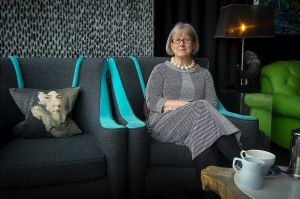
My continuing journey can be found in my blog: The Criminal Justice Blog www.faithspear.wordpress.com
Because my story is fairly unique it has been covered by BBC News, Channel 4 News, BBC Radio Oxford, BBC Radio Suffolk, 5Live, LBC as well as National and Local newspapers, law journals and online publications etc.
Religion is clearly important to you, what role does God play in your life?
I remember going to Chapel with my grandparents as a young child and hearing my Dad and Grandfather sing the old hymns with deep sincerity. Christianity has always been part of my life. My faith in God has often been tested.
How do you balance work and life responsibilities?
I often say I’m a Mum first, always have been always will be. My husband and my kids are the most important people in my life, I have a great relationship with them all. They understand who I am and what motivates me to do what I do. They understand the bigger picture and that for me it is a cause and not merely a job. That in itself I realise is exceptional and I find I am continually grateful because I know that the level of family support I have is sadly not available to everyone. I can’t do this stuff on my own. They are also aware of the work I do behind the scenes and the many hours of support I give freely.
What role, if any, has luck played in your life?
Things happens for a reason, we don’t always know or understand the reason why. We all have issues to face and hurdles to climb and times of joy and celebration. Luck doesn’t fit in my life at all.
Not only have you been a source of inspiration to me in certain areas, I have also seen you inspire others and would like to know who inspired, or inspires you and why?

A few years ago, I wrote a journal article with a friend of mine, Dr David Scott about a remarkable woman, Lady Constance Lytton, commemorating 100 years since her book Prisons and Prisoners was published. In it she presented one of the most significant challenges to 20th Century anti-suffrage politics. Her book is a harrowing personal account of her four prison sentences as a militant suffragette. It is also a compelling insight into the mind of a young woman consumed by a cause which would prove to be instrumental in prison reform and votes for women, as well as tragically being a contributory factor to her death. My inspiration, which comes from her being consumed by a cause, makes me wonder if that is still possible. This wasn’t a phase she was going through or a pastime, it was a lifestyle.
I admire her courage and determination. I see this in so few people but when I find it, it is unmistakable. Let me give you an example, Tracy Edwards MBE. At the age of 26 she was the skipper for the first all-female crew for the Whitbread Round the World Race. It is not so much the fact that she sailed around the world, although that in itself is remarkable, but it is the reason why that I find compelling. She said “First time in my life I stood up for something I believed in” I have met and chatted with Tracy, she is an inspiration to me without a doubt.
What would you say is your greatest accomplishment and/or achievement is?
I think that my greatest accomplishment is staying true to myself, maintaining integrity and not bowing to pressure to conform.
In terms of my greatest achievement let me give you a couple of examples. First, being nominated for the Contrarian prize 2017 especially when you realise the key criteria that the judges look for are Independence, Courage and Sacrifice.

Ali Miraj and Faith Spear
Second, last year I was deeply moved and excited to learn that I had been counted as one of the 100 inspirational Suffolk women alongside people such as Dame Millicent Fawcett.


As a female leader, what has been the most significant barrier in your career?
On one of my visits to the House of Parliament I took time to seek out one of the most outspoken MP’s known for saying it as it is. I sat down next to Dennis Skinner and asked him a very simple question. I asked, “How do you get heard in this place?”. Mr Skinner looked me straight in the eye and offered me advice I will never forget. With his characteristic directness, he said, “You have to be seen to be heard”. I’ve taken his advice and applied it to all I do. This has not come naturally to me as people who know me will tell you.
Everybody wants to have their say and everyone has an opinion. But there is a big difference between those who say their piece ad nauseum and those who have something to say.
In one sense all that people have heard from me so far is simply learning to overcome the barriers of not being heard. When I have learned enough then I am sure I will have gained the clarity with what I have to say.
If you were given the prisons and probation ministers role, what changes would you make?
I would scrap the titan prison building programme and instead invest in smaller local units, making families more accessible and start to break down the barriers between those in prison and those on the outside.
I would encourage industry to step out of their comfort zone and give more people with convictions a second chance. To remove the stigma of a criminal record so that it is not forever hanging around people’s necks. We are a deeply divided and hurt society that is full of prejudices.
I would ban all industries within prisons that do not provide purposeful activities and a decent wage. People need to be work ready on release with housing and job options already in place. Families should be able to stay together and be supported, children should be prioritised.
I would make sure everyone working within the CJS were trained sufficiently for their roles and supported in their jobs.
As a prisons minister you can only change what is in your field of influence to change. In other words, you need to be precise, you need be pragmatic and you need to learn whose advice you can trust. Then act on it.
One of my priorities as Prisons Minister would be to take advice to demonstrate better things to invest in. Diversion, or Restorative Justice or Community.
Put money into early years, into youth etc.
We have to stop this madness of believing that we can change people and their behaviour by banging them up in warehouse conditions with little to do and not enough to eat and sanitation from a previous century.
As Prisons Minister I would initiate change that would lead to every prison Governor carrying personal accountability for the way they run the prisons they are responsible for. It’s not their prison, its ours and they must run it properly, giving people in their care decent conditions and personal dignity regardless of what crime the courts have sent them to prison for. The moment Governors carry that personal accountability is the moment you will see astonishing changes in HMPPS.
I will ensure under performing Governors leave the service and are not continually rotated around the prison estate or promoted to more senior positions. They have to know the weight of the accountability they carry.
Finally, what are you hopes and aspirations for the future of the criminal justice, and also for you?
Transparency and Accountability should underline every decision made. No more carpets where issues are swept under. No more excuses for the crisis within the system. We talk too much, we deliberate too much and have too many committees. There are too many roundtable events, conferences, discussions where everyone is saying they are experts yet so much remains the same. We produce too many reports, reviews and paperwork that gets filed away. Now is the time for action, for investment in people and for priorities to change. Lets just get on with it and stop competing and instead work toward a common objective, such as drastically reducing the prison population
In the next five years, I will continue to speak up truthfully and will add my voice to the very many voices calling for change. I will support policies introduced by the current Prisons and Probation Minister or by their successor where those policies do bring about real change. However, I shall not hesitate in bringing a strong critique where those policies gloss over the hard questions or where they shirk the implementation of measures for real reform. I will finish on this:
Vision is often personal, but a cause is bigger than any one individual
People don’t generally die for a vision, but they will die for a cause
Vision is something you possess, a cause possess you
Vision doesn’t eliminate the options; a cause leaves you without any options
A good vision may out live you, but a cause is eternal
Vision will generate excitement, but a cause generates power
[Adapted from Houston (2001)]

HMP Berwyn: Does it raise more questions than it answers? Part 2
The Wales Governance Centre, a research centre and part of Cardiff University’s School of Law and Politics undertakes innovative research into all aspects of the law, politics, government and political economy of Wales.
This week they released a report: Sentencing and Imprisonment in Wales 2018 Factfile by Dr Robert Jones

Before looking at this report, lets put things in context by referring to the first unannounced inspection by HMIP of HMP Berwyn in March 2019. Here it is reported that “impressive” support procedures are in place for new arrivals. Positive note. However, use of force was considerably higher than at similar prisons and 1 in 4 prisoners (23%) told HMIP that they felt unsafe. Alarm bells?
Below are the four tests when inspecting a prison, Safety, Respect, Purposeful activity and Rehabilitation and release planning. Not the best outcome for the first inspection.
Safety: Outcomes for prisoners were not sufficiently good against this healthy prison test.
Respect: Outcomes for prisoners were reasonably good against this healthy prison test.
Purposeful activity: Outcomes for prisoners were not sufficiently good against this healthy prison test.
Rehabilitation and release planning: Outcomes for prisoners were not sufficiently good against this healthy prison test.
HMP Berwyn prison has only been open just over 2 years, hasn’t reached full capacity and has its 3rd governing Governor.
Now let’s look at some of the facts revealed that are not easy reading
The number of self-harm incidents
2017 = 231
2018 = 542
Self-harm incidents rose by 135% in 2018
Rate of self-harm: (48 per 100 prisoners)
This is what the Government website states:
“Self-harm may occur at any stage of custody, when prisoners are trying to deal with difficult and complex emotions. This could be to punish themselves, express their distress or relieve unbearable tension or aggression. Sometimes the reason is a mixture of these. Self-harm can also be a cry for help, and should never be ignored or trivialised” https://www.gov.uk/guidance/suicide-self-harm-prevention-in-prison
This is what the HMIP report states:
“The strategic management of suicide and self harm required improvement. Strategic meetings were poorly attended and too little was done to analyse, understand and take action to address the causes of self-harm. Most of the at-risk prisoners on assessment, care in custody and teamwork (ACCT) case management did not feel sufficiently cared for. ACCT documents required improvement, and initial assessments and care plans were weak”
Yet below are more uncomfortable facts showing that this prison is not just dangerous for prisoners but for staff too. Nothing to celebrate here.
The number of prisoner-on-prisoner assaults rose by 338% in 2018
Rate of prisoner-on-prisoner assaults: (20 per 100 prisoners)
The number of assaults on staff at HMP Berwyn increased by 405% in 2018
Rate of recorded assaults on staff (18 per 100 prisoners)
You would think that a new prison would have a security department second to none, with little chance of items being brought in. Yet these figures show that weapons, drugs, alcohol and tobacco are increasingly being found. Some may say hats off to the staff for finding these items, but really there’s still no cause for celebration…
The number of incidents where weapons were found in prison, years ending
March 2017 = 1
March 2018 =25
March 2019 Berwyn = 138
The rate of weapon finds (11 per 100 prisoners) year ending March 2019
This was the highest rate per prisoners in all prisons in Wales, astonishing. Serious problems with security.
The number of drug finds at HMP Berwyn increased by 328% in the year ending March 2019 (prison population increased by 67% during this period)
The rate of drug finds (16 per 100 prisoners)
Where are the robust measures to stop drugs coming into the prison?
The number of incidents where alcohol was found in HMP Berwyn years ending March
2017 = 0
2018 = 21
2019 = 146
Alcohol finds at HMP Berwyn rose by 595% (prison population increased by 67% during this period)
Rate of alcohol finds (12 per 100 prisoners) year ending March 2019.
Yet again the highest rate of alcohol finds in all the prisons in Wales
The number of incidents where tobacco was found in HMP Berwyn years ending March
2018 = 20
2019 = 61
Rate of tobacco finds (5 per 100 prisoners)
The prison is covered in photos of Wales and the countryside, everywhere you look there is a motivational quote, there are flowers, bees, greenhouses yet one in 4 prisoners didn’t feel safe.
Comfy chairs in reception, pretty pictures, colourful décor does not appear to contribute to the safety of HMP Berwyn.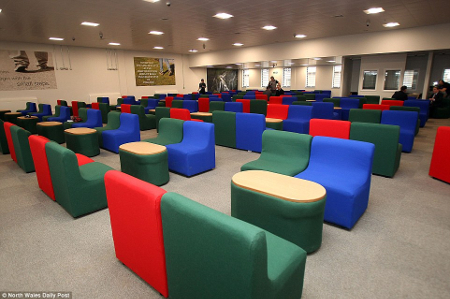
Motivational quotes such as “When a flower doesn’t bloom you fix the environment in which it grows not the flower” means nothing if a quarter of the population feel unsafe.
Prisons can be austere places, drab, filthy, old and not fit for purpose. But here we have a new prison with serious problems. There can be no excuse that these are teething problems, we are talking about peoples lives.
Remember the Berwyn Values?
V = value each other and celebrate achievements
A = act with integrity and always speak the truth
L = look to the future with ambition and hope
U = uphold fairness and justice in all we do
E = embrace Welsh language and culture
S = stick at it
Is this just a marketing ploy, designed for a feel-good factor, making us all think that the money spent on this Titan prison was worth every penny?
Independent monitors have praised the work of staff at HMP Berwyn describing their efforts to establish a new prison as a ‘considerable achievement” (Recent comment by IMB) After this shocking report, what will they now say? Or will they remain silent?
I don’t doubt there are some hard working, diligent and caring staff. In fact, I met some on my visit last year. But when the prison opened in 2017 over 90% of staff had never worked in a prison before. When you have prisoners arriving from over 60 prisons all with different regimes, you find they have far more experience of the prison estate than the majority of prison officers.
But more worryingly is that the Government is continuing with its programme of building new prisons. A new prison will be built in Wellingborough as part of the Government’s Prison Estate Transformation Programme. I’ve read gushing articles on how this prison will benefit the community etc, similar to when HMP Berwyn began construction. Just like HMP Berwyn there are many promises and opportunities, but theory and practice can be a million miles apart.
HMP Berwyn: Does it raise more questions than it answers?
A bright summer’s day. A short car journey, a train, 2 tubes, 2 more trains and I finally arrived after more than 5 hours of travelling, into Wrexham. I’ve come to HMP Berwyn. I’m here with an open mind and at the invitation of the No 1 Governor, Russell Trent.
HMP Berwyn is not very well signposted, it’s as if the locality is reluctant to admit such a place exists in their own backyard. On the way here, I asked some locals for their opinion on the prison, its location and its size given that it is not yet at full capacity. Many local people were hesitant in speaking about it. Others were really bemused when I said I was on my way there to meet the Governor.
“Well, they need to build a bigger car park”, one local said.
On arrival, from the outside, it resembles a business park not a prison.
Entering through large open doors I was greeted by a uniformed officer with a friendly face who showed me the lockers for my bag and phone, and the door to enter the prison. But it was the wrong door. I wasn’t asked why I was there or even who I was. I was sent back outside to another door, this time I approached a glass window and said I was here to see Russell Trent. Simple.
Unfortunately, the officer there had no record of my visit. Great start. I was then asked to put my driving licence onto the window, so they could read my name. Bingo, the glass screens opened, and I was inside.
I fully expected to be patted down. I wasn’t. I expected an officer to pass a wand over me. They didn’t. This surprised me.
The site is huge. I was immediately impressed by the overall cleanliness, both inside and out, the wide-open spaces between communities and grass, yes real grass, and flower beds. There was even a small area where they hold services of remembrance.
Berwyn Values
V = value each other and celebrate achievements
A = act with integrity and always speak the truth
L = look to the future with ambition and hope
U = uphold fairness and justice in all we do
E = embrace Welsh language and culture
S = stick at it
Sitting on a comfortable sofa opposite Number 1 Governor Russell Trent in his office, he pointed out the motivational quote on the wall.
“When a flower doesn’t bloom you fix the environment in which it grows not the flower”
But motivational quotes are everywhere throughout the prison, on stairwells, in corridors alongside photos of Wales. Another one that caught my eye was:
“You have got to be the change you want to see”
The Governor handed me a small pack of cards; each card represents a different Berwyn practice for each day of the month.
Day 1. We recognise achievements and celebrate successes #thankyou
Day 2. We actively listen to each other and make eye contact #respect
Day 3. We offer and ask for help and feedback #support
You get the idea.
This is a first, I have never brought anything out of a prison that I haven’t taken in and I have never seen such motivational material in quite the same way in any other prison I have visited. And I’ve been to every category of prison, more than once.
Having the opportunity to accompany Governor Trent as he did his rounds meant we could talk as we toured communities, healthcare, college, library, horticulture, accommodation, etc.
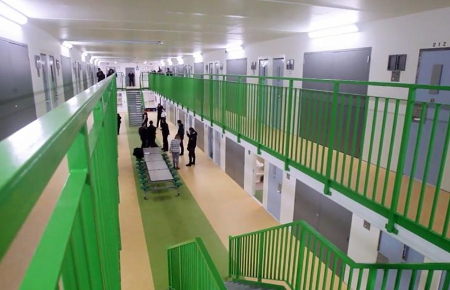 I watched as well as listened, as I always do, with my notebook at the ready for contemporaneous note taking. Governor Trent appears to be on the ball, knowing the names of the men and their sentence. Many politely came up to him with a query or problem they wanted resolving. If he didn’t have the answer, then he signposted or agreed to meet them later. I did find it odd when he was called “Russ” and even “Trenty”. I thought that was a bit over-familiar considering the whole ethos was of respect. Something didn’t quite add up.
In various conversations, the name of a certain community came up more than once and so did the name of a member of staff. It appeared some men felt fobbed off by this individual. I chose not to probe this but preferred to watch how it was dealt with.
I was introduced to the prosocial model of behaviour, a rehabilitative culture, making big feel small, the principle of normality and much more. Yes, Governor Trent is driven and considering over 90% of frontline staff have never worked in a prison before he has to sell his regime not only to the men but to the staff also.
The Ministry of Justice is very good at musical chairs, moving leaders around the prison service. It makes me wonder how long Governor Trent will remain at Berwyn.
Can Berwyn culture function without him and will the vision live on without his oversight?
Or will the settling cracks be more prominent or permanent?
In March 2018 there was a Death in Custody at Berwyn. The Prison and Probation Ombudsman (PPO) is still investigating and this death is unclassified as the cause is not yet known. I will not jump to any conclusions.
What I can say is during my visit I neither saw nor heard nor smelled any signs of drug abuse or spice.
Health and Wellbeing
Page 12 of ‘Rehabilitative Culture at Berwyn‘ states that “promotion of health and wellbeing is the responsibility of all whether they are living or working at Berwyn”. I think that collective ownership like this is a good thing because it means that the sole responsibility is not just carried on the shoulders of the healthcare team. The reason why this is good is because it replicates what goes on in the wider society.
I saw team sports in action, outdoor gym equipment and the outdoor running track. One initiative that caught my interest was the ‘Governor’s Running Club’. Men were proudly wearing their t-shirts which they were entitled to have once they had attended 5 successive weeks. Governor Trent emphasised to me that it was more about the commitment than the fitness.
Whilst all this looks favourable, one question I still have is the level of staff sickness at Berwyn. In ‘Annual HM Prison and Probation Service digest: 2017 to 2018, Chapter 15 tables – Staff sickness absence’ for the period 1st April 2017 to 31st March 2018 there were 3,628 working days lost (see Table 15.1, Column U, Row 18). It raises a concern as to why this is, given that Berwyn is not at full capacity and new communities are only opened once sufficient staff are in place.
Purposeful Activity
It’s all very well having unlock at 08:15 and lockup at 19:15 but if the industries, education, workshops, purposeful activities are not there then what?
And what do we mean by purposeful activity?
I saw one of the workshops, sewing prison regulation towels. A monotonous task, processing the same off-white coloured towelling. I’ve seen the same activity in other prisons such as HMP Norwich. Why is this happening in Berwyn? If sewing is to be one of the “purposeful activities” then surely this could be expanded to sewing something less bland and uninteresting using acquired skills that may be genuinely useful on release. For example, Fine Cell Work showcases how this is possible both inside and after release with their post-prison programme.
In another workshop I saw, I felt I was looking at something more purposeful; it was a call centre, provided by Census Group, run by a woman who was keen to praise the men in her group. I could see how skills learned here could translate into meaningful employment on the outside as well as provide interest, variation and a challenge for those participating in this activity.
I briefly stepped into the College building housing the prison library. If it wasn’t for the jangling of keys you could have been in any educational institution.
Accommodation
Whereas I had expected the heat, because my visit was in August, I had not expected the temperature levels inside on the landings of the communities and in the rooms I visited. It must have been at least 30 degrees.
I had heard a lot about the rooms here and saw many photos. However, you need to walk in one to fully understand the scale. For the rooms which are single occupancy they are compact, but I’ve seen smaller. A raised bed, with storage underneath, a desk with monitor, a plastic moulded chair. It has a shower/toilet/wash basin in the corner with a short curtain acting as a screen. And a small safe for locking away any medical supplies and that’s your lot.
Unfortunately, with only 30% of the rooms in Berwyn built for single occupancy the majority of the men have to double up.

In the double-occupancy rooms, it is the same layout for two but only slightly wider and another small bed with storage underneath. To share a room with someone you have never met and to have so little privacy going to the toilet or having a shower is entirely unacceptable for a new build prison in the 21st Century.
Here is where I have a problem with Berwyn as a model for Titan prisons.
According to ‘The Report of the Zahid Mubarek Inquiry’ published in June 2006, (download the PDF here) there were three main recommendations concerning enforced cell-sharing:
- The elimination of enforced cell-sharing should remain the objective of the Prison Service, and the achievement of this goal should be regarded as a high priority.
- The Prison Service should review whether the resources currently available to it might be better deployed towards achieving this goal, without compromising standards in other areas, and should set a date for realising this objective.
- If the resources currently available to the Prison Service are insufficient to produce a significant decrease in enforced cell-sharing, central government should allocate further funds to the Prison Service to enable more prisoners to be accommodated in cells on their own.
I’m sure I’m not the only one to be astonished that after 12 years these recommendations were not incorporated into the planning of Berwyn. They were made long before the architects’ drawings were prepared and before any ground works were dug.
How can the concept of a Titan prison be a showcase, a flagship, when recommendations such as these are willfully overlooked? Was it in pursuit of lower unit cost per prisoner?
Economies of scale
If it is such a flagship of the Ministry of Justice, a social experiment, a regime extraordinaire, or whatever you wish to call it, why hasn’t the Secretary of State for Justice or the Prisons Minister visited? I will urge them to come and see Berwyn for themselves.
I already have my doubts that Berwyn will ever reach its full capacity so in that case what is stopping it from turning all double rooms into single occupancy?
It has been built to 70% double, 30% single rooms, like a Walmart of the Prison Service, pack them high, sell them cheap
During my visit I was informed that the cost per head was £14,000. Afterwards, I contacted Berwyn to confirm and was told £13,500 per head. Compare this to the average annual overall cost of a prison place in England and Wales at £38,042 in 2017, according to Ministry of Justice report on ‘Costs per prison place and cost per prisoner by individual’, £35,182 in 2016 (download the 2017 PDF here and the 2016 PDF here). See: Table 2a, Summary Comparison
I wouldn’t be surprised if the figure was more like £11,000 – £12,000 per head at Berwyn, its “economies of scale” achieved by factors such as low salaries of frontline staff in their first year of service being the predominant workforce here.
The Berwyn Way
All the men arriving into HMP Berwyn are given Enhanced IEP status. The idea behind this is that the men then have to take some personal ownership to maintain that level. In other words, it leaves no room for incentives to improve status but only punishment if you don’t make the grade. In my opinion, it makes a nonsense of the IEP system and is inconsistent with many of the sending prisons of which there are 65. Is this demotivating those who have worked hard to achieve Enhanced elsewhere?
I remember when the last changes with IEP came into effect with Chris Grayling. Working in a prison where most of the men were on Enhanced yet half of them did not fulfil the new criteria to be on Enhanced. This brought about a two-tier system when people were transferred into the prison as they had to adhere to the new rules. This issue alone can have a big impact on the culture and effective daily operations inside a prison. I feel the same pitfall maybe true of Berwyn, albeit inadvertent.
I noted later that in the document ‘The Berwyn Way’ 3. Strategic priorities, Rehabilitative culture.
3.8 An important part of the realisation of Berwyn’s rehabilitative culture will be changing behaviour by reward, not punishment and everyone will work hard to uphold this ambition.
How can this be so when the IEP system is used not to reward, but to punish?
There is a clear disconnect here.
Respect: to get it you must give it
I noted that on one occasion entering a community, staff immediately stood up as we entered. My immediate thoughts, was this just a mark of respect or fear of reprisal later?
I rather hope it is the former rather than the latter.
But I have been in enough SMT meetings in other prisons, where Governing Governors have mouthed off over even a trivial matter, to know how that could have been out of fear.
I shook hands with many members of staff and the men housed there. Some men apologised for their language even though it wasn’t aimed at me. This showed self-awareness which is a vital characteristic in life as well as in living in a prison.
I came away with a brochure about the rehabilitative culture at Berwyn, a document on ‘The Berwyn Way’, a desk top flip chart and pack of cards of the Berwyn Values.
Summary
I’m commenting on a regime, I’m not criticising any individual. I’m evaluating and analysing what the consequences might look like for Berwyn based on what I have personally seen and heard.
The model of single-occupancy rooms is not a luxury, it’s a necessity.
It is time HMPPS stops putting profit before people.
Positive reinforcement of behaviour works much better than penalties.
In my opinion I would have to say, on the balance of probability, there should never be another prison built on the scale of Berwyn.
Featured photo courtesy of Inside Time which tweets as @InsideTimeUK
On-page photos courtesy of North Wales Daily Post which tweets as @dailypostwales
This visit to HMP Berwyn took place on Thursday 2nd August 2018.
My time and expenses were entirely self-funded.
~

Why Rehabilitation is a Right Prisoners are Entitled to: Adam Meylan-Stevenson
Much of the debate arguing that prisoners should be rehabilitated answers the question by claiming that rehabilitating people can benefit society by preventing future crimes. I agree with this claim and affirm it as true. However, I think the case for rehabilitation can be made stronger by showing that prisoners have a right to rehabilitation. If this claim succeeds, then opponents of rehabilitation must explain why it is legitimate to deny prisoners this right.
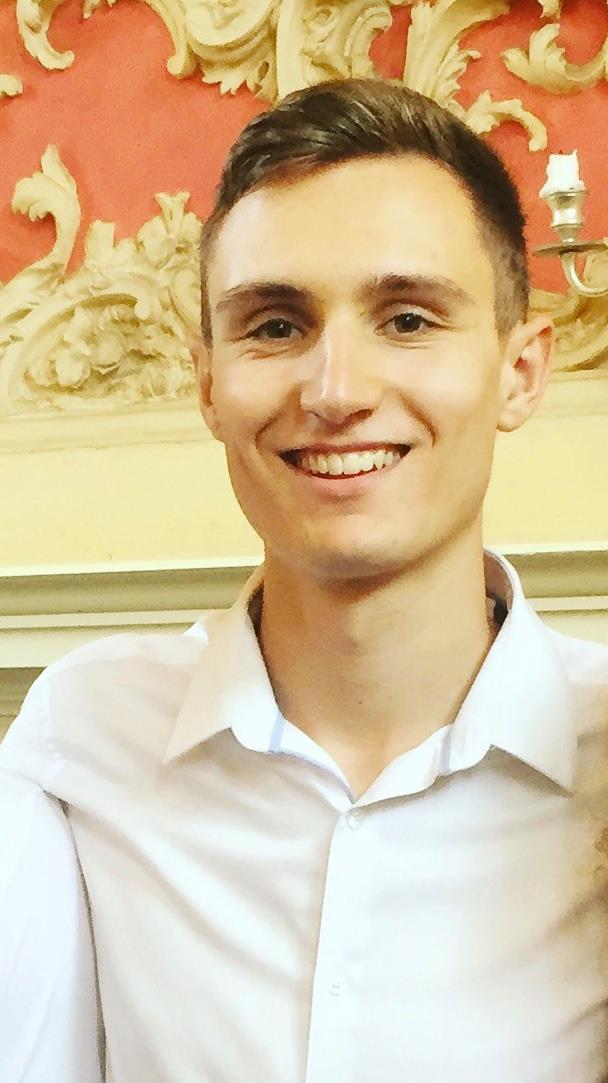
Adam Meylan-Stevenson
My argument is that people have a right to not find themselves in a worse position, economically, socially, or psychologically, after their prison sentence. It is common for people to be shunned after their release from prison. It can be hard to shake the label of ‘criminal’, despite having served their time. I think this attitude is mistaken. After a person has served their time and been released, they should have the opportunity to reintegrate with society and live purposeful lives.
One key advocate of this position is Egardo Rotman. Rotman has argued that just as the state has a right to punish individuals for wrongdoing, the individual has a right not to be made worse off by the effects of the punishment (Rotman, 1990, 184). However, the reality is that people are frequently made worse off by their punishments. One way, amongst others, this happens is how for many, having a criminal conviction is a barrier to leading a law-abiding life on release. In 2016, only one in four prisoners (27%) had a job to go to after release. One in five employers (19%) said they exclude or they were likely to exclude prisoners from the recruitment process (Prison Reform Trust, 2017, 16). The result of this is that even after serving their punishment in prison, people are still being debilitated.
From the above point, it seems imprisoning people is making people worse off after their punishment should have ended. We must ask ourselves, is it fair if an offender who has served their time is not able to move on with their life? From this, I think there is a moral requirement for the state to counteract the disabling effects of punishment and to provide rehabilitation, as a right, to offenders. Essentially, as the state is harming people by imprisoning them, it has a responsibility to counteract the harmful results that the punishment brings.
One worthwhile model of rehabilitation is ‘humanistic rehabilitation’. This model affirms the principle of prisoners as possessors of rights. The importance of this principle is that this legal status gives prisoners a sense of self-worth and trust in the legal system. An issue with our current system is that prisoners often feel alienated from society and hold resentment towards the outside world. Rotman argues embracing this model of rights-based rehabilitation favours the prospect of “self-command and responsible action within society” (Rotman, 1986, 1026). Following Rotman’s view, I believe this type of rehabilitation can be achieved through providing relevant psychological care, education, vocational training, and purposeful work. By purposeful work, I mean work that requires some skills that will be a stepping stone to allow prisoners to pursue full-time employment in a similar field upon release. Not menial work that only succeeds in making the prospect of full-time employment unappealing, like untangling headphones or packing plastic spoons (The Guardian, 2009).
Here, I will note that the Universal Declaration of Human Rights affirms all people have the right to work and education. Additionally, prisoners in the UK are entitled to the same healthcare individuals in the community receive, including mental health care. As this form of rehabilitation largely takes the form of education, work, and appropriate psychological treatment, the opponent of rehabilitating prisoners must explain why these rights should be removed from people in prison. I think there is no sound basis for removing these rights from prisoners. It is clear some rights can justifiably be removed from people. For example, the right to liberty can be removed for the justifiable reason of protecting the public from an individual and to protect the individual from vigilante reprisals. However, there is no justification for removing the rights to work and education that individuals enjoy before they are imprisoned. It would have no good end. Therefore, it can be shown that prisoners have the right to be rehabilitated.
Of course, the costs of the resources to achieve meaningful rehabilitation will be expensive. This approach will receive opposition from a public and political opinion that is generally punitive and other services across the country are strained. However, I would argue that this view is short-sighted. Whilst rehabilitating offenders is expensive in the short-term, if it is effective and crime goes down and communities get safer, then the cost has justifiable ends.
Ultimately, my argument is that prisoners have a right that entails that useful services should be provided, where appropriate and practically possible, to counteract the debilitating effects of prison. It is a case of justice that if prison makes people worse off, then the state is required to provide rehabilitation to counteract this. Prisoners are not sentenced to idleness, it is not necessary nor desirable. Instead, people’s time inside should be spent meaningfully, to allow them to reintegrate with society upon release.
Adam Meylan-Stevenson
adamcobblers@gmail.com
@Adammeylan_s
References
Allison, E. (2009). A fair day’s prison work? | Eric Allison. [online] The Guardian. Available at: https://www.theguardian.com/society/joepublic/2009/sep/09/prison-work-exploitation.
Prison Reform Trust (2017). Prison: The Facts. Bromley Briefings Summer 2017. [online] London: Bromley Trust, pp.4-16. Available at: http://www.prisonreformtrust.org.uk/Portals/0/Documents/Bromley%20Briefings/Summer%202017%20factfile.pdf [Accessed 9 Dec. 2017].
Rotman, E. (1986). Do Criminal Offenders Have a Constitutional Right to Rehabilitation?. The Journal of Criminal Law and Criminology (1973-), [online] 77(4), p.1023. Available at: https://scholarlycommons.law.northwestern.edu/cgi/viewcontent.cgi?referer=https://www.google.co.uk/&httpsredir=1&article=6540&context=jclc [Accessed 10 Dec. 2017].
Rotman, E. (1990). Beyond Punishment. 1st ed. New York: Greenwood Press, p.184.

Why rehabilitation is important for society

Society puts people in prison and expects them to reintegrate after their sentence and not reoffend. But recidivism is high because often the root cause of offending is not addressed.
Rehabilitation can be described as restoring, rebuilding, or repairing and in the context of those that have spent time in prison a means of re-joining society and hopefully being accepted, but that’s not always the case.
But what if they don’t want to be “rehabilitated” or don’t see the need for it? This is when questions arise such as:
Can true rehabilitation exist, if so what does it look like?
Does ‘rehabilitation’ force a way of life onto people that we deem ‘acceptable’?
Does our lifestyle fit the mould that we expect of those that have offended and ‘need to be rehabilitated’?
We must ask ourselves if we really want to give people a 2nd,3rd…chance or whether we as a society are too punitive to allow people to move forward with their lives.
So, society can and does hinder rehabilitation by placing certain requirements upon those that have broken the law that may not be relevant and therefore putting unnecessary pressures on them.
What we as part of society expect, could we even live up to and could it be said we are setting people up to fail so we can say “I told you so”?
It is too easy to recall over minor issues such as lateness to appointments or forgetfulness when we all fall foul of these from time to time. Making those expectations so high we could almost see rehabilitation as a form of control or conformity to a norm that many would not recognise.
For some picking up where they left off is not an option due to the nature of the crime, family circumstances or health.
But if we build a barrier to those who pose no threat to society which prevents them from re-joining their work sector then are we continuing to punish?
I have seen the crushing stigma that many live under on release; the failure of a system that is meant to be there for them beyond the gate, the lack of accommodation, the difficulties of finding work, the list goes on.
Recently David Gauke the Secretary of State for Justice said:
“…I want more employers to look past an offender’s conviction to their future potential.
How do we do that?
Well, we do it by working more closely with employers, so they open their eyes to the benefits of hiring ex-offenders…”
Sounds all well and good, however, the stigma of a criminal record can be a barrier to even getting an interview. As Christopher Stacey, Co-director of Unlock states:
“The current criminal record disclosure has multiple, harsh consequences and damaging effects on individuals, in particular it deters people from applying for employment and for those that do apply it brings high levels of stress, anxiety and feelings of shame and stigma. It acts as an additional sentence that often runs for life. It desperately needs reform”
https://twitter.com/unlockcharity/status/1008633161478176769
Is it time for society to think differently towards people who find themselves in prison and as Erwin James (The Guardian, 2013) succinctly wrote:
“…however unpalatable it may be to some, the fact is prisoners are still people, and if we want them to have any respect for society when they get out we need to be mindful of their dignity as fellow human beings” (Erwin James, The Guardian 2013)
first published on http://www.raggeduniversity.co.uk
 The Criminal Justice Blog