
Home » prison (Page 6)
Category Archives: prison
We don’t just need a vision, we need a cause!

“She’s no rebel and she’s got a cause”
In the space of 6 weeks I have written an article which has been published in The Prisons Handbook 2016, just before the Prime Ministers speech. I have been interviewed by Ian Dunt with an article put on politics.co.uk, been in my local paper with a 2 page spread, had a front page article in Converse prison newspaper, had an interview with another newspaper with an article ready for the next months edition… If I can achieve all this in just 6 weeks, just imagine what could be achieved in 6 months or a year?. It’s all about going at pace.
It’s not always about what you have achieved in the past, although it does help. But it’s about what you can/will/want to do in the future.
Can’t abide being held back because of what I haven’t done yet. Especially when I’m at the start of something significant and have plenty of passion, energy and drive for what is to come.
And despite the knock backs, to keep a sense of humour.
Yes I have mainly worked with vulnerable adults and children before, but we all have a vulnerable side to us. Some are able to reveal it, others not, some it leads to being a victim and others it leads them into criminal activity.
Have you noticed how quick some people are to judge others, put you into boxes and to categorise? I hope you won’t judge my life by the chapter you just walked in on.
Prisons are no different.
Many problems arise when people enter the prison system and then leave in a worse state than when they arrived.
Why after all the money pumped into prisons is this happening?
Profits are made out of prisoners, we all know that.
How many reviews, reports can you count over the last say 10 years that involve prisoners?
There have been countless
How many organisations do you know that work hard to bring reform to prisons and prisoners?
There are countless
How much money has been spent on prison reform?
Countless
On 8th February, the Prime Minister set out a vision for prison reform. Mr Cameron said:
This system will be hard to change because it is, in some ways, still stuck in the dark ages – with old buildings, old thinking and old ways of doing things.
So I don’t want to go slow here – I want us to get on with proper, full-on prison reform.
Today, 27th May the Public Accounts Committee report warns that the criminal justice system is close to breaking point:
Report summary
- The criminal justice system is close to breaking point.
- Lack of shared accountability and resource pressures mean that costs are being shunted from one part of the system to another and the system suffers from too many delays and inefficiencies.
- There is insufficient focus on victims, who face a postcode lottery in their access to justice due to the significant variations in performance in different areas of the country.
Criminal justice system “already overstretched”
- The system is already overstretched and we consider that the Ministry of Justice has exhausted the scope to make more cuts without further detriment to performance.
- The Government is implementing reforms to improve the system but we are concerned that users of the system won’t see the full benefit for another four years.
- There are opportunities for the Ministry to make improvements before then, including better sharing of good practice and making sure that everyone is getting things right first time.
But what is the answer?
(If I had the answer I would be a very rich woman!)
Over the last few years I have visited every category of prison, YOI and Women’s. I have sat behind the Right hon. Michael Gove MP whilst he has been in front of the Justice Select Committee twice. I have attended meeting after meeting in Westminster, attended conferences, training courses, lectures, seminars etc. at my own cost.
Why?
I want to learn, I want to understand but most of all I want answers to the questions I have posed.
I also want to be a part of the change that is so desperately needed in our prisons.
We don’t just need a vision, we need a cause!
Vision is often personal, but a cause is bigger than any one individual
People don’t generally die for a vision, but they will die for a cause
Vision is something you possess, a cause possess you
Vision doesn’t eliminate the options; a cause leaves you without any options
A good vision may out live you, but a cause is eternal
Vision will generate excitement, but a cause generates power
[Adapted from Houston (2001)]
Houston, B. (2001) For this Cause: Finding the meaning of life and living a life of meaning. Castle Hill: Maximised Leadership Inc.
What is it about the word ‘dishonesty’ you don’t understand?
Why the debacle inside HMP / YOI Hollesley Bay IMB impacts us all.
A Guest Blog by Joseph Spear.
In the world of business, nominations for top Board positions are taken very seriously. People have to be proposed, seconded and there is a formal transparent procedure that must be followed before appointments can be made.

Like a bridge over troubled water?
In clubs and associations, nominations for Board positions are also taken very seriously. Depending on the articles of association, a process is followed in a transparent way and a President or a Chair person is duly elected.
In professional bodies, nominations for Board positions similarly are taken seriously. A timely reminder is the appointment on 12 May of John Wadham as Chair of the National Preventative Mechanism (NPM).
These are the established rules of nominations.
So why then would equal weight not be given in the context of a holders of a statutory public office?
But that’s exactly what seems to be happening inside one body called the Independent Monitoring Board (IMB), which is meant to be the watchdog of the prison system in England and Wales.
Members of the IMB at HMP and YOI Hollesley Bay appear to think the rules don’t apply to them, taking matters into their own hands when it comes to how they treat their Chairman.
Unbeknown to the current Chairman, members of the IMB board there have gone behind their Chairman’s back, launching nominations that amounts to a coup d’état.
When the current Chairman caught wind of this complicity and divisiveness, naturally they were deeply unimpressed.
Now we all live in the real world and we all know these sorts of power struggles go on all the time. You would be forgiven for thinking this is a non-story.
Afterall, this isn’t exactly an impeachment of a nation’s president in Brazilia, this is a group of ten grey-haired people in a tiny Cat D open prison in sleepy Suffolk.
But wait.
What is remarkable about this story, and of far greater gravity than you might think, is what has also come to light since.
An email trail was leaked that showed not only the existence of Nomination Forms drawn up by the Board in anticipation of forcing out the current Chairman but also – and here’s the rub – a premeditated and deliberate intent to destroy the Nomination Forms and to lie that they ever existed.
Still think this is a non-story? Okay then, just read on.
This happening in business or in a club or association, or a professional body would be bad enough. But this happening in a Public Office, and being committed by holders of a statutory public office is reprehensible and could amount to conspiracy to commit misconduct in a public office.
Hardly a non-story now, is it?
The leaked email in question was sent from the previous Chairman to the current Vice Chair on 03 May 2016 and read as follows (unredacted):
“Nominees for Board positions. A delicate one, that was devised in the hope or expectation that Faith would resign. She has not and if she became aware that nominations had been requested, it would add fuel to the fire. But getting the process going shows our seriousness in planning for Board continuation. Might it be worth consulting John T/Alex and telling them what is in place? I suppose we could always tear up the nomination forms and pretend it never happened. Or brazen it out if everyone agrees to go ahead. Either way, Linda needs to know when to circulate the forms to all, inc Faith. Meantime, you might ask her to sit tight?”
Just take a moment to re-read and absorb that.
This in itself gives rise to further questions, for example:
- devised in the hope or expectation that [the current Chairman] would resign… Who devised them?
- if she became aware that nominations had been requested…. Why act in secrecy?
- tear up the nomination forms… Where are these forms now and What else might have been torn up?
- pretend it never happened… What else might have “never happened”?
These are inconvenient questions, especially in a prison.
IMB members hold a statutory public office and moreover are appointed precisely to ensure against situations such bullying in prisons. See the 4th paragraph of this IMB website page. They are meant to be trusted by the prisoners as well as by the public to handle issues confidentially not in secrecy; they aren’t meant to be the ones doing the bullying. They aren’t meant to be the ones tearing up official paperwork or lying about what happened, are they?
Why are these people behaving like this?
This whole episode erupted following the publication of an article in The Prisons Handbook 2016 entitled “Whistle Blower Without A Whistle” which calls out a number of reasons why independent monitoring of prisons is not fit for purpose in its current form.

It ain’t a Daisy either
The writer of that article was the current Chairman of the Board at Hollesley Bay IMB, but it was published under the pseudonym Daisy Mallet because, according to them, it was more about the issues than it was about the writer. And it was written in good faith, not as a personal grievance against anything or anyone.
The members of Board found out the current Chairman was the real author of the ‘Whistleblower’ article and took personal offence to one of the arguments it contained but ignored the rest. They then apparently colluded against the current Chairman, plotting to oust them from their position as Chairman in reprisal whilst maintaining a pseudo friendly front.
The pivot point arrived at the monthly Board meeting on 19th April when the current Chairman arrived as usual and started the monthly Board meeting with a short personal statement confirming they in fact did write the article and outlining the reasons why.
What ensued when the current Chairman finished their personal statement was workplace bullying on a scale never seen before in an IMB meeting. The other nine Board members, orchestrated by the Vice Chair, took turns to interrogate the current Chairman. They were each working from pre-prepared questions and had clearly all been briefed against the Chairman in advance of the Board meeting.
Whereas the current Chairman attended expecting to answer questions then move on with the agenda, nothing could have prepared them for the personal verbal attack they received from all members of the Board.
The attack lasted 50 minutes.
It was venomous.
It was brutal.
Against the odds, the current Chairman has decided to stand firm on the grounds they have actually done nothing wrong, certainly nothing so as to bring such reprisals upon themselves, simply expressing their own well-grounded and well-informed opinion in the context of an article.
The ‘Whistleblower’ article was even reproduced by the AMIBM on its own website. AMIMB is no stranger to criticising the IMB (see Independent Monitor, July 2015, Issue 116, pages 3-5 opens as pdf) but no reprisals are being levelled at them and no Chairman being removed in secrecy.
The treatment the current Chairman received on that day is currently under investigation by the Ministry of Justice. The investigator has interviewed all concerned and is due to file their report before the next monthly Board meeting of Hollesley Bay IMB, scheduled for Tuesday 17 May.
Subsequently, a senior officer of The Secretariat, a back office function staffed by salaried civil servants to support all IMBs and officed on the 9th Floor actually inside the MOJ HQ in 102 Petty France in London, took it upon themselves to telephone the current Chairman on their personal mobile phone.
In that call, which lasted 30 minutes, the Secretariat’s senior officer warned the current Chairman that the Minister would take a dim view of making public the leaked email trail, speaking as if they knew the mind of the Minister without even consulting them.
The current Chairman, quite understandably, took that verbal warning as even more pressure being applied on them to coerce and, ultimately, cause them to shut up and to go quietly.
Tellingly, the current Chairman has seen neither hide nor hair of the Area Representative for the National Council, the body which coordinates all IMBs. Not so much as a call or an email from the Area Rep to offer advice, support, or even to arrange a “local resolution” involving all the parties.
How strange.
That should have been the very first course of action, at least according to the IMB’s own protocols in cases of such disagreement at Board level.
Yet the Area Rep has had ample communication with the current Vice Chair and with the previous Chair, as a separate email trail clearly testifies. Moreover, so has the president of the National Council and the Head of The Secretariat.
It would seem that the degree of complicity and dishonesty is spreading from a localised level inside the Hollesley Bay IMB right to the heart of The Secretariat and National Council itself.
Or perhaps it is the other way round?
At the time of writing, Faith Spear is the current Chairman at Hollesley Bay IMB and intends to remain in office this year.
The situation continues.
Joseph Spear is married to Faith Spear.
Footnote from the author:
“You’d expect me to speak up for Faith because she’s my wife and because it’s the right thing to do.
If like me you’d also like to express support for Faith Spear, please feel free to share this blog using these Twitter hashtags: #SpeakUp #GoodFaith #whistleblower #prisons
Thank you.”
~
Getting personal about the cost of being a Whistleblower
When you feel so passionately about a subject or issue(s) it is very hard to keep quiet. This is what I have experienced recently:
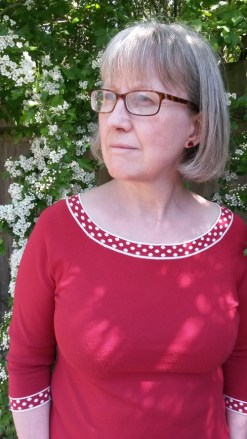
It’s not about me. It’s about the issues I’ve raised.
I had to weigh up the risk of possibly causing offence versus the need to speak.
I decided to speak!
What happened next shocked me.
Suddenly people that I had respect for and worked so well with turned against me in the most brutal way. I didn’t expect everyone to agree with me but I certainly didn’t expect quite the fallout.
I was looking at the bigger picture and the wider issues but they were blinkered. Was I wrong to speak out?
NO.
I wanted to raise issues and put them firmly on the agenda of those that could or should actually do something about them.
Maybe the problem was that they didn’t expect someone like me to put their head above the parapet and voice my opinion. We all have a voice, we all have opinions and we should not feel that we have to suppress them. I did, I felt that I couldn’t really express myself, would anyone listen?
It was an important step for me to speak out and it has come at a great personal cost. I haven’t slept well or eaten properly since 19th April. I have felt under pressure, stressed out and really not myself. It has been an emotional roller-coaster.
I made the decision to stand up, I could have rolled over and played dead but I didn’t.
But people are listening, they are taking notice and they are supportive and above all they agree!
We all know the saying ‘action speaks louder than words’ but often you have to speak before any action can take place. So I’ve spoken and I expect results.
I’m not looking for a slice of the action, the last time I was in a newspaper was at the age of 10 having won an art competition with my sister and fellow classmates. Now the press come looking for me!
Prisons.org.uk (pdf)
Converse (pdf)
I have faced criticism like never before, I have been told that I am not fit to stand for the public office I occupy and that they could never forgive me for what I have done.
But really it’s not about me, or shouldn’t be about me; instead it should be about the issues I have raised.
What happened on the way to prison

St Pancras rail station, London
Sat drinking my Earl Grey tea at the train station on my way to a London prison, I was approached by a young man. He was dressed in grey jogging bottoms, a hooded jacket and a union Jack bobble hat, carrying a small bag and a small blanket tied to the straps.
He asked me for any loose change and I asked him what he needed it for. In a hushed voice he said it was for a bed for tonight yet it was only 11:15 am. He explained the hostel would cost £12 for 5 nights. I asked him if they provided food he said yes. I apologised for not having any change with me but said I hoped he would manage to get the money together and told him to take care.
There are many like this young man; you could see the hopelessness in his eyes and his manner.
We live in such a rich country yet there are so many who struggle financially for various reasons.
It wasn’t really the poverty of that young man that struck me, but the way other people in their fine clothes completely ignored him.
Even if we are not in a position to help we can still show kindness. We are all capable of prejudices, even when we don’t see the full picture. I think we need to stop living our lives with our heads in the sand!
Volunteering in the Justice Sector
Today I read volunteering is good for your health as you tend to visit the doctor less!
This may be the case and I should know, I have worked as a volunteer for over 20 years and in the Justice sector for over 3 years
A big misconception is that a volunteer just makes tea!
After going to University as a mature student I received a BSc (Hons) in Criminology in Nov 2011. I then spent a year working with my local CAB and completed the course to become a Gateway Assessor as I was told you need to have voluntary work on your CV especially if you have changed direction. This was a real eye opener to the needs of people. After answering an advert in the paper to join the Independent Monitoring Board at HMP/YOI Hollesley Bay in 2013, I started on a very interesting journey. I am now the Chairman.
Apart from the IMB, I have been a group leader for Prison Fellowship England and Wales since 2012 involving managing a small team, all volunteers that deliver the Sycamore Tree victim awareness course in prisons. Meeting monthly and also speaking at various clubs, groups and churches on Restorative Justice and the work I do in prison. I have also been on the Steering Group for the Reclaim Justice Network for over 3 years, attending meetings, AGM’s and supporting events when I am able.
In addition I am a member of the Centre for Crime and Justice Studies (CCJS) and the Howard League. I have been invited to visit many prisons and events in the Justice sector and have been an observer at the Justice Select Committee. I have lost count of the number of conferences, lectures, wine receptions and exhibitions I have attended as I try and keep informed. I write a blog and am known on twitter!
I am passionate about wanting change within the prisons, purposeful activity and education are but a few of changes needed. I try to encourage those in prison and those that have been released.
But all of this is as a volunteer.
I have applied for many jobs since graduating but there have been two main problems. The first being the idea that volunteers make the tea and don’t have real input and so can be a bit clueless. The second being I cannot find a more interesting and at times rewarding line of work. I’m not someone to sit in front of a computer on a daily basis. My work is varied and I enjoy the interaction with prisoners, Governors, staff, my team and my many contacts. I like to be organised and punctual. I like tea, but don’t sit around drinking it all day.
Volunteering is rewarding, I recommend it as it’s an essential part of society but I’m ready for a change…!
Purposeful activity in Prisons!
Why is it that so many prisoners have very little to do whilst serving their custodial sentence?
Surely it cannot help their mental health that is often quite fragile anyway when they spend hours upon hours in their cells with nothing to do. With access to workshops, education and the library dependent on the number of staff on duty, prisoners are just locked away.
Prisoners need meaningful activities that serve a purpose not a mind numbing repetitive exercise. I remember having a tour of HMP Whitemoor after a meeting, one of the workshops was dismantling CD’s. Talk about repetitive. Prisoners removed the plastic film, took apart the case, removed the paper inside, and took out the CD for hours and hours on end. Come on I’m sure the prison service can do better than that. Recently I visited HMP Norwich; here they have a fantastic facility for training prisoners in sewing skills using industrial machines. They made prison issue towels and wash bags, however, all the material used was bland off-white no pattern no bright colour. Now I like sewing but staring at the same colour days on end would drive me potty! Why these machines can’t be used for something more stimulating I wonder? The equipment is available, the workforce is trained so…!
In society there are those that are not particularly academic but are very creative, it’s the same in prison.
Many prisoners seem to be placed in prison then spat out at the end of their sentence with not much to show for the time inside. This needs to change, how can prisoners be rehabilitated and not reoffend if they have often no job or education to go to afterward? It’s then a spiral downwards, what a waste of time, money and more importantly the lives of those that have been incarcerated.
There is so much un-tapped potential in prison!
Last weekend I travelled to Tymperley’s in Colchester to see an exhibition and sale of textiles such as cushions, bed-runners and Christmas decorations all produced by prisoners trained through Fine Cell work.
 There I met I met a very enthusiastic Lucy Baile, fundraising and administrative assistant.
It was so refreshing to see work produced to such a high standard and it certainly was one of the best examples of purposeful activity I have seen.
Lucy explained that there were around 270 volunteers giving up their time to teach needlework skills both to male and female prisoners so that the many hours spent in their cells are not time wasted.
Why can’t there be more schemes like this?

Buying a piece is an investment not just in a beautiful object but in people’s lives, to me worth every penny
This is what they say on their website:
OUR MISSION
STITCHING A FUTURE
Fine Cell Work trains prisoners in paid, skilled, creative needlework undertaken in the long hours spent in their cells to foster hope, discipline and self esteem. This helps them to connect to society and to leave prison with the confidence and financial means to stop offending.
OUR VISION
We wish to build Fine Cell Work as a sustainable charity with the prisoners as stakeholders in the enterprise. We are aiming to become more embedded in the prison system and to guide prisoners towards formal work training and qualifications and to match them up with organisations that can provide support or employment on release.
OUR VALUES
- Listening and Respect: Inclusiveness, equality and empathy with each other. We are non judgemental and accepting of our difference.
- Creating Opportunites: We believe in second chances and people’s ability to unlock their potential in a safe, creative environment.
- Giving back to Society: Not just us, but prisoners and volunteers too.
- Collaboration: We have a “can do approach”, we believe in clear boundaries, open, honest communication and in staff, volunteers and prisoners working together to create solutions.
- Creativity and Enterprise: We take pride in creating products of high value.
Suffragette extraordinaire: Constance Lytton: Living for a Cause
This is an article that I wrote last year with my good friend David Scott concerning a suffragette extraordinaire!
Constance Lytton: Living for a Cause
David Scott and Faith Spear
Vision is often personal, but a cause is bigger than any one individual
People don’t generally die for a vision, but they will die for a cause
Vision is something you possess, a cause possess you
Vision doesn’t eliminate the options; a cause leaves you without any options
A good vision may out live you, but a cause is eternal
Vision will generate excitement, but a cause generates power
[Adapted from Houston (2001)]
In Prisons and Prisoners: Some personal experiences by Constance Lytton and Jane Warton, published 100 years ago this month in March 1914, Lady Constance Georgina Bulwer-Lytton presented one of the most significant challenges to 20th Century anti-suffrage politics. In so doing she put herself forward as a “champion of women” (Lytton, 1914) in the hope that one day women would attain political equality with men.[1] Prisons and Prisoners is a comprehensive and at times a harrowing personal account of her four prison sentences as a militant suffragette. The book is a compelling insight into the mind of a young woman consumed by a cause which would prove to be instrumental in prison reform and votes for women,as well as tragically being a contributory factor to her death.

Desperate to find some way of empathising with the other suffragettes, Constance Lytton had a desire to stand beside those who were fighting. She was with them not as a ‘spare part’ but as a comrade. Most famously, to avoid receiving special treatment and privileges as a result of her family connections, she took on the guise of ‘Jane Warton’ and in so doing personally experienced the horrors of prison, including force-feeding. Although her health suffered, her story is one which shows courage, determination and an undeniable dedication to equality and justice (Lytton, 1914).
Concentrating attention on political injustice and votes for women, Constance Lytton brought notice toclass and gender disparities in punishment and the struggles for the rights of women, always maintaining that the suffragette’s militant actions were political rather than criminal. This all from a woman that described herself as having an exaggerated dislike of society and of publicity in any form and yet remarkably was at the same time a militant suffragette who took part indeputations to Parliament and prolonged periods of penal incarceration (Lytton, 1914; Haslam, 2008).
Lady Constance Lytton is not the only woman from a privileged background who has written about her prison experiences. The famous Irish rebel, Countess Constance Georgine Markievicz (1927/1973), most well known for her participation in the 1916 Easter rising, wrote extensively about her time in prison. Indeed, her prison letters were published to huge acclaim and are still considered today to be of great political significance. In more recent times – October 2013 – Vicky Pryce, former joint head of the UK’s government economic service, published her account of her three and a half days incarcerated in HMP Holloway (12th-15th March 2013)and eight weeks in HMP East Sutton Park Open Prison (15th March – 12th May 2013).[2] Her book, Prisonomics, which ultimately seeks to predicate penal change on an economic rationale rather than on humanitarian concerns, has not been so well received. The reaction is partly because it cannot be considered as representative of the lived realities of most women in prison,[3] partly because of the privileged status she was accorded inside prison and the vast economic resources at her disposal,[4]and partly because of the support she was given in writing the book and her failure to identify closely with the painful realities of other prisoners.[5] Yet perhaps the most damning indictment comes when the book is compared to the prison writings of people like Countess Constance Markievicz or Lady Constance Lytton, for then it becomes evident just what is missing from Prisonomics.
Lytton’s experiences of imprisonment
After being arrested for being part of a deputation marching to Downing Street on 24th February 1909, Constance Lytton was sentenced to four weeks’ imprisonment in HMP Holloway. In Prisons and Prisoners, she provides extraordinarily rich descriptions of prison conditions, daily routine, fellow prisoners and prison wardresses in Holloway prison at that time. Although initially held in the hospital wing because of her poor health, following acts of resistance which in effect amounted to self-harm, she was allowed to join other prisoners on ‘the other side’ in the main wings (Lytton, 1914). She had a brilliant eye for detail and provides a number of clear and vivid accounts of sometimes overlooked aspects of prison life. For example, she describes how her prison clothes, with broad arrows stamped over them, were often ill-fitting, stained, unironed and looking unwashed even after they had been to the laundry. Further, the poor design and cut of her prison shirt was not just uncomfortable but so bad it “looked like the production of a maniac” whilst her prison shoes were too small and painful to walk in (Lytton, 1914). The prison cells were small, bitterly cold and poorly ventilated, making it hard for prisoners to breathe, never mind stay warm. Beds were uncomfortable whilst pillows were “stuffed with thunder”, making sleep and rest difficult under the best of circumstances and, when compounded by noise, impossible (Lytton, 1914).
In Prisons and Prisoners Constance Lytton draws the reader’s attention to the lack of privacy, including the ironies of being in so many ways alone in prison yet at the same time not having the opportunity to retreat to a private space of one’s own. She recounts the monotony of prison daily routine where days collapse into each other and the general dragging of time engendering feelings of wastefulness. She complains about the rigid enforcement of petty rules and the judgmental opinions of wardresses which make prisoners feel like they belong to “a race apart” (Lytton, 1914). Insightfully, Constance Lytton also recognised the difficulties wardresses had in understanding how the pains of imprisonment shape prisoners’ experiences, for such things the prison official can only “witness without sharing them”(Ibid). She rightly concludes that this results in a general failure on the part of prison officials to correctly read the feelings, meanings and actions of those they detain.
Constance Lytton acknowledged that her prison experience was mitigated somewhat by who she was. Despite the poor conditions she encountered, some improvements had been made on her arrival, including the supply of knives and forks which had not been available to prisoners in Holloway before her time there.As perhaps only an aristocrat would, she yearned for an authentic prison experience, and noted how other women prisoners seemed dejected, lifeless, listless, detached from each other and haunted by their own suffering, anxiety and bitterness (Lytton, 1914). On a number of occasions in her reflections on her time in Holloway prison,she uses her pen to poetically describe the abnormality, pain, sadness and venomous nature of penal incarceration, leaving the reader in no doubt of her repugnance of the penal machinery and its inevitably destructive results.
The prison from here looks like a great hive of human creeping things impelled to their joyless labours and unwilling seclusion by some hidden force, the very reversal of the natural, and which has in it no element of organic life, cohesion, or self-sufficing reason. A hive of hideous purposes from which flows back day by day into the surrounding stream of evil honey, blackened in the making and poisonous in result. The high central tower seemed to me a jam pot, indicative of the foul preserve that seethed within this factory for potting human souls (Lytton, 1914).
Despite all the bleakness of the prison experience, Constance Lytton emphasised above all else those moments when humanity and the human spirit were able to overcome the brutal indifference characterising daily prison routines. She writes about the kindness and compassion of other women prisoners (especially other suffragettes) and the brief glimpses of humanity that she saw hiding behind the “masks” worn by wardresses when performing their duties (Lytton, 1914). Indeed, for her such “rare occasions of gladness outweigh from their importance the much more numerous experiences of gloom, anxiety, anger and physical suffering” (Ibid). Yet she never became blinded by these brief moments of “gladness”, keeping her sights firmly upon carefully describing the “nightmare of horror” of HMP Holloway and a dehumanising system which trapped both prisoners and wardresses (Ibid).
Shortly after her release from Holloway prison, Constance Lytton was arrested and sentenced to imprisonment for a second time, on this occasion on Saturday 9th October, 1909 for throwing a stone at the car of Sir Walter Runciman in Newcastle-Upon-Tyne. Once imprisoned, she immediately went on hunger strike at HMP Newcastle. Although refusing medical examination, her health condition was still officiously checked and, after abstaining to eat food for three of the days into her one month sentence (Monday 11th – Wednesday 13th October, 1909), she was released. Her release was ordered – according to Home Secretary Herbert Gladstone – because of concerns regarding her heart condition. Unlike working class women suffragettes on hunger strike in prisons, the aristocrat Constance Lytton had not been force-fed. The belief that her class background had shaped her treatment in prison led to a fundamental change in her tactics.
‘Jane Warton, Spinster’ and Walton Prison
The writings of Lady Constance Lytton on Holloway and Newcastle prisons are undoubtedly worthy of commemoration in their own right, but what she did next was truly remarkable, making Prisons and Prisoners one of the most unique prisoner autobiographies ever written. After hearing about the force feeding of a working class suffragette of her acquaintance, Miss Selina Martin, and another named Miss Leslie Hall, while on remand at Walton Prison in Liverpool, Constance Lytton hatched a plan that would entail, if necessary, “sharing the fate of these women” (Lytton, 1914). Her intention was to transcend her class background in an attempt to understand the lived experiences of working class women prisoners. In so doing, she hoped to express political solidarity with the suffering of less fortunate others and to use her own frail body as the central way of achieving this.
Whilst visiting Manchester in early January 1910, she disguised herself with a most ridiculous hair-cut, cheap glasses and even cheaper clothes and then rejoined the WSPU [Women’s Social and Political Union] as ‘Jane Warton, Spinster’ (Lytton, 1914). She had chosen her new name carefully: the first name was taken from Jeanne of Arc (Jeanne is translated as either Joan or Jane)whilst the surname was derived from her relatives the ‘Warburtons’ but shortened to ‘Warton’ to appear more ordinary. She hoped the real meaning of her name ‘Jane Warton’ would give her strength in what she anticipated would be difficult times ahead (Ibid).
‘Jane Warton’ was subsequently arrested on Friday 14th January 1910 after participating in a protest march about the force feeding of working class women suffragettes like Selina Martin in Walton prison. ‘Jane Warton’ started her hunger strike in the police cells that Friday evening, a couple of days before she was to begin her sentence at Walton Prison. Just as she had done so under her real name, when in prison ‘Jane Warton’ refused medical examinations. There was, however, to be no further investigation into the health of working class suffragette ‘Jane Warton’ and 89 hours into her hunger strike, force-feeding began. Between Tuesday 18th and Saturday 22nd January 1910, ‘Jane Warton’ was to have liquidised food poured into a tube forced into her stomach through her mouth on eight separate occasions.
At 6.00pm, Tuesday 18th January1910 her first force feeding started. The medical officer and five wardresses entered her cell with the “feeding apparatus” (Lytton, 1914). There was no attempt to medically examine ‘Jane Warton’ and the half-hearted made attempts by the medical officer to induce her to eat unsurprisingly failed.
I offered no resistance to being placed in position, but lay down voluntarily on the plank bed. Two of the wardresses took hold of my arms, one held my head and one my feet. One wardress helped to pour the food. The doctor leant on my knees as he stooped over my chest to get at my mouth. I shut my mouth and clenched my teeth… The sense of being overpowered by more force than I could possibly resist was complete, but I resisted nothing except with my mouth… He seemed annoyed at my resistance and he broke into a temper as he plied my teeth with the steel implement… He said if I resisted so much with my teeth, he would feed me through the nose.The pain of it was intense and at last I must have give way for he got the gag between my teeth, when he proceeded to turn it much more than necessary until my jaws were fastened wide apart, far more than they could go naturally. Then he put down my throat a tube which seemed to me much too wide and was something like four feet in length.The irritation of the tube was excessive. I choked the moment it touched my throat until it had gone down. Then the food was poured in quickly; it made me sick a few seconds after it was down and the action of the sickness made my body and legs double up, but the wardresses instantly pressed back by back and the doctor leant on my knees. The horror of it was more than I can describe. I was sick over the doctor and wardresses and it seemed a long time before they took the tube out (Lytton, 1914).
When the force-feeding was over the doctor slapped ‘Jane Warton’ on the cheek and left her cell (Ibid).
I could not move, and remained there in what, under different conditions, would have been an intolerable mess. I had been sick over my hair, which, though short, hung on either side of my face, all over the wall near my bed, and my clothes seemed saturated with it, but the wardresses told me they could not get me a change that night as it was too late, the office was shut. I lay quite motionless, it seemed paradise to be without the suffocating tube, without the liquid food going in and out of my body and without the gag in my teeth… Before long I heard the sounds of forced feeding in the cell next to mine. It was almost more than I could bare (Ibid).
‘Jane Warton’ continued to vomit following being force-fed on further occasions (Ibid). Her physical frailty was noted by the medical officer but remarkably when her heart was checked by a junior doctor, he exclaimed “Oh ripping, splendid heart! You can go on with her” (Ibid). From her fourth to eighth feedings the doctor and wardresses were more gentle, for they had realised that ‘Jane Warton’ was someone else in disguise, even though they remained unsure of her true identity. Her physical and emotional strength was virtually broken and at her feeding on Friday 21st she was “convulsed with sobs” (Ibid). Following outside intervention from her family, she was released from HMP Walton on the morning of Sunday 23rd January 1910.
Writing, reception and legacy of ‘Prisons and Prisoners’
When Constance Lytton (‘Jane Warton’) was finally released from Walton prison on 23rd January, a major political scandal followed immediately. The then Home Secretary, Herbert Gladstone, claimed that ‘Lady Constance Lytton’ had been released from Newcastle prison when she went on hunger strike because she had heart disease, yet in her guise as ‘Jane Warton’ had been subjected to force feeding and was released due to “loss of weight and general physical weakness”(Lytton, 1914; Haslam, 2008). Before Constance Lytton, some 35 other women suffragettes had been force-fed whilst on hunger strike, but none of these suffragettes were members of the ruling elite and their sufferings during force feedings had largely been ignored. Lady Constance Lytton’s treatment as ‘Jane Warton’ by contrast was a major political embarrassment, although the extent of the fall-out from her revelations and the concerted petitioning of her brother and sisters remain unclear. Although Herbert Gladstone ended his tenure as Home Secretary shortly after the release of ‘Jane Warton’, it is debatable whether the two events were linked.[6] The personal consequences for Constance Lytton of her ‘force feeding’, sadly, are undoubted. Following herrelease, she was confined to her bed for six weeks because her heart was so weak, and in the autumn of 1910 a heart seizure temporarily paralysed her. Her health never fully recovered and although the initial paralysis eased,two more years of suffering from heart seizures followed (Lytton, 1914).
Remarkably, Constance Lytton somehow found the passion and energy to continue as by this time she had personal insight complete with understanding, but most of all a strategy, and yet again she was arrested and sent to Holloway between 21st – 28th November 1911. Although the sentence was for a month, members of her family paid the requisite sum for her release and so she served one week only. Tragedy was to strike her on 5th May 1912, when Constance Lytton suffered a stroke. In Prisons and Prisoners she wrote:
… had a stroke and my right arm was paralysed; also, slightly my right foot and leg. I was taken from my flat to my sister’s house … from that day I have been incapacitated from working for the Women’s Social and Political Union, but I am with them still with my whole soul (Lytton, 1914).
This remarkable and courageous woman wrote her book Prisons and Prisoners with her left hand as a result of the paralysis. She spent the final years of her life (1912-1923) an invalid at Knebworth, cared for by her mother and hired nurses, one of which she closely befriended. As the Letters of Constance Lytton, selected and arranged by Betty Balfour (Lytton, 1925) published posthumously in 1925 indicate, Constance Lytton was a prolific letter writer prior to her stroke in 1912, but following this was able to write only very few personal letters, showing us just how much of a struggle it must have been to write Prisons and Prisoners with her left hand. Christabel Pankhurst on 20th March 1914 wrote “Prisons and Prisoners is in itself a triumph of will – a great conquest of the spirit over bodily infirmity”. Indeed it was.
The story of Constance Lytton as detailed by her own hand, and that of others, caught the imagination of both her peers and fellow suffragettes. Her story was first to come out in a fictionalised form, as a thinly disguised character in the classic Gertrude Colmore (1911) novel Suffragette Sally.[7] Her struggle also had a far reaching effect on legislation. This can be illustrated by the Prisoners (Temporary Discharge of Ill Health) Act, which became known as the Cat and Mouse Act. It was rushed through parliament in 1913 to allow the discharge of hunger-striking suffragettes from prisons as a response to growing public disquiet about the use of forcible feeding. This Act allowed for the early release of prisoners who were so weakened by hunger striking that they were at risk of death. However, they were to be recalled to prison once their health was recovered, where the process would begin again. Though hardly a victory, political pressure continued to mount and finally, in Constance Lytton’s lifetime, propertied women aged over 30 got the vote 1918.[8]
As a consequence of her actions ‘for this cause’ (Houston, 2001), Constance Lytton had many that were grateful for the sacrifice she gave. Below are some of the many testimonies:
The Outlook (28th January 1910) “Whenever the annals of the human race are preserved, this deed of hers will be treasured up as a priceless possession”
Emmeline Pethick Lawrence (28th January 1910)
“[her act] will be written in letters of gold upon the tables of human history”
Mrs Coombe Tennant, (visiting justice, 1925, cited in Balfour, 1925)
“prisons today are different from what they would have been had she not gone down into hell.”
Constance Lytton died at the age of 54. At her funeral Emmeline Pethick Lawrence placed a palm leaf on the casket, with the statement:
Dearest Comrade – You live always in the hearts of those who love you and live forever in the future race which inherits the new freedom you gave your life to win (cited in Miles and Williams, 1999).
Critical appraisal
When looking back at Prisons and Prisoners 100 years on, it is clear that the book is not only an important historical artefact in terms of publicisingthe struggle for women’s equality but also as aremarkable testimony of one women’s experience of imprisonment. Prisons and Prisoners provides insights neglected by some penological narratives of that time and directly contradicts official reports and documents–most famously those of then Home Secretary, Herbert Gladstone (see Haslam, 2008). Undoubtedly, Prisons and Prisoners continues to humanise prison studies and to enrich understandings of prison life, both past and present.
It also provides an antidote for those drawn to the publicity-craving celebrity autobiographies of the political elite imprisoned for their own corruption. When contrasting Constance Lytton’s Prisons and Prisoners with the more recent Prisonomics by Vicky Pryce (2013)it seems the two books provide almost a mirror image of each other. Prisons and Prisoners is a personally courageous attempt to uncover the terrible truth regarding the experiences of both ordinary prisoners and suffragettes. Rooted in radical and emancipatory politics, it questions imprisonment because it is a dehumanising environment creating unnecessary human suffering. In comparison Prisonomics central focus is upon the economic, rather than human, costs of penal incarceration. But what distinguishes the two books more than anything else is the political commitments of the authors to their given cause. Whereas a strong political commitment is evident in nearly every act undertaken by Constance Lytton as described in her autobiography it is noticeable in the main through its absence in the writings of Vicky Pryce. As such it is difficult to imagine commemorating the publication of Prisonomics in the next century.
Nonetheless Prisons and Prisoners, and what it attempted to achieve, is also not without difficulties. Despite her best efforts, it was always an impossible ambition for Constance Lytton to entirely transcend class boundaries and gain an experience that could reflect the lived realities of ordinary women prisoners. Even as ‘Jane Warton’ she could never experience the restricted choices and power-differentials shaping pre- and post -incarceration for working class women offenders. Her understanding of working class women in prison was always informed by a pastoral and maternal ideology rather than by an ideology of political emancipation and resulted in a tone which in the main sought to foster sympathy for prisoners through their ‘victimhood’ rather than actualising change motivated by an understanding of prisoners as free-willed autonomous agents. Consequently, whereas suffragette women prisoners (Constance Lytton included) are presented as engaging in acts of resistance, working class criminal women prisoners are constructed as passive and unable to fight back against penal oppression (Lytton, 1914).
Furthermore, Constance Lytton made little progress in providing a platform from which the actual voices of either working class women suffragettes or ‘ordinary’ prisoners could be heard, although her stroke and subsequent paralysis in 1912 may have made such endeavours physically impossible. Nevertheless, in Prisons and Prisoners and in the wider writings of Constance Lytton (Lytton, 1909, 1910a, 1910b), we only ever hear her privileged voice and significant though this is, it can only provide us with a partial narrative of that historical moment. Despite these concerns, the courage, bravery and commitment of Constance Lytton to expose the brutal treatment of working class women in prison, whatever the cost to her fragile health, must be recognised for the heroism it undoubtedly was. It represents a victory of the human spirit over what appear to be insurmountable odds and, 100 years on, is a story that can inspire those working against dehumanisation and for human equality in all of its rich and wonderful diversity.
References
Balfour, B (1925) “Introduction” in Lytton, C. (1925) Letters of Constance Lytton, selected and arranged by Betty Balfour London: Heinemann
Gertrude Colmore (1911) Suffragette Sally Toronto: Broadview Press
Haslam, J. (ed) (2008) Prisons and Prisoners: Some Personal Experiences by Constance Lytton Toronto: Broadview Press
Houston, B. (2001) For this Cause: Finding the meaning of life and living a life of meaning. Castle Hill: Maximised Leadership Inc.
Lee, A. (2008) Suffragette Sally by Gertrude Colmore Toronto: Broadview Press
Lytton, C. (1909) No votes for Women”: A reply to some recent Anti-Suffrage Publications. London: A. C. Fiefield
Lytton, C. (1910a) “A Speech by Lady Constance Lytton, Delivered at Queen’s Hall, 31st January 1910” pp 326-332 in Lee, A. (2008) Suffragette Sally by Gertrude Colmore Toronto: Broadview Press
Lytton, C. (1910b) “The prison experience of Lady Constance Lytton” in Votes for Women 28th January 1910 pp 301-305 in Haslam, J. (ed) (2008) Prisons and Prisoners: Some Personal Experiences by Constance Lytton Toronto: Broadview Press
Lytton, C. (1914) Prisons and Prisoners: Some Personal Experiences by Constance Lytton and Jane Warton, Spinster London: William Heinemann
Lytton, C. (1925) Letters of Constance Lytton arranged by Betty Balfour London: Heinemann
Markievicz, C. (1927 / 1973) Prison Letters of Countess Markievicz London: Virago Press
Miles, P. and Williams, J. (1999) An Uncommon Criminal: The Life of Lady Constance Lytton, Militant Suffragette 1869-1923. Knebworth: Knebworth House Education and Preservation Trust
Pankhurst, C. (1914) “A Prisoner’s Book” inThe Suffragette, 20th March 1914, pp 323-326 in Haslam, J. (ed) (2008) Prisons and Prisoners: Some Personal Experiences by Constance Lytton Toronto: Broadview Press
Pethick Lawrence, E. (1910) “Lady Constance Lytton” in Votes For Women28th January, 1910, pp 314-315 in Haslam, J. (ed) (2008) Prisons and Prisoners: Some Personal Experiences by Constance Lytton Toronto: Broadview Press
Pryce, V. (2013) Prisonomics London: Biteback
Scott, D. and Spear, F. (2014) “Constance Lytton/ Jane Warton Prisons and Prisoners: 100 years on” in Howard Journal of Criminal Justice, September 2014
The Outlook (1910) editorial of Votes For Women, 28th January, 1910 pp 311-314 in Haslam, J. (ed) (2008) Prisons and Prisoners: Some Personal Experiences by Constance Lytton Toronto: Broadview Press
David Scott teaches at Liverpool John Moores University. He is a former coordinator of the European Group for the Study of Deviance and Social Control and an associate editor of the Howard Journal. He is currently completing a book for Palgrave entitled The Caretakers of Punishment: Power, Legitimacy and the Prison Officer.
Faith Spear is an independent Criminologist and is a member of the Reclaim Justice Network steering group and Vice-chair of the Independent Monitoring Board (IMB YOI/HMP Hollesley Bay).
[1] For further details, see Lytton (1909).
[2] HMP East Sutton Park is a Grade II listed 16th Century building
[3] Criticism includes the limited time she spent inside and her social background before and after prison.
[4] Undoubtedly relationships were distorted as both fellow prisoners and prison officers knew who she was and that she writing a book. She also brought more than £1490 in cash into prison. This level of economic resource can be contrasted to that of ordinary prisoners whose weekly wage is around £10-£15.
[5] Four researchers were paid to collect data for part two of the book; much of the book refers to life outside the prison; and whilst she writes about ‘lovely’ people, things and places (i.e. pages 49, 68, 74, 79, 98) and ‘kindnesses’ (i.e. pages 18, 42, 84), she distances herself from acknowledging painful prison realities.
[6] For discussion on this see Haslam (2008).
[7] For further details on this classic text see Lee (2008).
[8] The struggle for the vote for working class women continued until 1928, after Constance Lytton had died.
Kids in prison…!
My first visit to a YOI was a few years ago around Christmas time. I had been invited for the annual Carol Service. I arrived early and awaited the youngsters, to be honest I wasn’t sure what to expect. 10 minutes later they started to file into the Chapel, followed by almost as many members of staff.
Dressed in plain ill-fitting sweatshirts and mis-matched jogging trousers, goodness knows how many times these clothes had been passed on, there was no pride in their appearance as they were dressed in basically clothes you would sling on. My heart went out to these children who were deemed too dangerous to be in society and therefore locked up. What a pitiful sight!
Some joined in with the singing of carols but most stood up and looked bored and dejected; a few smiles came afterwards with the juice and chocolate biscuits. Others were fascinated with the musical instruments which were left out so they could have a try; this gave me chance to talk to them. I remember one lad told me he was 13 years old and hadn’t had a Christmas outside some sort of institution for 5 years. I didn’t ask why they were there; I didn’t want or need to know.
I wanted to hear laughter and chatter but most of these children were fairly quiet and expressionless!
There has been a lot in the media about children locked up, new contracts signed by companies that have dubious methods and terrible treatment.
I applause the Howard League for their tireless campaign to close down prisons for children…
Yes kids need boundaries, yes they need to be taught what is/isn’t appropriate behaviour but is a prison really the place to learn these principles?
I don’t think so.
I’m well aware how some children can be a problem to society but surely we don’t help as we put in so many unnecessary rules and regulations. How about the signs such as “no ball games” “no-skateboarding” and “keep off the grass” around where we live?
Kids need stimulus; they are inquisitive and like to push boundaries. Often the kids in prison have had a difficult past; often they have been victims themselves and have had to survive.
For those that think prison is right for kids then try spending time in one!
Justice Select Committee…Part two
This morning I was pleased to attend the Justice Select Committee meeting. It was the first one with Rt Hon Michael Gove MP being called as a witness in his new role as Lord Chancellor and Secretary of State for Justice.
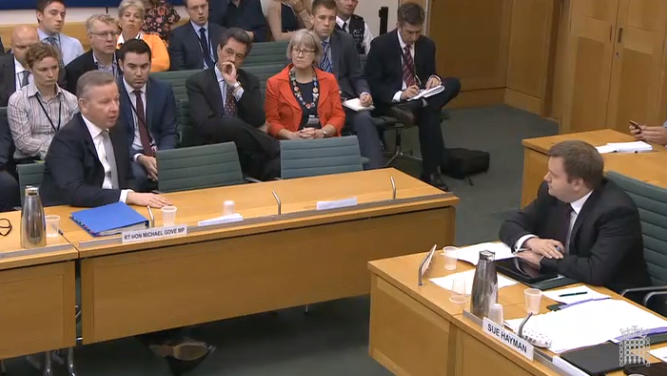
Pantomime – She’s behind you.
The session was recorded on video. Watch it here.
Getting down to business
After an exchange of pleasantries and mutual congratulations on appointment, the committee set about putting forward questions on important issues such as safety in prisons, rehabilitation, absconds from Open Prisons, court closures, and court and tribunal fees. This was good to see; Select Committees sit to scrutinise Government policy and progress.

This Justice Select Committee meeting came just a few days after the publication by the HM Chief Inspector of Prisons for England and Wales’ Annual Report 2014-15, in which Open Prisons have been highlighted once again.
On the same day as the HMIP Annual Report, Nick Harwick also published the unredacted version of the report on Release on Temporary Licence (ROTL) featuring three high profile cases of prisoners who each committed awful crimes whilst out on ROTL has challenged the current risk assessment within prisons.
The cases of Ian McLoughlin, HMP Springhill, Al-Foday Fofanah, HMP Ford and Alan Wilmot, HMP North Sea Camp were highlighted by Hardwick of where those on ROTL committed the same offence as they were sent to prison for in the first place, giving rise to questioning on whether there is ‘Rehabilitation’ in prison.
You can read the report here.
This was raised by Philip Davies MP when asking Mr Gove “what are you doing to protect the public from these future awful consequences?”
His reply was “…transfer to open prison should only follow an appropriate risk assessment.” He then added …”there will always be cases where there are individuals even if they have committed very serious offences may be suitable for a transfer to an open prison. Each case has to be judged on its own individual merits”. However, the underlying message was that public safety is paramount.
It was clear that Mr Gove was new to the job, there were many err and ums in his answers, but he did assure the committee that he would be happy to return when he had reviewed various aspects within the justice system.
So will I.
London Road – my personal memories
Almost 9 years ago back in the autumn of 2006, I moved back to Ipswich with my 3 children after living abroad for 6 years.
We thought Ipswich would be an easier way for the children to reintegrate back into English culture than moving to an unfamiliar town.
Within weeks suddenly Ipswich was on the map for all the wrong reasons, local news, national news and international news.
Young women were disappearing and then a body was found. And another. And another.
In total the bodies of 5 young women were found, all naked, and it was reported that they were probably killed elsewhere and dumped in the surrounding countryside.
A serial killer was on the loose. It was portrayed in the media as the new “Jack the Ripper”.
I was so delighted that my youngest son has managed to get a place at a very good primary school as he only had one year before high school, a huge leap having never attended an English school. Its location hadn’t been a problem when the other two attended before moving abroad. But now it was a real problem, it was on the edge of the ‘red light district’ and one by one the bodies found were identified as prostitutes known to frequent the London Road, just around the corner from the school.
I remember many times parking as close to the school as possible, sometimes in residents parking areas as I was nervous walking on my own to collect my son. I remember one afternoon parking and hearing on the radio another body had been found; at the same moment I was approached by a traffic warden insisting that I move my car from residents parking whilst taunting me with the possibility of a parking ticket. I refused and relayed what I had heard but he was adamant that I move to a car park which happened to be in the heart of the area where these women were last seen.
A concession was offered; I was told to run as fast as I could to fetch my son from school and if I was less than 5 minutes I wouldn’t get a fine. It was an unnecessary pressure upon me. No wonder these people are despised.
Ripple effect
What on earth had happened in the last 6 years that I had been away, how could this small town have changed so much?
What had I brought my children back to, why did we come back to Ipswich; doubt crept in. Had we made a huge mistake?
Yes it affected London Road residents but it went further than that, like a ripple effect. I felt vulnerable, scared and cheated, our landing back in the UK had come with a bump.
Even now 9 years later my kids don’t like me parking on the 2 hr free parking in the area whilst I nip into town.
The film ‘London Road is being shown tonight at the Ipswich Film Theatre, I had considered viewing it but have decided not to. Why put myself through those 3 to 4 months again.
Did life get back to normal? …Not at all
 The Criminal Justice Blog