
Home » prison reform
Category Archives: prison reform

Dichotomy of Lived v Learned Experience
I first stepped foot in a prison in 2010; I was invited to be a community witness for a victim awareness course at HMP/YOI Hollesley Bay, around 40 minutes’ drive from my home. The environment was unfamiliar and so were the attendees. At that time, I was approaching my final year at University studying for BSc (Hons) Criminology, as a mature student, and I needed to figure out what my next steps should be. Each presentation I prepared as part of my coursework steered towards the justice system, prisons in particular. The first being a 10 minute talk on the Corston Report, by Baroness Jean Corston, published in the light of 6 women dying within a year in Styal prison.
I still remember the feedback I received as it was rather disheartening “Who is interested in women in prison?”
It soon became clear to me that very few were interested in prisons at all, both fellow students and lecturers.
Undeterred I carried on, highlighting where possible the appalling issues within the prison estate.

So, 15 years on, I have had the privilege to visit every category of prison up and down the country including the Women’s estate. I have delivered training in prisons, monitored a Cat D prison and became the Chair of an Independent Monitoring Board (IMB), attended numerous prison art exhibitions, toured prisons on the invitation of Governors, watched graduation celebrations for those that have completed courses in a Cat B, listened to guest speakers in prison libraries, judged a debating competition in a Cat C, written and edited policy documents and have published countless blogs that have been read and shared in over 150 countries. I have tirelessly spoken out for reform, and my work has been mentioned in the House of Lords.
I have seen the desperation, and I have felt the fear in prison, yet I have never resided in a prison.
“Well, what do you know?”
This question often ringing in my ears, as though I have just popped in from another planet.
“You don’t have lived experience”
A statement that is levelled against me far too many times to remember along with being White, A woman and Middle class…etc.
“Why is your writing so negative, instead of writing about problems, come up with solutions?”
It’s true, I don’t have a certain kind of “lived experience”, I’ve never stood in court accused of a crime and pleaded guilty or not guilty. I’ve never attended court awaiting my fate when the sentence is being read out.
I have sat and watched trials in the Supreme Court, the High Court and the courts in my local area. I have attended inquests and have given evidence, but most importantly I have been there for others, in court, supporting and comforting.
We all have lived experiences in some form. Personal lived experience of the justice system gives valuable insight, but does it make you an expert?
Surely, we can all work together to bring about much needed reform in our all too often failing system.
I believe there is a place for all who share a desire, a passion and determination to transform our criminal justice system into a fairer and more just structure. To give those that are or have been in prison the tools to rebuild or even build their lives for the first time. To give hope and a future.
Should lived experience and learned experience go hand in hand?
Do you think both are credible experts to whom we should be listening?
However, recently we have read about an individual with lived experience that became a valuable member of a prominent reform organisation, given responsibilities and then defrauded their employer.
This wasn’t a small amount, it was over £300,000. The organisation – Prison Reform Trust (PRT). They had appointed an individual with a previous fraud conviction for a senior role involving financial responsibility. Little by little right under the nose of the board of trustees, with the then Chairman who is now the Minister of State for Prisons, Probation and Reducing Reoffending. The current CEO, the former Head of Women’s prison estate was quick to say: “We would like to assure our supporters that no programmes or services were affected by this incident, and the charity remains committed to its mission to create a just, humane and effective prison system”.
Basically the money wasn’t missed?
That quote came from this statement on 19 May 2025 which has now been removed from the PRT website, so I have included a screenshot of it.

So where were the safeguards?
This case reminded me of 2021 when I received the Prison Reform Trust (PRT) booklet to commemorate their 40 years, after having attended their celebration in London. A short time afterwards I read the former CEO of The Howard League, Frances Crooks (farewell) piece.
PRT and The Howard League are two organisations that work for reform, two organisations that basically admitted they had failed in what they set out to do.
So why is so much money ploughed into them through donations, grants, membership, and legacies?
Both have an annual salary bill of over £1M, astonishing isn’t it. Yes, they have initiated some important campaigns, but our prisons are still in crisis and reform is taking too long.
So, what is going wrong?
Does the Ministry of Justice (MoJ) squeeze organisations and charities by limiting their progress and their ability to instigate change? Many rely on either their approval or their funding.
As you can deduce, I’m not here to popularise organisations, or to popularise individuals.
I am fiercely independent and intend to stay that way.
But I have many questions.
Was the system designed to be ineffective or designed to perpetuate harm?
Should prison be a place for healing as I have heard others say, or a place for true reform of itself or individuals?
Do we try and change something that does not want to change, does not want reforming, where politicians gaze briefly at and when those in a position to do something, don’t?
It is a place where inspectors inspect and issue recommendations, a place where monitors monitor and issue recommendations.
Endless reports and endless reviews.
Endless round table meetings.
New committees formed.
Let’s just step away for a moment.
I hear big voices, big egos and big personalities shout out, but no one can hear anything anymore.
Has society closed their ears to the noise?
Has society closed their eyes to the mess?
I will say again “Our prisons are in crisis and reform is taking too long”
Vision is often personal, but a cause is bigger than any one individual
People don’t generally die for a vision, but they will die for a cause
Vision is something you possess, a cause possess you
Vision doesn’t eliminate the options; a cause leaves you without any options
A good vision may out live you, but a cause is eternal
Vision will generate excitement, but a cause generates power
[Adapted from Houston (2001)]
You can have lived or learned experience, but what is your cause?
If the cause is yourself, this is not true reform, it is perpetuating the system with a sense of power.
If you have a cause and integrity you are seen as an interrupter.
But the greatest power is humility either lived or learned.

Keir Starmer whips AGAINST Lord Thomas amendment to end shocking #IPP scandal as campaigners vow to fight on
Campaigning Lawyer and CEO of CAMPAIGN FOR SOCIAL JUSTICE Peter Stefanovic – who’s films have been watched hundreds of millions of times online – has posted a new film calling on Prime Minister Keir Starmer to end the IPP scandal once and for all by adopting a plan drawn up by Lord Thomas, the former Lord Chief Justice.

BACKGROUND
IPP sentences were introduced in England and Wales by the then New Labour government with the Criminal Justice Act 2003. It sought to prove it was tough on law and order by putting in place IPP sentences to detain indefinitely serious offenders who were perceived to be a risk to the public. However, they were also used against offenders who had committed low-level crimes, resulting in people spending 18 years in jail for trying to steal a coat or imprisoned for 11 years for stealing a mobile phone. In one instance 16 years in jail for stealing a flowerpot.
UNLAWFUL
In 2012, after widespread condemnation and a ruling by the European court of human rights that such sentences were, “arbitrary and therefore unlawful”, IPP terms were abolished by the Conservative government. But the measure was not retrospective, and thousands remain in prison.
Over 90 people serving sentences under the discredited IPP regime have sadly taken their own lives whilst in prison. In 2023 we saw the second year in a row of the highest number of self-inflicted deaths since the IPP sentence was introduced.
Former supreme court justice Lord Brown called IPP sentences: “the greatest single stain on the justice system”. When Michael Gove was justice secretary, he recommended, “executive clemency” for IPP prisoners who had served terms much longer than their tariffs. But he didn’t act on it. Lord Blunkett, the Labour Home Secretary who introduced the sentences, regrets them, stating: “I got it wrong.” And more recently, Dr Alice Edwards, the UN rapporteur for torture has called IPP sentences an “egregious miscarriage of justice.” Even former Justice Secretary Alex Chalk KC has called them a stain on the justice system, yet despite that, the previous Conservative Government refused to implement the Justice Committees recommendation to re-sentence all prisoners subject to IPP sentences.
CAMPAIGN FOR SOCIAL JUSTICE
Their families and campaign groups have been fighting to end this tragic miscarriage of justice for more than a decade and films posted online by social media sensation and campaigner Peter Stefanovic have ignited a wider public storm on this tragic miscarriage of justice gathering millions of views.
You can watch Stefanovic’s latest film here:
https://x.com/peterstefanovi2/status/1937394593672089988?s=46&t=g6PUk4YExrOYprJSzQZ3lw
It is not surprising that the public reaction to his films have been one of shock, outrage, and disbelief.
PUBLIC SUPPORT
Stefanovic has said: “The public support for my films has been overwhelming and the comments they are getting are a testament to the public’s anger, outrage and disbelief at this tragic miscarriage of justice.”
HOPE FOR JUSTICE
Now – the Labour government is being given the chance to end this monstrous injustice once and for all by adopting a plan drawn up Lord Thomas, the former Lord Chief Justice.
An expert working group convened by The Howard League and led by Lord Thomas has come forward with considered proposals aimed at protecting the public while ending the long-running IPP scandal.
Below are the members of the working group:
Farrhat Arshad KC, barrister
Dr Jackie Craissati, clinical and forensic psychologist
Andrea Coomber KC (Hon), Chief Executive of the Howard League for Penal Reform
Dr Laura Janes KC (Hon), solicitor
Dr Frances Maclennan, clinical psychologist
Andrew Morris, served IPP sentence
Dr Callum Ross, forensic psychiatrist
Claire Salama, solicitor Sir John Saunders, retired High Court judge and former Vice Chair and member of the Parole Board
Professor Pamela Taylor, psychiatrist and academic
Paul Walker, Therapeutic Environments Lead for the OPD Pathway (HMPPS)
The working group’s report puts forward six recommendations – the most important of which is a change to the Parole Board test which would require the Parole Board to give people on IPP sentences a certain release date, within a two-year window, and to set out what action is required to achieve that safely.
Setting a date of up to two years provides a long period of time to enable professionals and statutory agencies to work together and help the person to prepare for a safe release – it completely knocks on the head any argument the justice secretary has previously raised about public safety and will end once and for all one of the most cruel and monumental injustices of the past half century.
Campaigners have hit out at the “short-sighted” decision not to include prisoners on indefinite sentences in the plans announced by the government to reduce the prison population.
The government has recently published its long-awaited sentencing review, led by former Conservative justice secretary David Gauke, who recommended that some offenders who behave well in jail only serve a third of their term in custody before being released. Yet the Chair of the Justice Committee, Andy Slaughter MP has raised the point recently that “Even if David Gauke’s recommendations are wholly successful the prisons will still be full, and this has unintended consequences.”
With Government Ministers saying they have inherited a prison system “on verge of collapse” Stefanovic says this is “nonsensical”.
He concludes his latest film saying:
“With our prisons at breaking point now is the time for James Timpson – the prisons minister and Labour peer to accept this sensible, workable and detailed plan and seek to close this shameful chapter in the history of British criminal justice. If the Justice Secretary refuses to sign off on this plan for fear of handing ammunition to ignorant critics who accuse her of being soft on crime the Prime Minister, a former director of public prosecutions, who understands the criminal justice system better than any minister should instruct her to act on the proposals – because the simple fact is that by refusing to do so Keir Starmer’s government would become responsible for allowing one of the most cruel, inhumane and monumental injustices of the past half-century – a scandal rightly described as a stain on our justice system – a scandal described by the UN rapporteur for torture as an egregious miscarriage of justice and psychological torture – and which likely breaches Article 3 of the Human Rights Act – to be continued and perpetrated – and I for one cannot believe that that is what a Labour government would want to happen”
Update:
We have now found out that Keir Starmer has whipped against Lord Thomas to end this shocking IPP scandal.
CAMPAIGNING LAWYER CALLS ON PRIME MINISTER TO END SHOCKING IPP SCANDAL
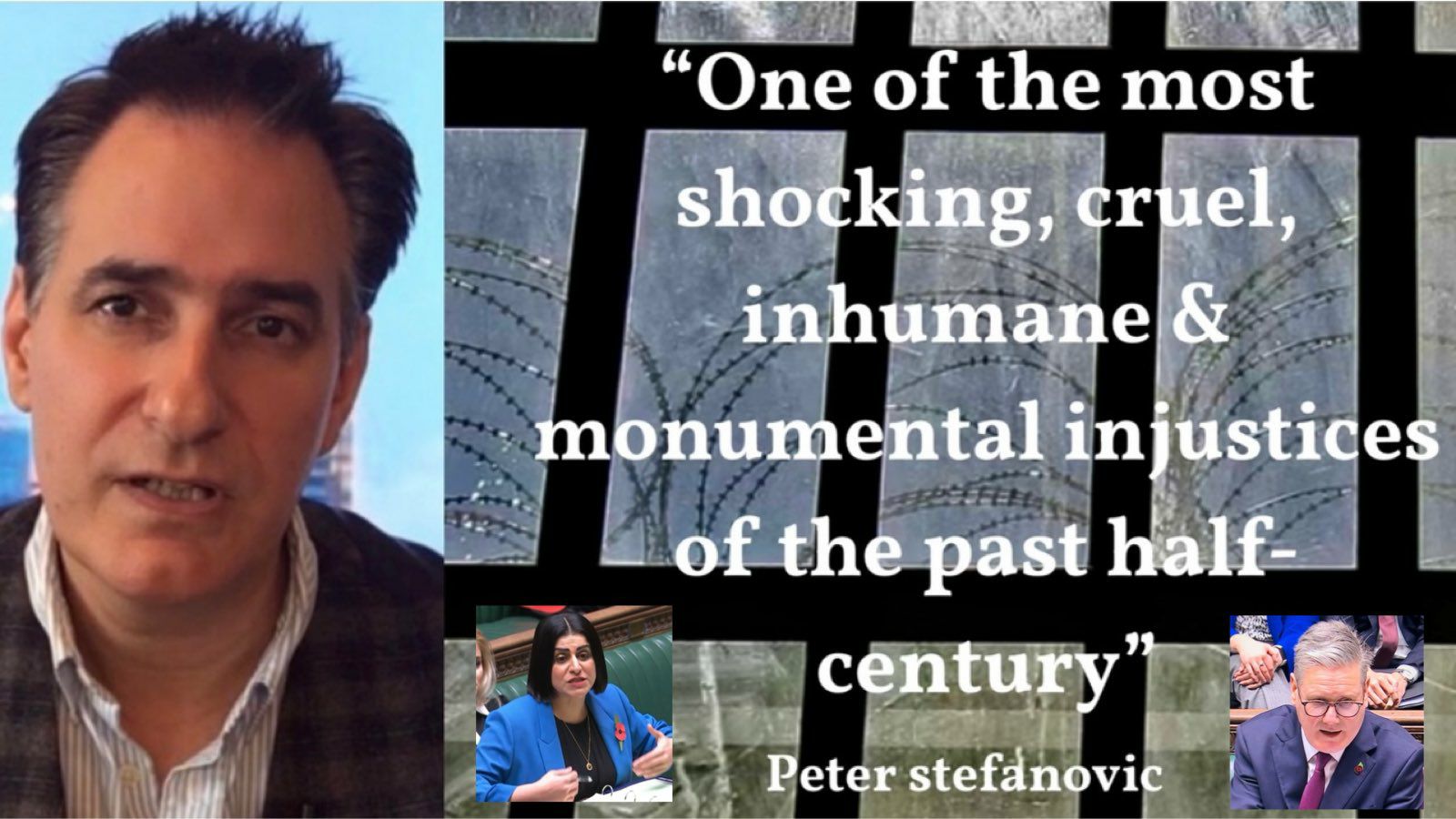
Campaigning Lawyer and CEO of CAMPAIGN FOR SOCIAL JUSTICE Peter Stefanovic – who’s films have been watched hundreds of millions of times online – has posted a new film, this time calling on the Prime Minister Keir Starmer to end the IPP scandal by backing a Private Members’ Bill by Labour peer Lord Woodley – the Imprisonment for Public Protection (Resentencing) Bill. Stefanovic has also called on the government to allow a free vote on this bill.
BACKGROUND
Some background information:
IPP sentences were introduced in England and Wales by the then New Labour government with the Criminal Justice Act 2003, as it sought to prove it was tough on law and order. These sentences were established to detain indefinitely serious offenders who were perceived to be a risk to the public. However, they were also used against offenders who had committed low-level crimes.
Astonishingly, this sentence has led to some people spending 18 years in jail for trying to steal a coat or imprisoned for 11 years for stealing a mobile phone. In one instance 16 years in jail for stealing a flowerpot.
UNLAWFUL
In 2012, after widespread condemnation and a ruling by the European court of human rights that such sentences were, “arbitrary and therefore unlawful”, IPP terms were abolished by the Conservative government. As the measure was not retrospective, thousands remain in prison.
Over 90 people serving sentences under the discredited IPP regime have sadly taken their own lives whilst in prison. In 2023 we saw the second year in a row of the highest number of self-inflicted deaths since the IPP sentence was introduced. This cannot be ignored.
Lord Brown, former supreme court justice called IPP sentences: “the greatest single stain on the justice system”. When Michael Gove was justice secretary, he recommended, “executive clemency” for IPP prisoners who had served terms far longer than their tariffs. But he didn’t act on it. Lord Blunkett, the Labour Home Secretary who introduced the sentences, regrets them, stating: “I got it wrong.” And more recently, Dr Alice Edwards, the UN rapporteur for torture has called IPP sentences an “egregious miscarriage of justice.” Even former Justice Secretary Alex Chalk KC has called them a stain on the justice system, yet despite that, the Conservative Government refused to implement the Justice Committees recommendation to re-sentence all prisoners subject to IPP sentences and the Labour government has so far similarly refused to engage in a resentencing exercise for those subject to IPP’s.
CAMPAIGN FOR SOCIAL JUSTICE
Campaign groups and their families have been fighting to end this tragic miscarriage of justice for more than a decade and films posted online by social media sensation and campaigner Peter Stefanovic have ignited a wider public storm on this tragic miscarriage of justice.
You can watch Stefanovic’s latest film here; https://x.com/peterstefanovi2/status/1927420211331772461?s=46&t=g6PUk4YExrOYprJSzQZ3lw
It is not surprising that the public reaction to his films have been one of shock, outrage, and disbelief.
PUBLIC SUPPORT
Stefanovic has said:
“The public support for my films has been overwhelming and the comments they are getting are a testament to the public’s anger, outrage and disbelief at this tragic miscarriage of justice.”
HOPE FOR JUSTICE
Now – a fresh attempt will be made to resolve the IPP scandal once and for all in the form of a Private Members’ Bill by the Labour peer Lord Woodley – the Imprisonment for Public Protection (Resentencing) Bill – a bill which Stefanovic is backing. In his latest film Stefanovic included an interview with Lord Woodley in which he asked the Labour peer about the importance of his bill. This was Lord Woolley’s reply:
“We’ve got a right as human beings to try and get things right and that’s why it’s really important that we force the government to take action and resentence these people who have no hope in life whatsoever at the moment”
Lord Woodley agrees with calls for a free vote on his bill. “It takes the politics out of it, instead of everyone fighting to say we don’t want to be seen to be weak on crime. It’s not about weak, it’s about fairplay, fairness, it’s about justice, it’s about treating families and family members with a degree of fairness and that’s why I think a free and open vote will allow people to see the justification in what we are asking for do the right thing” he says passionately.
If Lord Woodley’s Bill becomes law it will place the Justice Secretary under a legal obligation to ensure that all those serving an IPP sentence – whether in prison or in the community – are retrospectively given a determinate sentence.
To end the injustice faced by those serving IPP sentences the House of Commons Justice Select Committee has recommended a resentencing exercise take place, overseen by a panel of experts, for everyone still serving these sentences as the only way to address the unique injustice caused by the IPP sentence – but the Labour government has so far refused to engage with a such an exercise with Justice Secretary Shabana Mahmood telling MPs:
“We are not considering a resentencing exercise for IPP prisoners because that would automatically release a number of people who we do not believe would be safe to release”
However, as Stefanovic points out in his latest film
“the resentencing exercise recommended by the House of Commons Justice Select Committee would be overseen by a panel of experts who would explore how resentencing could happen in a timely way but one that would NOT jeopardise public protection – so it doesn’t mean immediate & automatic release as the Justice Secretary wrongly suggests”
Campaigners have recently hit out at the “short-sighted” decision not to include prisoners on indefinite sentences in the plans announced last week to reduce the prison population.
SENTENCING REVIEW
On Thursday 22nd May, the government published its long-awaited sentencing review, led by former Conservative justice secretary David Gauke, who recommended that some offenders who behave well in jail only serve a third of their term in custody before being released.
Not included in the scheme are prisoners serving IPP sentences. With Government Ministers saying they have inherited a prison system “on verge of collapse” Stefanovic says this is “nonsensical”. He concludes his latest film with strong words:
“So for heavens sake (Prime Minister) get behind Lord Woodley’s bill – If our prisons are at breaking point why on earth are prisoners given a 12 month sentence still there 19 years later whilst others are released early, it’s completely non sensical – almost three thousand people serving IPP sentences from behind bars is the equivalent to the population of four medium-sized men’s prisons, resentencing them will not only end once and for all one of the most cruel and monumental injustices of the past half century it will also head off the medium-term prison capacity crisis at the same time…the simple fact is that by refusing to engage in the resentencing exercise recommended by the House of Commons Justice Select Committee the Labour government is now allowing one of the most cruel, inhumane and monumental injustices of the past half-century – a scandal rightly described as a stain on our justice system – a scandal described by the U N rapporteur for torture as an egregious miscarriage of justice and psychological torture – and which likely breaches Article 3 of the Human Rights Act to be continued and perpetrated – this has got to end, so please prime minister – end this appalling injustice once and for all by getting behind and supporting Lord Woodleys bill – please don’t wait for the next ITV drama to do the right thing”

Prisons: still we build them and still we fill them
Transcript of speech by Faith Spear FRSA delivered at Battle of Ideas, Church House, Westminster, London on 20 October 2024.
“I’m not a political person… I’ve never wanted to get involved… I don’t like the idea of having to play to someone else’s tune and say things I don’t necessarily believe in.”
For those who know me, they would say that this sounds like something Faith would say, but it wasn’t me this time. In fact it was James Timpson – Lord Timpson, Minister of State for Prisons, Parole and Probation – talking with Andy Coulson in an interview a couple of years ago.
Now as Prisons minister, he must have changed his tune?
In the same interview he also said that instead of people serving 50% of a sentence in prison, this should be reduced to 25%. I wonder if he has changed his mind about that too?
But one thing that I have said repeatedly is:
“We have to stop this madness of believing that we can change people and their behaviour by banging them up in warehouse conditions with little to do and not enough to eat and sanitation from a previous century.”
The prison estate is running out of space and Early release schemes have been implemented by the new government to avoid gridlock in the justice system.
Mainstream media frequently report on prisons in England and Wales that are squalid and fuelled by drugs.
I have seen it for myself and have been writing about it for over 10 years. The lack of rehabilitation, the lack of education, lack of purposeful activity, overcrowding, understaffing, gang related violence.
Yet still we build them and still we fill them.
In 2016 I was invited to write an article from my experience as a chair of an Independent Monitoring Board (IMB) in my local prison in Suffolk. It was factual, honest and challenged the independence of the IMB. Even before it went to print in The Prisons Handbook, I received notification that it had been sent to the Ministry of Justice lawyers.
What followed was 9 months of hell; I was bullied, suspended from my role, gagged and investigated by the MoJ – twice – called in front of a disciplinary hearing at Petty France and then dismissed.
Two Prisons Ministers were involved in the whole debacle.
My crime? I broke the IMB code of conduct.
One of the investigators wrote:
“In my view she breached the code of conduct, but as there is no clear IMB code of conduct or any reference to the Cabinet Office guidance, this was not entirely Ms Spear’s fault.”
Allegedly I broke the code of conduct which did not exist.
Even the then President of the IMB wanted to rewrite the ‘Constitution Template’, to close a loophole to dissuade others in the IMB from speaking out.
Not the last bastion of chauvinism I have come across.
HM Chief Inspector of Prisons, Charlie Taylor, is saying the same things today as I said then. He’s paid to say these things; I was dismissed for saying these things.
People always harp on about the prisons in Scandinavia, Halden and Bastøy in Norway seem to be the best known. But few seem to know that a prison in England had visitors from Scandinavia looking at their regimes etc with a view to model some of their best practices.
It was called HMP Blantyre House located in Kent, and over in Norway a resettlement prison was set up based on the principles and methods used at Blantyre House.
So, how was this beacon of best practice recognised here?
Instead of promoting their good practice, the then Director General of the Prison Service authorised squads of approx 80 officers and dogs, led by the then Governor of Swaleside prison, to raid Blantyre House.
They trashed it.1
All prisoners were tested for drugs, yet not a single test proved positive. The whole episode ruined a lot of the trust built up between prisoners and staff.
The then Governor of HMP Blantyre House was unaware of what was about to happen because he was removed from his position hours before.
But it was a prison that exceeded all their key performance targets and had the lowest rate of drug abuse of any prison in the UK.
Even when something works, still they trash it.
So, when we read the Ministry of Justice mission statement: “The Ministry of Justice is a major government department, at the heart of the justice system. We work to protect and advance the principles of justice. Our vision is to deliver a world-class justice system that works for everyone in society” I just don’t believe it.
And neither should you.
~

From the speech by Faith Spear FRSA given 20 October 2024 at Battle of Ideas 2024 held at Church House, Westminster, London, convened by Academy of Ideas.
Speaker bio https://www.battleofideas.org.uk/speaker/faith-spear-frsa/
~
- Book ‘Beyond Redemption: The Truth Behind the Raid on Her Majesty’s Prison Blantyre House’ by Eoin Edward McLennan-Murray. Hardcover – 19 Oct. 2023 ↩︎

CAMPAIGNING LAWYER BACKS PRIVATE MEMBERS BILL FOR RESENTENCING TO END SHOCKING IPP SCANDAL
INTRODUCTION
Campaigning Lawyer and CEO of CAMPAIGN FOR SOCIAL JUSTICE Peter Stefanovic, who’s films have been watched hundreds of millions of times online, has posted a new film backing a Private Members’ Bill by the Labour peer Lord Woodley – the Imprisonment for Public Protection (Resentencing) Bill. Stefanovic is calling on the new government to allow a free vote on the bill.
BACKGROUND
IPP sentences were introduced in England and Wales by the then New Labour government with the Criminal Justice Act 2003, as it sought to prove it was tough on law and order. They were put in place to detain indefinitely serious offenders who were perceived to be a risk to the public. However, they were also used against offenders who had committed low-level crimes. Astonishingly, this sentence has led to some people spending 18 years in jail for trying to steal a coat or imprisoned for 11 years for stealing a mobile phone. In one instance 16 years in jail for stealing a flowerpot.
UNLAWFUL
In 2012, after widespread condemnation and a ruling by the European court of human rights that such sentences were, “arbitrary and therefore unlawful”, IPP terms were abolished by the Conservative government. Yet the measure was not retrospective, and thousands still remain in prison.
Whilst in prison, under the discredited IPP regime, over 90 people serving this sentence have sadly taken their own lives. In 2023 we saw the second year in a row of the highest number of self-inflicted deaths since the IPP sentence was introduced.
Former supreme court justice Lord Brown called IPP sentences: “the greatest single stain on the justice system”. When Michael Gove was Justice Secretary, he recommended, “executive clemency” for IPP prisoners who had served terms much longer than their tariffs. But he didn’t act on it. Lord Blunkett, the Labour Home Secretary who introduced the sentences, regrets them, stating: “I got it wrong.” And more recently, Dr Alice Edwards, the UN rapporteur for torture has called IPP sentences an “egregious miscarriage of justice.” And yet, even when the former Justice Secretary Alex Chalk KC who also called them a stain on the justice system, the Conservative Government refused to implement the Justice Committees recommendation to re-sentence all prisoners subject to IPP sentences.
CAMPAIGNING
Campaign groups and their families have been fighting to end this tragic miscarriage of justice for more than a decade. In addition, films posted online by Peter Stefanovic, a lawyer and CEO of CAMPAIGN FOR SOCIAL JUSTICE have ignited a wider public storm on this tragic miscarriage of justice with over 20 MILLION VIEWS. It is not surprising that the public reaction to his films have been one of shock, outrage, and disbelief.
PUBLIC SUPPORT
Stefanovic has said:
“The public support for my films has been overwhelming and the comments they are getting are a testament to the public’s anger, outrage and disbelief at this tragic miscarriage of justice.”
PRIVATE MEMBERS BILL
Now – a fresh attempt will be made to resolve the IPP scandal once and for all in the form of a Private Members’ Bill by the Labour peer Lord Woodley – the Imprisonment for Public Protection (Resentencing) Bill – a bill which Stefanovic is backing. In his latest film Stefanovic included an interview with Lord Woodley in which he asked the Labour peer about the importance of his bill. This was Lord Woolley’s reply:
“We’ve got a right as human beings to try and get things right and that’s why it’s really important that we force the government to take action and resentence these people who have no hope in life whatsoever at the moment..3,000 prisoners, many of whom have served sentences way and beyond anything that would be fair or reasonable, even acceptable to human beings. Let’s help the individuals, their families, they’ve suffered far too much, and I believe it can be put to sleep pretty quickly if common sense appertains here.”
HOPE FOR JUSTICE
Lord Woodley agrees with calls for a free vote on his bill. “It takes the politics out of it, instead of everyone fighting to say we don’t want to be seen to be weak on crime. It’s not about weak, it’s about fairplay fairness, it’s about justice, it’s about treating families and family members with a degree of fairness and that’s why I think a free and open vote will allow people to see the justification in what we are asking for do the right thing” he says passionately.
NEXT STAGE
If Lord Woodley’s Bill becomes law, it will place the Justice Secretary under a legal obligation to ensure that all those serving an IPP sentence – whether in prison or in the community – are retrospectively given a determinate sentence. For the vast majority of IPP prisoners this will result in their swift and more than justified release.
On Friday 15th November, Lord Woodley’s bill passed its second reading and it now goes to committee stage, despite The Lord Timpson OBE DL, Minister for Prisons, Parole and Probation saying:
“Legislating to give every IPP prisoner a definite release date and post-release licence, or legislating to provide for a resentencing by court, would result in them being released automatically…either legislative approach would put the public at an unacceptable risk of harm, which the Government is not prepared to countenance.”
With recent reports suggesting there are fewer than 100 places available across the entire prison estate in England and Wales Stefanovic says:
“It’s a no brainer. It will go some way to heading off the medium-term prison capacity crisis and surely now is the time to completely take the politics out of this with a Free vote on the bill. Let’s now get this done – let’s work together to end one of the most shocking, cruel, inhumane and monumental injustices of the past half-century by getting behind and supporting Lord Woodleys bill – before more lives are tragically lost”

Labour finds its courage as House of Lords tackle decades of injustice in crucial vote on IPP amendments.
Next Tuesday, 21st May, the House of Lords will vote on significant amendments to the Victims & Prisoners Bill, aimed at rectifying one of the most shocking injustices of the past half-century – Imprisonment for Public Protection (IPP) sentences.
BACKGROUND
IPP sentences were introduced in England and Wales by the New Labour government with the Criminal Justice Act 2003, as it sought to prove it was tough on law and order. They were put in place to detain indefinitely serious offenders who were perceived to be a risk to the public. However, they were also used against offenders who had committed low-level crimes.
Astonishingly, this sentence has led to some people spending 18 years in jail for trying to steal a coat or imprisoned for 11 years for stealing a mobile phone.
UNLAWFUL
In 2012, after widespread condemnation and a ruling by the European court of human rights that such sentences were, “arbitrary and therefore unlawful”, IPP terms were abolished by the Conservative government. But the measure was not retrospective, and as a result, thousands remain in prison.
Let’s not forget that over 90 people serving sentences under the discredited IPP regime have sadly taken their own lives whilst in prison.
In 2023 we saw the second year in a row of the highest number of self-inflicted deaths since the IPP sentence was introduced.
The former supreme court justice Lord Brown called IPP sentences: “the greatest single stain on the justice system”. When Rt Hon Michael Gove MP was justice secretary, he recommended, “executive clemency” for IPP prisoners who had served terms much longer than their tariffs. But he didn’t act on his own recommendation. Lord Blunkett, the Labour Home Secretary who introduced the sentences, regrets them, stating: “I got it wrong.” And more recently, Dr Alice Edwards, the UN rapporteur for torture has called IPP sentences an “egregious miscarriage of justice.” Even the Justice Secretary Rt Hon Alex Chalk KC MP has also called them a stain on the justice system, despite that, the Government has so far refused to implement the Justice Committees recommendation to re-sentence all prisoners subject to IPP sentences.
CAMPAIGN FOR SOCIAL JUSTICE
Campaign groups and their families have been fighting to end this tragic miscarriage of justice for more than a decade and a film posted online by social media sensation and campaigner Peter Stefanovic, a lawyer and CEO of CAMPAIGN FOR SOCIAL JUSTICE has ignited a wider public storm on this tragic miscarriage of justice and has been viewed a staggering 15 MILLION TIMES. It is not surprising that the public reaction to this film has been one of shock, outrage, and disbelief.
PUBLIC SUPPORT
Stefanovic said: “The public support for my film has been overwhelming and the comments it is getting are a testament to the public’s anger, outrage and disbelief at this tragic and monumental miscarriage of justice. Political leaders from both main parties must find the courage to step up and address the tragic injustice of indefinite jail terms”.
HOUSE OF LORDS DEBATE
His film was mentioned by Baroness Jones, Lord Moylan and Baroness Fox in the House of Lords debate on March 12. Furthermore, Baroness Fox also cited The Criminal Justice Blog.

HOPE FOR JUSTICE
The House of Lords is set to vote on a series of amendments to the government’s Victims and Prisoners Bill next Tuesday. These amendments are expected to challenge the government, with potential defeats on several fronts.
Of particular significance is the “Simon Brown Memorial Amendment,” named after the late former Supreme Court Justice who condemned IPP as the “greatest single stain on the British Justice system.” This amendment seeks to reverse the Parole Board release test burden, offering hope to IPP prisoners trapped in prolonged incarceration.
LABOUR FINDS IT’S COURAGE
Keir Starmer’s Labour Party has offered much needed hope to IPP prisoners trapped in the nightmare of prolonged incarceration and desperately needed hope for their families. In March 2024, Lord Ponsonby speaking for Labour said this in response to the important “Simon Brown Memorial Amendment”
“The noble Lord, Lord Moylan, in his amendment 161, is effectively reversing the burden of proof for IPP prisoners. He described it as a nudge to the Parole Board and discussed how significant that nudge would be, but it is a welcome nudge, non the less. It has the historic credentials of being supported originally by Lord Brown of Eaton-under-Haywood. It is a welcome amendment”
With Lord Ponsonby having confirmed Labour’s support for the all-important “Simon Brown Memorial Amendment,” which has given so much hope to those serving these sentences and their families. Campaign groups are now calling on the Lib Dems, Green Party, back benchers, Bishops and Tory rebels to join Labour in supporting it. The amendments will be voted on next Tuesday. Let’s hope they all step up and help bring to an end this injustice.

Video Igniting Public Storm On IPP Sentencing Scandal Hits 14 Million Views
A video that has been posted online by campaigner, lawyer and the CEO of Campaign for Social Justice Peter Stefanovic has ignited a public storm by bringing the issue of the IPP sentencing scandal to a wide audience.

Now on a staggering 14 million views the following are typical of the comments it is getting,
“Truly shocking”
“Absolutely horrifying”
“Unbelievable”
“Utterly awful”
“Madness”
“inconceivable”
“cruel”
There has been overwhelming public support for this film which has manifested in an online petition signed by thousands which has forced the Government to respond.
Peter Stefanovic, a social media sensation, said:
“The public support for my film has been overwhelming & the comments it is getting are a testament to the public’s anger, outrage & disbelief at this tragic miscarriage of justice. If Labour step up next week and back the amendments supported in the Lords by both Lib Dem and Green Party peers we can end this tragedy now. It’s time to do what we all know is right before more lives are tragically lost”
IPP sentences were introduced in England and Wales by the New Labour government with the Criminal Justice Act 2003, as it sought to prove it was tough on law and order. They were put in place to detain indefinitely serious offenders who were perceived to be a risk to the public. However, they were also used against offenders who had committed low-level crimes.
Astonishingly, this sentence has led to some people spending 18 years in jail for trying to steal a coat or imprisoned for 11 years for stealing a mobile phone.
In 2012, after widespread condemnation and a ruling by the European court of human rights that such sentences were, “arbitrary and therefore unlawful”, IPP terms were abolished by the Conservative government. But the measure was not retrospective, and thousands remain in prison.
90 people serving sentences under the discredited IPP regime have sadly taken their own lives whilst in prison. In 2023 we saw the second year in a row of the highest number of self-inflicted deaths since the IPP sentence was introduced.
The former supreme court justice Lord Brown has called IPP sentences: “the greatest single stain on the justice system”. When Rt Hon Michael Gove MP was justice secretary, he recommended, “executive clemency” for IPP prisoners who had served terms much longer than their tariffs.
But he didn’t act on it.
Lord Blunkett, the Labour home secretary who introduced the sentences, regrets them, stating: “I got it wrong.” And more recently, Dr Alice Edwards, the UN rapporteur for torture has called IPP sentences an “egregious miscarriage of justice.” Even the Justice Secretary Rt Hon Alex Chalk KC MP has also called them a stain on the justice system but the Government has so far refused to implement the Justice Committees recommendation to re-sentence all prisoners subject to IPP sentences.
CAMPAIGN FOR SOCIAL JUSTICE
Campaign groups & their families have been fighting to end this tragic miscarriage of justice for more than a decade and now the film posted online by Peter Stefanovic has ignited a wider public storm on this tragic miscarriage of justice. The public reaction to it his film has been one of shock, outrage, and disbelief.
HOPE FOR JUSTICE
Hope for justice at last now comes in the form of 2 amendments tabled in the House of Lords to the Victims & Prisoners Bill (161 & 167) by Lord Moylan which are backed by the Lib Dems and Green Party peers, and which have wide cross bench support.
Amendment 167 seeks to implement the Justice Committees recommendation to re-sentence all prisoners subject to IPP sentences. Amendment 161 would require the state to demonstrate that a prisoner is still a risk to the public rather than, as at present, requiring the prisoner to prove the opposite. Under the proposed amendment, they would be released unless the Parole Board “is satisfied that it remains necessary and proportionate for the protection of the public from serious harm that they should continue to be confined”.
Amendment is 161 is supported by Lord Blunkett, Baroness Chakrabarti & the former deputy president of the Supreme Court Lord Hope of Craighead. It’s also supported by the Bar Council, representing 17,000 barristers in England and Wales. The outpouring of public support generated by Stefanovic’s video adds further pressure on Keir Starmers Labour to step up and act by backing the amendments tabled by Lord Moylan that are supported by Lib Dem and Green Party peers.
With Labour support this stain on our justice system can finally be ended,
NOW.
The amendments above will be debated in the House of Lords on 12 March.
Let’s not wait for an ITV drama to do the right thing.
Let’s not sit by whilst more tragically lose their lives. We must act now & we must act URGENTLY.

As IPP film hits 13 million views new figures scupper Government argument against resentencing.
IPP sentences were introduced in England and Wales by the New Labour government with the Criminal Justice Act 2003, as it sought to prove it was tough on law and order. They were put in place to detain indefinitely serious offenders who were perceived to be a risk to the public. However, they were also used against offenders who had committed low-level crimes.
Astonishingly, this sentence has led to some people spending 18 years in jail for trying to steal a coat or imprisoned for 11 years for stealing a mobile phone.
In 2012, after widespread condemnation and a ruling by the European court of human rights that such sentences were,
“arbitrary and therefore unlawful”,
IPP terms were abolished by the Conservative government. But the measure was not retrospective, and thousands remain in prison. Sadly, many have taken their own lives.
The former supreme court justice Lord Brown has called IPP sentences:
“the greatest single stain on the justice system”.
When Rt Hon Michael Gove MP was justice secretary, he recommended,
“executive clemency”
for IPP prisoners who had served terms much longer than their tariffs. But he didn’t act on it. Lord Blunkett, the Labour home secretary who introduced the sentences, regrets them, stating:
“I got it wrong.”
And more recently, Dr Alice Edwards, the UN rapporteur for torture has called IPP sentences an
“egregious miscarriage of justice.”
Even the Justice Secretary Rt Hon Alex Chalk KC MP has also called them a stain on the justice system but the Government has so far refused to implement the Justice Committees recommendation to re-sentence all prisoners subject to IPP sentences.

Campaign groups & their families have been fighting to end this tragic miscarriage of justice for more than a decade and now a film posted online by media sensation and CEO of Campaign for Social Justice Peter Stefanovic has ignited a storm by bringing the issue to wider public attention. It has already had over 13 million views online and the public’s reaction to it has been one of shock, outrage, and disbelief.
Despite calls from parliament’s own Justice Select Committee – which said the sentence was “irredeemably flawed” and had caused “acute harm” to those serving them – the government has resisted calls to resentence remaining IPP prisoners, citing concerns for public safety.
But new figures obtained by SKY News through a Freedom of Information (FOI) appear to scupper the Government’s argument against resentencing. The request shows only 83 IPP prisoners who have been released since 2012 have been convicted of a serious further offence (SFO) upon or after their release, including those who may have been released, recalled back to custody and rereleased.
The figure represents just 1.7% of the 4,776 IPP prisoners who have been released since the sentence was abolished, although the Ministry of Justice (MoJ) has said this does not account for those who have been recalled back into custody. The new figures appear to make a mockery of the government’s argument against implementing the primary recommendation of parliament’s own Justice Select Committee for re-sentencing those serving IPP sentences.
The Labour Party is still to clarify its position on this issue.
However, in a letter written by Kevin Brennan MP- now Shadow Minister for Victims and Sentencing and sent to the then Secretary of State for Justice, The Rt Hon Dominic Raab MP in March 2023 he outlines a meeting with Bernadette Emerson, a constituent of his, concerning her husband in prison under an IPP sentence. In the third paragraph, Kevin Brennan MP stated,
“It was the correct thing to do when the government abolished these sentences in 2012”, but as you will be aware there is a terrible legacy issue of injustice for those who are effectively serving a life sentence despite having been convicted of a crime that carried a fairly low tariff”.
Mr Brennan MP continued his letter:
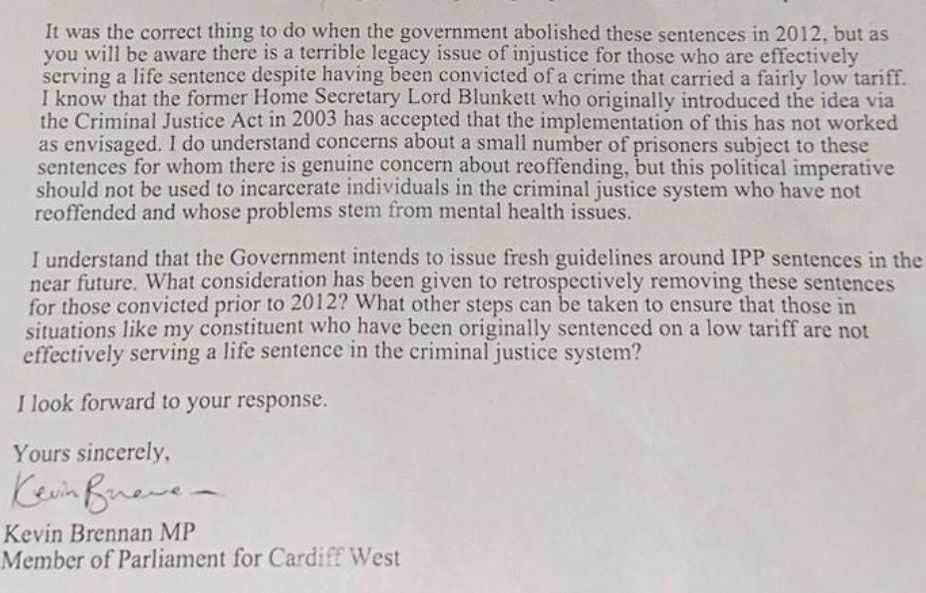
“I know that the former Home Secretary Lord Blunkett who originally introduced the idea via the Criminal Justice Act in 2003 has accepted that the implementation of this has not worked as envisaged. I do understand concerns about a small number of prisoners subject to these sentences for whom there is genuine concern about reoffending, but this political imperative should not be used to incarcerate individuals in the criminal Justice system who have not reoffended and whose problems stem from mental health issues.”
Mr Brennan MP goes on to ask the question,
“What consideration has been given to retrospectively removing these sentences for those convicted prior to 2012?”
What Mr Brennan MP says is both welcome and not surprising given this tragic miscarriage of justice has sadly already taken many lives.
But the position of the Labour Party on this egregious miscarriage of justice is now in question.
On 6th December, during the second reading in the House of Commons of the Victims and Sentencing Bill, Chair of the Justice Committee, Conservative MP Sir Bob Neill, proposed “new clause 1” which would add a resentencing exercise to the Bill in line with the Justice Committees long standing recommendation. Sir Neill’s proposed amendment would help to end this accepted miscarriage of justice.
However, Kevin Brennan MP, surprisingly, given his letter just a few months earlier, opposed the idea, saying:
“Unfortunately, given the impact of the Government’s effective destruction of the criminal justice system, we lack the infrastructure and resources to keep the public safe, should his new clause be implemented immediately. Our priority is, and always must be, the safety of the British public. We are concerned that if new clause 1 were enacted without provisioning for significant improvements in probation and parole, we would potentially significantly increase the risk to the public and to the prisoners themselves.”
However, the new data now obtained by SKY News will add pressure on Labour to get behind the Justice Committee recommendation for resentencing.
HOPE FOR JUSTICE
Hope for justice at last now comes in the form of 2 amendments tabled in the House of Lords to the Victims & Prisoners Bill (161 & 167) by Lord Moylan which are backed by the Lib Dems and Green Party peers, and which have wide cross bench support.
Amendment 167 seeks to implement the Justice Committees recommendation to re-sentence all prisoners subject to IPP sentences.
Amendment 161 would require the state to demonstrate that a prisoner is still a risk to the public rather than, as at present, requiring the prisoner to prove the opposite.
Under the proposed amendment, they would be released unless the Parole Board “is satisfied that it remains necessary and proportionate for the protection of the public from serious harm that they should continue to be confined”.
Amendment is 161 is supported by Lord Blunkett, Baroness Chakrabarti & the former deputy president of the Supreme Court Lord Hope of Craighead. It’s also supported by the Bar Council, representing 17,000 barristers in England and Wales.
This is finally a real opportunity to put right an egregious miscarriage of justice. But for the amendments, backed by both Lib Dem & Green Party peers (as well as many cross benchers) to succeed, Labour front bench support will be needed. Hopefully the new data obtained by SKY News will embolden Labour to do the right thing.
The question now is whether Keir Starmers Labour party will step up for justice or will we have to wait for ITV to produce another compelling drama series like Mr Bates vs The Post Office?

The watering down of prison scrutiny bodies
I want to concentrate on two scrutiny bodies: His Majesty’s Inspectorate of Prisons (HMIP) and the Independent Monitoring Boards (IMB).
It appears that both have changed their remit to compensate for the ineffectiveness of their scrutiny. Are they trying to improve something, or are they trying to hide something?
Does the Ministry of Justice (MoJ) want these bodies to obfuscate the facts of the state of prisons? The dilution of scrutiny results in degradation of conditions for your loved ones in prison, staff and inmates alike, both in the same boat.

His Majesty’s Inspectorate of Prisons (HMIP)
Website https://www.justiceinspectorates.gov.uk/hmiprisons/
HMIP inspections have routinely issued recommendations to prisons where failure in certain areas needed to be addressed and in cases where it is possible for issues to be rectified or improved. Applying the healthy prison test, prisons are rated on the outcomes for the four categories below:
- Safety
- Care
- Purposeful activity
- Resettlement
Since 2017, if the state of a prison is of particular concern an Urgent Notification (UN) has been issued. This gives the Secretary of State 28 calendar days to publicly respond to the Urgent Notification and to the concerns raised in it. There have been twelve Urgent Notifications issued so far, and the details from the latest urgent notification for HMYOI Cookham Wood, for example, is uncomfortable reading:
“Complete breakdown of behaviour management”
“Solitary confinement of children had become normalised”
“The leadership team lacked cohesion and had failed to drive up standards”
“Evidence of the acceptance of low standards was widespread”
“Education, skills and work provision had declined and was inadequate in all areas”
“450 staff were currently employed at Cookham Wood. The fact that such rich resources were delivering this unacceptable service for 77 children indicated that much of it was currently wasted, underused or in need of reorganisation to improve outcomes at the site.”
Source: https://www.justiceinspectorates.gov.uk/hmiprisons/wp-content/uploads/sites/4/2023/04/HMYOI-Cookham-Wood-Urgent-Notification-1.pdf
However, the Inspectorate now have a new system where recommendations have been replaced by 15 key concerns, of these 15, there will be a maximum of 6 priorities. On their website it states:
“We are advised that “change aims to encourage leaders to act on inspection reports in a way which generates real improvements in outcomes for those detained…”
Source: https://www.justiceinspectorates.gov.uk/hmiprisons/about-our-inspections/reporting-inspection-findings/
One of my concerns is whether this change will act as a pretext to unresolved issues being formally swept under the carpet. A further concern is what was seen as a problem previously will now be accepted as the norm. As a consequence how will the public be able to get a true and full picture of the state of the prisons?
Will there be a reduction in Urgent Notifications?
I think not.
Or will the issuing of urgent notifications be the only way to get the Secretary of State for Justice to listen and act? In my view, issues that would previously have been flagged up during an inspection are more likely to disappear into the abyss along with all past recommendations which have been left and ignored.
Could it be said that this change of reporting is a watering down of inspection scrutiny that you expect of the Inspectorate?
Before you answer that, let’s look at the IMB.
Independent Monitoring Board (IMB)
Website: https://imb.org.uk/
Until very recently, the Independent Monitoring Board (IMB) website stated that for members: “Their role is to monitor the day-to-day life in their local prison or removal centre and ensure that proper standards of care and decency are maintained.”
But looking at the IMB website today I have noticed that they have changed their role. Instead, it now states that members: “They report on whether the individuals held there are being treated fairly and humanely and whether prisoners are being given the support they need to turn their lives around.”
Contrast that with what the Government website http://www.gov.uk displays, where you will find two more alternatives to what the IMB do:
- 1st. “Independent Monitoring Boards (IMBs) monitor the treatment received by those detained in custody to confirm it is fair, just and humane, by observing the compliance with relevant rules and standards of decency.”
Source: https://www.gov.uk/government/organisations/independent-monitoring-boards-of-prisons-immigration-removal-centres-and-short-term-holding-rooms
The first is a large remit for volunteers as there are rather a lot of rules to be aware of. I’m sure the IMB training is unable to cover them all, so how can members be required to know if the prison is compliant or not.
- 2nd. “Independent Monitoring Boards check the day-to-day standards of prisons – each prison has one associated with it. You don’t need specific qualifications and you get trained.”
Source: https://www.gov.uk/volunteer-to-check-standards-in-prison
This checking comes across as a mere tick box exercise, which it certainly should not be. Again, I question whether IMB members training is sufficient. What they say and what actually happens is another example of the absence of ‘joined-up’ government.
In point of fact, the IMB has never been able to ensure anything; if it had then they have completely failed in their remit, as evidenced by the decline in the state of prisons in England and Wales. Clarifying their role is an important change, and one I have been calling out the IMB on for years.
Could it be said that this change of wording is a watering down of monitoring scrutiny you can expect of IMB members?
To help you answer that, you may also need to consider the following:
Although the IMB has become a little more visible, I still have to question their sincerity whether they are the eyes and ears in the prisons of society, of the Justice Secretary, or of anyone else?
The new strapline adopted by IMB says: “Our eyes on the inside, a voice on the outside.” Admirable ambition, and yet compare that with the lived reality, for example, of my being the eyes on the inside and a voice on the outside, which was exactly the reason why, in 2016, I was targeted in a revolt by the IMB I chaired, suspended by the then Prisons Minister Andrew Selous MP. For being the eyes on the inside and a voice on the outside I was subjected to two investigations by Ministry of Justice civil servants (at the taxpayer’s expense), called to a disciplinary hearing at MoJ headquarters 102 Petty France, then dismissed and banned from the IMB for five years from January 2017 by the then Prisons Minister, Sam Gyimah MP.
If the prisons inspectorate have one sure-fire way of attracting the attention of the Secretary of State for Justice in the form of an Urgent Notification, then why doesn’t the IMB have one too? Surely the IMB ought to be more aware of issues whilst monitoring as they are present each month, and in some cases each week, in prisons. Their board members work on a rota basis. Or should at least.
And then of course there is still the persistent conundrum that these two scrutiny bodies are operationally and functionally dependent on – not independent of – the Ministry of Justice, which makes me question how they comply with this country’s obligation to United Nations, to the UK National Preventative Mechanism (NPM) and Optional Protocol to the Convention against Torture and other Cruel Inhuman of Degrading Treatment or Punishment (OPCAT), which require members to be operationally and functionally independent.
In 2020, I wrote: “When you look long enough at failure rate of recommendations, you realise that the consequences of inaction have been dire. And will continue to worsen whilst we have nothing more compelling at our disposal than writing recommendations or making recommendations.”
and: “Recommendations have their place but there needs to be something else, something with teeth, something with gravitas way beyond a mere recommendation.”
As a prisons commentator I will watch and wait to see if the apparent watering down of both of these organisations will have a positive or detrimental effect on those who work in our prison environments and on those who are incarcerated by the prison system.
As Elisabeth Davies, the new National Chair of the Independent Monitoring Boards, takes up her role from 1st July 2023 for an initial term of three years, I hope that the IMB will find ways to no longer be described as “the old folk that are part of the MoJ” and stand up to fulfil the claim made in their new strapline: “Our eyes on the inside, a voice on the outside”.
And drop the misleading title “Independent.”
~
Photo: Pexels / Jill Burrow. Creative Commons
~

Penitence versus Redemption in the Criminal Justice System: Unedited
I once entered a cell of a high-profile prisoner; his crime had been blazoned on every national newspaper and was serving the last few months of his sentence as an education orderly. He sat on his raised bed, his legs dangling over the menial storage where he had meticulously and precisely arranged his pairs of trainers and invited me to sit on the only chair in the cell. During our 20-minute conversation, he was pensive and reflective, looking down all the while, except for when he raised his head, adjusted his glasses, then looked me straight in the eye.
“Don’t count the days, but make every day count,” he said, his voice monotone and hushed. Yet behind him, I noticed a calendar marked with neatly drawn crosses. He was clearly counting down his days, paying his penitence until his eventual release from prison.
As an independent criminologist, I have met many who feel a deep-seated obligation to “pay back” continuously in some way to society or a higher power. Those who are caught and convicted for committing a crime experience punishment in some form or other, but when should that punishment end? Is it once a sentence has been served or longer?
Over the last 12 years, I have visited every category of prison in England and Wales and monitored a Category D prison for four years. In all that time, I have encountered hundreds of inmates, many struggling with the punishment, not only that of the sentence given by the courts, but the continual punishment they experience as they serve it, as well as after release and beyond.
The Ministry of Justice proudly states on their website that their responsibility is to ensure that sentences are served, and offenders are encouraged to turn their lives around and become law-abiding citizens. Apparently, the Ministry has a vision of delivering a world-class justice system that works for everyone in society, and one of four of their strategic priorities is having a prison and probation service that reforms offenders.
But I am not at all convinced by this hyperbole. In my opinion, we must stop the madness of believing that we can change people and their behaviour by banging them up in warehouse conditions with little to do, not enough to eat, and sanitation from a previous century.
Penitence
If true reform is supposed to be achieved through time served, then a former inmate emerging from prison with a clean slate would be ready to contribute fully to society. Yet beyond prison gates people who have served their time all too often live under a cloud of penitence, suppressing a sense of guilt for their deeds.
Many of the formerly incarcerated insist on a daily act of penitence, a good deed, even raising money for a worthy cause. For onlookers, such acts carry an air of respectability, but it is important to understand what is really happening on the inside because some of those who engage in them do so as a form of self-punishment. The punishing of self both physically and mentally.
They sense they must compensate.
Their account never fully paid.
Lifelong indebtedness.
And of course there are those who appear to genuflect to the Ministry of Justice and the Criminal Justice System; a sign of respect or an act of worship to those always in a superior position.
On the balance of probabilities, it is more likely than not that some penal reform organisations and some individuals with lived experience approach the Ministry of Justice with such reverence showing their cursory act of respect.
The same act of penitence or faux reverence ingrained into them whilst they served their custodial sentence.
For others penitence is an act devoid of meaning or performed without knowledge.
According to the Oxford English Dictionary, the definition of penitence is “the action of feeling or showing sorrow and regret for having done wrong, repentance, a public display of penitence.” In addition to the formal punishment they endure, many prisoners engage in penitence both physically and mentally during and after serving their time, which keeps them from moving forward with their lives and is damaging to their sanity.
According to a 2021 report by the Centre for Mental Health, (page 24) “former prisoners…had significantly greater current mental health problems across the full spectrum of mental health diagnosis than the general public, alongside greater suicide risk, typically multiple mental health problems including dual diagnosis, and also lower verbal IQ…and greater current social problems.”
In my work, I have found that some people who have broken the law want others to know that they are sorry, whilst at the same time feel the pressure to prove this to themselves. In such cases, their penitence becomes a public display for families, caseworkers, and those in authority.
Witnesses to this display of penitence often think these people are a good example of someone who has turned their life around, but often, these former prisoners find themselves stuck in the act of penitence. Rather than turning their lives around, they are trapped forever in their guilt. In these cases, the act of atoning becomes all-consuming, an insatiable appetite to heed the voices in their soul that tell them, “you must do more and more, it’s not enough, I’m hungry.”
Redemption
When I speak to those who are serving a whole-life tariff, I know that their debt to society can never be repaid: they are resigned to a lifelong burden of irredeemable indebtedness. But many of those who are released from prison remain incarcerated by their own guilt, feeling as if they must hide any hint of happiness they may find in life after prison so as not to be judged.
For example, in 2019, I interviewed Erwin James, author, Guardian columnist and convicted murderer, who had just come out with his third book, Redeemable: a Memoir of Darkness and Hope. When I asked him, “What makes you happy?” he replied: “In the public, if I am laughing, I feel awful because there are people grieving because of me. Even in jail, I was scared to laugh sometimes because it looked like I didn’t care about anything.”
Just like I saw with the prisoner sat on his bed, I have witnessed a cloud hanging over many, especially when redemption, or the act of repaying the value of something lost, relates to acceptance and society’s opinion of you.
There are of course prisoners who have the intellectual capacity to learn from their mistakes, have the emotional capacity to adapt to their situations and – not forgetting – the spiritual capacity, a dimension that can lead to a voyage of self-discovery. But by no means all.
Unfortunately, in the UK, paying back to society can either be the light at the end of the tunnel, or a tunnel with no light.
I believe we live in a punitive society in which the continual punishment of those who have offended is tacitly endorsed. In so doing, society inadvertently encourages the penitentiaries of this world to hold offenders in an ever-tightening grip.
Even a sentence served in the community—a sentencing option all too often shunned by magistrates—can carry an arduous stigma. In a public show of humiliation, the words “Community Payback” are garishly emblasoned on the offenders’ brightly-coloured outerwear, announcing their status as a wrongdoer to all who see them. Basically, this is society’s way of saying, “we want you to be sorry, we want you to show you are sorry and we will not let you forget it.”
Statements such as “the loss of liberty is the punishment” become fictitious, enabling punishment in its various form to continue throughout the sentence served and even after release.
Let us no longer have this traditional stance, rather should we try to embolden others to move on from their actions?
And can groundless nimbyism be finally assigned to history?
I am mindful that pain and grief still abounds, that some crimes will not be erased from our minds, and that crimes will stubbornly continue. But surely, the answer cannot be to condemn those who have done wrong to a lifetime without forgiveness.
To move forward as a society, we need to discourage the continual need to offer an apology, and instead accept when former prisoners have paid their dues and served their sentences. Only then will we move from a vicious cycle of unending penitence to a world in which reform and redemption is truly possible.
~
An edited version of this article was first published on 28 February 2022 by New Thinking.
~
 The Criminal Justice Blog