
Home » offenders (Page 2)
Category Archives: offenders
Volunteering in the Justice Sector

Today I read volunteering is good for your health as you tend to visit the doctor less!
This may be the case and I should know, I have worked as a volunteer for over 20 years and in the Justice sector for over 3 years
A big misconception is that a volunteer just makes tea!
After going to University as a mature student I received a BSc (Hons) in Criminology in Nov 2011. I then spent a year working with my local CAB and completed the course to become a Gateway Assessor as I was told you need to have voluntary work on your CV especially if you have changed direction. This was a real eye opener to the needs of people. After answering an advert in the paper to join the Independent Monitoring Board at HMP/YOI Hollesley Bay in 2013, I started on a very interesting journey. I am now the Chairman.
Apart from the IMB, I have been a group leader for Prison Fellowship England and Wales since 2012 involving managing a small team, all volunteers that deliver the Sycamore Tree victim awareness course in prisons. Meeting monthly and also speaking at various clubs, groups and churches on Restorative Justice and the work I do in prison. I have also been on the Steering Group for the Reclaim Justice Network for over 3 years, attending meetings, AGM’s and supporting events when I am able.
In addition I am a member of the Centre for Crime and Justice Studies (CCJS) and the Howard League. I have been invited to visit many prisons and events in the Justice sector and have been an observer at the Justice Select Committee. I have lost count of the number of conferences, lectures, wine receptions and exhibitions I have attended as I try and keep informed. I write a blog and am known on twitter!
I am passionate about wanting change within the prisons, purposeful activity and education are but a few of changes needed. I try to encourage those in prison and those that have been released.
But all of this is as a volunteer.
I have applied for many jobs since graduating but there have been two main problems. The first being the idea that volunteers make the tea and don’t have real input and so can be a bit clueless. The second being I cannot find a more interesting and at times rewarding line of work. I’m not someone to sit in front of a computer on a daily basis. My work is varied and I enjoy the interaction with prisoners, Governors, staff, my team and my many contacts. I like to be organised and punctual. I like tea, but don’t sit around drinking it all day.
Volunteering is rewarding, I recommend it as it’s an essential part of society but I’m ready for a change…!
Insidetime: not just for prisoners!

On 2nd November I was pleased to attend the Prisoners Education Trust, annual lecture celebrating 25 year of ‘Inside Time’ the prison newspaper, at Clifford Chance. There were many people there I have either met face to face before or communicated with via twitter! Some said “Hello Faith” as they recognised me from twitter, maybe I tweet too often?
Eric McGraw was very entertaining whilst giving us insight into the initial trials and tribulations of producing and distributing Insidetime.
For the first-timer in prison it offers help, support, an inroad into the complexities of prison life, but most of all it can be a lifeline in some of the darkest days. A lot of it is written by prisoners for prisoners but don’t be put off by that.
I believe Insidetime is an excellent tool for other organisations working within the prison estate. It can be used to show the bigger picture of what really goes on in prison. Yes we all read the often media hype, the stories that sell papers which increases the gap between ‘them’ and ‘us’. But what picture do they paint reality? Probably not!
If you have never read it I recommend it as it’s not just for prisoners!
Justice Select Committee…Part two
This morning I was pleased to attend the Justice Select Committee meeting. It was the first one with Rt Hon Michael Gove MP being called as a witness in his new role as Lord Chancellor and Secretary of State for Justice.
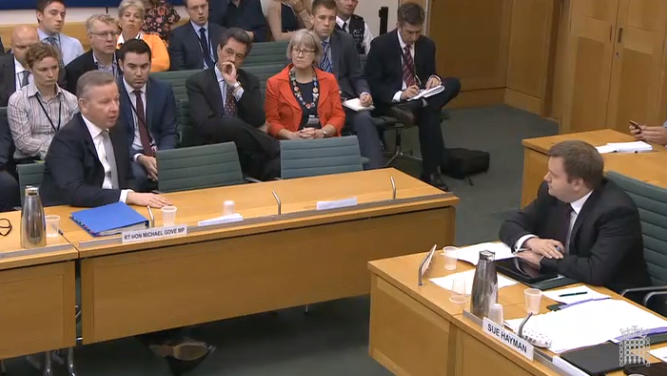
Pantomime – She’s behind you.
The session was recorded on video. Watch it here.
Getting down to business
After an exchange of pleasantries and mutual congratulations on appointment, the committee set about putting forward questions on important issues such as safety in prisons, rehabilitation, absconds from Open Prisons, court closures, and court and tribunal fees. This was good to see; Select Committees sit to scrutinise Government policy and progress.

This Justice Select Committee meeting came just a few days after the publication by the HM Chief Inspector of Prisons for England and Wales’ Annual Report 2014-15, in which Open Prisons have been highlighted once again.
On the same day as the HMIP Annual Report, Nick Harwick also published the unredacted version of the report on Release on Temporary Licence (ROTL) featuring three high profile cases of prisoners who each committed awful crimes whilst out on ROTL has challenged the current risk assessment within prisons.
The cases of Ian McLoughlin, HMP Springhill, Al-Foday Fofanah, HMP Ford and Alan Wilmot, HMP North Sea Camp were highlighted by Hardwick of where those on ROTL committed the same offence as they were sent to prison for in the first place, giving rise to questioning on whether there is ‘Rehabilitation’ in prison.
You can read the report here.
This was raised by Philip Davies MP when asking Mr Gove “what are you doing to protect the public from these future awful consequences?”
His reply was “…transfer to open prison should only follow an appropriate risk assessment.” He then added …”there will always be cases where there are individuals even if they have committed very serious offences may be suitable for a transfer to an open prison. Each case has to be judged on its own individual merits”. However, the underlying message was that public safety is paramount.
It was clear that Mr Gove was new to the job, there were many err and ums in his answers, but he did assure the committee that he would be happy to return when he had reviewed various aspects within the justice system.
So will I.
London Road – my personal memories
Almost 9 years ago back in the autumn of 2006, I moved back to Ipswich with my 3 children after living abroad for 6 years.
We thought Ipswich would be an easier way for the children to reintegrate back into English culture than moving to an unfamiliar town.
Within weeks suddenly Ipswich was on the map for all the wrong reasons, local news, national news and international news.
Young women were disappearing and then a body was found. And another. And another.
In total the bodies of 5 young women were found, all naked, and it was reported that they were probably killed elsewhere and dumped in the surrounding countryside.
A serial killer was on the loose. It was portrayed in the media as the new “Jack the Ripper”.
I was so delighted that my youngest son has managed to get a place at a very good primary school as he only had one year before high school, a huge leap having never attended an English school. Its location hadn’t been a problem when the other two attended before moving abroad. But now it was a real problem, it was on the edge of the ‘red light district’ and one by one the bodies found were identified as prostitutes known to frequent the London Road, just around the corner from the school.
I remember many times parking as close to the school as possible, sometimes in residents parking areas as I was nervous walking on my own to collect my son. I remember one afternoon parking and hearing on the radio another body had been found; at the same moment I was approached by a traffic warden insisting that I move my car from residents parking whilst taunting me with the possibility of a parking ticket. I refused and relayed what I had heard but he was adamant that I move to a car park which happened to be in the heart of the area where these women were last seen.
A concession was offered; I was told to run as fast as I could to fetch my son from school and if I was less than 5 minutes I wouldn’t get a fine. It was an unnecessary pressure upon me. No wonder these people are despised.
Ripple effect
What on earth had happened in the last 6 years that I had been away, how could this small town have changed so much?
What had I brought my children back to, why did we come back to Ipswich; doubt crept in. Had we made a huge mistake?
Yes it affected London Road residents but it went further than that, like a ripple effect. I felt vulnerable, scared and cheated, our landing back in the UK had come with a bump.
Even now 9 years later my kids don’t like me parking on the 2 hr free parking in the area whilst I nip into town.
The film ‘London Road is being shown tonight at the Ipswich Film Theatre, I had considered viewing it but have decided not to. Why put myself through those 3 to 4 months again.
Did life get back to normal? …Not at all
Can you spot a criminal?
When I first studied Criminology I remember lectures on Lombroso where he clearly thought that you could spot a criminal by the shape of his face and the debate of nature or nurture rested in the nature group.
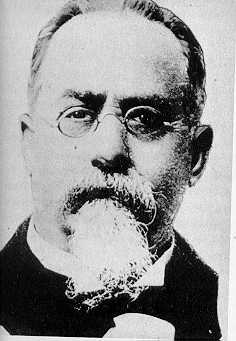
Recently I was asked to give a talk on working in prison. About 30 people were there arranged in groups at tables. I started by giving them some background to who I was and where I worked and the various hats I wear. I then gave each table a couple of sheets with photos of a variety of people including famous faces, friends and family including my husband! I asked them to study the photos carefully and write beside them if they knew their name and give each one a tick if they thought they had been convicted of a crime and been sentenced to prison. What an interesting session, I gave them about 15 minutes to complete the task.
I first gave this task to students in my cohort to see if they agreed/disagreed with Lombroso. I’m sure we have all said at one time or another “he looks dodgy” or “I wouldn’t trust them”. We are all guilty of making assumptions based on first impressions. One student asked to keep the photo of Colin Firth!
Back to this group, we discussed each photo; even though some were unfamiliar I wanted them to give each a tick who they thought had been an offender. They managed to identify the obvious such as Jeffrey Archer but struggled with others such as the suffragette, Lady Constance Lytton. It was an excellent time discussing how some had been integrated back into society yet others hadn’t and how we treated prisoners and how punitive a society we lived in. We were left with two photos where they couldn’t decide if either one of them was my husband. I found it hilarious that the two photos were of my husband and a friend Jonathan Robinson an author and prison reformer (IN_IT_THE_BOOK). Although it might seem that this was just an amusing game to get people relaxed and open to hear what I had to say, it was actually an important part of the talk. There is no set person who offends, and why do we label someone who has offended and released from prison as an ex-offender?
The group was keen to encourage reintegration back into society to those that had offended but yet again I found that they didn’t want it to happen in their society. It was the NIMBY problem again.
I have friends that have been to prison.
I visit prisons regularly.
I work in a prison.
I hope that the misguided opinions I hear don’t rub off
I often say that I want justice to restore and not just criminalize!
I will continue with the Independent Monitoring Board (IMB) to make sure that prisoners are treated fairly.
Ministry of Justice priorities…?
At the beginning of the month (5th – 7th Feb 2015) I attended the IMB conference. It was my first after over 2 years serving on the board at HMP/YOI Hollesley Bay, 14 months as Vice-chair.
After the formalities of opening the conference by IMB President, John Thornhill, we were introduced to one of the key speakers Mr Andrew Selous MP, Minister for Prisons, Probation and Rehabilitation.
And then it got very interesting!
He told us that, according to the Ministry of Justice, these were the priorities:
- Education
- Family relationships
- Work and time out of cells
The following day, to a guest panel (Frances Crook, Chief Exec of The Howard League for Penal Reform; Paul Baker, Deputy Director of Custody East Midlands, HMPS; Ben Gunn, former long serving prisoner and Clare Checksfield, Director of Returns in the Home Office), I put the following question:
“Firstly I would like to congratulate The Howard League on the books for prisoner’s campaign. Secondly the Minister yesterday explained the MOJ’s priorities were Education, Family relationships and Work including time out of cells. Do you agree and do you see them implemented?”
Education

Let’s start with Education. On this priority, Frances Crook responded by saying that “MoJ priorities are fiction”. She went on to say,
“Don’t send people to prison to get an education, send them to college. Prison education budgets have been realigned so they focus on basic skills, which is all very well but what about the 30,000 adult men who are serving long sentences and who now get little education beyond the three Rs”.
I still come across prisoners that have served many years in prison and still struggle with basic reading and writing. But should we be blaming the prison system, what happened for them to enter prison without these skills, not a straightforward issue?
Well I’m sure many of us have heard about Jonathan Robinson and his experience when he was trained to teach other in-mates to read yet, when in an open prison, was prevented by the then head of Education.
However, four years later and with new staff this same prison has just been awarded ‘Outstanding’ from Ofsted. Change does happen!
Family relationships
On this priority, Frances Crook shared that desistance is about relationships, engagement, commitment, consistency. Prisons cannot fulfil this.
One of the workshops I attended was overseen by two very enthusiastic women from HMP/YOI Parc entitled ‘Family Interventions, Supporting Positive Family Involvement. They work with the whole family and look at their needs in order to reduce offending, reduce inter-generational offending and encourage community inclusion. In the Family Intervention wing Safe Ground runs a couple of courses, Fathers Inside and Family Man aimed at teaching essential fathering skills.
Work and time out of cells
On this priority, Frances Crook said,
“Time out of cell is disappearing as staff cuts are so swingeing. Latest figures show in the last six months of last year the big city prisons were still losing staff. Morale is at an all time low, MoJ survey showed that, and sickness rates sky high.”
There are many stories that prisoners spend up to 22 or 23 hours locked in their cells but with the shortage of staff very little can be done.
Work is an essential element to prepare for release and what is needed is more companies willing to take on those with a criminal record.
A couple of months ago I spoke to a group of people about ex-offenders being re-integrated back in society, all were for it and all thought it was an important step… until I asked
“what about your society?”
NIMBY!
Where’s Mum?…she’s in prison with an author and an actor off Eastenders!
Daughter: Did you just say Mum’s visiting a prison in London with an author and an actor off Eastenders ?
Son 1: If I stop someone from killing someone else and in so doing I kill them, am I a bad person or is it just what I have done bad?
Son 2: Did you really sit in a room with prisoners, what if they were murderers?
Boyfriend of daughter: Wow, you were in the audience and sat with prisoners?
Are these the kind of conversations you have with your family?

Over the past four years I have met many prisoners who all had one thing in common: they just needed someone to believe in them, to listen to them and to help them whilst in prison and once their sentence had ended.
I’ve found that, for some of them, criminal activity had become a way of life; they knew nothing else and would most likely continue in the same way after release. For others, falling into crime was a result of a stupid decision or action, often spontaneous, which had got them in to trouble with the law, convicted and sent to prison; they felt a debilitating remorse and that they had let themselves and their families down.
Crisis – what crisis?
We read that the prison population continues to rise, overcrowding in prison seems to be the norm rather than the exception and violence, suicides and self-harm are weekly occurrences. There is tragedy after tragedy yet we are told that there is no crisis in our prison system.
So what should we do? One solution is to accept the status quo and keep our heads in the sand. Another is to actually address the issues. But, as I keep hearing, this has to be a coherent team effort.
Not settling for the status quo
In January, I visited a London prison and was accompanied by NoOffence! Patron, actor Derek Martin (Eastenders’ Charlie Slater) and author Jonathan Robinson (@IN_IT_THE_BOOK) from their Advisory Board. I’ve already blogged about the visit and the lessons I took away from that experience.
At a peer mentoring conference last year, I met with Rob Owen OBE the chief executive of St Giles Trust, an Ambassador for NoOffence!
St Giles Trust aims to help break the cycle of prison, crime and disadvantage and create safer communities by supporting people to change their lives.
Next week, I will be meeting Geoff Baxter OBE the CEO of Prison Fellowship who is also an Ambassador of NoOffence!
This is just a small sample of the organisations that work to improve the lives of offenders, there are many more.
I’d dearly like to explore how these organisations can find more ways to work together; these plus leaders such as Howard League perform outstanding work as organisations in their own right. Just imagine what could be achieved if new ways of working could be agreed to improve the Criminal Justice System.
In December 2012 I was accepted by the Secretary of State to the Independent Monitoring Board (IMB) of an open prison. To carry out my duties effectively, the role provide the right of access to every prisoner and every part of the prison I monitor, and also to the prison’s records. Independent monitoring ensures people in custody are treated fairly and humanely; I take this work very seriously.
When I started working in prisons it was as a group facilitator for Sycamore Tree, a victim awareness programme teaching the principles of restorative justice. For many offenders on Sycamore Tree one of the most powerful element of the programme is when a victim of crime visits to talk with the group how crime has impacted their lives. In week 6 of the programme, participants have an opportunity to express their remorse – some write letters, poems or create works of art or craft. Members of the local community are invited to the course to observe the many varied symbolic acts of restitution.
I’ve seen some remarkable lives turned around among offenders who make it to this stage of the programme. Okay, you argue, there is no way these outcomes can be achieved in 100% of cases. I agree.
But programmes that provide education and encouragement have to be a more purposeful activity and more effective towards increasing the chances of better outcomes with more offenders than them simply being banged up for 23 hours a day with the TV.
But all it takes is a bit of coherent team work.
I like what NoOffence! says in their mission statement and vision:
Mission Statement: NoOffence! will encourage, promote and facilitate the collaboration of organisations from the voluntary, public and private sectors to address the issue of reducing crime and reoffending.
Vision: To be the leading online criminal justice communication, information exchange and networking community in the world. Our vision for NoOffence! has always been to bring justice people together to overcome barriers to rehabilitation. We believe the solution to complex justice problems lie with the people…
They have got a point, haven’t they?
I for one would be open to try to forge more collaboration than we see today. And I know I’m not alone in that view; many others are prepared to voice a similar willingness and appetite for supporting each other.
Actions speak louder than words. Let’s get on with it.
Continue the conversation on Twitter #rehabilitation
Cat B visited
Well I have now visited Cat A, B, C, D and a YOI just leaving women’s estate which is on the agenda and an IRC.
Cat B yesterday, I must say it was not what I expected, Razor wire yes, heightened security yes, but not what I would call a “typical” prison environment.
I accompanied an actor and an ex-prisoner who campaigns for prison reform; Derek Martin an Eastenders actor and Jonathan Robinson, who I nick-named the “Dynamic Duo”.

From left: Jonathan Robinson and Derek Martin.
Photo: Faith Spear
My reason for visiting this prison was that after hearing good things about staff and their attitude towards prisoners with encouragement and motivation, I wanted to see for myself and not rely on the accounts of others.
This planned event started around 12.30, where the three of us met in the prison car park. I had met Jonathan before at various events but it was a first with Derek who came across as such a likeable character I was sure it was going to be a memorable afternoon!
On the inside
Fast tracked through security we waited in a through room for our host the Librarian and Learning Leader. Wow was he tall (well most people are tall to me)
Our first port of call was the library, what a vibrant organised room, a place where you would just want to learn in. Education was encouraged. There were colourful posters covering the walls, some of which showed previous guest appearances and reading schemes. You might say “a library is a library” what’s so special about a library?
But this was in a Cat B prison! I would have been quite happy to curl up on their sofa with a good book for a couple of hours.
I then expected just to go to the room for the talk given by Derek, instead we had a cuppa in the visits hall, a large bright modern room, laid out in small seating areas, well stocked kids play area and a purpose built coffee bar. Although I didn’t see it, the staff raved about the new baby unit just off the main hall.
It was good to chat with staff about the ways that families are supported with one member in prison. There was such a relaxed atmosphere which reflected the staff’s willingness to engage with the inmates. I believe maintaining family ties are such an important element in the rehabilitation programme. They even had incentives to enable inmates to earn extra time with their loved ones.
Our visit included Tesco express well the store for prisoner’s canteen, a wing, cell, laundry and the impressive gym. I started talking with a very enthusiastic member of staff who I immediately warmed to. Her determination to work with the prisoners to achieve was remarkable. As with my work, I meet many in prison that have never achieved anything positive in their lives. This was not something that this staff member was going to accept, she explained when faced with barriers there was always a solution even to the point of condensing courses, providing material in Braille and help with dyslexia.
Yet again education was encouraged at what ever age and what ever ability.
Oi, Charlie!
Sure, the celebrity guest was Derek, but we all were treated so well. Walking towards the multi-faith room. cheers went up from inmates and staff alike as they recognised Charlie (Derek).
On finally reaching the room, Derek and Jonathan sat at the front and Derek addressed the audience. Then the entertainment began with Derek’s sense of humour being displayed as he recounted story after story. Then it was time for the questions from “where can you buy pie and mash?” to “how can you be an extra on a television show?”
I enjoyed the chatting afterwards with the inmates; many wanted a signed poster from Derek or a copy of Jonathan’s book IN_IT.
Key takeaways
So what effect did the day have on me?
Today I have been going over and over in my mind the experiences of yesterday:
- I met inspirational staff who enjoyed their job
- I saw respect from staff and inmates
- There was no heaviness in the air that I have experienced at other prisons
- There was a hunger to learn
- At no point did I feel vulnerable
- There was a sense that the staff were all singing from the same hymn sheet
- Rehabilitation in prison can and should start from day one
- Even short sentences can be filled with purposeful activity
- Prisoners taking responsibility
- Education is a key to rehabilitation
Now I’m not saying this prison is perfect, there are issues facing the whole of the prison estate. But good practice needs to be shared.
We cannot sit by and see wasted lives within a prison environment, rehabilitation is the key to breaking the cycle of reoffending and yet its not about money, its more about attitude.
Westminster: Justice Select Committee
Tuesday 9th September 2014
Entering into Westminster Hall with its stone floor, places where famous people have stood and given speeches and seeing police with weapons can make you wonder where on earth you are. But walking up the steps at the back you enter a statue lined corridor and then you enter the lobby, beautiful architecture which never ceases to amaze me. I half expected to see Nick Robinson conducting an interview, instead I met Jonathan Robinson, an ex-prisoner, now author and prison reform campaigner.
Jonathan Robinson along with Paula Harriott, Head of Programme, User Voice, Angela Levin, former Chair of HMP Wormwood Scrubs Independent Monitoring Board, and Deborah Russo, Prisoners’ Advice Service were witnesses giving evidence on Prisons: Planning and Policies in front of the Justice Select Committee. The complete oral evidence is available from the following link:
I decided to sit in the public area and hear each witness in order to gain insight into what is actually happening in prisons. It is important that prisoners are rehabilitated whilst inside and one way is through using the skills that are present within the prison population itself.

Courtesy of Parliamentlive.tv
The Toe by Toe project run by the Shannon Trust is an excellent example of this, where literate prisoners help those that are illiterate. This is a peer-to-peer mentoring program. Not being able to read has a negative impact on job prospects and also self-esteem. It’s quite shocking when prisoners that have been in the prison estate many years face release unable to read!
Jonathan Robinson has spent the last three years pushing for prison reform, he has written on his own personal prison experience and is a voice for those inside. He champions mentoring and is on the Advisory Board for NoOffence CIC!
http://www.jonathanrobinson.org/
Evolution of Peer Power
It was a privilege to be a delegate at the No Offence! Evolution of Peer Power ‘The new revolution in breaking the cycle of offending’ conference in London on 18th September.

It was designed to celebrate peer mentoring as good practice and to give prominence to the achievements of both peer mentors and their clients.
There has in recent years been a lot of talk about breaking the cycle of offending. We all waited with bated breath for the governments’ launch of the green paper in December 2010 ‘Breaking the Cycle Effective Punishment, Rehabilitation and Sentencing of Offenders’. This Green Paper set out plans for fundamental changes to the criminal justice system in order to break the destructive cycle of crime, meaning that more criminals make amends to victims and communities for the harm they have caused. In so doing create a rehabilitation revolution that will change those communities whose lives are made a misery by crime. However, the criminal justice system is relied upon to deliver the response of: punishing offenders, protecting the public and reducing re-offending. This Green Paper addressed all three of these priorities, setting out how an intelligent sentencing framework, coupled with more effective rehabilitation, will enable the cycle of crime and prison to be broken.
So where does mentoring fit in? Well it is mentioned twice,
139. We have already launched the Social Impact Bond in Peterborough prison focused on those offenders serving less than 12 months in custody. Social investors are paying up front for intensive services and mentoring delivered by the voluntary and community sector. We will pay solely on the results they deliver.
266. In line with our broader reforms on transparency we also believe that local communities should know how their local youth justice services are performing, and have an opportunity to be involved. Both Youth Offending Teams and secure estate providers significantly involves volunteers to support the work that they do; there are approximately 10,000 volunteers already working within the youth justice system. This includes participation as youth offender panel members and mentors. We want to build on this, including encouraging voluntary and community sector providers, where appropriate, to deliver services. We also intend to publish more data at local level so that communities can see the effectiveness of their local Youth Offending Team for themselves, and use this information to inform and shape local priorities.
Let’s move forward 4 years……..
Offender Rehabilitation Act 2014
An Act to make provision about the release, and supervision after release, of offenders; to make provision about the extension period for extended sentence prisoners; to make provision about community orders and suspended sentence orders; and for connected purposes. [13th March 2014].
So yet again we consider where mentoring fits in the overall scheme of rehabilitation and breaking the cycle of offending. According to Rob Owen Chief Executive, St Giles Trust, highly motivated, uniquely credible, well-trained and well-managed, ex offender Peer Advisors deliver a professional, high calibre, impactful service to help other ex offenders through peer-led support. With each £1investment in peer mentoring the tax payer saves £10, sounds like good value for money.
Former Cabinet Minister, Author and prison reform campaigner Jonathan Aitken, stated that:
“Rehabilitation is falling off the agenda within prisons” and “mentoring needs to start in prison and not at the gate”.
However, with the Transforming Rehabilitation programme, it is hoped that this is not the case as mentoring is now on the agenda.
Ministry of Justice (2010) Breaking the cycle: Effective Punishment, Rehabilitation and Sentencing of Offenders. London: TSO. (Cm. 7972).
 The Criminal Justice Blog