Home » offenders
Category Archives: offenders

‘The Grass Arena’ by John Healy
‘The Grass Arena’ by John Healy is a book centred round a world I thankfully have never ventured into – either by choice or circumstance. Drink, drugs, vagrancy, death, prostitution and money – the somewhat graphic portrayal of a life I can only describe as ‘brutal’.

A daily struggle for life itself, for the breath to breathe and the sustenance to give strength is a battle many start but then give up, as hurdles become visible, barriers are built and prejudice is rife. Drink becomes an obsession. I am sure we have all at some point tried to look through the window of others’ lives. We analyse their behaviour; we penalise whilst categorising them, we pity them. Not forgetting we compare their misfortune with our own accomplishments.
We read about them. Some use it as research to further their own life chances whilst disregarding the people involved. Some may find it entertaining; others as a measure of how they personally are doing, or how far they have failed. For myself, when reading about others there is an element of intrigue of course, but it’s more than that. I do not like small talk, its uncomfortable. I want facts and meaningful conversations. That is true communication.
This book communicates.
I frequently read about people’s journeys in life.
We all have a story to tell and I am eager to listen.
I have met many authors with fascinating quotes and anecdotes and maybe one day I will have the opportunity of meeting John. It was hard to put down this autobiography, an often harrowing account mirrored by the lines on my forehead, my furrowed brow. It is intense, it is absorbing yet thought provoking in a greater sense than most books on my shelves.
“Life was becoming more complicated. I was back in the old routine: stealing, drinking, fighting, my probation order, car insurance, detectives. I was pulling so many strokes for drink that I could not remember what I was doing…”
The stories of Fred, Dipper, Spikey and more carry merit, lives entwined with a common desire in life. Their struggles, contentions, crusades, rivalry and exploitations all add to the chart laid out in front of us.
“We look at people with only one thought. How can we get the price of a drink out of them? Looking, always looking, even when there is nothing to observe”.
An obsession leading to a lifestyle and a painful path trodden – alcohol picking you off one by one becomes a dangerous liaison. Yet seeing others fall is no way to interrupt the cycle, there is no end in sight, its continuous. I tried not to interpret my initial thoughts, the “if only”, “but” or even “what if” can become a distraction.
I just read. The shady doorways, the open green spaces, the derelict houses and the public houses all feed John’s obsession. Recovery from excess is quick and the thought of drink is always on his mind and he will do anything to take the constant battle, the weight on his shoulders and the voice in his ear, away.
This book is about a fight for survival, the many characters described within it are people trying to get through trauma, abuse and hopelessness. Many do not make it through.
Prison, I would not wish on anyone, I have visited enough to know they are not holiday camps, never have been and never will be. They are dangerous places. Here in ‘The Grass Arena’ they imitate the chaotic world that John is in. Familiar faces, familiar stories, and familiar issues to deal with.
Is it possible to escape from the grip of an obsession – even in prison? I read with impatience, asking that question many times.
Can John break free?
Does he want to break free?
Slowly but surely his obsession is substituted, by a game of chess. Yes chess, a game often associated with money, with brilliant minds; not a wino living each day for the dangerous toxic thrill of a drink.
A good book impacts you, challenges you, and this book is no exception, but it does leave the reader wanting more.
As I wrote earlier, it is a window into many lives and now the onus is on the reader to decide what to do next…
first published, Insidetime November 2020

A conversation with: Erwin James
Busy train
Busy tube
Busy London streets
Police everywhere
I made my way out of the crowds towards my destination: The National Portrait Gallery, London.
Although this will be a time to indulge my love of Art, I’m actually here to interview rather than be an interviewee.
I arrived early and found a quiet(ish) corner of the café to collect my thoughts, helped enormously by the Earl Grey tea and slice of orange and polenta cake.
Two days previously I attended the Koestler Art exhibition on the South Bank entitled “Another Me”
I prefer to visit alone; I don’t want other people’s initial reflections to become mine. For me it’s not just the pieces of art that can stop me in my tracks but the titles of the pieces. This year I discovered “Stand Alone”, “Consequences”, “Innocent Man” and “Woo Are You Looking at?”.
From matchsticks to J-cloths, from socks to gold leaf such variety of materials, such ingenuity.

Erwin James at National Portrait Gallery, London
But the question that stayed in my mind was:
“Are these exhibits examples of escapism or expressionism?”
I made my way up to the large information desk at the National Portrait Gallery and sat patiently awaiting my guest.
Ten minutes later, he arrived looking rather bemused at my choice of venue to interview him.
Erwin James followed me up a flight of stairs where we slowly wandered around looking at portraits of people, from HM The Queen to Zandra Rhodes and every conceivable individual in between.
Trying to get my bearings, we turned a corner and entered the Statesmen’s Gallery, lined on each side by a series of white marble busts on projecting plinths in between painted portraits. It looked outstanding.
At the far end hung a portrait painting of Dame Christabel Pankhurst by Ethel Wright (oil on canvas, exhibited 1909), militant Suffragette, persuasive speaker and effective strategist. Erwin and I stood and pondered.
In one of the rooms off this gallery we found a bench, sat down and started to talk. Straight ahead was a significant portrait, covering a large part of the wall, entitled:
The Mission of Mercy: Florence Nightingale receiving the Wounded at Scutari

The Mission of Mercy: Florence Nightingale receiving the Wounded at Scutari by Jerry Barrett. Oil on canvas. 1857
Faith Spear: When you look at that picture what does it tell you?
Erwin James: There are people who care about people that others don’t care about. This lady cared for the wounded she didn’t care about the war, she cared about people.
FS: How does it make you feel when you see that?
EJ: My experience of prison was that occasionally, more than occasionally there are people who care about people, about the wounded people in our prisons who need assistance, it’s a challenge for any community or society to think that we should care or help those that have hurt us. But she cared about everybody.
FS: Do paintings like that inspire you?
EJ: I found paintings in prison. I did an Arts degree and I was given this folder of great art; I had never had access to art or that sort of thing, ever in my life until I went to prison. I found art through the Open University.
I have never seen this painting before if I’m honest, but it tells us, “this lady, she doesn’t care who you are. She just wants to heal you.” The Onlookers: What are they thinking, should we help this person? There’s hesitance, others are standing away, observing. But you can’t hesitate or observe when people need help. My feeling about our attitudes to prisoners is that’s it’s a challenge to help people who’ve hurt us but if we don’t help them, they are going to hurt more people. When I look at that painting, I promise you some are taking advantage of the crowd.
FS: That’s interesting “taking advantage of the crowd”
EJ: We do that in our society now, longer prison sentences…we deserve a prison system that hates the crime, perhaps hates the criminal but for Christ sake give the prisoner a chance. That’s my philosophy really.
We slowly moved from room to room admiring and yet questioning the art we saw. Both of us were struck by a painting of Henrietta Maria (1635) and our hidden thoughts became open dialogue
EJ: Look how attractive we are, look how wealthy we are, look how amazing we are
FS: Always trying to prove something
EJ: Always
FS: Is that because people can’t accept who they are?
EJ: People seem to want to portray an image that is more than what they are, that is exactly what these people did
FS: It’s not just status is it?
EJ: Status, its look at me, look at us, all the poverty in the country when she was painted.
The poor people, we always looked up to the people doing well, we always aspire to be like them
FS: Always looking down on those that are not doing so well?
EJ: I don’t know why because we are all trying to get up that ladder
FS: Do you think we fall into the trap that we don’t actually accept people for who they are?
EJ: Well we are not sure who they are, all we know is we think we know who we are we want to be better versions of ourselves come what may
There are many self-portraits in the National Portrait Gallery, some more obvious than others.
FS: With a self-portrait you are not necessarily portraying the real you
EJ: No, you are portraying what you want the world to know about you. As a writer I am the same, I’m exactly the same, I want the world to know me through words because the world sort of knew me through the courts through prison through prosecution
FS: So, do you think you were trying to re-invent yourself
EJ: Yes
FS: But then that is saying previously that wasn’t the true you
EJ: Yes, that wasn’t the true me
FS: Do you think that this is the true you now, what you are doing now?
EJ: Yes, before I became who I think I am, I’m not perfect by any means, but I am my own person and I think lots of people go through life thinking, well is this me? I’m born into this way of living but gradually you think did I decide this. Other people decide our lives and what prison gave me was the freedom to choose my own, if that makes any sense. But even though I am a million miles away from perfect, I am a real person
They all portray dominance over everyone else. The whole purpose of art in these ages was to say look at us, we dominate you – and then the dominated looked up and said, “we are so pleased to be dominated by you”, we didn’t know then that any of us could be dominate and dominated we didn’t realise then before mass education, we didn’t understand that we can all be people with education with skills and abilities
We walked up to level 2, not knowing what to look at first. We entered a small room.
FS: Do you see that painting over there of John Wilmot, 2nd Earl of Rochester, with his books showing he is an educated man, well in fact, a poet?
EJ: Books for the educated people? No. books are for everyone, to me Faith, books are a great leveller. If you can read, you can be a King.
By this time, I needed to sit down; juggling bag, jacket, notebook, pen and phone was getting problematic. I found a wooden bench in one of the corridors and with phone at the ready I continued my questions as we sat down.
FS: One thing I am always amazed at in an art gallery is that everything is categorised, often by year, era or by event. Everything is numbered. And there is a lot of security. When you come into an art gallery you are watched by cameras everywhere.
Everything is numbered, everything is categorised exactly the same as it is in a prison.
How did it feel to be categorised and given a number?
EJ: That is a really good question.
Well I was categorised; I was a Cat A prisoner for 5 or 6 years. The system categorises you and gives you a number. I hated my prison number. I was in Devon driving down a lane and I saw a signpost for the B73…, arghhhhhh! That’s my prison number!
It was awful, I had forgotten it, forgotten it purposely. When you are categorised and given a number you become labelled, you’re not human you’re a prisoner. But thank god there are some amazing people that work in prisons who want you to be human. For various reasons you end up there, they work there, and they are there to help you to become like them. Thank god for that. Without those people I would never be here I would never have made it. Teachers, psychologists, probation officers some prison officers…
FS: But when people are reduced to a number do you think that is degrading?
EJ: Well I think the danger Faith, you are asking me something quite profound here, because the danger when we do that, we detach people psychologically from our community. Now prison is detaching. You did harm, you caused pain, grief etc, but what we do with that in our prison system is that we detach further psychologically so the people in prison psychologically don’t feel part of society. Don’t feel part of the community, there’s no sense of wanting to come back.
I want to do some good when I come back, but mostly we don’t want them back. But actually, there’s so many people that do come back do good but it’s the physiologically detachment that presents danger from the released prisoner.
As Erwin is a writer, I wanted to probe a little more into different aspects of his life.
FS: For someone who is setting out on a journey as a writer what advice would you give?
EJ: Well what I would say is first and foremost is tell your truth. But first, you have got to find your truth because if you don’t know your truth you will never be able to share that truth. So, there are a couple of things: have discipline, have courage because when you put your truth out there you are going to get people who hate you and your truth. You need to have courage and be bold, but as long as you know your truth you will have a significant number of people who will accept that. Whatever the obstacles whatever the challenges you just keep going.
I decided to probe a little deeper too.
FS: What makes you laugh?
EJ: You will be amazed how many people in prison laugh, it’s a funny thing in jail you laugh at the most banal things.
FS: But what makes you laugh now?
EJ: My great granddaughter she makes me laugh. “Grandad, grandad look at the chickens” she chases chickens and I run after her and I’m laughing like hell and then she catches a chicken. Then she chases the ducks.
I do laugh but I am a very serious thinker, but I laugh when she laughs, its infectious. I feel safe to laugh with my great granddaughter.
FS: Is that because you are not being judged?
EJ: In the public if I am laughing, I feel awful because there are people grieving because of me. Even in jail I was scared to laugh sometimes because it looked like I didn’t care about anything.
FS: What makes you cry, do you cry?
EJ: I cried a long time ago in prison when I came to terms with what I had done with the effects on victims’ families of my crimes. I didn’t cry before that.
What makes me cry now? A good drama where there’s an amazing writer who brings the human condition into our living rooms and shows us how weak, strong, dominant, how we are as humans.
That makes me cry.
My final question was about what others say.
FS: What is one of the most memorable statements about yourself?
EJ: The best thing that’s been said of me, that I am really proud of, I do school talks. I was in a school in Southampton a few years ago, the Headmaster said afterwards:
“It was one of the best talks we have had all year and, for some, will be an abiding memory of school.”
It was time to switch my recorder off, I took in a last view of this amazing gallery and headed outside for some air. After a refreshing drink we said goodbye and I headed for the tube.
What an interesting conversation.
Erwin James is editor-in-chief of ‘Inside Time’, the national newspaper for people in prison and the author of ‘Redeemable: A Memoir of Darkness and Hope’.
Photos: Copyright © FM Spear. All rights reserved.
~

HMP Berwyn: Does it raise more questions than it answers? Part 2
The Wales Governance Centre, a research centre and part of Cardiff University’s School of Law and Politics undertakes innovative research into all aspects of the law, politics, government and political economy of Wales.
This week they released a report: Sentencing and Imprisonment in Wales 2018 Factfile by Dr Robert Jones

Before looking at this report, lets put things in context by referring to the first unannounced inspection by HMIP of HMP Berwyn in March 2019. Here it is reported that “impressive” support procedures are in place for new arrivals. Positive note. However, use of force was considerably higher than at similar prisons and 1 in 4 prisoners (23%) told HMIP that they felt unsafe. Alarm bells?
Below are the four tests when inspecting a prison, Safety, Respect, Purposeful activity and Rehabilitation and release planning. Not the best outcome for the first inspection.
Safety: Outcomes for prisoners were not sufficiently good against this healthy prison test.
Respect: Outcomes for prisoners were reasonably good against this healthy prison test.
Purposeful activity: Outcomes for prisoners were not sufficiently good against this healthy prison test.
Rehabilitation and release planning: Outcomes for prisoners were not sufficiently good against this healthy prison test.
HMP Berwyn prison has only been open just over 2 years, hasn’t reached full capacity and has its 3rd governing Governor.
Now let’s look at some of the facts revealed that are not easy reading
The number of self-harm incidents
2017 = 231
2018 = 542
Self-harm incidents rose by 135% in 2018
Rate of self-harm: (48 per 100 prisoners)
This is what the Government website states:
“Self-harm may occur at any stage of custody, when prisoners are trying to deal with difficult and complex emotions. This could be to punish themselves, express their distress or relieve unbearable tension or aggression. Sometimes the reason is a mixture of these. Self-harm can also be a cry for help, and should never be ignored or trivialised” https://www.gov.uk/guidance/suicide-self-harm-prevention-in-prison
This is what the HMIP report states:
“The strategic management of suicide and self harm required improvement. Strategic meetings were poorly attended and too little was done to analyse, understand and take action to address the causes of self-harm. Most of the at-risk prisoners on assessment, care in custody and teamwork (ACCT) case management did not feel sufficiently cared for. ACCT documents required improvement, and initial assessments and care plans were weak”
Yet below are more uncomfortable facts showing that this prison is not just dangerous for prisoners but for staff too. Nothing to celebrate here.
The number of prisoner-on-prisoner assaults rose by 338% in 2018
Rate of prisoner-on-prisoner assaults: (20 per 100 prisoners)
The number of assaults on staff at HMP Berwyn increased by 405% in 2018
Rate of recorded assaults on staff (18 per 100 prisoners)
You would think that a new prison would have a security department second to none, with little chance of items being brought in. Yet these figures show that weapons, drugs, alcohol and tobacco are increasingly being found. Some may say hats off to the staff for finding these items, but really there’s still no cause for celebration…
The number of incidents where weapons were found in prison, years ending
March 2017 = 1
March 2018 =25
March 2019 Berwyn = 138
The rate of weapon finds (11 per 100 prisoners) year ending March 2019
This was the highest rate per prisoners in all prisons in Wales, astonishing. Serious problems with security.
The number of drug finds at HMP Berwyn increased by 328% in the year ending March 2019 (prison population increased by 67% during this period)
The rate of drug finds (16 per 100 prisoners)
Where are the robust measures to stop drugs coming into the prison?
The number of incidents where alcohol was found in HMP Berwyn years ending March
2017 = 0
2018 = 21
2019 = 146
Alcohol finds at HMP Berwyn rose by 595% (prison population increased by 67% during this period)
Rate of alcohol finds (12 per 100 prisoners) year ending March 2019.
Yet again the highest rate of alcohol finds in all the prisons in Wales
The number of incidents where tobacco was found in HMP Berwyn years ending March
2018 = 20
2019 = 61
Rate of tobacco finds (5 per 100 prisoners)
The prison is covered in photos of Wales and the countryside, everywhere you look there is a motivational quote, there are flowers, bees, greenhouses yet one in 4 prisoners didn’t feel safe.
Comfy chairs in reception, pretty pictures, colourful décor does not appear to contribute to the safety of HMP Berwyn.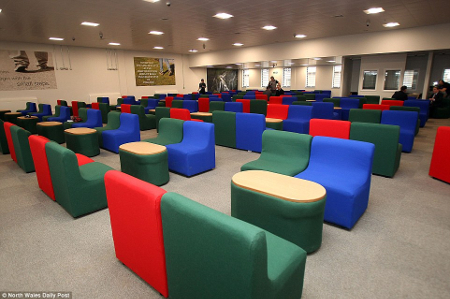
Motivational quotes such as “When a flower doesn’t bloom you fix the environment in which it grows not the flower” means nothing if a quarter of the population feel unsafe.
Prisons can be austere places, drab, filthy, old and not fit for purpose. But here we have a new prison with serious problems. There can be no excuse that these are teething problems, we are talking about peoples lives.
Remember the Berwyn Values?
V = value each other and celebrate achievements
A = act with integrity and always speak the truth
L = look to the future with ambition and hope
U = uphold fairness and justice in all we do
E = embrace Welsh language and culture
S = stick at it
Is this just a marketing ploy, designed for a feel-good factor, making us all think that the money spent on this Titan prison was worth every penny?
Independent monitors have praised the work of staff at HMP Berwyn describing their efforts to establish a new prison as a ‘considerable achievement” (Recent comment by IMB) After this shocking report, what will they now say? Or will they remain silent?
I don’t doubt there are some hard working, diligent and caring staff. In fact, I met some on my visit last year. But when the prison opened in 2017 over 90% of staff had never worked in a prison before. When you have prisoners arriving from over 60 prisons all with different regimes, you find they have far more experience of the prison estate than the majority of prison officers.
But more worryingly is that the Government is continuing with its programme of building new prisons. A new prison will be built in Wellingborough as part of the Government’s Prison Estate Transformation Programme. I’ve read gushing articles on how this prison will benefit the community etc, similar to when HMP Berwyn began construction. Just like HMP Berwyn there are many promises and opportunities, but theory and practice can be a million miles apart.

Now it’s my turn to ask what’s acceptable online
Only those who know me know who I am and what I do, often away from the public eye.
On top of my commitments this week I want to talk about this. I have seen a barrage of messages on Twitter, sent to me and about me; messages which are good, bad and certainly ugly, sent mainly from those who don’t know me and have never met me.
Why? Online abuse is unacceptable. I am calling it out and people don’t like it.
To put things in context, I myself have received a fair amount of online abuse over the last few years but last summer it reached a new level because the online abuse included a death threat from an individual who I had never met, but who was going through a very unstable time. This was totally unacceptable, so I reported it to Twitter. Twitter said they had broken Twitter rules and consequently Twitter suspended the account they were using.
I had a short period of relative peace until the Autumn. The snide remarks started up again primarily from an individual, then a small group emerged, tweeting in agreement with them. I decided to inquire who these people were, but not on open social media. I contacted people I knew and trusted and asked for their advice, questioning the reasons behind this unacceptable attack on me, but even in asking questions it seemed I opened a can of worms. I learned there were those hiding behind Twitter accounts who had other professional accounts. It seems I hit a raw nerve; I’ve done that before and it will probably happen again!
Never once did I try to get any ex-offenders fired from their jobs. This is pure fabrication.
Over the last fortnight, I have seen tweets primarily from one individual with relentless bombardment on a daily basis. How is this acceptable behaviour and especially from someone who, yet again, I don’t know and have never met?
Starting rumours, planting seeds of doubt into the minds of others, and propagating things which are blatantly untrue: the tweets by that individual are being proliferated by others. They talk about what I wear, what I eat, who I associate with, what events I have attended, and even have the audacity to want to know what is in my diary. Their remarks and exchanges place me in false light.
Why the obsession?
Seriously why?
The stories they invent are worth a Bafta.
Why am I constantly seeing tweets by those who want me to confirm or deny certain issues, that I allegedly did or said or even thought? And why am I accused of being the bully and generating a climate of fear and frightening people into silence? Utter nonsense.
In an example of online abuse unrelated to previous examples I have given above, here is a tweet I saw recently:
“If it’s covered in sugar it’ll ruin your teeth. If covered in salt, it’ll affect your blood pressure. Spear is a withering insipid excuse for a woman. And I’ve little time for bullshit and her version of victim hood”
Really is this acceptable?
This is from an individual who works in the criminal justice system. Astonishing.
Turning to yet another separate example of online abuse, I remember being at an academic round table event a couple of years ago. The person sat beside me, who I knew of but had never met before, started to cry so I reached into my bag and gave them a tissue. I had a few online conversations with them before and afterward, but didn’t know their full story and didn’t get involved in their life. Yet, allegations were made online against me, by a third party, of lifting them up, carrying them then dropping them. All I did was give them a tissue for goodness sake and for my trouble they themselves later sent messages to me on Twitter including disgusting photos with increasingly nasty comments.
And the stories started to circulate.
Is the online abuse I receive a form of deflection?
Am I regarded as a legitimate target for people to offload their frustrations?
Are the people sending online abuse themselves hurt and damaged?
When the majority state that they are there for others, to support them, how ironic they tweet things so unsupportive such as:
“Wow – if this is true it is despicable, but not surprising…”
“Allegedly you caused…”
“I personally fear for all those connected to you…”
What does this smear campaign hope to achieve? Remember when you point the finger at someone there are three pointing back at you.
If this is how you treat me when all I work for is positive change within the prison sector, then how can others trust you? In smearing me you are making yourselves less credible, ruining your own reputation and doing yourself and the cause you fight for a disservice.
I’m not perfect, I make mistakes. Who doesn’t?
But I will not stand by and put up with this online abuse orchestrated against me. Piling on is the online equivalent to dishing out a pad beating in a prison. Anyone who has served time and who now uses social media will understand the devastating effect I am talking about.
Unlike those who level allegations against me, I have chosen not to name anyone, they know who they are and should reflect upon what they do and say online.
I’m upset, feel bruised, frustrated, bewildered and many other emotions. But I will not shut up and will not go away.
What I saw and heard visiting many prisons (every category including women’s prisons) gives me motivation to work with others to restore decency for those in prison and for their families.
I will do all I can to help bring positive change, to speak the truth and face the consequences. I may not be everyone’s cup of tea, but I am me.
~
Everything on this blog has been out on social media; I just collated it.
~
Updated 20 March:
13th paragraph has been modified following a request on Twitter that I associated the person who issued the online abuse in 12th paragraph with the person who issued the death threat against me cited in 4th paragraph. Therefore, the 13th paragraph now starts with new words to make it abundantly clear the two individual examples on online abuse originated from separate individuals and in order to resolve any misinterpretation this may have caused.
16th paragraph has been modified following a request issued on Twitter that in some way I identified the person who issued the online abuse cited verbatim in the 12th paragraph. Therefore, certain wording about the individual’s background has been removed as this was regarded to be pejorative and reference to the nature of their work has also been removed in order to resolve any misinterpretation this may have caused.
17th paragraph has been modified following a request issued on Twitter that in some way I identified the person who issued the online abuse covered in this paragraph. Therefore, certain wording about the individual’s gender has been removed as this was regarded to be the identifier and in order to resolve any misinterpretation this may have caused.
~

Why Rehabilitation is a Right Prisoners are Entitled to: Adam Meylan-Stevenson
Much of the debate arguing that prisoners should be rehabilitated answers the question by claiming that rehabilitating people can benefit society by preventing future crimes. I agree with this claim and affirm it as true. However, I think the case for rehabilitation can be made stronger by showing that prisoners have a right to rehabilitation. If this claim succeeds, then opponents of rehabilitation must explain why it is legitimate to deny prisoners this right.
Adam Meylan-Stevenson
My argument is that people have a right to not find themselves in a worse position, economically, socially, or psychologically, after their prison sentence. It is common for people to be shunned after their release from prison. It can be hard to shake the label of ‘criminal’, despite having served their time. I think this attitude is mistaken. After a person has served their time and been released, they should have the opportunity to reintegrate with society and live purposeful lives.
One key advocate of this position is Egardo Rotman. Rotman has argued that just as the state has a right to punish individuals for wrongdoing, the individual has a right not to be made worse off by the effects of the punishment (Rotman, 1990, 184). However, the reality is that people are frequently made worse off by their punishments. One way, amongst others, this happens is how for many, having a criminal conviction is a barrier to leading a law-abiding life on release. In 2016, only one in four prisoners (27%) had a job to go to after release. One in five employers (19%) said they exclude or they were likely to exclude prisoners from the recruitment process (Prison Reform Trust, 2017, 16). The result of this is that even after serving their punishment in prison, people are still being debilitated.
From the above point, it seems imprisoning people is making people worse off after their punishment should have ended. We must ask ourselves, is it fair if an offender who has served their time is not able to move on with their life? From this, I think there is a moral requirement for the state to counteract the disabling effects of punishment and to provide rehabilitation, as a right, to offenders. Essentially, as the state is harming people by imprisoning them, it has a responsibility to counteract the harmful results that the punishment brings.
One worthwhile model of rehabilitation is ‘humanistic rehabilitation’. This model affirms the principle of prisoners as possessors of rights. The importance of this principle is that this legal status gives prisoners a sense of self-worth and trust in the legal system. An issue with our current system is that prisoners often feel alienated from society and hold resentment towards the outside world. Rotman argues embracing this model of rights-based rehabilitation favours the prospect of “self-command and responsible action within society” (Rotman, 1986, 1026). Following Rotman’s view, I believe this type of rehabilitation can be achieved through providing relevant psychological care, education, vocational training, and purposeful work. By purposeful work, I mean work that requires some skills that will be a stepping stone to allow prisoners to pursue full-time employment in a similar field upon release. Not menial work that only succeeds in making the prospect of full-time employment unappealing, like untangling headphones or packing plastic spoons (The Guardian, 2009).
Here, I will note that the Universal Declaration of Human Rights affirms all people have the right to work and education. Additionally, prisoners in the UK are entitled to the same healthcare individuals in the community receive, including mental health care. As this form of rehabilitation largely takes the form of education, work, and appropriate psychological treatment, the opponent of rehabilitating prisoners must explain why these rights should be removed from people in prison. I think there is no sound basis for removing these rights from prisoners. It is clear some rights can justifiably be removed from people. For example, the right to liberty can be removed for the justifiable reason of protecting the public from an individual and to protect the individual from vigilante reprisals. However, there is no justification for removing the rights to work and education that individuals enjoy before they are imprisoned. It would have no good end. Therefore, it can be shown that prisoners have the right to be rehabilitated.
Of course, the costs of the resources to achieve meaningful rehabilitation will be expensive. This approach will receive opposition from a public and political opinion that is generally punitive and other services across the country are strained. However, I would argue that this view is short-sighted. Whilst rehabilitating offenders is expensive in the short-term, if it is effective and crime goes down and communities get safer, then the cost has justifiable ends.
Ultimately, my argument is that prisoners have a right that entails that useful services should be provided, where appropriate and practically possible, to counteract the debilitating effects of prison. It is a case of justice that if prison makes people worse off, then the state is required to provide rehabilitation to counteract this. Prisoners are not sentenced to idleness, it is not necessary nor desirable. Instead, people’s time inside should be spent meaningfully, to allow them to reintegrate with society upon release.
Adam Meylan-Stevenson
adamcobblers@gmail.com
@Adammeylan_s
References
Allison, E. (2009). A fair day’s prison work? | Eric Allison. [online] The Guardian. Available at: https://www.theguardian.com/society/joepublic/2009/sep/09/prison-work-exploitation.
Prison Reform Trust (2017). Prison: The Facts. Bromley Briefings Summer 2017. [online] London: Bromley Trust, pp.4-16. Available at: http://www.prisonreformtrust.org.uk/Portals/0/Documents/Bromley%20Briefings/Summer%202017%20factfile.pdf [Accessed 9 Dec. 2017].
Rotman, E. (1986). Do Criminal Offenders Have a Constitutional Right to Rehabilitation?. The Journal of Criminal Law and Criminology (1973-), [online] 77(4), p.1023. Available at: https://scholarlycommons.law.northwestern.edu/cgi/viewcontent.cgi?referer=https://www.google.co.uk/&httpsredir=1&article=6540&context=jclc [Accessed 10 Dec. 2017].
Rotman, E. (1990). Beyond Punishment. 1st ed. New York: Greenwood Press, p.184.

The State of our Prisons: WALES Overcrowded. Understaffed. Underfunded.
Mr David TC Davies (Twitter @DavidTCDavies), Conservative MP for Monmouth and chair of the Welsh Affairs Committee, has launched an inquiry into prison provision in Wales. At the moment, there are no facilities for women yet there are proposals for another “Titan” prison in South Wales at Baglan.
Let’s look briefly at the record
HMP Swansea, HMP Parc and HMP Cardiff rank amongst the worst prisons in the UK.
All have serious problems with prisoner-on-prisoner assaults, suicides, overcrowding and drugs. Here are some statistics:
Swansea: 80% of prisoners are in overcrowded cells. On arrival at the prison 53% have a drug problem and 32% have an alcohol problem.
Parc: this prison is ranked 111th place out of 117 in England and Wales. In 2017 there were 881 prisoner-on-prisoner assaults and 1451 incidents of self-harm.
Cardiff: 64.5% of prisoners are in overcrowded cells. There were 220 prisoner-on-prisoner assaults in 2017.
Usk/Prescoed: There is no full-time health care provision at either prison, concern by IMB of frequency of ‘lie downs’
If South Wales is serious about a new super prison it should first take a long look at what’s happened in North Wales:
Berwyn, the flagship of the MoJ which opened in February 2017.
Despite being Europe’s second biggest prison, with a capacity of more than 2,100, up to July of last year the £212m facility was less than a quarter full – with just over 500 inmates being catered for. By November there were 800 men.
Digging a little deeper, we find:
- HMP Berwyn received 319 complaints from prisoners February to September 2017.
- There were 219 complaints about the living quarters in the first seven months and 31 complaints about the quality of the food.
- There were 4 complaints about prisoner-on-prisoner violence or assault compared to 50 lodged by prisoners alleging abuse or assault by prison officers.
- Five of the alleged assaults were passed to North Wales Police for investigation, no action was taken over any of them.
- Ministry of Justice revealed that 376 items were confiscated from prisoners between its opening in February and October last year.
- 30 unspecified weapons, 56 items relating to drug paraphernalia and 34 mobile phones were among the items found in the possession of prisoners.
- Other items confiscated include 21 debt list items, 66 lighters, 17 USBs, 26 vaping objects and 10 chargers.
- There were also a number of items described as “miscellaneous” that were confiscated by prison officers.
So, whether prisons are new, old, Victorian, large, average size, have highly respected Governors or frankly those that should not be there (believe me I’ve met both!), it makes no difference as they all have similar issues to contend with:
Overcrowded. Understaffed. Underfunded.
To alleviate this prison crisis, we need fresh approaches in order to:
REDUCE the population: send fewer people to prison for non-violent offences
INCREASE the use of community orders
CUT the number of recalls
DEAL with indefinite sentences IPP’s convert to fixed length sentences?
FACILITATE prison release, therefore reduce self-inflicted deaths and reduce self-harm
REFORM prison estate and ensure all facilities are decent
SHARE best practice
INVEST in the long term and DELIVER in the short term
ADD more mental health facilities
The list can be endless and will depend on whether we see the purpose of prison as punishment, rehabilitation, both of these or a form of social cleansing.
Only last September, Lord McNally said in the House of Lords debate on prison overcrowding:
“We therefore have to understand the debate today which will be overwhelming in favour of sensible reform still has to pass that test of how we get a Secretary of State, a Prisons Minister and a Prime Minister who are willing to drive through reforms”
But that’s not the end of the story
We need a change in public attitude and that can only come from being informed and educated and not continually having issues covered up and hidden, the brushing under the carpet syndrome. There must be transparency.
We then need investment in life after prison in the provision of a home, a place of work, training or education and a reduction of the stigma in having a criminal record.
~
The Power of the written word

Richard W. Hardwick (@RWHardwick) asked me recently if I would consider writing a review for his new book The Truth About Prison in the form of a blog. So here goes.
Reading this book is like listening to myself as Richard writes like I think!

This is a compilation of journeys of many people within a prison environment with a reoccurring theme, the truth about prisons. Truth can be hard to swallow, it can be hidden, but it’s there if we take the time to find it.
I know that speaking the truth can come at a personal cost.
Truth also hurts. But should we ignore it, should we cover it up? No, certainly not.
Walking into a prison is like opening that door C.S. Lewis wrote about and entering another world. A world without the same rules regulations or expectations. To start with its rather strange, almost intriguing and no day is ever the same. Conversations are limited, people are watching you and waiting for you to make a mistake as you are expected to know the rules, but when they are unwritten how can you? It’s like you walk into someone else’s life

When you start reading this book you open in your mind that wardrobe door. If you have never visited a prison you begin to visualise what really happens, who lives and works there. Most importantly you begin to wonder what are the benefits? What is its purpose? And just Why?
Questioning the stories, the anecdotes, the nitty gritty of prison life changes you. Once you open that door there is no going back. From then on, the reader cannot say “I never knew” as you have just begun to learn and hopefully understand about prison.

Prison reform: paying the price
Well D-Day is rapidly approaching for me, the day the Ministry of Justice and the Independent Monitoring Board decide on my future not just as a Chairman but as a member of the IMB as I have to attend a Disciplinary Hearing.
 How it got to this is a long story.
In a nutshell, I spoke out for Prison Reform and IMB reform in an article in the Prisons Handbook 2016 entitled “Whistleblower without a whistle” and suffered reprisals for it.
Have you seen the state of prisons lately?
Have you heard about the state of prisons lately?
Too much is swept under the carpet pretending it’s not there.
But I put my head above the parapet, I made a personal stand.
The President of the IMB National Council, John Thornhill obtained a copy of my article “Whistle blower without a whistle” without permission before it went to print and sent it to the whole of the IMB organisation with his comments.
That action meant that any investigation would be prejudicial and it was!
I have had Prison Governors, prison staff, prisoners, ex-prisoners, prison reformers, those working in the justice sector, those working in the legal profession, leading academics, criminologists both here and abroad, friends and family standing up for me.
Are we all wrong?
Of course not!
But its like I have opened a can of worms which can’t be closed.
As I complete my final preparations for tomorrow I decided to bake a cake. It was my Nanna’s answer to everything as a child, comforting home-made cake.
I have upset the status-quo, I have revealed devious behaviour of other IMB members, I have spoken out about the nonsense in two MoJ investigations. I have had to endure bullying, intimidation, being ostracised, I have lost sleep and haven’t eaten properly, and I have been suspended from a role I loved. I have battled for over six months to clear my name and show what really is going on behind the scenes.
It has of course affected my family, yet my husband Joseph has been my rock.
I have a good idea of the outcome tomorrow at the Disciplinary Hearing, I’m not naive or stupid. But I think the MoJ and the IMB need to take a long hard look at their behaviour.
But whatever the outcome I will not be silenced and I will not go away.
If you are passionate enough about something then that cause which owns you can never be taken away from you.
The MoJ and the IMB can never say “Faith Spear who is she?”
This is not the end, it is the beginning…
P.S.
Even at the last-minute a former IMB member has sent in a pathetic plea to discredit me, obviously he is worried as now I have my chance to talk. Well DS your bullying, intimidation and manipulation I have endured for a couple of years is over!
And DH, your worries that I would let people know what you have said, haha now its my turn. You said you were on my side until I read out my statement and you told me it would have helped if I had cried. How dare you, as a woman I will not be intimidated by you. The fact you said you don’t deal in black and white only grey areas is perfect for the role as an IMB monitor in a prison, yet again an example of the farcical recruitment process.
CS, we worked well together but you followed your head and not your heart. You listened to a manipulative member and along with BM who I had much respect for started a damning campaign against me. Your friendship is a loss to me.
GR, you are a man with integrity and heart
Its time to build new bridges

I used to be ‘IN’ but now I’m ‘OUT’
An antidote to the EU Referendum.
The nation goes to the polls today to determine whether we Leave or Remain, but that’s all I’m saying about the European Referendum. You can think of this post as an antidote to all the drivel you’ve heard, from both sides of the debate it has to be said. The claims, the counterclaims and the half-truths we’ve all heard uttered sometimes with spectacular bravado.
There’s a micro- In or Out conundrum going on over here in the East of England, coincidentally not far from the most easterly geographical point of the UK to continental Europe.
Let’s talk about In or Out of prison.
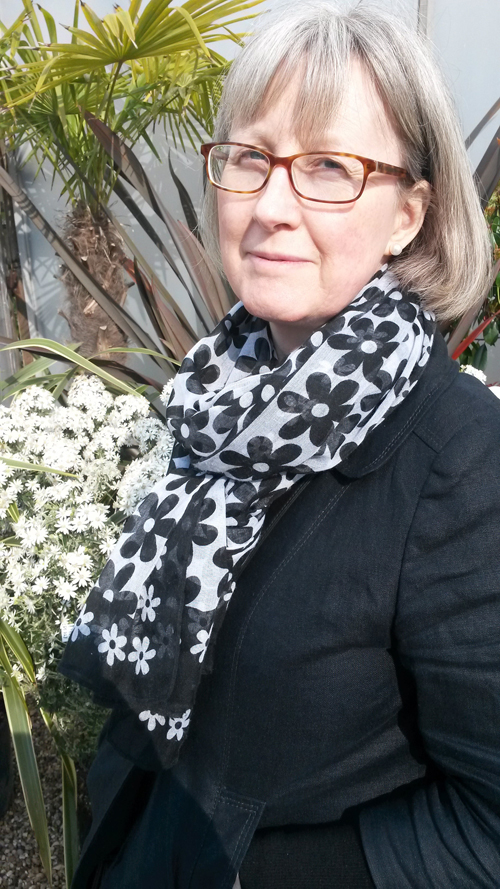
“I will not stop. I will not be silenced. I want to be reinstated”
I used to be ‘IN’
There’s truth in the well-used idiom “with power comes responsibility”. The right of access all areas within a prison is one of those situations to which this applies. I never took it lightly. Having keys to the prison seems to be a thoroughly abstract concept for many, but as a public official appointed by the Secretary of State for Justice to monitor that’s exactly what you have. You’re appointed to be the eyes and the ears. And to record what you see and what you hear around the prison you monitor.
This isn’t some fanciful hobby for those with a lot of time on their hands. Long the brunt of jibes about beige Volvos, tweed twin set and pearls, being an independent monitor should not be a country club. This is the sharp end of monitoring how a nation treats those in its custody. And it requires people who have the big picture as well as an eagle eye for the detail. I’ve seen a lot and I’ve heard a lot. And as a monitor I only write what I see and what I hear. No spin and no opinion. Just the facts.
Remembering how thrilled I was to be accepted onto the Independent Monitoring Board (IMB) when I first started. I absorbed the training, passed induction and quickly found my feet performing monitoring visits as part of the team rota. As a member, I derived considerable satisfaction from thinking that what I was doing was making a difference. It had to make a difference; there was no salary for the work so the only payback was the job satisfaction. And make no mistake, monitoring done properly is real work.
As a Vice-Chair, I served a frequently absent Chairman as if I were their very own personal assistant. It felt like it at times, especially the Saturday evening calls to my home number or the Sunday-for-Monday interruptions. My network became the area Chairs in other prisons. My responsibilities expanded and I took it all on board, in part relishing the challenge. Yet there were some niggles creeping in, as I was required to shoulder the thick end of the workload without being empowered with the authority to do much about any of it.
On one occasion I recall being put firmly back on my box by the then Chairman. “How dare you say you’re the acting Chair. You’re my Vice-Chair, not the acting Chair” they said, speaking down at me like an intolerant owner upbraiding a truanting cocker spaniel. Bit rich really, given that the then Chairman was the one for whom I had covered no less than 162 days absence in a single calendar year. Yes I kept a record! (as I told you, monitors record exactly what they see and what they hear, and tend to notice when the Chair is away for 44% of the time).
Believing the best and hoping it wouldn’t last, I went along with it. I wouldn’t go along with it now. Nor will I ever again in the future. I don’t recall many, if any, occasions I felt truly supported by them.
In retrospect, it’s a bit sad really, don’t you think?
When the time came, I embraced the opportunity to serve the Board as Chairman only after I was sure I was ready to fulfil the role and could gather dependable people around me. These positions are never ones to grasp at.
A colleague agreed that if I was willing to serve as Chairman then they would step up as Vice-Chair. Despite commitments running their own business the Vice-Chair was incredibly supportive in every way the past Chair wasn’t able to be. Or didn’t wish to be. And so it was from January 2016, following nominations the previous October, we set to work and gelled like dream team.
And together we worked hard to build the team around us. Sacrificing time from other priorities to come in to the prison often when it was inconvenient, why, because it just had to be done. These are the sort of things they don’t tell you about when they pitch volunteering to you. But we did it anyway, and cheerfully for the most part; it’s what you make if it.
Mentoring volunteers was very enjoyable but it took on dimensions I never thought would be part of the remit, for example, teaching an IMB member how to use a computer mouse for the first time in their lives, let alone the depths of Quantum, the NOMS secure intranet (Gawd bless it) or the CJSM email system (don’t get me started on that one).
More than matching time volunteered on monitoring with time volunteered on Chairman’s responsibilities (yes, even Chairs should perform monitoring visits), I expanded on my knowledge of the criminal justice system through taking up invitations to visit other prisons. I wanted to learn as much as I could about every category of prison and see for myself the conditions for those held in custody in those places, and better understand what monitoring looked like for them.
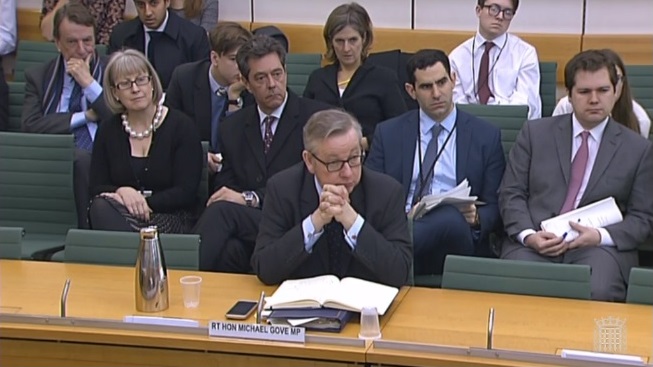
Grimond Room, 16 March 2016
Additionally, to learn more on policy, I became a frequent visitor at the House of Commons Select Committee on Justice (Twitter @CommonsJustice) where I could see, hear and meet those giving oral evidence. I learned to fine tune my own sense of scrutiny, making less hasty judgements and leaping to conclusions without having first studied the facts.
I read widely on the subject of justice, even calling into The Institute of Criminology and the Cambridge University Library on occasions to check for myself the validity of references being cited in some of the material I was consuming. (The Tea Room there is as much an eye opener as the Rare Books section; you get to talk and make friends with rather influential and interesting people over a cuppa).
In short, I was fortunate to gain a well-informed view of the big picture and a well-grounded understanding of how that applied to specific areas, including monitoring.
As my understanding grew, very obvious holes in the system began to make themselves clear to me, making them compelling enough for me not to look the other way.
As I monitored, I looked and listened. As I worked, I saw. As I visited, I heard. As I studied, I realised. And as I realised, I knew – I knew that what I was seeing and hearing and learning was not all it is cracked up to be.
So I wrote, firstly about topics that caught my attention and my responses to them and then about good practice and about areas for improvement. Whereas these first appeared only in blog format now my opinions have been published in The Prisons Handbook 2016, the definitive guide to prisons in England and Wales for over 18 years.
Just imagine my amazement when, having gone beyond the call of duty and having delivered all this into a Board I thought I had alongside me, an ambush was set for me on 19 April 2016 for which nothing could have prepared me.
I’ve written before about this awful episode and yes, regardless of what may have been claimed by others, I have had to call it what it was, workplace bullying (remember, as a monitor I only write what I see and what I hear, no spin). Suffice to say it has become a tipping point in more ways than anyone would have anticipated.
But now I’m ‘OUT’
Suspending me pending an MOJ investigation is what the Prisons Minister decided to do when he received a report from The IMB Secretariat about me. I’ve no idea what was in that report; I’ve not been given sight of it and although I’ve asked for a copy, nothing has been forthcoming. Despite what the Minister himself wrote, I have now been told it is not a report, but a submission from The IMB Secretariat, and legislation has been quoted to try and prevent me from seeing it.
Barred from stepping foot on the prison estate without prior appointment and vetting, the system has spat me out. Where once there was free movement anywhere inside, now I’m bouncing off the perimeter unable to enter let alone monitor.
The story is not quite finished and I’m not leaving it there.
There now seems to a “war of attrition” but I’m not playing those games. Information about me is being withheld despite my requesting unredacted copies of it from the Minister and the MOJ, and they are trying to keep me in the dark.
I want to be reinstated.
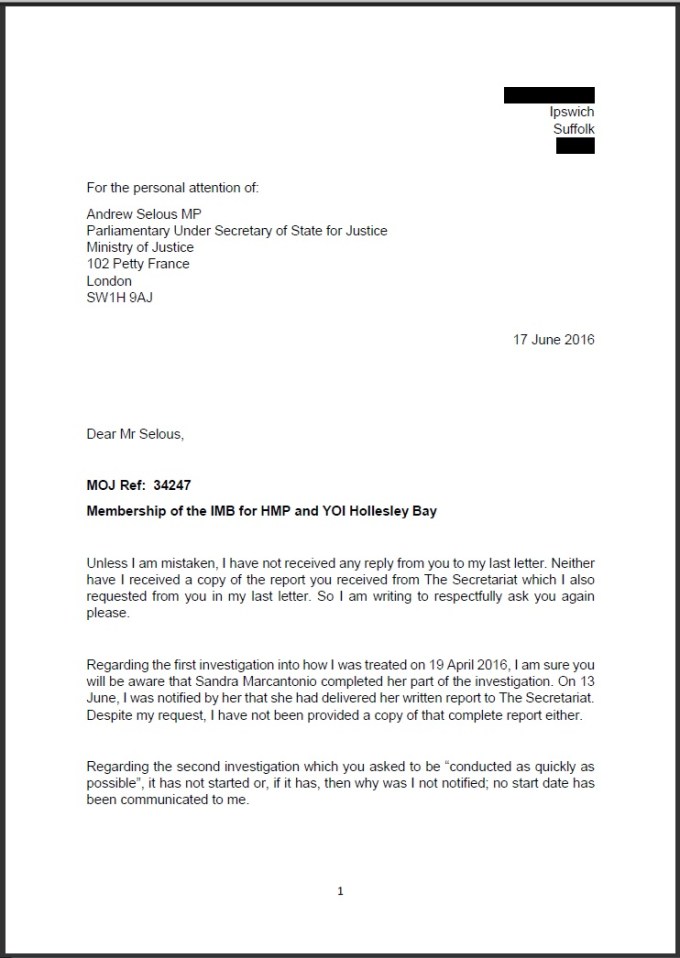
The second letter went in to the Prisons Minister on 17 June. I’ve asked the Minister to reinstate me.
But I’ve also asked the Prisons Minister eleven questions which you the public have a right to hear from him on. Refer to page 2 and page 3. If he doesn’t reply to me, perhaps he will reply to you. Write to him and press him for answers on what’s happening with Hollesley Bay monitoring. Don’t accept “stock answers” copied and pasted into pre-templated letters; demand the facts in a personal letter from the Minister not his staff.
DOWNLOAD : Letter Spear to Selous 17 Jun 2016 public
It’s not about me. It’s always been about the issues
And the issues I raised in my original article published in The Prisons Handbook 2016 have never been disputed by the Minister or by the Secretary of State, yet seem to be enough to turn my fellow board members hard-fast against me, to raise the hackles in the IMB Secret-ariat (sic) and to cause a thunder storm inside the MOJ.
Of course I do want the personal cost I’ve paid, and that my family has paid with me since 19 April, to amount to something.
I don’t want to be a name that meant something to a handful of people once then was quickly forgotten or surreptitiously ‘air-brushed’ from record.
Being reinstated would mean the Board can get on with the vital job of monitoring, becoming a watchdog again, and being in the heart of the action to realise prison reform.
IN CASE OF EMERGENCY
BREAK GLASS
In all candour, I’m so fearful that the net result of my speaking out in good faith will leave me at a massive disadvantage and consequently damage any prospects I might have had to find employment in anything related to the justice sector. Outside again, with a reputation on a par with the zika virus and with my self-esteem around my ankles tripping me up when trying to move forwards from here.
But my biggest fear of all is that nothing will change for those already in the sector.
Not calling out issues means no change for salaried civil servants spending immensely valuable time just going through the motions at taxpayers’ expense.
Keeping quiet on issues means no change for prison Governors with the Inspectorate breathing down their neck every so often without monitors there to provide real checks and balances.
Not calling out issues means no change for members of IMBs everywhere whose well-meaning sense of duty and willingness to volunteer is privately despised and whose voice is muffled by a dysfunctional Secretariat which is anything but independent.
Keeping quiet on issues means no changes to a pointless National Council whose nameless and faceless structure smacks more of a secret society with a presidency that’s widely regarded as irrelevant and a President even the public regard as yesterday’s man.
And whilst all that turbulence goes on inside the MOJ, not calling out issues means there’s no change for people in custody. In paying their “debt to society” through loss of liberty they also pay perhaps a higher price than most people imagine, banged up for 23 hours a day in institutions which for the most part are understaffed, unfunded and underperforming.
Penal facilities which neither correct, rehabilitate nor reduce reoffending are, in my considered opinion, facilities that should be the most closely monitored facilities of all.
I believe in monitoring.
And I want to be reinstated.
I want to be ‘IN’ all over again.
Justice Select Committee part 3
I seem to be making a habit of this; on Wednesday 16th March I attended the Justice Select Committee for the third time, again listening to the Rt Hon Michael Gove MP being questioned by a team of MP’s.
I sat behind Mr Gove and watched as he interacted with the committee. The meeting can be accessed from this link: http://parliamentlive.tv/Event/Index/e67772ca-8c75-4112-853a-0fbd80688389
The first question he was asked was “How would you encapsulate the overall purpose of the thrust of the Government’s prison policy”? Michael Gove replied “In a sentence, it is about turning prisoners from liabilities into assets”. Interesting use of language I thought.
He continued by stating that…”the critical thing is to make sure that during their time in prison there is purposeful activity…” I have come across some excellent forms of purposeful activity but to be honest there just isn’t enough going on. Is it all down to money? If millions can be found to build new prisons then surely purposeful activity has to be included.
The stories coming out of many of the prisons in England and Wales are appalling, locked up at least 22 hours a day, rat infested are but a few I have read this week.
When will we see real progress?
The most successful custodial establishment according to Nick Hardwick former chief inspector of prisons was the Military Corrective Training Centre (MCTC) in Colchester. However, in October 2015 there were 35 being held at the MCTC, hardly an example to compare. The ratio of staff to detainees is far higher than within the prison estate which is surely a factor along with greater governor autonomy that contributes to its success. I have visited it and was impressed by the order, cleanliness and regime. https://www.gov.uk/government/uploads/system/uploads/attachment_data/file/484448/Detainees_Military_Corrective_Training_Centre_Colchester.pdf
But how do you really measure success?
Michael Gove gave an example of Bronzefield prison as being a very successful female prison, yet this week one of the main stories I have read is about staff giving out sleeping bags to women released with no accommodation. It doesn’t add up!
I want to read more success stories, see real progress and watch as these “liabilities are turned into assets”
 The Criminal Justice Blog