
Home » National Portrait Gallery
Category Archives: National Portrait Gallery

The boy in the cowboy outfit – my tribute to Erwin James 1957 – 2024
Many have seen the small black and white photo of a young boy in his favourite play outfit, an image that was etched in the memories of a once happy young boy.
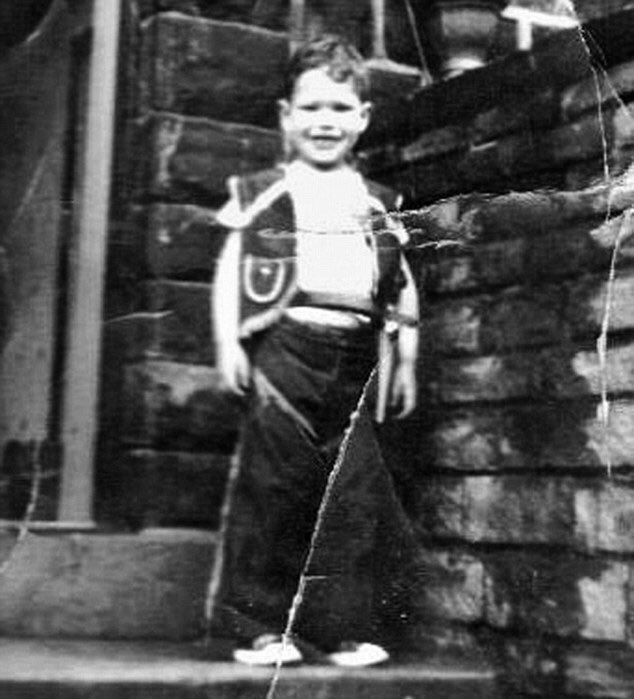
But circumstances and a grief-stricken father destroyed all chances of returning to that happy place for Erwin. At the age of seven, with the loss of his mother in a car accident and his father turning to drink, put Erwin on a pathway he never thought imaginable.
Sent from pillar to post, never settled anywhere for very long, his childhood was abruptly curtailed.
His life cascaded from petty thieving to the care system and from homelessness and drunkenness to serious crime.
Wanted for murder he fled the country and joined the French Foreign Legion. Attracted by a sense of belonging and a new disciplined lifestyle was then to encompass him.
But it was short lived.
Two years later Erwin was sent back to England to face a trial with his co-defendant which resulted in a life sentence for the murder of two men. Straight to prison, a daunting prospect but he was relieved that the life he had been living was over.
“Big Jim” as he was referred to, began a new journey with the help from a psychologist, a lady called Joan, who encouraged him to get an education. There were hurdles to climb but Joan’s words “you owe it to your victims to be the best you can be with the life you have left” propelled him to passing his first exam in English.
As a natural writer, his skills initially helped to compose letters for his fellow inmates.
After many years in prison Erwin was asked by the Guardian to be a regular columnist. His stories of life on the wings became so popular that these articles were published in his first book “A life inside”.
On release, Erwin became a sought-after speaker at book festivals, events and academic conferences, and that is where I first met him, at Cambridge University. By that time, he had published his third book ‘Redeemable: A Memoir of Darkness and Hope’ and had become the editor in chief of the Inside Time newspaper, his dream job.
He loved writing and he passed on his passion to so many including myself. I can still hear his voice in my head,
“Narrative, Description and Dialogue”
Three years ago, Erwin sent me a draft copy of an insightful article he was writing and asked what I thought. It was a refreshing change as I was usually the one seeking his opinion on work. He wrote:
“I’d been adrift on my own sea of time for so long, living the same day over and over for weeks, months and years – trying to endure the psychology of just ‘doing time’ – amidst an environment awash with death, self-harm, violence and human corrosion. Like many long termers I never really knew where the prison journey was going to take me, or if I’d ever make it. But twenty years to the day, I walked out of those prison gates a better man because of books.”
Believing in prison reform but never saw himself as a prison reformer yet advocating for prison education at every opportunity. He had many roles over the years encouraging the Arts within the justice sector.
I had the opportunity to interview Erwin in The National Portrait Gallery, London where I wanted to introduce art as our common ground alongside prison reform. I pointed to a painting of a man with his books commenting on whether he was showing himself as an educated man, Erwin immediately responded:
“Books for the educated people? No. Books are for everyone, to me Faith books are a great leveller. If you can read, you can be King”

When the interview was published, he wrote this:
“I’ve known and admired Faith for a number of years. We haven’t always agreed on prison reform issues, but I’ve always respected her integrity, which shines in her writing, her passionate crusade for a more humane and effective prison system – and above all her indomitable spirit. I’m just glad we’re on the same side.”
Under the surface there was always the inward battle of feeling undeserved of any praise for himself or any of his writings. I believe this inner turmoil was always there ready to bubble up to the surface.
His death, so sudden sent shock waves through the prison community, his many friends, colleagues and acquaintances. He will be missed.
May his legacy remain, that education in prison will continue to greatly enrich all those that are given the opportunity to participate in the future.
Erwin James died on 20th January 2024.

Her indomitable spirit
A retrospective of 2019
It was a year of challenging the norms, exploring the Arts and Media and pushing some boundaries. It has had its highs and lows with times of difficulty and frustration yet amongst it all there have been moments to celebrate, moments of laughter and new friendships made.
The year began at one of my favourite places, the beach at Aldeburgh on the beautiful Suffolk coast, wrapped up against the elements, a brisk walk with my family and then tea in the warm. Perfect.

My first trip of the year into Westminster was for the APPG on Miscarriages of Justice, at a session entitled: ‘Aftermath of Wrongful Convictions: Addressing the Needs of the Wrongfully Convicted in England and Wales’. We were reminded that half of all victims of miscarriages of justice were homeless within six months of their convictions being overturned.
According to ‘Supporting Exonerees’ a JUSTICE report published 2018, in the last five years only five people have received compensation from the Ministry of the Justice after having their convictions overturned and not a single person in 2018. By contrast, between 1999 and 2004, there were 162 successful applications.
Across the year there were four sessions of the APPG on Miscarriages of Justice, all of which I managed to attend. These were co-chaired by Baroness Stern and Lord Garnier QC, and featured members including: Dame Anne Owers, National Chair of Independent Monitoring Boards; Michelle Nelson QC, Barrister at Red Lion Chambers; Dr Philip Joseph, Consultant Forensic Psychiatrist; and Erwin James, Editor-in-Chief of Inside Time.
My sincere hope is that the work performed by this APPG, even though it has no statutory powers, will be effective in some way and not evaporate like a silent conversation that never happened.
It was also a pleasure to attend a joint Criminal Justice Alliance (CJA) and Ministry of Justice event, held at Petty France, London to discuss the aging population in prisons. It’s well known that the level of healthcare and social care within prisons is inconsistent and all too often not fit for purpose.
This was the first of six CJA round tables and meetings I attended and participated in during the year, including their AGM.
Not all my work is in Westminster or even in London. For example, as a part of the Female Leaders at 50 (Twitter: @femaleleaders50), I was able to share part of my story, listen to others and enjoy a fantastic evening reception and dinner in Cambridge. Thank you to Ciara Moore, looking forward to our next gathering this year.

Female Leaders at 50
Being recommended for membership of the Royal Society for the Encouragement of Arts, Manufactures and Commerce (RSA) was a highlight because it showed that what I am able to contribute to society has value. In fact the letter I received from the RSA included a copy of the statement by the person who recommended me, saying:
“Faith is a very potent voice and commentator on prison issues. Her blog https://faithspear.wordpress.com/ has quite a following. She is an accomplished writer and speaker and has huge respect in prison reform circles.”
In the letter, the RSA said:
“I believe that you have an important contribution to make in supporting our work, and that you will be a valuable addition to our diverse and influential movement of like-minded people committed to building a better society”
I was so delighted and can assure you I’ve already begun to make good use of my membership to this prestigious organisation. Planning, sharing ideas and debriefing after meetings. The RSA provides an excellent space to meet and greet at its venue in central London which is very convenient given the nature of the work I am asked to do.
The Spring season was busy both personally and professionally. Dr Marianne Colbran kindly invited me to attend an LSE media event: ‘Breaking prison narratives’. The event produced interesting conversations, some heated debate, and time for participants to reflect individually on what the day meant for them. It was eye-opening and definitely an event I was pleased not to miss.
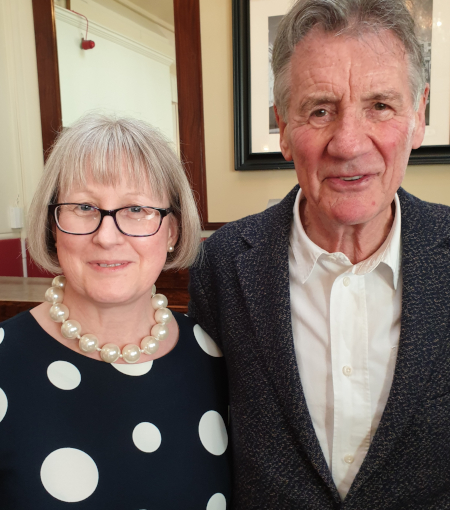
Michael Palin
The Executive Ladies lunch with Lady Val Corbett later the same month featured guest speaker Michael Palin. Michael was very engaging to listen to, with anecdotes of his life and adventures. He showed particular patience afterwards as many asked for a memento selfie photo. Networking, raising funds for prison reform and for the Robin Corbett Awards always makes it a working lunch with a clear and meaningful objective. The help, strength, encouragement and inspiration that people derive from these lunches is priceless. And that was exactly how it was when Prue Leith joined us as guest speaker later in the year. What an entertaining and fascinating woman.
Large parts of my work can be challenging and distressing. Sometimes it can be harrowing.
I attended the inquest into the death of a young man, Thomas Kemp. The Suffolk area coroner, Jacqueline Devonish, recording narrative conclusions, said: “Kemp stabbed his wife to death during a psychotic episode when she tried to prevent him from harming himself. He then took his own life.”
The fact that he killed his wife and then himself was widely reported, including in my local media because he worked at the local university. But his full connection with the justice arena was not mentioned. I first met him back in Summer 2017 when visiting the University campus because I was invited to observe training of graduates. Thomas was employed by the University of Suffolk as an administrator. He worked on the Masters programme called ‘Unlocked Graduates’. After his death, his name was rapidly erased from the university’s website and, to the best of my knowledge, no acknowledgement of his tragic death was ever published on the Unlocked Graduates website.
Let’s hope the memory of Thomas Kemp has not been totally erased. Whilst I do not condone what he did, as someone who appeared to have serious mental health issues, it is clear that the system failed him and his wife.
I have subsequently learned that many involved in the teaching of the Unlocked Graduates programme at the University of Suffolk have themselves had to take time off due to stress. For me, there are many questions about Unlocked Graduates which remain unanswered and I know I’m not the only one.
The Creative arts in prisons is an area which interests me greatly. So, this year it was particularly interesting to have visited Snape Maltings for the celebration of their 20-year collaboration with HMP Warren Hill. The day was made up of performances, art exhibition and workshops showcasing the role of music and arts in rehabilitation with their partners Koestler Arts, The Irene Taylor Trust, Clean Break and Fine Cell Work.
Entering the main auditorium, I noticed someone waving at me and was surprised to see it was Dame Anne Owers (Chair of Trustees, Koestler Arts). We sat together to watch the performance; at one point, they handed out percussion instruments and everyone was encouraged to join in with creating improvised music. The whole event was one of inclusion, acceptance, hope and the potential of those currently serving sentences. It was a privilege to speak afterwards with some of the musicians and singers.
From that event came an invitation by Fanny Jacob, Creative Project Leader and Julian Earwaker, Writer in Residence at HMP Warren Hill to an art exhibition and fundraiser. A fascinating afternoon was spent with around 30 guests including the local Mayor. I chose to support the Families In Need (FIND) charity by purchasing one of the works of art.
I wanted to explore a little more about what role the Arts play within the prison estate. For that reason, I attended another Koestler Art exhibition, this time on London’s South Bank entitled “Another Me”.

Erwin James
Some people visit these exhibitions in groups, others in pairs but I prefer to visit alone so that other people’s initial reflections don’t become mine. For me it’s not just the pieces of art that can stop me in my tracks but the titles given to the pieces. For example, this year I discovered works of art called “Stand Alone”, “Consequences”, “Innocent Man” and “Woo Are You Looking At?”.
From matchsticks to J-cloths, from socks to gold leaf, such variety of materials used with such ingenuity.
But the question that stayed in my mind was:
“Are these exhibits examples of escapism or expressionism?”
I took this question forward and developed it when having the opportunity to interview the writer Erwin James. Choosing a venue familiar to me but unfamiliar to Erwin, my motivation was to try to explore the impact on a person who becomes a prisoner of being categorised and given a number and watched by security; just like works of art in galleries. An interesting parallel that I have tried to explore in the past.
This is the amazing feedback from Erwin:
“One of the highlights of my year in 2019 was being interviewed by Faith in the National Portrait Gallery. I’ve been interviewed many times over the years by press, radio and tv – but what I liked about Faith’s approach was that she wanted to introduce art as our common ground as well as our interest in prison reform. I’ve known and admired Faith for a number of years. We haven’t always agreed on prison reform issues, but I’ve always respected her integrity, which shines in her writing, her passionate crusade for a more humane and effective prison system – and above all her indomitable spirit. I’m just glad we’re on the same side…”

Jeremy Paxman
My return visit to the Bernard Jacobson Art Gallery in London was on a warm summers evening. It was the occasion of the bi-annual Contrarian Prize, for which I was pleased to have been nominated in 2017. The gallery was full and I met some real and would-be contrarians. The winner was Katherine Birbalsingh (Twitter: @Miss_Snuffy), founder of Michaela School and the prize was awarded by Jeremy Paxman. Chatting afterwards, Jeremy told me he had heard of me, which was somewhat astonishing. But the conversation with him was good and far from superficial.
It was also a genuine pleasure to catch up with my friend Ali Miraj, founder of the Contrarian Prize.
Being met in the entrance hall at the Lebanese Embassy by His Excellency the Ambassador for Lebanon to the United Kingdom, Rami Mortada, was an unexpected and memorable moment. Having received an invitation from Dr Lewis Owens the evening reception was arranged for former hostages Terry Waite and John McCarthy to meet on Lebanese soil together for the first time since their kidnap. It was a proud moment for me to meet them both, Dr Waite for the second time, and to have the opportunity for a short conversation. The ordeal of these remarkable men, imprisoned against their will, provides us all huge lessons about incarceration.

Terry Waite and John McCarthy
This year it has once again been a pleasure to be an associate member of The Corbett Network. It’s founder Lady Val is an inspirational woman, who I am pleased to call a friend. Her determination to promote reintegration and to support those released from prison into meaningful employment is exemplary. She has gathered around her a group of people who share this vision. Among them is Jo Apparicio, Business Management Director at The Chrysalis Programme, with whom I share the same passions and sense of humour, and to whom I leave the last words of this blog.
Thank you for reading.
“I was first introduced to Faith in May 2017 at a Networking event. I was immediately struck by Faith’s absolute passion, drive grace & unconquerable spirit in ensuring that individuals caught up in our judicial system are listened to, given a voice opportunity & support to reintegrate back into their families & communities in a positive & sustainable way with dignity as returning citizens to our society. Working with Faith over the past couple years in this environment sharing many common goals & thoughts I am in constant awe of Faith’s passion & drive and feel a great privilege to call her a dear friend. Faith is indeed a rare lady & a real woman of substance & I have no doubt that with her drive & passion she will be instrumental in the future in helping change the judicial system & prison reform for the better supporting individuals both in the prison system & also on release reintegrate and return to our society in a positive way”
In the context of a blog like this, it’s possible to only mention a fraction of the workload, time and miles covered. For obvious reasons you will appreciate I’m unable to share the full extent of everyone I have met or all that has been done.
~

A conversation with: Erwin James
Busy train
Busy tube
Busy London streets
Police everywhere
I made my way out of the crowds towards my destination: The National Portrait Gallery, London.
Although this will be a time to indulge my love of Art, I’m actually here to interview rather than be an interviewee.
I arrived early and found a quiet(ish) corner of the café to collect my thoughts, helped enormously by the Earl Grey tea and slice of orange and polenta cake.
Two days previously I attended the Koestler Art exhibition on the South Bank entitled “Another Me”
I prefer to visit alone; I don’t want other people’s initial reflections to become mine. For me it’s not just the pieces of art that can stop me in my tracks but the titles of the pieces. This year I discovered “Stand Alone”, “Consequences”, “Innocent Man” and “Woo Are You Looking at?”.
From matchsticks to J-cloths, from socks to gold leaf such variety of materials, such ingenuity.
Erwin James at National Portrait Gallery, London
But the question that stayed in my mind was:
“Are these exhibits examples of escapism or expressionism?”
I made my way up to the large information desk at the National Portrait Gallery and sat patiently awaiting my guest.
Ten minutes later, he arrived looking rather bemused at my choice of venue to interview him.
Erwin James followed me up a flight of stairs where we slowly wandered around looking at portraits of people, from HM The Queen to Zandra Rhodes and every conceivable individual in between.
Trying to get my bearings, we turned a corner and entered the Statesmen’s Gallery, lined on each side by a series of white marble busts on projecting plinths in between painted portraits. It looked outstanding.
At the far end hung a portrait painting of Dame Christabel Pankhurst by Ethel Wright (oil on canvas, exhibited 1909), militant Suffragette, persuasive speaker and effective strategist. Erwin and I stood and pondered.
In one of the rooms off this gallery we found a bench, sat down and started to talk. Straight ahead was a significant portrait, covering a large part of the wall, entitled:
The Mission of Mercy: Florence Nightingale receiving the Wounded at Scutari

The Mission of Mercy: Florence Nightingale receiving the Wounded at Scutari by Jerry Barrett. Oil on canvas. 1857
Faith Spear: When you look at that picture what does it tell you?
Erwin James: There are people who care about people that others don’t care about. This lady cared for the wounded she didn’t care about the war, she cared about people.
FS: How does it make you feel when you see that?
EJ: My experience of prison was that occasionally, more than occasionally there are people who care about people, about the wounded people in our prisons who need assistance, it’s a challenge for any community or society to think that we should care or help those that have hurt us. But she cared about everybody.
FS: Do paintings like that inspire you?
EJ: I found paintings in prison. I did an Arts degree and I was given this folder of great art; I had never had access to art or that sort of thing, ever in my life until I went to prison. I found art through the Open University.
I have never seen this painting before if I’m honest, but it tells us, “this lady, she doesn’t care who you are. She just wants to heal you.” The Onlookers: What are they thinking, should we help this person? There’s hesitance, others are standing away, observing. But you can’t hesitate or observe when people need help. My feeling about our attitudes to prisoners is that’s it’s a challenge to help people who’ve hurt us but if we don’t help them, they are going to hurt more people. When I look at that painting, I promise you some are taking advantage of the crowd.
FS: That’s interesting “taking advantage of the crowd”
EJ: We do that in our society now, longer prison sentences…we deserve a prison system that hates the crime, perhaps hates the criminal but for Christ sake give the prisoner a chance. That’s my philosophy really.
We slowly moved from room to room admiring and yet questioning the art we saw. Both of us were struck by a painting of Henrietta Maria (1635) and our hidden thoughts became open dialogue
EJ: Look how attractive we are, look how wealthy we are, look how amazing we are
FS: Always trying to prove something
EJ: Always
FS: Is that because people can’t accept who they are?
EJ: People seem to want to portray an image that is more than what they are, that is exactly what these people did
FS: It’s not just status is it?
EJ: Status, its look at me, look at us, all the poverty in the country when she was painted.
The poor people, we always looked up to the people doing well, we always aspire to be like them
FS: Always looking down on those that are not doing so well?
EJ: I don’t know why because we are all trying to get up that ladder
FS: Do you think we fall into the trap that we don’t actually accept people for who they are?
EJ: Well we are not sure who they are, all we know is we think we know who we are we want to be better versions of ourselves come what may
There are many self-portraits in the National Portrait Gallery, some more obvious than others.
FS: With a self-portrait you are not necessarily portraying the real you
EJ: No, you are portraying what you want the world to know about you. As a writer I am the same, I’m exactly the same, I want the world to know me through words because the world sort of knew me through the courts through prison through prosecution
FS: So, do you think you were trying to re-invent yourself
EJ: Yes
FS: But then that is saying previously that wasn’t the true you
EJ: Yes, that wasn’t the true me
FS: Do you think that this is the true you now, what you are doing now?
EJ: Yes, before I became who I think I am, I’m not perfect by any means, but I am my own person and I think lots of people go through life thinking, well is this me? I’m born into this way of living but gradually you think did I decide this. Other people decide our lives and what prison gave me was the freedom to choose my own, if that makes any sense. But even though I am a million miles away from perfect, I am a real person
They all portray dominance over everyone else. The whole purpose of art in these ages was to say look at us, we dominate you – and then the dominated looked up and said, “we are so pleased to be dominated by you”, we didn’t know then that any of us could be dominate and dominated we didn’t realise then before mass education, we didn’t understand that we can all be people with education with skills and abilities
We walked up to level 2, not knowing what to look at first. We entered a small room.
FS: Do you see that painting over there of John Wilmot, 2nd Earl of Rochester, with his books showing he is an educated man, well in fact, a poet?
EJ: Books for the educated people? No. books are for everyone, to me Faith, books are a great leveller. If you can read, you can be a King.
By this time, I needed to sit down; juggling bag, jacket, notebook, pen and phone was getting problematic. I found a wooden bench in one of the corridors and with phone at the ready I continued my questions as we sat down.
FS: One thing I am always amazed at in an art gallery is that everything is categorised, often by year, era or by event. Everything is numbered. And there is a lot of security. When you come into an art gallery you are watched by cameras everywhere.
Everything is numbered, everything is categorised exactly the same as it is in a prison.
How did it feel to be categorised and given a number?
EJ: That is a really good question.
Well I was categorised; I was a Cat A prisoner for 5 or 6 years. The system categorises you and gives you a number. I hated my prison number. I was in Devon driving down a lane and I saw a signpost for the B73…, arghhhhhh! That’s my prison number!
It was awful, I had forgotten it, forgotten it purposely. When you are categorised and given a number you become labelled, you’re not human you’re a prisoner. But thank god there are some amazing people that work in prisons who want you to be human. For various reasons you end up there, they work there, and they are there to help you to become like them. Thank god for that. Without those people I would never be here I would never have made it. Teachers, psychologists, probation officers some prison officers…
FS: But when people are reduced to a number do you think that is degrading?
EJ: Well I think the danger Faith, you are asking me something quite profound here, because the danger when we do that, we detach people psychologically from our community. Now prison is detaching. You did harm, you caused pain, grief etc, but what we do with that in our prison system is that we detach further psychologically so the people in prison psychologically don’t feel part of society. Don’t feel part of the community, there’s no sense of wanting to come back.
I want to do some good when I come back, but mostly we don’t want them back. But actually, there’s so many people that do come back do good but it’s the physiologically detachment that presents danger from the released prisoner.
As Erwin is a writer, I wanted to probe a little more into different aspects of his life.
FS: For someone who is setting out on a journey as a writer what advice would you give?
EJ: Well what I would say is first and foremost is tell your truth. But first, you have got to find your truth because if you don’t know your truth you will never be able to share that truth. So, there are a couple of things: have discipline, have courage because when you put your truth out there you are going to get people who hate you and your truth. You need to have courage and be bold, but as long as you know your truth you will have a significant number of people who will accept that. Whatever the obstacles whatever the challenges you just keep going.
I decided to probe a little deeper too.
FS: What makes you laugh?
EJ: You will be amazed how many people in prison laugh, it’s a funny thing in jail you laugh at the most banal things.
FS: But what makes you laugh now?
EJ: My great granddaughter she makes me laugh. “Grandad, grandad look at the chickens” she chases chickens and I run after her and I’m laughing like hell and then she catches a chicken. Then she chases the ducks.
I do laugh but I am a very serious thinker, but I laugh when she laughs, its infectious. I feel safe to laugh with my great granddaughter.
FS: Is that because you are not being judged?
EJ: In the public if I am laughing, I feel awful because there are people grieving because of me. Even in jail I was scared to laugh sometimes because it looked like I didn’t care about anything.
FS: What makes you cry, do you cry?
EJ: I cried a long time ago in prison when I came to terms with what I had done with the effects on victims’ families of my crimes. I didn’t cry before that.
What makes me cry now? A good drama where there’s an amazing writer who brings the human condition into our living rooms and shows us how weak, strong, dominant, how we are as humans.
That makes me cry.
My final question was about what others say.
FS: What is one of the most memorable statements about yourself?
EJ: The best thing that’s been said of me, that I am really proud of, I do school talks. I was in a school in Southampton a few years ago, the Headmaster said afterwards:
“It was one of the best talks we have had all year and, for some, will be an abiding memory of school.”
It was time to switch my recorder off, I took in a last view of this amazing gallery and headed outside for some air. After a refreshing drink we said goodbye and I headed for the tube.
What an interesting conversation.
Erwin James is editor-in-chief of ‘Inside Time’, the national newspaper for people in prison and the author of ‘Redeemable: A Memoir of Darkness and Hope’.
Photos: Copyright © FM Spear. All rights reserved.
~
 The Criminal Justice Blog