
Home » Ministry of Justice (Page 8)
Category Archives: Ministry of Justice
Justice Select Committee…Part two
This morning I was pleased to attend the Justice Select Committee meeting. It was the first one with Rt Hon Michael Gove MP being called as a witness in his new role as Lord Chancellor and Secretary of State for Justice.
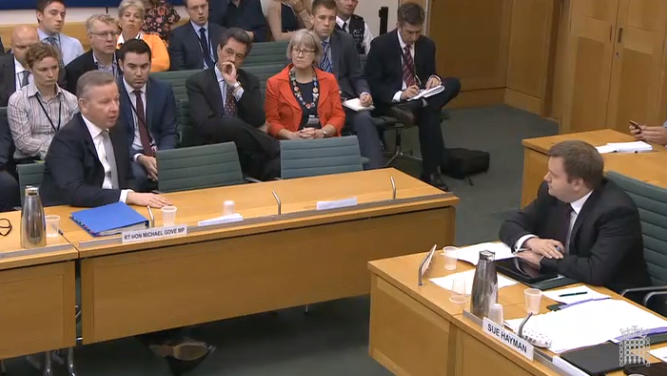
Pantomime – She’s behind you.
The session was recorded on video. Watch it here.
Getting down to business
After an exchange of pleasantries and mutual congratulations on appointment, the committee set about putting forward questions on important issues such as safety in prisons, rehabilitation, absconds from Open Prisons, court closures, and court and tribunal fees. This was good to see; Select Committees sit to scrutinise Government policy and progress.

This Justice Select Committee meeting came just a few days after the publication by the HM Chief Inspector of Prisons for England and Wales’ Annual Report 2014-15, in which Open Prisons have been highlighted once again.
On the same day as the HMIP Annual Report, Nick Harwick also published the unredacted version of the report on Release on Temporary Licence (ROTL) featuring three high profile cases of prisoners who each committed awful crimes whilst out on ROTL has challenged the current risk assessment within prisons.
The cases of Ian McLoughlin, HMP Springhill, Al-Foday Fofanah, HMP Ford and Alan Wilmot, HMP North Sea Camp were highlighted by Hardwick of where those on ROTL committed the same offence as they were sent to prison for in the first place, giving rise to questioning on whether there is ‘Rehabilitation’ in prison.
You can read the report here.
This was raised by Philip Davies MP when asking Mr Gove “what are you doing to protect the public from these future awful consequences?”
His reply was “…transfer to open prison should only follow an appropriate risk assessment.” He then added …”there will always be cases where there are individuals even if they have committed very serious offences may be suitable for a transfer to an open prison. Each case has to be judged on its own individual merits”. However, the underlying message was that public safety is paramount.
It was clear that Mr Gove was new to the job, there were many err and ums in his answers, but he did assure the committee that he would be happy to return when he had reviewed various aspects within the justice system.
So will I.
Ministry of Justice priorities…?
At the beginning of the month (5th – 7th Feb 2015) I attended the IMB conference. It was my first after over 2 years serving on the board at HMP/YOI Hollesley Bay, 14 months as Vice-chair.
After the formalities of opening the conference by IMB President, John Thornhill, we were introduced to one of the key speakers Mr Andrew Selous MP, Minister for Prisons, Probation and Rehabilitation.
And then it got very interesting!
He told us that, according to the Ministry of Justice, these were the priorities:
- Education
- Family relationships
- Work and time out of cells
The following day, to a guest panel (Frances Crook, Chief Exec of The Howard League for Penal Reform; Paul Baker, Deputy Director of Custody East Midlands, HMPS; Ben Gunn, former long serving prisoner and Clare Checksfield, Director of Returns in the Home Office), I put the following question:
“Firstly I would like to congratulate The Howard League on the books for prisoner’s campaign. Secondly the Minister yesterday explained the MOJ’s priorities were Education, Family relationships and Work including time out of cells. Do you agree and do you see them implemented?”
Education

Let’s start with Education. On this priority, Frances Crook responded by saying that “MoJ priorities are fiction”. She went on to say,
“Don’t send people to prison to get an education, send them to college. Prison education budgets have been realigned so they focus on basic skills, which is all very well but what about the 30,000 adult men who are serving long sentences and who now get little education beyond the three Rs”.
I still come across prisoners that have served many years in prison and still struggle with basic reading and writing. But should we be blaming the prison system, what happened for them to enter prison without these skills, not a straightforward issue?
Well I’m sure many of us have heard about Jonathan Robinson and his experience when he was trained to teach other in-mates to read yet, when in an open prison, was prevented by the then head of Education.
However, four years later and with new staff this same prison has just been awarded ‘Outstanding’ from Ofsted. Change does happen!
Family relationships
On this priority, Frances Crook shared that desistance is about relationships, engagement, commitment, consistency. Prisons cannot fulfil this.
One of the workshops I attended was overseen by two very enthusiastic women from HMP/YOI Parc entitled ‘Family Interventions, Supporting Positive Family Involvement. They work with the whole family and look at their needs in order to reduce offending, reduce inter-generational offending and encourage community inclusion. In the Family Intervention wing Safe Ground runs a couple of courses, Fathers Inside and Family Man aimed at teaching essential fathering skills.
Work and time out of cells
On this priority, Frances Crook said,
“Time out of cell is disappearing as staff cuts are so swingeing. Latest figures show in the last six months of last year the big city prisons were still losing staff. Morale is at an all time low, MoJ survey showed that, and sickness rates sky high.”
There are many stories that prisoners spend up to 22 or 23 hours locked in their cells but with the shortage of staff very little can be done.
Work is an essential element to prepare for release and what is needed is more companies willing to take on those with a criminal record.
A couple of months ago I spoke to a group of people about ex-offenders being re-integrated back in society, all were for it and all thought it was an important step… until I asked
“what about your society?”
NIMBY!
Corston review revisited
It’s about time the Corston review was revisited.
Baroness Corston was commissioned in 2006 by the then Home Office Minister Patricia Scotland, to examine the issue of vulnerable women within the criminal justice system (Ministry of Justice, 2007 p. 2). This was not the first time that the Government had sought to assess the specific needs of women.
In 2004, the ‘Women’s Offending Reduction programme’ was launched; this project was for three years to deal with women’s offending rates and to help reduce the number of women in prison. Also in 2005 the ‘Together Women Programme’ of many diverse agencies came together to look into the various needs of women offenders. This was launched with a government funding of £9.15 million (Government Equalities Office, 2008 p.44).
The Corston Review was conducted as a result of 6 deaths of women prisoners in HMP Styal between August 2002 and August 2003. The classification for all these deaths was self-inflicted. The cause of death for 4 prisoners was hanging and for the remaining 2 was overdose. The youngest was Sarah Campbell aged 18 who had drug problems and overdosed on prescription tablets the day after she had been sentenced and returned to HMP Styal.
These deaths highlighted the problem of vulnerable women with a history of mental health problems, drug misuse or violent and sexual abuse within the criminal justice system and the risk of self-harm. In the case of Sarah Campbell, the coroner at the inquest Nicholas Rheinberg issued recommendations to ensure that similar situations would not occur again. This included a review of the use of segregation units within prisons and training in suicide and self-harm should be available to all prison staff.
According to INQUEST, a non-governmental organisation in England and Wales working directly with the families of those who die in custody, in 2003 there were 14 self-inflicting deaths of women in prison and 13 in 2004. This showed that the system in some way had failed these offenders (INQUEST, 2005)
Deaths of Women in HMP Styal August 2002-August 2003
| Name | Classification | Establishment | Ethnicity | Age | Status | Cause | Date of Death |
| Julie Walsh | Self-inflicted | HMP Styal | UK white | 39 | Convicted | Overdose | 12/08/2003 |
| Hayley Williams | Self-inflicted | HMP Styal | UK white | 41 | Convicted | Hanging | 04/06/2003
|
| Jolene Willis | Self-inflicted | HMP Styal | UK white | 25 | Convicted | Hanging | 20/04/03 |
| Sarah Campbell | Self-inflicted | HMP Styal | UK white | 18 | Convicted | Overdose | 18/01/03 |
| Anna Baker | Self-inflicted | HMP Styal | UK black | 29 | Remanded | Hanging | 26/11/2002 |
| Nissa Smith | Self-inflicted | HMP Styal | UK white | 20 | Remanded | Hanging | 10/08/2002 |
Source: INQUEST Casework and Monitoring
The report was welcomed by Juliet Lyon, Director of the Prison Reform Trust who saw it as a blueprint for reform and stated “The Corston Review gives government the chance at long last to join up its social policy with its criminal justice policy” (Prison Reform Trust, 2007).
Baroness Corston examined each stage of the criminal justice system from arrest to sentencing to resettlement in order to ‘address the multiple and complex needs of women’ over a time scale of 9 months. The subsequent report was published on 13th March 2007 (Ministry of Justice, 2007 p.4).
The recommendations were divided into 5 areas, Governance, Sentencing, Community provision, Prison and Health which the Government pledged its commitment.
Fast forward now to what has arisen since the May 2010 election. A commitment was made in March 2012 to set out strategic priorities for women in the penal system but as of January 2013 no such document had materialised. In written evidence to the Justice Select Committee in September 2012 the Ministry of Justice pledged this document would be published in the New Year.
In September’s government reshuffle Helen Grant MP was appointed Minister with particular responsibility for women in the justice system. This was short lived after yet another reshuffle in the summer of 2013.
In January 2013 Chris Grayling, Secretary of State at the Ministry of Justice said in a written Ministerial statement:
“I am conscious that women offenders have particular needs and that the custodial female estate should be organised as effectively as possible to meet gender specific requirements whilst also delivering best value for the public. I have therefore asked officials to undertake a review of custodial arrangements for women. I expect this review to be completed by the summer.”
An All Party Parliamentary Group (APPG) on women in the penal system was set up in July 2009 with Baroness Corston as the chair and with administrative support from the Howard League for Penal Reform. Its purpose was to publicise issues around women in the penal system and push for implementation of the Corston Reforms. In March this year there was a meeting of the All Party Parliamentary Group on Women in the Penal System entitled “Community interventions for women: lessons from the frontline” (All Party Parliamentary Group on Women in the Penal System, 2013).
Let’s go to the present day what do we know about the Government’s attitude to women prisoners, what has Chris Grayling got lined up for them?
It has been announced that Mother and baby units are to close. Separation of infants from their mothers is cruel and is likely to cause bonding problems later. When you have a baby why should a man in Whitehall insist that your baby is taken from you just because you are in prison? I’m sure there are plenty of other ideas we could give Mr Grayling on how to save money!
I recommend you read Frances Crook’s blog; its enlightening nothing seems to be as it first appears.
…“Holloway prison’s mother and baby unit is to close. This means that London women prisoners or those from the South East who have babies will be faced with a choice: go hundreds of miles to Cheshire or the Welsh borders to a mother and baby unit, or, separate from your baby so that you can stay in a London prison so you can be near your other children. Askham Grange was the only open prison that had a mother and baby unit and that is to close down. With the closure of two mother and baby units there are now only five units.” (Frances Crook, 2013)
A child should not have to pay for a woman’s crime; a woman should pay for her crime! Moreover, if you speak to people like Frances Crook, the woman should never have been put in prison in the first place, especially if she is a teenage mother.
But let’s not forget “Gender appears to be the single most crucial variable associated with criminality. Put more bluntly, most crime is committed by men; relatively little crime is committed by women” (Heidensohn, 1987 in Carlen and Worrell, 2004 p. 119).
All Party Parliamentary Group on Women in the Penal System (2013) ‘Community interventions for women: lessons from the frontline’, Minutes of committee meeting 6 March 2013, All Party Parliamentary Group on Women in the Penal System, Committee Room 4, House of Lords.
Carlen, P. and Worrall, A. (2004) Analysing Women’s Imprisonment. Cullompton, Willan Publishing.
Frances Crook (2013) Don’t be fooled by the government’s deceit over women’s prisons, Frances Crook’s blog, 1 November. Available at: <http://www.howardleague.org/francescrookblog/> [accessed 3 November 2013]
Great Britain. Government Equalities Office (2008) Women’s Changing Lives Priorities for the Ministers for Women One Year On Progress Report. London, The Stationery Office [Online]. Available at <http://www.official-documents.gov.uk/document/cm74/7455/7455.pdf> [accessed 10 November 2009].
Great Britain. Ministry of Justice (2007) The Government’s Response to the Report by Baroness Corston of a Review of Women with Particular Vulnerabilities in the Criminal Justice System. London, The Stationery Office [Online]. Available at <http://www.official-documents.gov.uk/document/cm72/7261/7261.pdf> [accessed 10 November].
INQUEST (2005) Verdict in Sarah Campbell inquest – 18-year-old woman who died in HMP Styal. [Online] at <http://inquest.gn.apc.org/pdf/2005/Sarah%20Campbell%20Inquest%20verdict%202005.pdf> [accessed 11November 2009].
Prison Reform Trust (2007) Women’s Imprisonment: Corston review provides blueprint for reform. [Online] at <http://www.prisonreformtrust.org.uk/subscription.asp?id=866> [accessed 9 November 2009].
Let’s talk
New measures are being put in place by the government to support separating couples at the time of year when the number of people considering separation and divorce is at its peak.
The Government plans to spend an additional £10 million this year on legal aid for mediation, taking the total spent to £25 million, and want to ensure that couples who decide to separate give consideration to using the process. In recent years a greater number of people have been successfully using mediation – where they are helped to agree the issues between themselves rather than argue it out through lawyers with a judge taking the final decisions http://www.justice.gov.uk/news/features/extra-10-million-for-mediation
According to the Ministry of Justice the average cost of resolving property and financial disputes as a result of separation is in the region of £500 through mediation for a publicly funded client. This can be compared to £4,000 for issues settled through the court system In addition; the average time for a mediated case is 110 days compared to 435 days for non-mediated cases. What a difference!
Family Justice Minister Lord McNally said:
‘The benefits of mediation are clear – it is quicker, cheaper and leads to better outcomes. That is why we are introducing new laws – which will require couples to attend a mediation information assessment meeting first – to find out more and consider whether it is suitable for them.”
https://www.gov.uk/government/news/new-mediation-laws-to-help-separating-couples
 The Criminal Justice Blog