Home » Ministry of Justice (Page 4)
Category Archives: Ministry of Justice

On this day the only April fools are my critics: Part 2
It is 4 years today that I put pen to paper and wrote about the Independent Monitoring Board (IMB) from my direct experience and my perspective as a prison monitor. My article “Whistle blower without a whistle” published in The Prisons Handbook 2016, sent shock waves across the criminal justice sector, locally, nationally and internationally.
When you feel so passionately about a cause it is very hard to keep quiet, I couldn’t stay quiet any longer. I was given the opportunity and used my voice.
First, I had to weigh up the risk of possibly causing offence versus the need to speak up in the public interest.
What I didn’t expect was it resulting in a prejudicial character assassination, a fight to clear my name, being gagged by a grooming culture within the IMB, being investigated twice by UK Ministry of Justice, a disciplinary hearing at Petty France and the involvement of not one but two Prison Ministers. I felt that I was on my own against a bastion of chauvinism. Not the last bastion of their kind I would come across. Welcome to the IMB!
Maybe the problem was that the IMB and the MoJ didn’t expect someone like me to put their head above the parapet or to dare voice an opinion. Yet we all have a voice; we all have opinions and we should not feel the need to suppress them. I did, I felt that I couldn’t really express myself, would anyone listen?
Faced with adversity, people either ‘fight, flight or play dead’. I made the decision to fight. I have no regrets.
People started listening, taking notice and lending their support. Above all, they agreed with me but felt unable to say anything publicly themselves for fear of reprisals.
We all know the saying ‘action speaks louder than words’ but often you have to speak before any action can take place. So, I spoke out and expected results.
Since then I have written on many occasions about the IMB, its lack of effectiveness, lack of diversity and most troubling of all its lack of independence. The IMB Secretariat is staffed by MoJ civil servants, the National Chair is an MoJ employee, the purse strings are held by the Permanent Secretary of the MoJ and Board members expenses are paid by the MoJ.
“I’m finding the working environment intolerable and detrimental to my health, and part of me would like the IMB to recognise this as a symptom of its unsustainable system and the pressure it puts on people (but they probably won’t care)”.
Sadly, when I continue to receive messages such as this one from a serving IMB Chair, I realise very little has changed.
Unchanging. Unchangeable.
Even with a new governance structure, the appointment of its first National Chair and a written protocol between the MoJ and the IMB, none of these has persuaded me that there is enough independence, effectiveness or impact.
If there are concerns and issues that don’t add up, instead of staying silent, ignoring the facts or even dismissing them, it is imperative to ask questions.
As I have seen first-hand with the relationship between the IMB and the MoJ where they appear to be marking their own homework where monitoring of prisons is concerned, I noticed another irregularity.
During 2019 whilst attending sessions of the All Party Parliamentary Group (APPG) on Miscarriages of Justice, I noticed something of vital importance about the composition and scope of the inquiry of the Westminster Commission on Miscarriages of Justice, which states:
“Given that there are serious misgivings expressed in the legal profession, and amongst commentators and academics, about the remit of the Criminal Cases Review Commission (CCRC) and its ability to deal with cases of miscarriages of justice, and given that perceptions of injustice within the criminal justice system are as damaging to public confidence as actual cases of injustice, the WCMJ will inquire into:
1. The ability of the CCRC, as currently set up, to deal effectively with alleged miscarriages of justice;
2. Whether statutory or other changes might be needed to assist the CCRC to carry out is function, including;
(i) The CCRC’s relationship with the Court of Appeal with particular reference to the current test for referring cases to it (the ‘real possibility’ test);
(ii) The remit, composition, structure and funding of the CCRC
3. The extent to which the CCRC’s role is hampered by failings or issues elsewhere in the criminal justice system;
and make recommendations.”
But between 2010 and March 2014 Dame Anne Owers who currently sits on the Westminster Commission on Miscarriages of Justice “established by the All-Party Parliamentary Group on Miscarriages of Justice (APPGMJ) with a brief to investigate the ability of the criminal justice system to identify and rectify miscarriages of justice”, was a non-executive director of the CCRC.
Public purse. Public interest.
I have a problem with a system that allows for a person to occupy a role paid for from the public purse who then later occupies a separate post, albeit as a volunteer with expenses paid from the public purse, which is meant to scrutinise the work that has been done previously by that same person.
This is utterly incompatible because of the risk that the full truth of what was done or was not done previously may never see the light of day. I believe it is in the public interest to ensure that officials never get the opportunity to mark their own homework. This is especially true when it comes to the substantive issues of miscarriages of justice.
We are talking about miscarriages of justice. We are talking about lives that have been ruined. We are talking about lives which have been lost and about families that no longer have their loved ones.
Deciding to ask someone with a link to a current CCRC application, whose opinion I trust, if they would see the APPG on Miscarriages of Justice differently should a member of its commission have had previous links with the CCRC, their response was startling and very revealing:
“I certainly would Faith. A commission looking at the inner workings and efficiency of the CCRC should be totally independent looking at the watchdog with open and unclouded eyes. I dread to think which kinds of bias would come into play if somebody with a past association to the CCRC were allowed to be part of the investigatory commission”
Separately, as a friend once said to me:
“Faith has stood her ground where many others have feared to tread and of course I admire this characteristic immensely but more than that, she has survived and continued her quest with renewed vigour”
I am nobody’s fool and the Ministry of Justice has left me with no alternative than to continue to take more robust action in the public interest. This in part means being willing to ask probing questions whenever I discover irregularities in the Criminal Justice System, and fully intend to continue to do so.
~
Credit
Photo is copyright and used with permission.
Erratum
Paragraph 18. “also paid for from the public purse” deleted and replaced with: “albeit as a volunteer with expenses paid from the public purse,”
~

Monitoring of prisons has ceased
This week I was sent information issued by Independent Monitoring Board (IMB) Head of Policy and Communications Sarah Clifford, to IMB Regional Reps, Chairs and Vice Chairs detailing guidelines for all Board members.
It read:
“Following the Prime Minister’s announcement last night, Boards should not visit the establishment they monitor for any purpose and should move fully to indirect monitoring. This includes serious incidents, during which Boards should arrange to be kept in contact with the command suite via telephone. We will review the position if the Government’s approach changes following the initial three-week lockdown period.”
Indirect monitoring? There is no such thing.
Board members will now have to rely on the prison staff to pass on information, further removing any semblance of independence it ever claimed to have had.
“It is important to maintain active contact with the establishment by phone, email and other electronic means. As a minimum, Boards should ensure that every member is receiving the daily briefing from the establishment and, for prison Boards, any updates to the regime management plan”
Keeping IMB up to date
Whereas it is essential that individual boards are kept up to date indirect monitoring will, at best, be from the prison’s perspective and biased as a consequence. Very little can be verified when you are outside a prison.
On 25th March, all members were sent a comprehensive letter from the IMB Secretariat. In that letter, under the heading “Impact on prisoners/detainees – reporting mechanism”, there was this statement:
“We will be gathering Boards’ serious concerns about deteriorating conditions and treatment for prisoners/detainees caused or significantly exacerbated by the Coronavirus/COVID-19 outbreak so we can bring these to ministerial/senior level attention”
How on earth are monitors meant to collect and collate information such as this if Board members cannot go into prison for their own safety?
Indirect monitoring is complete nonsense.
Under the heading “Board meetings via teleconference/videoconference” the letter stated:
“Boards now each have dedicated teleconference lines to enable meetings to take place by phone. Please note that only Skype has been cleared by the MoJ for use for Board business”
I have been informed that dedicated teleconference lines are completely different technology to Skype, which uses Voice over Internet Protocol (VoIP) running over the public internet and which is susceptible to hacking. Confidential information of a serious and official sensitive nature should not be discussed using Skype.
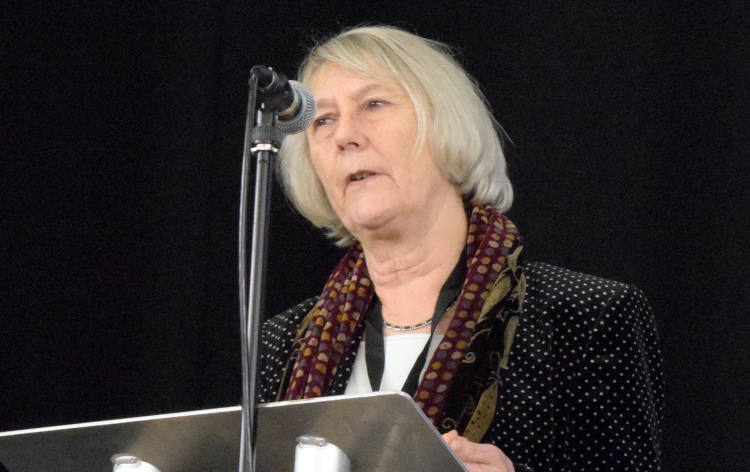
Dame Anne Owers, National Chair at Independent Monitoring Board
IMB Applications
Posters have been issued to be stuck onto IMB application boxes showing inmates the changes in dealing with their applications. One notable detail is this:
“We will still get daily updates from senior managers, so we know what is going on in the prison”
In other words, senior managers will tell IMB only what they want them to know.
IMB boxes will be emptied by IMB clerks (MoJ staff) or prison officers (MoJ staff). The IMB clerk or member of administrative staff will scan the application and email it to the prison’s IMB who will investigate concerns.
Responses may be emailed to the IMB clerk or member of administrative staff and delivered in an envelope or it may come direct from the IMB in an envelope. But not all Boards have access to a clerk.
Many members of the IMB may be in the high-risk category due to their age, others may have children to look after. Therefore, it is inevitable that changes will need to happen to safeguard prisoners, detainees, staff, and IMB members to minimise the risk of spreading infection.
Although the situation is changing daily, I think it’s safe to say:
All scrutiny of prisons is lost for the foreseeable future
The IMB has placed itself in an impossible position; the failure of the Secretariat to assure a sufficiently diverse membership is only one of a set of longstanding issues which the Covid-19 pandemic is exposing in the full glare of public attention.
IMB National Chair Dame Anne Owers, who holds ultimate responsibility for the organisation, must urgently rethink how the IMB is to fulfill its statutory obligation to provide monitoring of the prisons in England and Wales.
UPDATE 3rd April 2020
According to www.imb.org.uk. the message has now changed:
“Dame Anne Owers, IMB National Chair, has today (30 March) written to stakeholders to update them about monitoring of prison and immigration detention during the Coronavirus/COVID-19 epidemic:
Given the significant health risks for prisoners, detainees and staff during the current COVID-19 crisis, and following the Government advice issued this week, direct monitoring activity in prisons and immigration detention has inevitably been restricted.
Boards will be able to carry out some limited on-site work where it is safe and feasible to do so. However, we have also developed remote methods of providing some independent assurance at a time of heightened concern for prisoners and detainees. This is a fast-moving situation, but we have advised Boards as follows:..
With the ongoing COVID-19 pandemic affecting prisons, a change of direction such as this raises serious questions. How is it safer than a week ago for Board members?
~
Credits:
Photos of Dame Anne Owers by Paul Sullivan. Used with kind permission.

Recommendations are futile
People working within the Criminal Justice System will have noticed how writing or making recommendations carries little or no weight any longer. Defined as “a suggestion or proposal as to the best course of action, especially one put forward by an authoritative body”, a recommendation has few or no consequences for those delivering them or for those receiving them.
Yet those who write recommendations have no power to mandate them.
Prisons are bombarded with recommendations from the Prisons and Probation Ombudsman, HM Inspectorate of Prisons, the Independent Monitoring Boards, and a host of so-called arm’s length bodies.
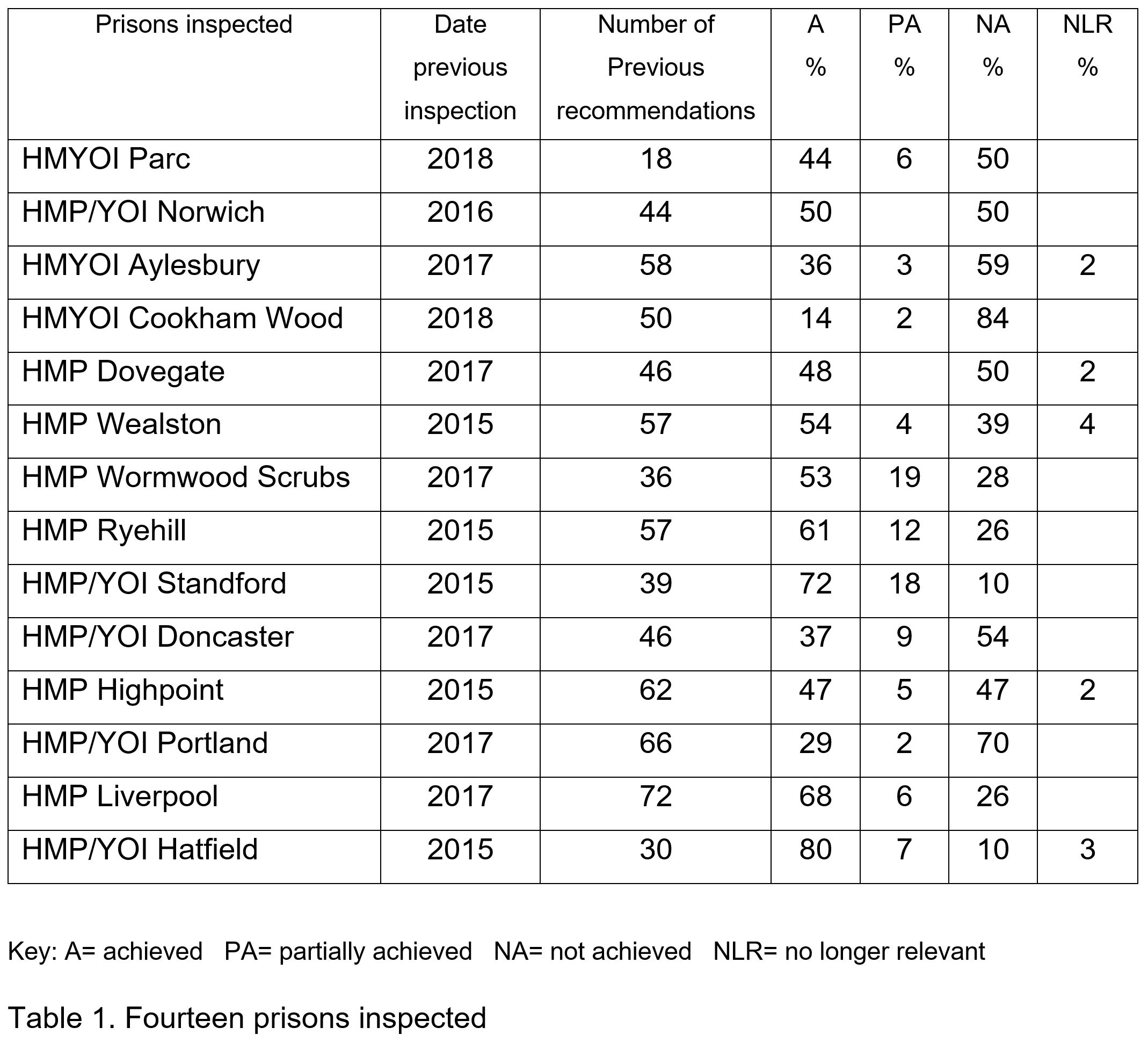
It is remarkable that their recommendations in reality are routinely ignored, albeit officially named differently as you will see in the table. Since there appears to be no recourse and no accountability, why continue to rely on this method of scrutiny which has become ineffective and, therefore, a waste of time, effort and money?
 Surely if all No 1 Governors were held personally accountable for enacting recommendations given to them then maybe there would be more action. Instead it is like a carousel, where certain Governors get away with the appearance of activity before being moved to another prison or a newly created role at HQ. After all, why work hard on recommendations when you can use a ‘Get Out of Jail Free’ card? Meanwhile, the mess they leave behind them is inherited by successive Governors.
On 25th February 2020, I attended the ‘Keeping Safe’ conference organised by the Independent Advisory Panel on Deaths in Custody (IAP). I’m telling you this because it perfectly illustrated to me how recommendations in and of themselves are futile.
For example, under the section on the agenda ‘Learning from reports and recommendations to prevent future death’ we heard from representatives from four prominent organisations, including Jonathan Tickner representing HM Inspectorate of Prisons who stated that in the last reporting period 14 prisons were inspected and none had been rated “good” in the safety aspect.
In each inspection recommendations are given. I decided to look at recommendations and to analyse how many were achieved. I chose those same 14 prisons inspected in 2019 and noticed huge variations which I’ve summed up in the table below:
Sue McAllister, Prison and Probation Ombudsman (PPO), raised some relevant points about policies not being good enough on their own and action plans not being good enough in response to PPO recommendations, like a tick box exercise. However, if there is no follow up on whether recommendations have been adhered to, or no consequences of not following up recommendations, then nothing has been achieved and the whole process is worthless.

Sue McAllister, Prison and Probation Ombudsman
In the 12 months to September 2019 there have been:
308 deaths in custody (6 every week)
90 self-inflicted deaths (1 every 4 days)
8 deaths in women’s prisons
We should be ashamed of ourselves. Those of us working in or for the Criminal Justice System must share a collective burden for the failure to keep people safe, sometimes from themselves.
According to ‘Deaths in prison: A national scandal‘ published January 2020 by Inquest:
This report identifies areas for the immediate reform within and outside of the prison system and concludes with recommendations to end deaths caused by unsafe systems of custody. (Inquest, 2020, p. 3)
As you can see, there is no shortage of recommendations.
Nobody knows which custodial sentence will become a death sentence.
The point is some do but none ever should.
Is it any wonder the MoJ has reformulated its mission statement from:
“Her Majesty’s Prison serves the public by keeping in custody those committed by the courts. Our duty is to look after them with humanity and help them lead law abiding and useful lives in custody and after release”
To how it reads today, portraying itself as a sterile, uncaring, faceless organisation.
“The Ministry of Justice is a major government department, at the heart of the justice system. We work to protect and advance the principles of justice. Our vision is to deliver a world-class justice system that works for everyone in society”
“The organisation works together and with other government departments and agencies to bring the principles of justice to life for everyone in society. From our civil courts, tribunals and family law hearings, to criminal justice, prison and probation services. We work to ensure that sentences are served, and offenders are encouraged to turn their lives around and become law-abiding citizens. We believe the principles of justice are pivotal and we are steadfast in our shared commitment to uphold them”
Source: https://www.gov.uk/government/organisations/ministry-of-justice/about
When you look long enough at failure rate of recommendations, you realise that the consequences of inaction have been dire. And will continue to worsen whilst we have nothing more compelling at our disposal than writing recommendations or making recommendations.
Recommendations have their place but there needs to be something else, something with teeth, something with gravitas way beyond a mere recommendation.

Rt Hon Robert Buckland QC MP, Lord Chancellor and Secretary of State for Justice
Show me a system where action is mandatory, where action has a named owner assigned to it, where action has a timeline attached to it, and where action is backed by empowerment to deliver it and I’ll show you a system which functions better than the one in operation today in the Criminal Justice System obsessed with recommendations.
Culture is what you do when no one is watching.
Integrity is doing the right thing even when nobody is looking.
I found it very telling that the most poignant part of the conference came with the stories and sadness from families who had lost loved ones and to learn that every 4 days a person takes their own life in custody. If the changes being recommended were changes being mandated, who knows how many deaths could have been averted?
Robert Buckland QC MP, Lord Chancellor and Secretary of State for Justice, arrived early enough to have heard from those family members. He talked about working together with shared humanity and wanting to be notified personally of all deaths and the circumstances surrounding each one, which of course he already is. In closing his speech Mr Buckland said:
“As we continue to work together during my tenure as the Secretary of State, please know that my door is always open to those who want to make a difference”
It’s time to put him to the test on that.
But don’t go in with recommendations; go in with a plan for action.
~
Credits:
Photos of Robert Buckland QC MP and Sue McAllister, both by Paul Sullivan. Used with kind permission.
Monopoly Board Game, 2006 Hasbro. Photo by the author.

Just how ‘independent’ is the Independent Monitoring Board?
For many years I have struggled with the concept of the Independent Monitoring Board (IMB) being actually independent.
This is an organisation which was based at the Ministry of Justice (MoJ) HQ, Petty France for many years, but now shares open plan offices in a Government Hub at Canary Wharf alongside HM Inspectorate of Prisons, Prison and Probation Ombudsman (PPO), Parole Board for England and Wales and the Lay Observers Secretariat.
The introduction of IMB’s new Governance structure, where the role of President was replaced by a Chair and an additional layer of management, has failed to persuade me otherwise.
Dame Anne Owers, formerly Chair of The Independent Police Complaints Commission (IPCC) and prior to that Chief Inspector of Prisons (2001-2010), took up the role of National Chair of the IMB in November 2017.
We appear to differ on the definition of independence. Or do we? Across a committee room in the House of Lords, she and I exchanged glances as soon as the word “independence” was mentioned. I get the impression she knows it’s not.
Does it matter that the IMB is not independent?
It unquestionably matters because an application to the IMB requires a response within a certain time frame from an “independent” voice. But as the IMB is a department of the Ministry of Justice any problems or issues highlighted cannot be dealt with in a proper manner if they are basically monitoring themselves. The phrase “marking their own homework” comes to mind.
Is this the reason why the IMB does not have any real powers?
The IMB was established by statute (Offender Management Act 2007, Section 26), unlike the National Chair or the Management Board, neither of which are statutory entities. IMB responsibilities within prisons are set out in Section 6 of the Prison Act 1952 (as amended), Prison Rules Part V 1999, and Young Offenders Institution Rules Part V 2000.
In addition, IMB responsibilities in the Immigration Detention Estate (IDE) are set out in Section 152 of the Immigration and Asylum Act 1999, the Detention Centre Rules Part IV 2001 and the Short-term Holding Facilities Rules Part 7 2018.
In Summer 2019, MoJ and IMB co-produced a 23-page document “Protocol between The Ministry of Justice as the department and the Management Board of the Independent Monitoring Boards” A copy is available via this page of the IMB website.
This is where it gets interesting.
This protocol was drawn up by the MoJ and the Management Board of the IMB, setting out the role of each body in relation to the other. Furthermore, it sets out the responsibilities of the principal individuals running, sponsoring and overseeing the IMB Secretariat.
At this point, it’s relevant to look at the IMB structure:
-
First, we have the National Chair: Dame Anne Owers, appointed by the Secretary of State for Justice (Ministerial appointment) and a non-statutory public appointment
-
Second, there is the IMB Management Board, appointed by the National Chair which sets out the overall strategy and corporate business plans for the IMB (Protocol, p. 2: 1.3)
Both work with and through a regional representative’s network also appointed by the National Chair, providing support and guidance to the IMB.
-
Third, we come to the IMB Secretariat, a team of MoJ civil servants providing the IMB with administrative and policy support. This team is tasked by the National Chair and Management Board
It is the National Chair, Management Board and regional representatives that have the responsibility for the operation of this protocol. Yet with all the effort in its production this protocol does not confer any legal powers or responsibilities (Protocol, p.2: 1.6).
This protocol is approved by the Permanent Secretary of the MoJ, who is Sir Richard Heaton, and the sponsoring Minister. It is signed and dated by the Permanent Secretary (i.e. Sir Richard Heaton) and the National Chair (i.e. Dame Anne Owers).
But why should the independence of the IMB, the National Chair and the Management Board be of paramount importance? (Protocol, p.4: 3.1)
Let me try to answer this succinctly.
The IMB is part of the UK’s National Preventive Mechanism (NPM), designated by the Government to meet the obligations of the United Nations Optional Protocol to the Convention Against Torture and other Cruel, Inhuman or Degrading Treatment or Punishment (OPCAT).
To be part of the OPCAT, it is necessary to be independent (Part I, Art 1; Part II, Art 5.6; Part IV, Art 17; Part VII, Art 35).
NPMs are required to be functionally and operationally independent. Therefore, the IMB is required to be functionally and operationally independent.
Yet:
-
IMBs are sponsored by MoJ
-
National Chair is a ministerial appointment
-
IMBs receive funding through the MoJ and the Home Office
-
MoJ is responsible for ensuring the use of funds meets the standards of governance, decision-making and financial management, as set out in Managing Public Money 2013 revised 2018
-
The head of the IMB Secretariat accounts to the Principal Accounting Officer (PAO) for the appropriate use of resources
-
The PAO is the Permanent Secretary of the MoJ (Sir Richard Heaton) and is responsible for ensuring that IMB meets the standards set out in Managing Public Money
-
MoJ has appointed a sponsorship team
-
The sponsorship team is drawn from the Sponsorship of Independent Bodies Team in the MoJ’s Policy, Communications and Analysis Group. Its policy responsibilities are to act as the policy interface for the IMBs and assurance responsibilities are to act as a “critical friend” to the IMBs
-
The Head of the IMB Secretariat is a civil servant and employee of the MoJ and has accountability for IMB finances
In conclusion
It appears throughout this document that the MoJ exerts operational and functional control of the IMB. If that is the case then it is not independent, cannot call itself “Independent” and questions should now be asked concerning its membership of NPM and OPCAT.
IMB is not some vanity project for Ministers to appoint people to and to dismiss people from. Neither is it an arms-length body of any central Government department to sponsor in a whimsical way for its own ends.
Related Links
Protocols:
MoJ and HM Inspectorate Probation Download PDF
20 pages
Dated: 17 Apr 2018
Signed: Heaton 17 Apr 2018 and Stacey 02 May 2018
Published: 17 May 2018
MoJ and PPO Download PDF
19 pages
Dated: 01 Mar 2019
Signed: Heaton 20 Feb 2019 and McAllister 27 Feb 2019
Published: 12 Mar 2019
MoJ and IMB Download PDF
23 pages
Dated: 25 Jul 2019
Signed: Heaton 11 Jul 2019 and Owers 25 Jul 2019
Published: 14 Aug 2019
MoJ and HM Inspectorate Prisons Download PDF
24 pages
Dated: 10 Oct 2019
Signed: Heaton 30 Sep 2019 and Clarke 14 Oct 2019
Published:
Can you see the common denominator between all these protocols?
NB. The Protocol between MoJ and HMI Prisons was promised by the Ministry to the Commons Justice Select Committee back in March 2016.
~
This article was first published in Converse, November 2019 print edition and The Prison Oracle on 14 October 2019.
~

Her indomitable spirit
A retrospective of 2019
It was a year of challenging the norms, exploring the Arts and Media and pushing some boundaries. It has had its highs and lows with times of difficulty and frustration yet amongst it all there have been moments to celebrate, moments of laughter and new friendships made.
The year began at one of my favourite places, the beach at Aldeburgh on the beautiful Suffolk coast, wrapped up against the elements, a brisk walk with my family and then tea in the warm. Perfect.

My first trip of the year into Westminster was for the APPG on Miscarriages of Justice, at a session entitled: ‘Aftermath of Wrongful Convictions: Addressing the Needs of the Wrongfully Convicted in England and Wales’. We were reminded that half of all victims of miscarriages of justice were homeless within six months of their convictions being overturned.
According to ‘Supporting Exonerees’ a JUSTICE report published 2018, in the last five years only five people have received compensation from the Ministry of the Justice after having their convictions overturned and not a single person in 2018. By contrast, between 1999 and 2004, there were 162 successful applications.
Across the year there were four sessions of the APPG on Miscarriages of Justice, all of which I managed to attend. These were co-chaired by Baroness Stern and Lord Garnier QC, and featured members including: Dame Anne Owers, National Chair of Independent Monitoring Boards; Michelle Nelson QC, Barrister at Red Lion Chambers; Dr Philip Joseph, Consultant Forensic Psychiatrist; and Erwin James, Editor-in-Chief of Inside Time.
My sincere hope is that the work performed by this APPG, even though it has no statutory powers, will be effective in some way and not evaporate like a silent conversation that never happened.
It was also a pleasure to attend a joint Criminal Justice Alliance (CJA) and Ministry of Justice event, held at Petty France, London to discuss the aging population in prisons. It’s well known that the level of healthcare and social care within prisons is inconsistent and all too often not fit for purpose.
This was the first of six CJA round tables and meetings I attended and participated in during the year, including their AGM.
Not all my work is in Westminster or even in London. For example, as a part of the Female Leaders at 50 (Twitter: @femaleleaders50), I was able to share part of my story, listen to others and enjoy a fantastic evening reception and dinner in Cambridge. Thank you to Ciara Moore, looking forward to our next gathering this year.

Female Leaders at 50
Being recommended for membership of the Royal Society for the Encouragement of Arts, Manufactures and Commerce (RSA) was a highlight because it showed that what I am able to contribute to society has value. In fact the letter I received from the RSA included a copy of the statement by the person who recommended me, saying:
“Faith is a very potent voice and commentator on prison issues. Her blog https://faithspear.wordpress.com/ has quite a following. She is an accomplished writer and speaker and has huge respect in prison reform circles.”
In the letter, the RSA said:
“I believe that you have an important contribution to make in supporting our work, and that you will be a valuable addition to our diverse and influential movement of like-minded people committed to building a better society”
I was so delighted and can assure you I’ve already begun to make good use of my membership to this prestigious organisation. Planning, sharing ideas and debriefing after meetings. The RSA provides an excellent space to meet and greet at its venue in central London which is very convenient given the nature of the work I am asked to do.
The Spring season was busy both personally and professionally. Dr Marianne Colbran kindly invited me to attend an LSE media event: ‘Breaking prison narratives’. The event produced interesting conversations, some heated debate, and time for participants to reflect individually on what the day meant for them. It was eye-opening and definitely an event I was pleased not to miss.
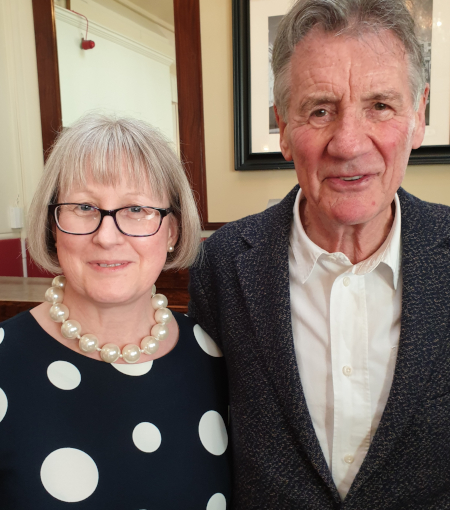
Michael Palin
The Executive Ladies lunch with Lady Val Corbett later the same month featured guest speaker Michael Palin. Michael was very engaging to listen to, with anecdotes of his life and adventures. He showed particular patience afterwards as many asked for a memento selfie photo. Networking, raising funds for prison reform and for the Robin Corbett Awards always makes it a working lunch with a clear and meaningful objective. The help, strength, encouragement and inspiration that people derive from these lunches is priceless. And that was exactly how it was when Prue Leith joined us as guest speaker later in the year. What an entertaining and fascinating woman.
Large parts of my work can be challenging and distressing. Sometimes it can be harrowing.
I attended the inquest into the death of a young man, Thomas Kemp. The Suffolk area coroner, Jacqueline Devonish, recording narrative conclusions, said: “Kemp stabbed his wife to death during a psychotic episode when she tried to prevent him from harming himself. He then took his own life.”
The fact that he killed his wife and then himself was widely reported, including in my local media because he worked at the local university. But his full connection with the justice arena was not mentioned. I first met him back in Summer 2017 when visiting the University campus because I was invited to observe training of graduates. Thomas was employed by the University of Suffolk as an administrator. He worked on the Masters programme called ‘Unlocked Graduates’. After his death, his name was rapidly erased from the university’s website and, to the best of my knowledge, no acknowledgement of his tragic death was ever published on the Unlocked Graduates website.
Let’s hope the memory of Thomas Kemp has not been totally erased. Whilst I do not condone what he did, as someone who appeared to have serious mental health issues, it is clear that the system failed him and his wife.
I have subsequently learned that many involved in the teaching of the Unlocked Graduates programme at the University of Suffolk have themselves had to take time off due to stress. For me, there are many questions about Unlocked Graduates which remain unanswered and I know I’m not the only one.
The Creative arts in prisons is an area which interests me greatly. So, this year it was particularly interesting to have visited Snape Maltings for the celebration of their 20-year collaboration with HMP Warren Hill. The day was made up of performances, art exhibition and workshops showcasing the role of music and arts in rehabilitation with their partners Koestler Arts, The Irene Taylor Trust, Clean Break and Fine Cell Work.
Entering the main auditorium, I noticed someone waving at me and was surprised to see it was Dame Anne Owers (Chair of Trustees, Koestler Arts). We sat together to watch the performance; at one point, they handed out percussion instruments and everyone was encouraged to join in with creating improvised music. The whole event was one of inclusion, acceptance, hope and the potential of those currently serving sentences. It was a privilege to speak afterwards with some of the musicians and singers.
From that event came an invitation by Fanny Jacob, Creative Project Leader and Julian Earwaker, Writer in Residence at HMP Warren Hill to an art exhibition and fundraiser. A fascinating afternoon was spent with around 30 guests including the local Mayor. I chose to support the Families In Need (FIND) charity by purchasing one of the works of art.
I wanted to explore a little more about what role the Arts play within the prison estate. For that reason, I attended another Koestler Art exhibition, this time on London’s South Bank entitled “Another Me”.

Erwin James
Some people visit these exhibitions in groups, others in pairs but I prefer to visit alone so that other people’s initial reflections don’t become mine. For me it’s not just the pieces of art that can stop me in my tracks but the titles given to the pieces. For example, this year I discovered works of art called “Stand Alone”, “Consequences”, “Innocent Man” and “Woo Are You Looking At?”.
From matchsticks to J-cloths, from socks to gold leaf, such variety of materials used with such ingenuity.
But the question that stayed in my mind was:
“Are these exhibits examples of escapism or expressionism?”
I took this question forward and developed it when having the opportunity to interview the writer Erwin James. Choosing a venue familiar to me but unfamiliar to Erwin, my motivation was to try to explore the impact on a person who becomes a prisoner of being categorised and given a number and watched by security; just like works of art in galleries. An interesting parallel that I have tried to explore in the past.
This is the amazing feedback from Erwin:
“One of the highlights of my year in 2019 was being interviewed by Faith in the National Portrait Gallery. I’ve been interviewed many times over the years by press, radio and tv – but what I liked about Faith’s approach was that she wanted to introduce art as our common ground as well as our interest in prison reform. I’ve known and admired Faith for a number of years. We haven’t always agreed on prison reform issues, but I’ve always respected her integrity, which shines in her writing, her passionate crusade for a more humane and effective prison system – and above all her indomitable spirit. I’m just glad we’re on the same side…”

Jeremy Paxman
My return visit to the Bernard Jacobson Art Gallery in London was on a warm summers evening. It was the occasion of the bi-annual Contrarian Prize, for which I was pleased to have been nominated in 2017. The gallery was full and I met some real and would-be contrarians. The winner was Katherine Birbalsingh (Twitter: @Miss_Snuffy), founder of Michaela School and the prize was awarded by Jeremy Paxman. Chatting afterwards, Jeremy told me he had heard of me, which was somewhat astonishing. But the conversation with him was good and far from superficial.
It was also a genuine pleasure to catch up with my friend Ali Miraj, founder of the Contrarian Prize.
Being met in the entrance hall at the Lebanese Embassy by His Excellency the Ambassador for Lebanon to the United Kingdom, Rami Mortada, was an unexpected and memorable moment. Having received an invitation from Dr Lewis Owens the evening reception was arranged for former hostages Terry Waite and John McCarthy to meet on Lebanese soil together for the first time since their kidnap. It was a proud moment for me to meet them both, Dr Waite for the second time, and to have the opportunity for a short conversation. The ordeal of these remarkable men, imprisoned against their will, provides us all huge lessons about incarceration.

Terry Waite and John McCarthy
This year it has once again been a pleasure to be an associate member of The Corbett Network. It’s founder Lady Val is an inspirational woman, who I am pleased to call a friend. Her determination to promote reintegration and to support those released from prison into meaningful employment is exemplary. She has gathered around her a group of people who share this vision. Among them is Jo Apparicio, Business Management Director at The Chrysalis Programme, with whom I share the same passions and sense of humour, and to whom I leave the last words of this blog.
Thank you for reading.
“I was first introduced to Faith in May 2017 at a Networking event. I was immediately struck by Faith’s absolute passion, drive grace & unconquerable spirit in ensuring that individuals caught up in our judicial system are listened to, given a voice opportunity & support to reintegrate back into their families & communities in a positive & sustainable way with dignity as returning citizens to our society. Working with Faith over the past couple years in this environment sharing many common goals & thoughts I am in constant awe of Faith’s passion & drive and feel a great privilege to call her a dear friend. Faith is indeed a rare lady & a real woman of substance & I have no doubt that with her drive & passion she will be instrumental in the future in helping change the judicial system & prison reform for the better supporting individuals both in the prison system & also on release reintegrate and return to our society in a positive way”
In the context of a blog like this, it’s possible to only mention a fraction of the workload, time and miles covered. For obvious reasons you will appreciate I’m unable to share the full extent of everyone I have met or all that has been done.
~

An interview on a Summer’s day
How/why did your involvement in the CJS come about?
I turned down a place to study for a degree and instead moved from Lincolnshire to Essex at the age of 19. My first “proper” job was in admin with NACRO in Colchester. I worked primarily in wages and finance. At that point NACRO provided 6 months work placements in painting and decorating or in gardening teams etc for those who had just come out of prison. I heard amazing stories from those men and some brought newspaper cuttings to show me of their various escapades, including a headline “Most wanted man in Britain” They made me laugh and some made me shed a few tears. But for me I had many questions that were never answered.
What happens after 6 months?
What about their families, how can they support them financially?
Was this really a way for integration back into society?
Why is only manual labour available?
I helped set up and train staff for a new branch of NACRO and then moved on to work in Finance for the NHS. However, I believe a seed was planted all those years ago.
Fast forward 25 years, I was accepted into University. I became a full-time student studying Criminology with 2 kids at school, 1 at college, a part time job and my husband working full time and studying also, I embarked on a very busy 3 years of multi-tasking!
For my first presentation I chose to speak on Women in prison and the Corston report, I researched thoroughly but was marked down because no one was interested in prisons and especially not women in prison, it was deemed not an exciting enough subject. Great start. My next presentation was about Restorative Justice and yet again I was questioned as to why I was interested, one lecturer even said, “What’s that?”. A pattern was emerging of my interest into those within the CJS and those that had been released increased. I was not put off and in my 3rd year the title for my dissertation was: Restorative Justice: Is it delivering strategic change in England and Wales or just a cost cutting exercise by the Government?
To understand the significance of Restorative Justice I arranged interviews with experts in the UK, NZ and USA, even Howard Zehr widely regarded as the Grandfather of RJ agreed to help. I consumed document after document on RJ and was a frequent visitor at the Cambridge University Library, floor 6 (those stairs almost killed me!) and the Institute of Criminology Library.
I graduated with an honours degree in Criminology and looked for my next step.
I joined the Independent Monitoring Board (IMB) at HMP/YOI Hollesley Bay and in just three years became the Chair.
I wrote about the things I saw and heard but what I didn’t expect was what happened next. I was confronted with a prejudicial character assassination brought against me, a fight to clear my name, being investigated twice by the Ministry of Justice, called in front of a disciplinary hearing in Petty France and the involvement of not one but two Prison Ministers. I felt that I was on my own against a bastion of chauvinism. Not the last bastion of their kind I would come across. Welcome to the IMB!

My continuing journey can be found in my blog: The Criminal Justice Blog www.faithspear.wordpress.com
Because my story is fairly unique it has been covered by BBC News, Channel 4 News, BBC Radio Oxford, BBC Radio Suffolk, 5Live, LBC as well as National and Local newspapers, law journals and online publications etc.
Religion is clearly important to you, what role does God play in your life?
I remember going to Chapel with my grandparents as a young child and hearing my Dad and Grandfather sing the old hymns with deep sincerity. Christianity has always been part of my life. My faith in God has often been tested.
How do you balance work and life responsibilities?
I often say I’m a Mum first, always have been always will be. My husband and my kids are the most important people in my life, I have a great relationship with them all. They understand who I am and what motivates me to do what I do. They understand the bigger picture and that for me it is a cause and not merely a job. That in itself I realise is exceptional and I find I am continually grateful because I know that the level of family support I have is sadly not available to everyone. I can’t do this stuff on my own. They are also aware of the work I do behind the scenes and the many hours of support I give freely.
What role, if any, has luck played in your life?
Things happens for a reason, we don’t always know or understand the reason why. We all have issues to face and hurdles to climb and times of joy and celebration. Luck doesn’t fit in my life at all.
Not only have you been a source of inspiration to me in certain areas, I have also seen you inspire others and would like to know who inspired, or inspires you and why?

A few years ago, I wrote a journal article with a friend of mine, Dr David Scott about a remarkable woman, Lady Constance Lytton, commemorating 100 years since her book Prisons and Prisoners was published. In it she presented one of the most significant challenges to 20th Century anti-suffrage politics. Her book is a harrowing personal account of her four prison sentences as a militant suffragette. It is also a compelling insight into the mind of a young woman consumed by a cause which would prove to be instrumental in prison reform and votes for women, as well as tragically being a contributory factor to her death. My inspiration, which comes from her being consumed by a cause, makes me wonder if that is still possible. This wasn’t a phase she was going through or a pastime, it was a lifestyle.
I admire her courage and determination. I see this in so few people but when I find it, it is unmistakable. Let me give you an example, Tracy Edwards MBE. At the age of 26 she was the skipper for the first all-female crew for the Whitbread Round the World Race. It is not so much the fact that she sailed around the world, although that in itself is remarkable, but it is the reason why that I find compelling. She said “First time in my life I stood up for something I believed in” I have met and chatted with Tracy, she is an inspiration to me without a doubt.
What would you say is your greatest accomplishment and/or achievement is?
I think that my greatest accomplishment is staying true to myself, maintaining integrity and not bowing to pressure to conform.
In terms of my greatest achievement let me give you a couple of examples. First, being nominated for the Contrarian prize 2017 especially when you realise the key criteria that the judges look for are Independence, Courage and Sacrifice.

Ali Miraj and Faith Spear
Second, last year I was deeply moved and excited to learn that I had been counted as one of the 100 inspirational Suffolk women alongside people such as Dame Millicent Fawcett.


As a female leader, what has been the most significant barrier in your career?
On one of my visits to the House of Parliament I took time to seek out one of the most outspoken MP’s known for saying it as it is. I sat down next to Dennis Skinner and asked him a very simple question. I asked, “How do you get heard in this place?”. Mr Skinner looked me straight in the eye and offered me advice I will never forget. With his characteristic directness, he said, “You have to be seen to be heard”. I’ve taken his advice and applied it to all I do. This has not come naturally to me as people who know me will tell you.
Everybody wants to have their say and everyone has an opinion. But there is a big difference between those who say their piece ad nauseum and those who have something to say.
In one sense all that people have heard from me so far is simply learning to overcome the barriers of not being heard. When I have learned enough then I am sure I will have gained the clarity with what I have to say.
If you were given the prisons and probation ministers role, what changes would you make?
I would scrap the titan prison building programme and instead invest in smaller local units, making families more accessible and start to break down the barriers between those in prison and those on the outside.
I would encourage industry to step out of their comfort zone and give more people with convictions a second chance. To remove the stigma of a criminal record so that it is not forever hanging around people’s necks. We are a deeply divided and hurt society that is full of prejudices.
I would ban all industries within prisons that do not provide purposeful activities and a decent wage. People need to be work ready on release with housing and job options already in place. Families should be able to stay together and be supported, children should be prioritised.
I would make sure everyone working within the CJS were trained sufficiently for their roles and supported in their jobs.
As a prisons minister you can only change what is in your field of influence to change. In other words, you need to be precise, you need be pragmatic and you need to learn whose advice you can trust. Then act on it.
One of my priorities as Prisons Minister would be to take advice to demonstrate better things to invest in. Diversion, or Restorative Justice or Community.
Put money into early years, into youth etc.
We have to stop this madness of believing that we can change people and their behaviour by banging them up in warehouse conditions with little to do and not enough to eat and sanitation from a previous century.
As Prisons Minister I would initiate change that would lead to every prison Governor carrying personal accountability for the way they run the prisons they are responsible for. It’s not their prison, its ours and they must run it properly, giving people in their care decent conditions and personal dignity regardless of what crime the courts have sent them to prison for. The moment Governors carry that personal accountability is the moment you will see astonishing changes in HMPPS.
I will ensure under performing Governors leave the service and are not continually rotated around the prison estate or promoted to more senior positions. They have to know the weight of the accountability they carry.
Finally, what are you hopes and aspirations for the future of the criminal justice, and also for you?
Transparency and Accountability should underline every decision made. No more carpets where issues are swept under. No more excuses for the crisis within the system. We talk too much, we deliberate too much and have too many committees. There are too many roundtable events, conferences, discussions where everyone is saying they are experts yet so much remains the same. We produce too many reports, reviews and paperwork that gets filed away. Now is the time for action, for investment in people and for priorities to change. Lets just get on with it and stop competing and instead work toward a common objective, such as drastically reducing the prison population
In the next five years, I will continue to speak up truthfully and will add my voice to the very many voices calling for change. I will support policies introduced by the current Prisons and Probation Minister or by their successor where those policies do bring about real change. However, I shall not hesitate in bringing a strong critique where those policies gloss over the hard questions or where they shirk the implementation of measures for real reform. I will finish on this:
Vision is often personal, but a cause is bigger than any one individual
People don’t generally die for a vision, but they will die for a cause
Vision is something you possess, a cause possess you
Vision doesn’t eliminate the options; a cause leaves you without any options
A good vision may out live you, but a cause is eternal
Vision will generate excitement, but a cause generates power
[Adapted from Houston (2001)]

HMP Berwyn: Does it raise more questions than it answers? Part 2
The Wales Governance Centre, a research centre and part of Cardiff University’s School of Law and Politics undertakes innovative research into all aspects of the law, politics, government and political economy of Wales.
This week they released a report: Sentencing and Imprisonment in Wales 2018 Factfile by Dr Robert Jones
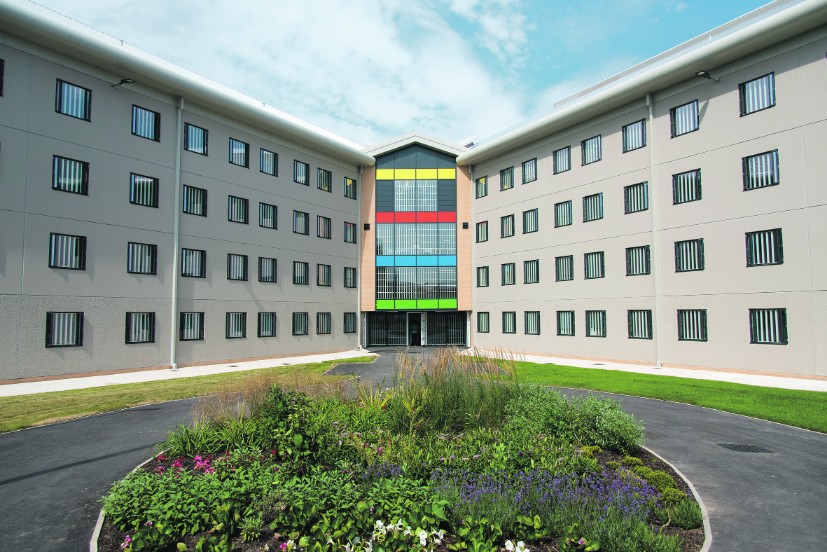
Before looking at this report, lets put things in context by referring to the first unannounced inspection by HMIP of HMP Berwyn in March 2019. Here it is reported that “impressive” support procedures are in place for new arrivals. Positive note. However, use of force was considerably higher than at similar prisons and 1 in 4 prisoners (23%) told HMIP that they felt unsafe. Alarm bells?
Below are the four tests when inspecting a prison, Safety, Respect, Purposeful activity and Rehabilitation and release planning. Not the best outcome for the first inspection.
Safety: Outcomes for prisoners were not sufficiently good against this healthy prison test.
Respect: Outcomes for prisoners were reasonably good against this healthy prison test.
Purposeful activity: Outcomes for prisoners were not sufficiently good against this healthy prison test.
Rehabilitation and release planning: Outcomes for prisoners were not sufficiently good against this healthy prison test.
HMP Berwyn prison has only been open just over 2 years, hasn’t reached full capacity and has its 3rd governing Governor.
Now let’s look at some of the facts revealed that are not easy reading
The number of self-harm incidents
2017 = 231
2018 = 542
Self-harm incidents rose by 135% in 2018
Rate of self-harm: (48 per 100 prisoners)
This is what the Government website states:
“Self-harm may occur at any stage of custody, when prisoners are trying to deal with difficult and complex emotions. This could be to punish themselves, express their distress or relieve unbearable tension or aggression. Sometimes the reason is a mixture of these. Self-harm can also be a cry for help, and should never be ignored or trivialised” https://www.gov.uk/guidance/suicide-self-harm-prevention-in-prison
This is what the HMIP report states:
“The strategic management of suicide and self harm required improvement. Strategic meetings were poorly attended and too little was done to analyse, understand and take action to address the causes of self-harm. Most of the at-risk prisoners on assessment, care in custody and teamwork (ACCT) case management did not feel sufficiently cared for. ACCT documents required improvement, and initial assessments and care plans were weak”
Yet below are more uncomfortable facts showing that this prison is not just dangerous for prisoners but for staff too. Nothing to celebrate here.
The number of prisoner-on-prisoner assaults rose by 338% in 2018
Rate of prisoner-on-prisoner assaults: (20 per 100 prisoners)
The number of assaults on staff at HMP Berwyn increased by 405% in 2018
Rate of recorded assaults on staff (18 per 100 prisoners)
You would think that a new prison would have a security department second to none, with little chance of items being brought in. Yet these figures show that weapons, drugs, alcohol and tobacco are increasingly being found. Some may say hats off to the staff for finding these items, but really there’s still no cause for celebration…
The number of incidents where weapons were found in prison, years ending
March 2017 = 1
March 2018 =25
March 2019 Berwyn = 138
The rate of weapon finds (11 per 100 prisoners) year ending March 2019
This was the highest rate per prisoners in all prisons in Wales, astonishing. Serious problems with security.
The number of drug finds at HMP Berwyn increased by 328% in the year ending March 2019 (prison population increased by 67% during this period)
The rate of drug finds (16 per 100 prisoners)
Where are the robust measures to stop drugs coming into the prison?
The number of incidents where alcohol was found in HMP Berwyn years ending March
2017 = 0
2018 = 21
2019 = 146
Alcohol finds at HMP Berwyn rose by 595% (prison population increased by 67% during this period)
Rate of alcohol finds (12 per 100 prisoners) year ending March 2019.
Yet again the highest rate of alcohol finds in all the prisons in Wales
The number of incidents where tobacco was found in HMP Berwyn years ending March
2018 = 20
2019 = 61
Rate of tobacco finds (5 per 100 prisoners)
The prison is covered in photos of Wales and the countryside, everywhere you look there is a motivational quote, there are flowers, bees, greenhouses yet one in 4 prisoners didn’t feel safe.
Comfy chairs in reception, pretty pictures, colourful décor does not appear to contribute to the safety of HMP Berwyn.
Motivational quotes such as “When a flower doesn’t bloom you fix the environment in which it grows not the flower” means nothing if a quarter of the population feel unsafe.
Prisons can be austere places, drab, filthy, old and not fit for purpose. But here we have a new prison with serious problems. There can be no excuse that these are teething problems, we are talking about peoples lives.
Remember the Berwyn Values?
V = value each other and celebrate achievements
A = act with integrity and always speak the truth
L = look to the future with ambition and hope
U = uphold fairness and justice in all we do
E = embrace Welsh language and culture
S = stick at it
Is this just a marketing ploy, designed for a feel-good factor, making us all think that the money spent on this Titan prison was worth every penny?
Independent monitors have praised the work of staff at HMP Berwyn describing their efforts to establish a new prison as a ‘considerable achievement” (Recent comment by IMB) After this shocking report, what will they now say? Or will they remain silent?
I don’t doubt there are some hard working, diligent and caring staff. In fact, I met some on my visit last year. But when the prison opened in 2017 over 90% of staff had never worked in a prison before. When you have prisoners arriving from over 60 prisons all with different regimes, you find they have far more experience of the prison estate than the majority of prison officers.
But more worryingly is that the Government is continuing with its programme of building new prisons. A new prison will be built in Wellingborough as part of the Government’s Prison Estate Transformation Programme. I’ve read gushing articles on how this prison will benefit the community etc, similar to when HMP Berwyn began construction. Just like HMP Berwyn there are many promises and opportunities, but theory and practice can be a million miles apart.

Whistle while you work
Is whistleblowing a band wagon to jump onto?
Usually you don’t suddenly wake up in the morning and say, “Today I’m going to be a whistle-blower”. The negative connotations surrounding whistleblowing such as being an informant, betrayer, or even a backstabber is not something to aspire to.
Yet, these descriptions cannot truly explain why there are those in the minority that will put their head above the parapet, will risk their reputation and often lose their job through speaking out.
So, have we become largely a society that will cower rather than stand up, do we lack courage or integrity or both?
Fear of reprisals can cause us to retreat, to stay silent but in so doing are we not being true to ourselves. It takes more than just determination to be vocal about issues you are passionate about. Unfortunately, when living in such a punitive society, the norm is to shut people down rather than to listen.
Having sat at an employment tribunal with an experienced Prison Officer listening to their case of dismissal, my thoughts were not that they wanted revenge, not at all. I saw passion, I heard a very determined individual with a story that has affected not only their work, their life but possibly their health too.
It’s too easy for society to ignore the reality in our prisons in England and Wales, where violence, instability and a lack of investment over decades has reduced them to warehouses of the vulnerable. Numerous are inhumane and on the point of crisis.
Equally, let’s not point the finger at those that want transparency in the Criminal Justice System, instead we should push for accountability and not lose sight that one day those in prison may be a loved one or will become our neighbour.
Time to stop shooting the messenger
Recently I met Michael Woodford, the inaugural winner of the Contrarian Prize and former CEO of Olympus who exposed a $1.7 billion fraud at the heart of Olympus and was sacked for doing so. He had more than most to lose by speaking out.

Faith Spear and Michael Woodford
According to: https://www.gov.uk/whistleblowing
“As a whistleblower you’re protected by law – you should not be treated unfairly or lose your job because you ‘blow the whistle’.
You can raise your concern at any time about an incident that happened in the past, is happening now, or you believe will happen in the near future”
But is this really so?
It also states:
“You’re a whistleblower if you’re a worker and you report certain types of wrongdoing”
But what if you are a volunteer?
Yes, you work and often very hard, but where is the protection mechanism?
In my experience, being a volunteer for many years offers little protection especially when dealing with the Ministry of Justice. Even going through the “normal” channels produces little response. Suddenly people become hard of hearing, blind to what is happening all around them and stick their heads in the sand.
I’m not like that, I am very aware of many untold stories and issues within the justice system.
I put my head above the parapet once, I have no regrets even now still living with the consequences.
I would do it again.
And plan to do shortly!

Courage for the year ahead

Faith Spear
Introduction
The year 2018 was historic for many reasons not least because it saw the first statue of a woman placed in Parliament Square, London.
More so its message, marking a pivotal moment in social history, with “Courage calls to courage everywhere”
And for me personally, I can look back on a year of Exploration, Celebration and Collaboration.
Exploration
I traveled many miles in 2018 including two trips to Wales.
I was delighted to be invited to the Welsh Assembly, the Synedd, Cardiff in January to sit on a panel after the screening of the Injustice Documentary.

Faith with Claire Melville
The whole subject of injustice was brought home though an introduction to Michael O’Brien jailed for 11 years for a murder he did not commit.
One woman at that event stood out for me, Claire Melville, who has since become a source of great encouragement.
My second trip to Wales took me north to Wrexham where, at the beginning of August, I visited HMP Berwyn on the invitation of the Governing Governor, Russell Trent. I have already written about my experience in a previous blog.
However, my visit and subsequent write-up caused quite a stir as within a week Russell was suspended from his duties and not just the media but trolls on Twitter had a field day.
The BBC and Channel 4 contacted me to ask if what I wrote was “the cause”. I raised some important points concerning the design and build of this “Titan prison” a flagship of the Ministry of Justice, which I sincerely hoped would be the last.
I made the most of my time whilst in the area and met with Erwin James (InsideTimes), had dinner with Arfon Jones (Police and Crime Commission for North Wales) and a working lunch with Keith Fraser, (retired Police Superintendent and Clean Sheet Ambassador). It was an enlightening few days to say the least.
Celebration
I have had many reasons to celebrate in 2018, let me share some of them with you.
As the two-year anniversary of my article ‘Whistle-blower without a whistle‘ published in the Prisons Handbook 2016, approached, I was informed that the 2018 edition had been dedicated to me.
That was quite something as my original article upset those who walk the corridors of power in the Ministry of Justice, challenged the Independence of the Independent Monitoring Board and involved not one but two Prisons Ministers.
But the celebrations didn’t end there.
2018 has been a celebration of women; 100 years since women were given the vote and 100 years since the first women MP.

Womens Voices Womens Votes
In July I was named one of the 100 Inspirational Suffolk women from the past and present day alongside many amazing women including Dame Millicent Garrett Fawcett GBE campaigner for women’s suffrage. It is the statue of Millicent Fawcett which can be found in Parliament Square.
What an honour and a privilege to be recognised alongside women like that. And yes, I did make a big song and dance about it, why not. Who wouldn’t?
Then in September I received an email out of the blue from Brad Jones, Editor, EADT and Ipswich Star (Archant), which said:
Dear Faith,
It is 100 years since women won the right to vote, and to mark this anniversary Archant Suffolk, which publishes the East Anglian Daily Times and Ipswich Star, launched a very special project.
We asked the public to help us choose Inspiring Women of Suffolk…
I am delighted to say that you have been nominated and chosen as one of our Inspiring Women of Suffolk…
It was the public that chose me, and I am so grateful for everyone that voted.
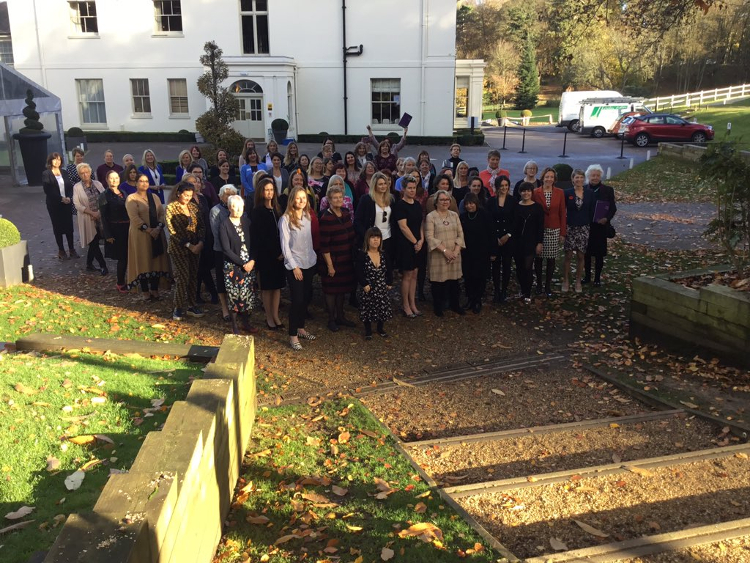
Suffolk’s Inspiring Women
I even celebrated the birthday of HM the Queen with members and guests of the National Liberal Club at a champagne reception on the invitation of my friend Trevor Peel.
What a highlight to discuss the criminal justice system with MP’s, an Ambassador and even a Royal Navy Admiral.
Isn’t it strange how talking about celebrations brings out the good, the bad and the ugly in people.
Social media is no exception.
Consequently, I have had to put up with a barrage of abuse from people. They have never met me, don’t know me but time after time they target their rancour at me. I know I’m not the only one under fire.
In November, I was invited by the Fawcett Society to Portcullis House for an All Party Parliamentary Group (APPG) to celebrate 100 years of Women MP’s. How appropriate then that during the question and answer slot the main topic was abuse on social media and how women should not expect it, or accept it.
Collaboration
For many years I have been concerned about the lack of opportunities within prisons to educate, train and equip individuals on release.
People with a criminal record are immediately penalised in the job market regardless of whether they have the relevant skills; it’s an uphill battle.
So, you can imagine my delight when in March I was invited on to the Board of trustees of Clean Sheet, a charity with one simple purpose – to offer people with convictions the hope of a better future by finding real, permanent employment.
Clean Sheet’s Annual Review took place at the House of Lords attended by Rory Stewart MP OBE.
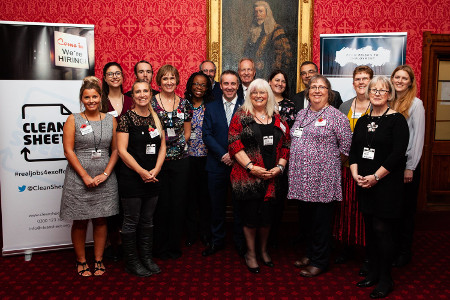
Clean Sheet team
In April, I took up my usual seat behind people giving evidence at the Justice Select Committee.
Once the formalities of the meetings finish, the room usually empties very quickly and ministers hurry back into the corridors and disappear. But not this time.
After giving evidence, just weeks into his new job as Prisons and Probation Minister, Rory Stewart hung back, so I stood up and shook his hand.
“I thought I would introduce myself, I am Faith, Faith Spear”
“Yes, hello Faith, I follow you on Twitter,” he said
“It would be good to meet sometime,” I added
“Let’s do it now,” he replied
Slightly gobsmacked, I followed him out of the room where he was met by his entourage and those wanting to ‘have a quick word’.
“I’m with Faith” he said as we started walking down the corridor. He gave me his full attention.
We went into the atrium of Portcullis House, found a table and talked together. It was a productive conversation and we agreed to keep in touch.
Invitations
As a year celebrating women, my list would have to include Sarah Burrows (Children Heard and Seen). In March, I attended an event in Oxford at Sarah’s invitation ‘What would it be like to have a parent in prison?’
The event displayed incredible art work from their competition judged by Daniel Lee and Korky Paul, who wrote and illustrated the book ‘Finding Dad’, and Sir Trevor McDonald OBE, newsreader and journalist.

Faith with Sir Trevor McDonald
A moving short film was screened made by a young man Luke and his mentor about having his father in prison, including an interview with, Ralph Lubkowski, then Deputy Governor of HMP Leicester.
I had the pleasure of having dinner at ‘Malmaison’ Oxford with Ralph, Sarah and all the judges. Sarah seated me next to Sir Trevor and we exchanged thoughts and experiences with each other about prisons.
A week later, I was discussing women in the Criminal Justice System at the House of Lords at the invitation of the Rt Revd Rachel Treweek Bishop of Gloucester and the Rt Hon the Baroness Jean Corston.
Women’s voices
I remember a time a couple of years ago, when I was sat in the Central Lobby at the Houses of Parliament talking to Dennis Skinner MP. I asked him:
“How do you get heard in this place?”
He looked me in the face.
“You have to be seen to be heard,” he said.
This is one of the reasons why you have seen me in so many diverse places:
In Westminster Hall listening to David Lammy, at the RSA listening to David Gauke, taking part in panels such as at Warwick University with SafeGround and Sheffield Hallam Uni, having discussions with leading Professors, Criminologists, PCC’s, at Police HQ’s, at roundtable events with the Criminal Justice Alliance, in Westminster for the Children’s Inquiry Report launch with Volteface, at the Parmoor and Longford Lectures and why I accept invitations to Prison Reform Trust wine receptions and listening to Lady Hale at the Fawcett Society lecture at the Royal Society.
I’m told some of my critics accuse me of being a ‘social climber’. Nothing could be futher from the truth.
If you don’t understand the issues, and unknown to the very people who can change things, how can you play a part in the solutions?
My part is: I ask questions
Tough questions
Some find that uncomfortable
I will continue to ask questions
In the last year I have seen first-hand how our Criminal Justice System can be an unjust system, I have seen how it breaks people, distresses children and separates families. I have seen inhumane conditions in prisons, I have spoken about it on the radio and television and I have written about it.
I have also spent time with victims and, yes, shed many a tear for them and with them.
Yet in 2018 I have also seen some good practice in purposeful activity, having sat in prisons at award ceremonies, having had guided tours of prisons by Governors, having eaten at restaurants within Prisons.
In all these places I have sensed optimism, hope and met those that believe in doing all they can to help with rehabilitation and re-integration.
Among the most inspiring women I have met is Khatuna Tsintsadze, Prison Programme Director for the Zahid Mubarek Trust. We worked together again this year and I have learnt so much from her, including human rights, equality and discrimination.
Unpicking myths
And finally, in this blog I wanted the last words to come from three people who have met me for the first time in 2018. I hope this will unpick some of the myths as to who I am and what matters to me.
“I first got to know Faith following her visit to HMP Berwyn, and the tour of our Prison Industries operation.
My first impression was one of her passion and conviction for getting to the real core of how we were working with the men to deliver real life work and training opportunities and asking specific questions – really emphasising that she had the best interests of the prisoners at heart. We rarely meet people that spend time engaging at this level whilst on a ‘guided tour’.
Subsequently I have had the opportunity to engage with Faith on a number of levels and have found her to always be absolutely trustworthy, insightful and generous with her network and her time.
She is not afraid to challenge the status quo, often attracting those that criticise her belief in wanting to make the CJS a better environment for its employees and those in its care”
Kelly Coombs, Co-founder Census Group
“I am drawn to people who are prepared to push boundaries in order to achieve change. Not rule breakers, but rule questioners. People who are not afraid to ask difficult questions but who are also prepared to help with the hard work needed to address the answers they might find. With this in mind, it was with no little amount of excitement that I met Faith Spear last year. Our areas of interest sit alongside each other yet might be a million miles from one another. Both feed each other in a continuous loop, creating demand and have long term impact on the people who become part of the Criminal Justice System.
Faith has stood her ground where many others have feared to tread and of course I admire this characteristic immensely but more than that, she has survived and continued her quest with renewed vigour.
When I met with Faith, I was contemplating a new step in my own quest but was still uncertain whether I would go ahead. Faith inspired me and left me believing not only that I ‘could’ do it, but that I really ‘should’ do it!
In a world full of naysayers, spending time with Faith is like finding water in a desert. ‘What would Faith do?’ has become my mantra”
Cate Moore, Independent Chair of Lincolnshire Police Ethics Panel
“I first met Faith Spear at a Corbett Network meeting in April 2018. I was hugely impressed by her warm-hearted nature, incredible knowledge and clear passion to make a positive difference in people’s lives.
We immediately clicked, in part due to our involvement with the award-winning charity Clean Sheet – Faith is a trustee, I am an ambassador – and also our shared vision to tackle the immense barriers that people with convictions face moving forward with their lives.
We both play very different roles in this hugely important agenda, but since my first meeting Faith she has become a great support to me, and I, in turn, have become a massive fan of her work and her brilliant thought-provoking blog. I look forward to continuing to collaborate with Faith for many years to come”
Dominic Headley, Director of Dominic Headley & Associates
In the context of a blog like this, it’s possible to only mention a fraction of the workload, time and miles covered. For obvious reasons you will appreciate I’m unable to share the full extent of everyone I have met or all that has been done.
Featured Photo: Faith with Michael Woodfood, Contrarian Prize 2013 winner and former CEO Olympus. To learn about Michael’s story please visit the Contrarian Prize website.
~

Unlocked Grads: Does it raise more questions than it answers?
What is the Unlocked Grads programme?
According to the website for University of Suffolk (10 September 2018) :
“Unlocked Graduates is a two-year programme and students who complete the programme are awarded an MSc in Leadership and Custodial Environments from the University of Suffolk”
https://www.uos.ac.uk/news/increased-interest-prison-officer-programme-partnership-university
When you look past all the ‘blurb’, in a nutshell, the programme starts as a Summer Institute comprising two week’s training as a prison officer and the beginning of a Master’s degree, followed by a two-week placement in a prison and finishes with two more weeks training. The taught modules at the Summer Institute leading to Prison Officer Entry Level Training (POELT) are based at the University of Suffolk, Ipswich.
It’s especially surprising to see that it is positioned as “a prestigious programme with influential supporters” when it is based here as the University is ranked 128 out of 131 Universities listed by The Complete University Guide.
https://www.thecompleteuniversityguide.co.uk/league-tables/rankings
Advice given for recruitment: “Fundamentally they need to be made of the right stuff to survive on the landings from Day 1… only a fairly ruthless and demanding selection process will guarantee you have the right people”
Part of the interview process includes having an interview with a former prisoner, but questions have been raised as to how this would be perceived and if unskilled interviewers could get the best out of the candidates.
![unlockedgrads dot org dot uk our organisation [recommendations] screenshot 22 Sept 2018](https://thecriminaljusticeblog.com/wp-content/uploads/2018/09/unlockedgrads-dot-org-dot-uk-our-organisation-recommendations-screenshot-22-sept-2018.jpg?w=960)
Website, 22 September 2018
The 2017 Cohort
The 2017 cohort started in Summer 2017 with placements in HMP Brixton, Coldingley, Downview, High Down, Isis and Wandsworth.
I was invited to sit in on a training session at the Summer Institute in 2017. I spoke with staff members to get a feel and understanding of the programme. I had a one-to-one with Natasha Porter, CEO of Unlocked Grads.
But I came away with so many questions.
Why were those prisons selected and why were they all in the South of England?
So how can the safety of these young novice trainees be assured? In the latest Government Annual Prison Statistics, it shows that Brixton is rated 1 for safety with Wandsworth and Isis rated 2.
Again, in the same report, looking at stats for Purposeful Activity, Brixton, Isis and Wandsworth are rated 1; that’s an awful lot of people likely to be stuck in their cell, frustrations brewing, leading to mental health issues. Not forgetting the domino effect upon families of prisoners and families of staff.
So that’s the prisoners but what about the staff in these prisons.
Staff sickness for Wandsworth shows that 5918 days were lost in the 12 months to 31st March 2018 that’s on average 12.4 days lost per FTE. High Down is not much better with 4146 days lost in 1 year on average 10.4 days lost per FTE.
Whilst it is unclear why so many days are lost to sick leave, you can imagine that many of these sick days are as a result of the stress placed upon the officers, the increased violence on the wings, inhaling psychoactive substances and the exhaustion.
https://www.gov.uk/government/statistics/annual-hm-prison-and-probation-service-digest-2017-to-2018
But if there are such acute staff shortages how is replacing experienced members of staff with newly qualified Unlocked Grads going to make a positive difference?
Andrea Albutt, President of the Prison Governors Association spoke out last year and said:
“large numbers of new recruits can actually add to the instability in prisons rather than improve it”
https://www.channel4.com/news/prison-governors-association-chief-government-overhaul-is-perverse
So, what exactly is this programme wanting to achieve?
We are told that the Summer 2017 candidates in the 1st cohort all passed their POELT training. Was the bar set too low, it makes you wonder? However, the first cohort 100% pass rate did not include those who dropped out early on, after their first visit to a prison.
One of the first sponsors wrote: “This is clearly an incredibly challenging leadership programme. Unlocked Grads will have to develop advanced communication skills, diplomacy and resilience as well as the creative entrepreneurial flair to bring new ideas to prisons. These are the skills I look for in my sector.” (Sir Martin Sorrell, former CEO of WPP).
Sounds all well and good, but there’s no scope for entrepreneurial flair inside a prison; it’s a process driven role, dependent on regime and written Prison Service Instructions (PSI’s).
The candidates didn’t appear to be encouraged to stay once they acquired their master’s degree.
This seems incredibly short-sighted of the MoJ. Why are they investing in these grads yet encouraging them to move on after two years and not retaining them?
Sam Gymiah, the then Prisons Minister wrote:
“Some bright, passionate & capable recruits joining the prison service to help fix our prisons. Well done @unlockedgrads” (Twitter, 21 August 2017)
Hardly able to “fix our prisons” just through this two-year scheme.
I was informed by Natasha Porter that these grads were not included in the 2,500 new staff members that were being recruited.
The 2018 Cohort
This year 105 candidates attended the Summer Institute and yet again Ipswich was suddenly the place to be, a tourist attraction for anyone in the ‘Justice arena’. Now that HMP Berwyn in no longer ‘flavour of the month’, Ipswich appears to be the place to be seen.
Between 29th July and 6th September, guest speakers galore appeared at the University to give talks: from Gethin Jones to Michael Spurr to Erwin James.

Neptune Quay, Ipswich – August 2018
Recently, when visiting the Ipswich Waterfront, I spotted dozens of mainly young men and women dressed in standard issue prison officer uniform complete with boots. Some were hiding their epaulettes with their hands and others showed their key chains.
It was the next instalment of the Unlocked Grads programme.
They were milling around on a lunch break (see photo) so I went and had a chat. I asked how they were finding the course and we briefly discussed the crisis within the prisons, as the HMIP report on Birmingham had just been published.
One of the 2018 Cohort said: “Oh but that’s just the media,” dismissing the squalor, violence and drugs in prisons as if it was some sort of fallacy.
Seriously, are they being taught about the reality of what is happening inside prisons?
Another eagerly said: “We are going to do something different; we will be on the landings, but it will be based on rehabilitation.”
If the Unlocked Grads are focusing on rehabilitation as “something different” then what is everyone else doing now?
And how many of them will stay long enough to make this “something different” happen?
If they are going onto the landings and have been told they will be focusing specifically on rehabilitation how will that go down with other members of staff, when they are so stressed that even the minimum requirements are hard to achieve?
Will there be a clash in their work expectations, disruption or problems with team dynamics, an “us and them”?
What people are saying about Unlocked Grads
I asked a former Prison Officer about his thoughts on this scheme, this is what he said, word for word:
“Hi Faith, my feelings are that most of them will be eaten alive by inmates, as grads won’t be from the same background as most inmates. A lot of grads would have been brought up with a “silver spoon in their mouths” and inmates will spot this a mile off and some inmates will sense this and will make their lives hell, I can’t see grads staying in the job for long, HMP need to employ people who are over 25 years old with some life experience”
I also spoke to someone who has been working in Education in prisons for years. They told me:
“The YO’s will make mincemeat of these university kids. And the older men will not like being told what to do by a kid. The whole enterprise seems absolutely mad, ill-thought out and with absolutely no thought given to basic – really basic – psychology”
Another quote, this time from a senior civil servant within the MoJ, who told me:
“the ideological approach is now wearing very thin”
One of the 2018 Cohort told me Unlocked Grads have a contract for 6 years and they described the 2017 Cohort as “guinea pigs”.
A few said they were going to be working in HMP Wandsworth, and they seemed somewhat amazed that I could describe in clear detail the layout, and the condition I personally encountered there at Wandsworth on numerous visits I had made.
Yet not one of them asked me who I was.
Curiously, I was told by a speaker at ICPA 2017 that, in his plenary address Michael Spurr said, without actually name-dropping Unlocked Grads, that he didn’t believe the principle of employing grads was the answer to the issue.
Given that Mr Spurr was invited to speak at Unlocked Grads Summer Institute in front of both the 2017 and the 2018 Cohorts, this is utterly remarkable and serves to remind us that Unlocked Grads doesn’t appear to have universal acceptance – even within HMPPS.
Overall, it all appears to be secretive, behind closed doors; many in the Justice sector I speak to about it is saying the same.

Michael Spurr at ICPA, London 25 October 2017. Pic: HMPPS Twitter
Media Coverage
On 9th September, I listened to the BBC report by Danny Shaw about the Unlocked Grads and questioned whether it was advertising? Where was the balance, where was the incisive journalism we have come to expect from BBC News’ home affairs correspondent?
In his report, Danny Shaw said: “Governors have found it hard to find and retain staff.”
Governors need to find and retain staff, right, but are the Unlocked Grads planning to stick around?
Also, I noticed in that report a focus on ‘Sophie’ from the 2017 Cohort deployed at HMP Coldingley. Half way through the video reportage where it says: ‘Now Sophie is helping to train the next set of recruits’. This seemed a bit odd; how developed is her jail craft after one year and why is someone who is not fully trained themselves, not a qualified trainer or an instructor, doing the training?
Further on in the reportage, Natasha Porter says:
“If you can deescalate a landing full of prisoners…”
That’s a big expectation, placing massive pressure on you as a new recruit.
https://www.bbc.co.uk/news/av/uk-45455884/the-prison-job-attracting-graduates
It appears to me that the Unlocked Grads leadership scheme encourages the participants to see it is a stepping stone to a career elsewhere. This follows the same pattern that has occurred in the MoJ over the last few years with a continuous change of Secretary of State for Justice and Prisons Minister.
Does this just perpetuate the problem of lack of continuity in the Justice sector?
Retention, Retention, Retention
Unlocked Grads Programme purports to fill a gap in frontline prison staff but if these grads walk into other opportunities after 2 years, with other Government departments or with Private sector sponsors, then it defeats the objective of positioning it as anything with real-world ‘Custodial Environments’ credibility.
One young man on the 2nd Cohort said to me he hadn’t made up his mind if he would stay after the two years. Another said:
“I’m going to be Prison Officer for two years”
Therefore, if they are not contributing long-term, are they inadvertently placing a drain on already-scarce resources?
Academic standards and expectations
Unlocked Grads is delivered mainly as an online programme to an MSc with a summer school at the beginning of year one and the chance to write a policy document in the second year.
Job adverts have been posted asking for criminology dissertation supervisors that don’t necessarily have to be academics.
So apparently now we have those that are not trainers, training and those that are not academics supervising academic work at a Masters degree level !
Is it a prison officer training programme or an educational programme?

Click to Enlarge
A member of Unlocked Grads staff said to me last week that the Ministry of Justice will no longer evaluate the programme. So how will it now be evaluated and by whom?
https://www.jobs.ac.uk/job/BMK940/criminology-dissertation-supervisors
[If the link has been taken down, just click on the image here to read what the job advert said]
The University of Suffolk has been chosen to run this top-flight programme for training prison officers, yet where is any information?
If such a “prestigious” course is being run there why is nothing about it shared with the local press?
Local media were unaware of the start of the second cohort.
Were Sandy Martin MP for Ipswich (in whose constituency the University of Suffolk is located) or Tim Passmore, Suffolk’s Police and Crime Commissioner, invited for the launch?
What is it really all about – filling up desk spaces inside Petty France with Faststreamers?
Or is it even a short-term solution for Prison Officer shortages?
Yes, we do need leadership but that has to come through experience, surely?
Governance
Unlocked Graduates is currently incubated within the registered charity called Catch 22 Charity Limited, Charity Number 1124127. It is not a stand-alone charity even though on the Unlocked Grads website it states: “Unlocked is a charity…” (see image below).
![unlockedgrads dot org dot uk what is unlocked [charity] screenshot 22 Sept 2018](https://thecriminaljusticeblog.com/wp-content/uploads/2018/09/unlockedgrads-dot-org-dot-uk-what-is-unlocked-charity-screenshot-22-sept-2018.jpg?w=478&h=432)
Website, 22 September 2018
It is funded by Unlocked Graduates which is financed by the Ministry of Justice.
In other words, these young people are being offered Master’s level qualifications paid for from the public purse.
This necessitates openness and fully transparency, doesn’t it?
And yet in the Annual Report and Accounts to 31 August 2017 for Catch 22 Charity Limited, Company no. 6577534 there is a simple mention of Unlocked Grads on page 21 and page 25 but there is no reference to the specific activity of Unlocked Grads in Notes to the Accounts, either as restricted funds or as unrestricted funds.
http://beta.charitycommission.gov.uk/charity-details/?regid=1124127&subid=0
https://beta.companieshouse.gov.uk/company/06577534/filing-history
Misrepresentation
The Unlocked Grads website asserts that:
“The Unlocked Graduates programme was one of the key recommendations of the Coates’ Review of prison education, a report that argued that education needs to be put at the heart of the prison service if Government is serious about the rehabilitation of prisoners.”
I have read the Coates’ Review, and nowhere in the review does it cite that the Unlocked Grads programme was a key recommendation. In fact, the publicly available version of the Coates’ Review doesn’t include the words “Unlocked Graduates” at all, anywhere.
Therefore, this is a misrepresentation of what the review states. Below is the actual recommendation:
“Key recommendations
-
A new scheme to attract high calibre graduates to work in prisons for an initial period of two years should be introduced. The role should be as a prison officer with an additional remit to support education at the heart of the prison regime.”
https://www.gov.uk/government/publications/unlocking-potential-a-review-of-education-in-prison
Natasha Porter, CEO of the Unlocked Grads programme, was on the review panel for the Coates’ Review and Dame Sally Coates is on the board for Unlocked Grads.
How very convenient.
The Coates’ Review was published on 18th May 2016 and the Unlocked Grads scheme was launched on 21st Dec 2016. Why are these dates important, shouldn’t this exceptionally rapid time to market be commended?
In normal circumstances, yes, such as in the private sector, but this is Government and we all know that the government rarely, if ever, moves that quickly on justice-related issues. Take for example, the Corston Report ‘A review of women with particular vulnerabilities in the criminal justice system’ from March 2007; on the shelf for over 11 years and counting.
As this is a Government contract, and we have learned they have it for 6 years what was the procurement process and where is the publicly available tender?
I cannot find it on Official Journal of European Union (OJEU). If it was a non-competitive tender, why was only one private-sector provider aware of it? No other educators I have spoken to were ever approached.
Surely nothing is stopping any other private education company from setting up a similar training scheme. BPP University was the first private educator to be granted the ability to award recognised degrees in 2013. What is stopping them, or a similar organisation, coming up with a Graduate programme using prisons?
Launched so quickly after the publication of the Coates’ Review, it is completely out of character for public sector procurement processes to have been satisfied within such a short timescale.
Which leads us to have to question whether prior knowledge played a material part in either the establishing of the Unlocked Grads programme or the inclusion of Recommendation 11, or both, or neither.
Wrong people in the wrong place at the wrong time?
Is now the time for a scheme like Unlocked Grads to place quantities of inexperienced officers in the frontline when the Inspectorate have just issued their 4th urgent notification to Secretary of State for Justice?
In the latest urgent notification for HMP Bedford, Peter Clarke, HM Chief Inspector of Prisons, states:
“A lack of staff and experience undermined the work of the offender management unit.
…77% of available officers had less than one years’ service. There was a corresponding lack of experience at all levels, and it was clear that this was having a significant impact on many areas of prison life”
One young female Unlocked Grad in the 2018 Cohort told me her parents were worried about what she was doing. I’m not surprised, as a parent I would be too.
It made me think why is the Unlocked Grads scheme putting young people’s lives in possible dangerous and hostile surroundings such as HMP Wandsworth after only a few weeks training? They are ill-equipped and not sufficiently trained for what may lie ahead.
Final thoughts
We have unskilled interviewers marking candidates on their suitability, we have untrained trainers training the latest cohort, and we have the possibility of non-academics as supervisors for the Master’s dissertation.
In addition, we have a course led by a member of the review panel of the Coates’ Review.
Moreover, was recommendation 11 of the Coates’ Review written to fit the Unlocked Grads Programme or was the Unlocked Grads programme written to fit recommendation 11?
In the public interest, I think we all have the right and duty to question this to assure that Government reports have not been manipulated by private sector commercial interests or non-government organisations.
The question needs to be asked and the answer given, in plain English that everyone can understand.
In reality, very little real information is available in the public domain about the Unlocked Grads programme. In drafting this blog, I have taken great care to gather, collate and corroborate information in which I could personally have sufficient confidence. The objective of this blog is not to criticise any individual but to question the soundness of this programme and the way in which it is conducted. I commend the young people for their ambitiousness and intellect; the issue is not with them. It is with those policy makers, who have approved this programme – they are the ones to whom questions should now be addressed.
SITUATION UPDATE 28 SEPT 2018
Subsequent to publishing this post on 22 September 2018, it has come to my attention that the leading local newspaper East Anglian Daily Times has published not one but two articles about Unlocked Grads.
27 Sept 2018 ‘‘No substance’ to claim uniform policy threatens prison guard trainees‘ by Tom Potter (tweeting as @TomPotterEADT)
28 Sept 2018 ‘Could Netflix’s Orange is the New Black be attracting more British women to become prison officers‘ by Jessica Hill (tweeting as @jessjanehill)
This is an astonishing turn of events. Either Unlocked Grads and University of Suffolk have moved quickly to resolve the question I asked “If such a “prestigious” course is being run there why is nothing about it shared with the local press?” and to dispel concerns of secrecy, or these were pre-scheduled PR pieces.
Either way, it raises more questions.
~
 The Criminal Justice Blog