Home » Justice Secretary (Page 2)
Category Archives: Justice Secretary

Is the IPP Prisoner scandal the next Mr. Bates vs the Post office?
IPP sentences were introduced in England and Wales by the New Labour government with the Criminal Justice Act 2003, as it sought to prove it was tough on law and order. They were put in place to detain indefinitely serious offenders who were perceived to be a risk to the public. However, they were also used against offenders who had committed low-level crimes.
Astonishingly, the sentence has led to some people spending 18 years in jail for trying to steal a coat or imprisoned for 11 years for stealing a mobile phone.
In 2012, after widespread condemnation and a ruling by the European court of human rights that such sentences were “arbitrary and therefore unlawful”, IPP terms were abolished by the Conservative government. But the measure was not retrospective, and thousands remain in prison. Sadly, many have taken their own lives.
The former supreme court justice Lord Brown has called IPP sentences “the greatest single stain on the justice system”. When Rt Hon Michael Gove MP was justice secretary, he recommended “executive clemency” for IPP prisoners who had served terms much longer than their tariffs. But he didn’t act on it. Lord Blunkett, the Labour home secretary who introduced the sentences, regrets them, stating: “I got it wrong.”
And more recently, Dr Alice Edwards, the UN rapporteur for torture has called IPP sentences an “egregious miscarriage of justice.”
Even the Justice Secretary Rt Hon Alex Chalk KC MP has also called them a stain on the justice system but the Government has so far refused to implement the Justice Committees recommendation to re-sentence all prisoners subject to IPP sentences.
CAMPAIGN FOR SOCIAL JUSTICE
Campaign groups & their families have been fighting to end this tragic miscarriage of justice for more than a decade and now a film posted online by campaigning lawyer and CEO of CAMPAIGN FOR SOCIAL JUSTICE Peter Stefanovic has ignited a storm by bringing the issue to wider public attention. It has already had over 12 million views online and the public’s reaction to it has been one of shock, outrage, and disbelief.

The Labour Party is still to clarify its position on this issue. However, in a letter written by Kevin Brennan MP- now Shadow Minister for Victims and Sentencing and sent to the then Secretary of State for Justice, The Rt Hon Dominic Raab MP in March 2023 he outlines a meeting with Bernadette Emerson, a constituent of his, concerning her husband in prison under an IPP sentence.
In the third paragraph, Kevin Brennan MP stated,
“It was the correct thing to do when the government abolished these sentences in 2012”, but as you will be aware there is a terrible legacy issue of injustice for those who are effectively serving a life sentence despite having been convicted of a crime that carried a fairly low tariff”.
Mr Brennan MP continued his letter:
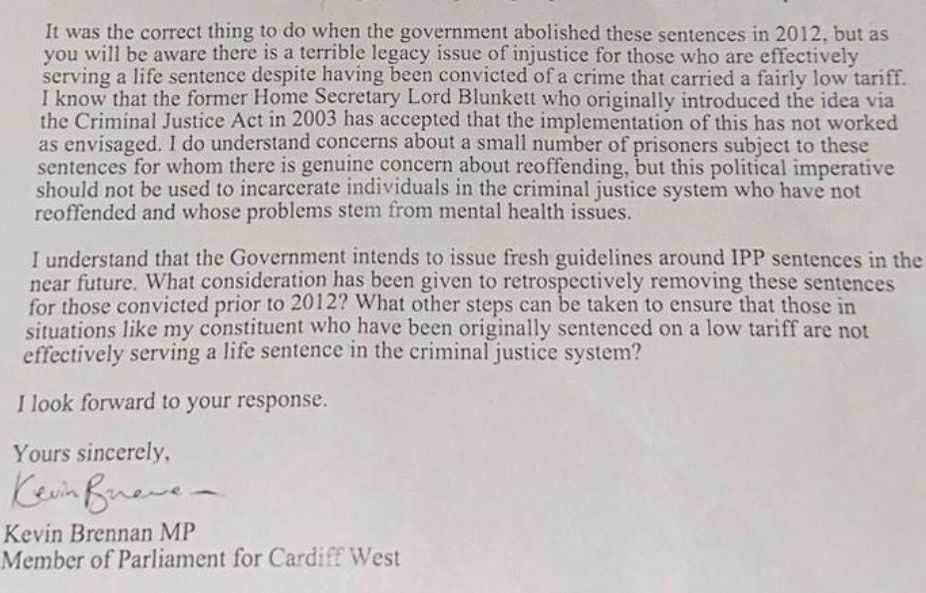
“I know that the former Home Secretary Lord Blunkett who originally introduced the idea via the Criminal Justice Act in 2003 has accepted that the implementation of this has not worked as envisaged. I do understand concerns about a small number of prisoners subject to these sentences for whom there is genuine concern about reoffending, but this political imperative should not be used to incarcerate individuals in the criminal Justice system who have not reoffended and whose problems stem from mental health issues.”
Mr Brennan MP goes on to ask the question,
“What consideration has been given to retrospectively removing these sentences for those convicted prior to 2012?”
What Mr Brennan MP says is both welcome and not surprising given this tragic miscarriage of justice has sadly already taken many lives.
But the position of the Labour Party on this egregious miscarriage of justice is now in question.
On 6th December, during the second reading in the House of Commons of the Victims and Sentencing Bill, Chair of the Justice Committee, Conservative MP Sir Bob Neill, proposed “new clause 1” which would add a resentencing exercise to the Bill in line with the Justice Committees long standing recommendation. Sir Neill’s proposed amendment would help to end this accepted miscarriage of justice.
However, Kevin Brennan MP, surprisingly, given his letter just a few months earlier, opposed the idea, saying:
“Unfortunately, given the impact of the Government’s effective destruction of the criminal justice system, we lack the infrastructure and resources to keep the public safe, should his new clause be implemented immediately. Our priority is, and always must be, the safety of the British public. We are concerned that if new clause 1 were enacted without provisioning for significant improvements in probation and parole, we would potentially significantly increase the risk to the public and to the prisoners themselves.”
So where does Labour stand?
Surely the Labour Party can’t possibly be suggesting that “given the impact of the Government’s effective destruction of the criminal justice system” it plans to continue and perpetrate a gross miscarriage of justice? Was Mr Brennan perhaps referencing in December only the “small number of prisoners subject to these sentences for whom there is genuine concern about reoffending.”
HOPE FOR JUSTICE
Hope for justice at last now comes in the form of 2 amendments tabled in the House of Lords to the Victims & Prisoners Bill (161 & 167) by Lord Moylan which are backed by the Lib Dems and Green Party peers, and which have wide cross bench support.
Amendment 167 seeks to implement the Justice Committees recommendation to re-sentence all prisoners subject to IPP sentences.
Amendment 161 would require the state to demonstrate that a prisoner is still a risk to the public rather than, as at present, requiring the prisoner to prove the opposite.
Under the proposed amendment, they would be released unless the Parole Board “is satisfied that it remains necessary and proportionate for the protection of the public from serious harm that they should continue to be confined”.
Amendment is 161 is supported by Lord Blunkett, Baroness Chakrabarti & the former deputy president of the Supreme Court Lord Hope of Craighead. It’s also supported by the Bar Council, representing 17,000 barristers in England and Wales. This proposed amendment also appears to allay any concerns previously expressed by the Labour Party front bench.
This is finally a real opportunity to put right an egregious miscarriage of justice. But for the amendments, backed by both Lib Dem & Green Party peers (as well as many cross benchers) to succeed, Labour front bench support will be needed.
The question now is whether Keir Starmers Labour party will step up for justice and do the right thing or will we have to wait for ITV to produce another compelling drama series like Mr Bates vs The Post Office?
IPP Scandal: Labour front bench clarification needed
I have just read again a copy of a letter that was written by Kevin Brennan MP- Shadow Minister for Victims and Sentencing and sent to the then Secretary of State for Justice, The Rt Hon Dominic Raab MP in March 2023. It outlines a meeting with Bernadette Emerson, a constituent of his, concerning her husband in prison under an IPP sentence.
In the third paragraph, Kevin Brennan MP stated,
“It was the correct thing to do when the government abolished these sentences in 2012”, but as you will be aware there is a terrible legacy issue of injustice for those who are effectively serving a life sentence despite having been convicted of a crime that carried a fairly low tariff”.
The position set out by Mr Brennan in his letter is perhaps not surprising. Former supreme court justice Lord Brown has called IPP sentences “the greatest single stain on the justice system” (a view shared by the current Justice Secretary Alex Chalk). When Michael Gove was justice secretary, he recommended “executive clemency” for IPP prisoners who had served terms much longer than their tariffs but he didn’t act on it. David Blunkett, the Labour home secretary who introduced the sentences, regrets them, stating “I got it wrong” and the UN rapporteur for torture has called IPP sentences an “egregious miscarriage of justice.”
Mr Brennan continued his letter I know that the former Home Secretary Lord Blunkett who originally introduced the idea via the Criminal Justice Act in 2003 has accepted that the implementation of this has not worked as envisaged. I do understand concerns about a small number of prisoners subject to these sentences for whom there is genuine concern about reoffending, but this political imperative should not be used to incarcerate individuals in the criminal Justice system who have not reoffended and whose problems stem from mental health issues.”
Mr Brennan goes on to ask the question “What consideration has been given to retrospectively removing these sentences for those convicted prior to 2012?”
Again what Mr Brennan says is both welcome and not surprising given this tragic miscarriage of justice has sadly already taken many lives.
But the position of the Labour Party on this egregious miscarriage of justice is now in question.
On 6th December, during the second reading in the House of Commons of the Victims and Sentencing Bill, Chair of the Justice Committee, Conservative MP Sir Bob Neill, proposed “new clause 1” which would add a resentencing exercise to the Bill in line with the Justice Committees long standing recommendation. Sir Neill’s proposed amendment would help to end this long standing and accepted miscarriage of justice.
However, Kevin Brennan, surprisingly, given his letter just a few months earlier, opposed the idea, saying: “Unfortunately, given the impact of the Government’s effective destruction of the criminal justice system, we lack the infrastructure and resources to keep the public safe, should his new clause be implemented immediately. Our priority is, and always must be, the safety of the British public. We are concerned that if new clause 1 were enacted without provisioning for significant improvements in probation and parole, we would potentially significantly increase the risk to the public and to the prisoners themselves.”
So where does Labour stand?
Surely it can’t possibly be suggesting that “given the impact of the Government’s effective destruction of the criminal justice system” it plans to continue and perpetrate this gross miscarriage of justice which has seen people spend 18 years in jail for trying to steal a coat and imprisoned for 11 yrs for stealing a mobile phone? Was Mr Brennan perhaps referencing in December only the “small number of prisoners subject to these sentences for whom there is genuine concern about reoffending.”
This needs urgent clarification.
Will Labour see sense and do the right thing, only time will tell.
Later this month an amendment to the Victims and Prisoners Bill will be tabled in the House of Lords to implement the Justice Committee recommendation to re-sentence all those subject to an IPP sentence. I am given to understand that the Lib Dems and Greens are likely to support it.
If Labour stand up for justice and join the growing cross bench alliance there is every chance the amendment will pass. The Government might then accept it. An egregious miscarriage of justice can finally end.
In November 2023, a video posted by Peter Stefanovic and CAMPAIGN FOR SOCIAL JUSTICE highlighted the injustice of the IPP sentence. Just 2 months later it has reached 10 million views on social media.
That is extraordinary.
The public response to his film has been one of shock, outrage, and disbelief.
The IPP sentence is breaking people, and the overwhelming support from the public to end this sentence cannot be ignored. The Government will only be held to account if the public makes its views known.
How you can help:
Please sign the petition for re-sentencing, the link is HERE

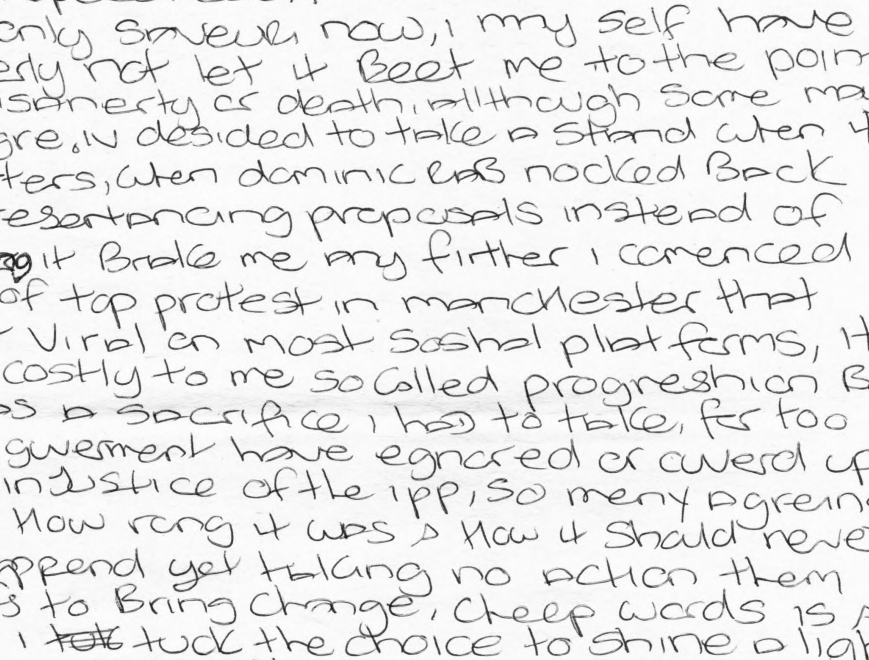
Joe Outlaw, an IPP: In his own words, part 1.
You may remember back in April 2023 a prisoner staged a 12-hour protest on the roof of Strangeways prison about the injustice of IPP prisoners. His name is Joe Outlaw, 37 years old and with 33 previous convictions. I was sent his story…
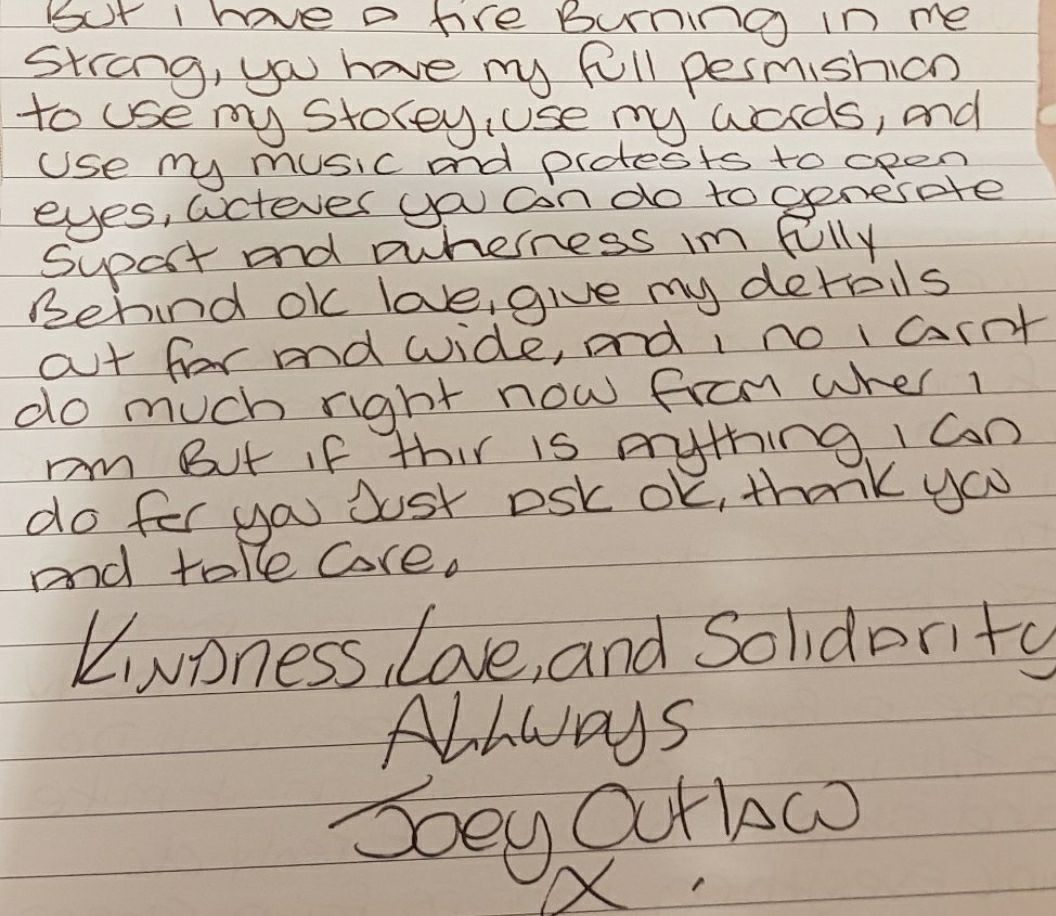
This is his story, in his own words
My story began in Bradford, Sunny West Yorkshire, and one of two children. The other being my sister Jill. At the start was a typical council estate life in the late 1980s. My Mom tried her best to bring us up as well as she could, but was cursed sadly by manic depression, what they now call bipolar. But this was not a fashion statement back then, it was dangerous and scary to witness. My Father was a gypsy from Hungary who never honoured his responsibilities as a father. Instead choosing to do a David Copperfield and disappear.
My sister was seven years older than me and would soon become my mum to be. By age three social services were involved and after one of my mom’s manic episodes, it was too dangerous for them to risk leaving us there. We were both placed on a full care order, which would cave the path years of painful memories I wish I could erase. Thankfully, they kept and Jill together in a wide range of foster parent, children’s homes and respite carers. Jill tried her best and I’m grateful for all the love she gave despite having to deal with her own sorrow as a young woman.
By the time she was 18 she had to leave me and that’s when I went off the rails. Constantly running away, and naively feeling more secure on the streets.
This stage of teenage growth embedded criminal dynamics to my survival and behaviour.
By fourteen social services basically gave up on me and I tell no lies when I say I was put in a B&B to live by myself, and no homes would take me. I was on a full care order until eighteen. Yet they lacked the support, guidance and interventions to raise me as expected. This happen twice, once in Shipley, West Yorkshire, and once in Wales at fifteen.
My criminality and reckless actions would continue for years.
I will say though, I was never a violent young offender. It was always nicking cars, motorbikes stealing etc. More a thief then a robber. I never sadly did manage to become rooted. I was always galivanting around the country, place to place. From twelve to nineteen life was an adventure, me a tent and a dog. Somehow, I always managed to pick up a stray for somewhere. I’ve always found animals and nature amazing. As a child I would find comfort and solace in beings alone in woods or on beaches. Just me and the pooch pondering life and all its confusions.
Well at age nineteen as destined, I get my first bit of proper jail.
Someone passed me an air rifle at a bus stop in the sticks in north Wales, and as he passed it to me, I generally shot him in the foot by mistake. I just grabbed the gun and the trigger was so sensitive, it popped and went off. I got three and a half years for that. But when I think back, I can barely remember it, it was just a life being in a children’s home, but I couldn’t run away and people were older, strange eh! Well to jump forward some years, by 23 I found love while I was travelling yet again. And for the first time in my life rooted in western-super-mare.
Despite being rooted my lifetime habits of survival were too deeply set.
To survive I sold weed, wheeling and dealing etc. and one night I was late in and my girlfriend at the time was arguing with me saying she was sick of me having my phone going off all the time, coming in late etc. She would take Valium on a night to sleep and said for me to take some and wind down, but I didn’t take any drugs like that back then. I had gone through all drug phases from young, except crack and heroin and by that time all I did was smoke weed. Well after some arguing, I just wanted to shut her up frankly, and I took three little blue tablets off her. Now little did I know that among the criminal knowledge, Valium are called Little Blue charge sheets, referring to their colour being blue, and the fact that people with criminal tendencies either wake up in cells, hence the charge sheet reference or they wake up surrounded by phones, money etc and not to have a clue how it all got there or what they had been up to obtain said items.
Needless to say, this inadvertently would be the little blue charge sheet that changed my life forever.
I do not remember a single thing of what I’m about to tell you and this is only what people have told me and information from statements etc. I took the tablets and drank some Southern Comfort, passed out, woke up and demanded more valium off my girlfriend. Once taken three more I then left the flat and went to a party. Where I stole a shotgun and shells, and then went into my local takeaway, where I went to every day by the way, and held it up at gunpoint. I left after being in this 60 seconds, and now rich with a grand sum of 200 pounds. Which by the way I would earn that in two hours selling weed etc. By the morning the police had come into my flat and arrested me. I woke up dazed and confused with a hangover from hell and realised I was in a police station. I had no idea how I had got there or why I was there. I got on the bell and ask them, and then I was told, I quote, you were brought in for armed robbery. I had no need to do what I did that night.
I cannot tell you why or what I did it for because I’ve been asking myself that for many years now.
I’m just glad I never hurt anyone that night. I’m trying to write to the shopkeeper through probation to ask for his forgiveness and do what I can to apologise. Any trauma I might have caused that night. Sadly, by the time I realised I needed to do this. It was too late. I was given an 18-year sentence for that on a guilty plea. So, the judge would have given me around 25 years for that. It was a determinate sentence without my guilty credit taken off. However, I was to become an IPP prisoner, so the 18 years would be halved, and a tariff would be put on it. I did appeal and got this taken to a 4½ year sentence. So, all I would have to do is keep my head down, do some courses and take the rehabilitation offered. I’d be out in four and a half, right?
I was like a lamb to the slaughter. Little did I know then the world of hate, pain, violence, despair, I will be thrown into.
On reflection now, it’s actually quite hard for me to put into words how I got to the place I’m at now physically and mentally. It’s not isolated to one place of fault or blame, there is so many different factors that contribute to the IPP crisis that I see today. Also, everyone is different, some can endure more than others. But the one thing that I am certain of is that it is the repetition of trauma that is most damaging. Trauma is trauma, we go through it and depending on what level of trauma one endures it’s about being able to deal with that, having the time, help, support and space to do so and heal.
The problem with the IPP is that every single thing needed to go through the healing process is not accessible and furthermore, over time we go through it again and again until we become a product of the environment, we can’t escape.
This trauma then becomes torture and the strangest thing of all is the people who create or enforce this way of life then take no responsibility for doing so. When a broken man sits in front of them they blame the man for indeed breaking.
Due to government cuts on prison staff, education, etc. wings are flooded with drugs, kilos coming in on drones on a nightly basis. An addict then comes to prison. But little does he know that he’s just swapping one drug house for another. And in this drug house, drugs are cheaper, and he hasn’t got to go shoplifting to get money to use. Then when he has a piss test, he is punished for using drugs. The prisoner estate covers everything up, they will portray that yeah, there is the problem, there always will be, but we’re working on it. When the truth is the whole system is burning with flame from hell, they have an obligation to provide criminals with drug free environments to progress, yet they will punish an addict for using drugs when it is the prison who has served it to them on a plate. It’s like telling an alcoholic not to drink but making him live and sleep in a bar. I’m sorry I’m digressing somewhat though. There is just so many systematic failures that contribute to the prison crisis that we live and see today.
As a normal prisoner, it is hard enough like I said at the start, but as an IPP is a soul-destroying environment to live in. Using a similar comparison as a drug addict, as IPPs we were told that under no circumstances can we get involved in violence. This is a big no no, yet the wings are some of the most violent places you have ever seen.
Do not let anyone fool you.
I have lived it and seen it for too long now. The things that I have witnessed are truly things of horror films. To be able to navigate yourself through this for years is so difficult. The social dynamics on wings is not the same as in the community. If faced with any confrontation, you only have three choices.
1. You submit and hope for the best, but now you are weak among your peers.
2. You stand your ground which can result in death or being slashed or stabbed.
3. Which is what the prison would expect you to do, go to staff and tell them. Now you’re a snitch and a target from everyone.
They are the only choice you have in an environment that is ever growing more violent and dangerous by the minute. I fear to see how things will be in years to come.
We as IPPs are put in impossible positions and as the years go by, the worse it gets.
And the more trauma we endure again and again. That in my opinion, is why so many IPPs now are suffering with PTSD, drug abuse, personality disorders, etc. The system has destroyed them and will continue to do so until people push for change.
There is only one resolution in my opinion, and that the Justice select committee had its spot on. Government needs to face facts and, on some level, admit what everyone else seems to know and that is that the system failed to rehabilitate them in the start, failed to rehabilitate during, and is failing to do so now 10 years after the abolition.
To the ones who remain that are sinking deeper and into hopelessness, freedom is indeed the only Saviour now.
I myself have luckily not let it beat me to the point of insanity or death, although some may disagree.
I decided to take a stand when it matters, when Dominic Raab knocked back the resentencing proposals.
Instead of letting it break me any further,
I commenced a roof top protest in Manchester that went viral on most social platforms.
It was costly to my so-called progression, but it was a sacrifice I had to take.
For too long government have ignored or covered up the injustice of the IPP, so many agreeing with how wrong it was and how it should never have happened yet taking no action themselves to bring change. Cheap words is all.
Well, I took the choice to shine a light on it and not let them hide.
I did a 12-hour protest for not only myself and all those still on IPP, but for all them families of the 81 lost souls.
All them must be held accountable who contributed to the failures that led to them poor people taking them lives. Even if it is for 12 hours, the support and love that I have received since then, has been overwhelming, at times truly beautiful.
Well after that I was sent to HMP Frankland, where their intention to punish me for my activism was made clear by the foul things they did to me in that segregation. They refused to give me my special NHS diet that I had had for over four years due to my health, starved me, then one day while moving me cell, jumped on me and began assaulting me. I was stripped naked and placed in a box cell for hours on end. Right there and then, I decided, I was not going to take been treated this way. Days later I went out on the yard and managed to scale the wall. I then use a CCTV camera to break the cage roof and escape the seg, becoming the only man to ever escape a cat A segregation in the UK.
I then got my own back for the weeks of bully boy treatment and abuse by smashing the place to pieces. Then having a nice sunbathe in my boxers. This made the papers again, so now in eight weeks I’ve scaled 2 roofs and I’ve been in the press in countless papers. For this level of exposure,
I have now been sent to HMP Belmarsh unit segregation, where I stay totally isolated from everyone.
I get what I have done embarrass the prison state, but some would say it was a long time coming. I stand up for what I believe in and I know my values and principles. I should be proud of decency, respect, honesty, loyalty, humility, and dignity. It is the system that lacks in these principles, not me. In 13 years I have not once assaulted a member of staff yet I’ve been battered, stabbed, had my nose broken, lit split, teeth knocked out and that is just the physical abuse. Yet despite all this I shall keep my resolve.
My life now consists of exercise with four screws, a dog unit and I’m handcuffed and made to wear flip flops. Anyone would think I’m Bruce Lee. Some would say justified I’ll leave that up to you.
Since being here I’ve been subjected to over 170 full body strip searches in 14 weeks, sometimes four or more a day for three months. I was told all my visit rights had been stopped. Thankfully, they developed a change of heart and I now get visits. When will they let me back on the wings. I don’t know how long until I see a person’s face in this place that’s not a staff member, I also don’t know.
What I do know is that try as they might, my spirit will not be broken.
There is a movement out there that I am part of which gives me such strength and resolve. The other day I heard a man’s voice that I’ve never met being played to me down the phone by my girlfriend. This man spoke in a demo outside the prison about my story and all the IPPs, I love that, I felt through that voice I’ve never felt better. I was instantly elevated and overwhelmed. I used to feel lost, I used to feel lonely.
But now while I sit in the most lonely, isolated part of a prison system I am loved, I am supported, and I am strong.
But there are many, many more that sadly are not and for them I hope they find strength.
Kindness and love always.
Joe outlaw
Public reaction to the IPP Scandal
On Monday 20th November, Peter Stefanovic, CEO, Campaign For Social Justice, said in a short film:
“Imagine a country where a man has spent 18 years in jail for trying to steal a coat or imprisoned for 11 years for stealing a mobile phone – sentences described by the United Nations as egregious miscarriages of justice it’s unthinkable & it’s happening in this country NOW”
Peter was referring to the Imprisonment for Public Protection (IPP) sentence, that has been described as “a stain on British justice” and was abolished in 2012.
This short video Peter put out on social media (X) has been viewed over 2.5M times. This is astonishing and shows the public reaction of shock, outrage, and disbelief.
On 28th September 2022, the Justice Select Committee, chaired by Sir Bob Neil MP, published a report calling for the Government to re-sentence all prisoners subject to IPP sentences. Unsurprisingly, Rt Hon Dominic Raab MP, the then Secretary of State for Justice, rejected this stating re-sentencing:
“could lead to the immediate release of many offenders who have been assessed as unsafe for release by the Parole Board, many with no period of supervision in the community”.
Then once again, a new Secretary of State for Justice, Rt Hon Alex Chalk KC MP even after the intervention from Dr Alice Edwards, United Nations special rapporteur on torture and other cruel, inhuman or degrading treatment or punishment, still refused to re-sentence those on an IPP sentence.
An amendment to the Victims and Prisoners Bill, tabled by Sir Bob Neil MP to implement the Justice Select Committee’s recommendation to re-sentence all IPP’s will be considered by the Government shortly. This must be supported by the majority of MPs from all parties.
The latest podcast from Trapped: The IPP Prisoner Scandal Episode 9 entitled Set up to Fail, tells the stories of two women, Nicole and Madison on a life licence, both of which served a sentence way beyond their original tariff. Even after release, many on an IPP sentence feel that they are set up to fail and are constantly walking on eggshells. This episode also relays the story of the tragic suicide of Matthew, having been released since 2013. In a letter, he wrote:
“I am stuck in a never-ending cycle of which suicide is quite possibly really the only way out. Asking for help will go against me, not asking for help will most likely kill me”.
Many have lost hope and have taken their own lives.
The IPP sentence is breaking people, and the overwhelming support from the public to end this sentence cannot be ignored. The Government will only be held to account if the public makes its views known.
So many people think “well what can I do?”
My response to that is:
Contact your MP in writing and ask them to support this amendment.
Watch the film.
Listen to the Trapped podcasts.
Inform those around you of this cruel and inhuman sentence.

IMB Soap Opera
Is the IMB like liquid soap?
Not the wonderful clear stuff which has a beautiful fragrance and an antibacterial effect on everything it touches.
No, not that.
More like that gawd awful stuff you find in greasy dispensers at motorway service station toilets, where hygiene means tick boxing inspection sheets on the back of the door. Its colour an insipid artificial pink like slime from old boiled sweets left too long in the sun, and its smell nauseous like cat sick.
But it is its opacity that irks me.
Designed to deliberately obfuscate, smother and shroud all that has any proximity to it, you never truly know whether it has any cleansing properties at all.
I neither like nor trust opaque liquid soap.
I happily tolerate the clear stuff, so long as it really is clear and totally free of nasty microbeads, creaming additives and fake foam.
It would have been far better for the IMB if it had been a bar of soap. At least you know where you are with a bar of soap. Visible, tangible, relatable, practical, and likeable. A bar of soap has these and many other qualities about it which reassures me of its fitness for purpose.
From the moment it is unwrapped and placed at the side of the sink, its very presence reassures you. Sitting there unblemished and ready to serve, a fresh bar of soap exudes a sense of personalised attentiveness and an unwillingness to be corrupted by falling into the wrong person’s hands.
I don’t think it is too much to ask that a bar of soap is fresh and that I am the first person to use it. There are some things that are unacceptable to pass around.

Even if we were to believe all they tell us then, at best, IMB would resemble a remnant of used soap, cracked and old. Once so full of purpose, now degraded in the hands of multiple ministers and permanent secretaries. Put on the side, its usefulness expended but its stubborn existence more a token gesture of monitoring rather than an effective part of the hygiene of the justice system.
It is an exhausted specimen of uselessness despite what its National Chair, Secretariat, Management Board would have you believe. They justify their own sense of importance with the sort of job roles that place them on a pedestal. But in reality it all just smacks of self aggrandizement; as they say in Texas – “Big hat, no cattle.”
Where once I bought into this whole parade, now I see it for the parody that it is. Where once I was pleased to serve, now I call out the servitude that the system enforces on those who work within it.
Where once I would write the annual reports, now I challenge the pointlessness of recording observations and making recommendations, an utterly futile exercise because there was never any intention by the Ministry of Justice to do anything about them.
A fresh bar of soap has an impressive versatility about it. It can give you clean hands, yes, but it can go a lot further than that. It can be carved, shaped and fashioned into an object of extraordinary beauty.
Some people serving their time in prison surprise me when they produce such intricate objects crafted from something as humble as a fresh bar of soap; an allegory of their own lives, in some cases I have known. Arguably a work of art to be admired and cherished.
Whereas an old, cracked bar of soap has no such versatility or value, and does not merit being kept.
If you can’t wash your hands with it, you should wash your hands of it.
In its present form, the IMB needs to be replaced.
~

Who watches the Watchdog?
The website for the Independent Monitoring Board (IMB) states:
“Inside every prison, there is an Independent Monitoring Board (IMB) made up of members of the public from all walks of life doing an extraordinary job!
You’ll work as part of a team of IMB volunteers, who are the eyes and ears of the public, appointed by Ministers to perform a vital task: independent monitoring of prisons and places of immigration detention. It’s an opportunity to help make sure that prisoners are being treated fairly and given the opportunity and support to stop reoffending and rebuild their lives.”
Anyone can see this is a huge remit for a group of volunteers.
IMB’s about us page also states:
“Their role is to monitor the day-to-day life in their local prison or removal centre and ensure that prisoners and detainees are treated fairly and humanely”
Another huge remit.
For those who believe they can make a difference, and I have met a few who have, the joining process is quite lengthy.
Once you have completed the online application form, bearing in mind you can only apply to prisons which are running a recruiting campaign (that doesn’t mean to say there are no vacancies in others) the applicant is then invited for an interview and a tour of the prison.
So, what is wrong with that you may ask?
At this point NO security checks have been done, so literally anyone can get a tour of a prison, ask questions, and meet staff and prisoners.
This is surely a red flag.
And then there is the ‘interview’.
Two IMB members from the prison you have applied to and one from another prison take it turn in asking questions. It is basically a ‘tick box exercise’; I know this because I have been involved myself, sitting on both sides of the table.
It is based on scores, so if you are competent in interviews, you will do well. With IMB boards desperate for members it means that as long as your security check comes through as okay, you will have made it on to the IMB board.
However, no references are required to become a prison monitor. NONE.
A red flag too?
One of the main problems I encountered was that if the IMB board member comes from a managerial background they will want to manage. But the IMB role is about monitoring a prison and not managing it. I have seen where members and staff have clashed over this.
Well done, you made it on to the board, what next?
Back to the IMB website:
“You do not need any particular qualifications or experience, as we will provide all necessary training and support you need during a 12-month training and mentoring period”
The first year is the probationary year where you are mentored, accompanied, and trained. To be accompanied for this period is unrealistic, there are insufficient members having neither the time nor resources to get new members up to speed before they start monitoring.
In addition, induction training can be between 3-6 months after joining and can be said it is at best haphazard.
As reported Tuesday by Charles Hymas and others in The Telegraph newspaper, and citing a set-piece statement from the MOJ press office, “a spokesman said that although they had unrestricted access, they were given a comprehensive induction…”
I beg to differ; the induction for IMB board members is hardly comprehensive.
I believe this needs to change.
For such an essential role, basic training must take place before stepping into a prison. Yes, you can learn on the job but as we have seen recently, IMB members are not infallible.
Membership of the IMB is for up to 15 years which leads to culture of “we’ve always done it this way”, a phrase all too often heard, preventing new members from introducing fresh ideas.

What if something goes wrong?
Not all IMB members have a radio or even a whistle or any means of alerting others to a difficult situation or security risk. If for any reason you need support from the IMB Secretariat, don’t hold your breath.
The secretariat is composed of civil servants, MOJ employees, a fluctuating workforce, frequently with no monitoring experience themselves who offer little or no assistance. I know, I’ve been in that place of needing advice and support.
What support I received was pathetic. Even when I was required to attend an inquest in my capacity as a IMB board member no tangible help was provided and I was told that IMB’s so-called ‘care team’ had been disbanded.
From the moment you pick up your keys, you enter a prison environment that is unpredictable, volatile and changeable.
As we have seen this week, an IMB member at HMP Liverpool has been arrested and suspended after a police investigation where they were accused of smuggling drugs and phones into prison.
This is not surprising to me and may be the tip of the iceberg. IMB board members have unrestricted access to prisons and prisoners. As unpaid volunteers they are as susceptible to coercion as paid prison officers.
Radical change needs to be put in place to tighten up scrutiny of, and checks on, members of the IMB when they visit prisons either for their board meetings or their rota visits.
In 4 years of monitoring at HMP/YOI Hollesley Bay I was never searched, and neither was any bag I carried. In over 10 years of visiting prisons, I can count on one hand, with fingers to spare, the number of times I have been searched. When visiting a large scale prison such as HMP Berwyn I only had to show my driving licence and the barriers were opened.
Whilst the situation at HMP Liverpool is an ongoing investigation and whilst the outcome of the investigation is not yet known, I do urge Dame Anne Owers, the IMB’s national Chair, to look urgently at the IMB recruitment process, at the IMB training and at the provision of on-going support for IMB board members.
Complacency has no part in prisons monitoring.
~

Hidden Heroes: Why are they hidden and why are they heroes?
Today, 29 September 2021, is the second Hidden Heroes Day. An initiative of The Butler Trust it aims be “a National Day of Thanks for our #HiddenHeroes across the UK”. As well as Hidden Heroes Day, there is a dedicated website http://www.hiddenheroes.uk and social media account.
“While most media coverage of the sector focuses on the negative, the @HiddenHeroes_uk Twitter account is used to share positive stories about prisons, IRCs, probation and youth justice services, and the #HiddenHeroes who work in them.”
Why is it that our prisons, IRCs, probation, and youth justice services is apparently full of hidden heroes?
It is one thing calling them heroes, but why are they hidden?
Who has made them hidden and what is keeping them hidden?
Are they hiding and if so what from?
Are they hiding something or from something?
Are they hidden because they don’t want a fuss or hidden because they don’t want people to know?
In this day and age, why is the harsh reality of prisons so well hidden?
How can it be that the average person still knows so little about what is happening behind prison walls?
Direct experience
It has been more than 10 years since I first stepped into a prison. The unfamiliar surroundings can quickly intimidate and unsettle you, and the smell can be nauseating.

Back then, I had to hide my job role. Some of my thoughts on my way to do my monitoring rota at a prison once were: “I need to get petrol for the journey to work, so I had better put my belt and key chain in my bag this morning as I don’t think I am supposed to let anyone see it. No one has said anything, and I haven’t read any rules about it, but I’ve got a feeling that it should stay hidden until I get to the prison car park. That’s the thing about being a prison monitor, there seems to be so many unwritten rules and regulations.”
How many paid staff feel that they too must hide the job they do from others?
I remember visiting a high security prison, for an Independent Monitoring Board (IMB) tour of the prison. We walked together as a small group and headed into a workshop. It was an example of one of those mind-numbingly boring workshops found in nearly every prison where they perform so-called “purposeful activity”.
As we entered escorted by IMB volunteers I was told by a member of staff that within that large room there were two blind spots. In a hushed voice they said:
“We are not responsible for your safety if you walk into a blind spot.”
The problem was that they avoided telling us where the blind spots were, for fear of being overheard.
Is that what is meant by hidden?
Yes, it can be a dangerous for staff but so too for those living inside.
Prisoner-on-staff attacks are counted, and stats reported. And they should be. Prisoner-on-prisoner attacks are also counted, and stats reported and they should be too. But have you ever tried to get stats for staff-on-prisoner attacks?
Along with others, perhaps yourself included, I took the time to review the HM Chief Inspector of Prisons report in August 2021 on HMP Chelmsford. The report said:
“Almost half of the prisoners said they had been victimised by staff, and those with disabilities and mental health problems were significantly more negative.”
How can you call them hidden heroes when reading something like this?
Should that be hidden too?
Can those who do such things really be heroes?
Opinions differ
Whilst preparing this blog, I decided to ask people for their views on Hidden Heroes.
Dita Saliuka told me:
“Prison staff get the good coverage in the media most of the time anyway and the public praise them for ‘doing a difficult job’. It’s more the prisoners that are labelled all sorts whether they committed a horrendous crime or not people just say all sorts just because they are a prisoner. I hate the word ‘hidden heroes’ so much as PPO (Prison and Probation Ombudsman) and Inquest clearly state that most deaths are due to staff failures so how is that a heroic thing? It’s disrespectful to us families that have lost a loved one in prison due to their neglect, failures and staff abuse.”
Phil O’Brien, who has a 40-year career in the Prison system, told me:
“I think it’s an excellent initiative. It quite rightly concentrates on the positives. But sometimes doing the dirty stuff can be equally effective and necessary but can’t be ‘celebrated’ because it’s not as easy to explain, not as attractive or appealing.”
Tough at the top
We have probably all read in the media this past week that there is a new Secretary of State for Justice, Dominic Raab MP, appointed on 15 September in the reshuffle. But did you also see that he has been quite vocal on what he really thinks about prisons.
Mr. Raab has said: “We are not ashamed to say that prisons should be tough, unpleasant and uncomfortable places. That’s the point of them”
Compare that with the official line that Ministry of Justice takes: “We work to protect and advance the principles of justice. Our vision is to deliver a world-class justice system that works for everyone in society.” And, according to its 4 strategic priorities, “a prison and probation service that reforms offenders”
https://www.gov.uk/government/organisations/ministry-of-justice/about
We are yet to learn the full extent of who is hiding what from whom at Petty France.
Mr. Raab will have to confront a few bastions of power there which prefer things to be properly hidden.
End of the day
#HiddenHeroesDay will come and go. Some people burst with enthusiasm for it, raising lots of money for great causes and all that is, of course, to be commended.
But at the end of the day the fact remains that the enduring problem of the criminal justice system, and daily for frontline workers in particular, is the pervading culture which dictates that everything remains hidden.
If we are to celebrate anything, wouldn’t it be better to celebrate openness rather than that which is hidden?
But within the justice arena so many tragedies stay hidden. Too many lives ruined, too many suicides, too many people suffering with mental health issues. And it is worsening by the day. That is the stark reality. And the reason things are hidden.
The Butler Trust, in creating the initiative, no doubt has the best of intentions.
In celebrating Hidden Heroes Day are we not in fact perpetuating the very problem it is trying to solve?
~ ends ~

On this day the only April fools are my critics: Part 2
It is 4 years today that I put pen to paper and wrote about the Independent Monitoring Board (IMB) from my direct experience and my perspective as a prison monitor. My article “Whistle blower without a whistle” published in The Prisons Handbook 2016, sent shock waves across the criminal justice sector, locally, nationally and internationally.
When you feel so passionately about a cause it is very hard to keep quiet, I couldn’t stay quiet any longer. I was given the opportunity and used my voice.
First, I had to weigh up the risk of possibly causing offence versus the need to speak up in the public interest.
What I didn’t expect was it resulting in a prejudicial character assassination, a fight to clear my name, being gagged by a grooming culture within the IMB, being investigated twice by UK Ministry of Justice, a disciplinary hearing at Petty France and the involvement of not one but two Prison Ministers. I felt that I was on my own against a bastion of chauvinism. Not the last bastion of their kind I would come across. Welcome to the IMB!
Maybe the problem was that the IMB and the MoJ didn’t expect someone like me to put their head above the parapet or to dare voice an opinion. Yet we all have a voice; we all have opinions and we should not feel the need to suppress them. I did, I felt that I couldn’t really express myself, would anyone listen?
Faced with adversity, people either ‘fight, flight or play dead’. I made the decision to fight. I have no regrets.
People started listening, taking notice and lending their support. Above all, they agreed with me but felt unable to say anything publicly themselves for fear of reprisals.
We all know the saying ‘action speaks louder than words’ but often you have to speak before any action can take place. So, I spoke out and expected results.
Since then I have written on many occasions about the IMB, its lack of effectiveness, lack of diversity and most troubling of all its lack of independence. The IMB Secretariat is staffed by MoJ civil servants, the National Chair is an MoJ employee, the purse strings are held by the Permanent Secretary of the MoJ and Board members expenses are paid by the MoJ.
“I’m finding the working environment intolerable and detrimental to my health, and part of me would like the IMB to recognise this as a symptom of its unsustainable system and the pressure it puts on people (but they probably won’t care)”.
Sadly, when I continue to receive messages such as this one from a serving IMB Chair, I realise very little has changed.
Unchanging. Unchangeable.
Even with a new governance structure, the appointment of its first National Chair and a written protocol between the MoJ and the IMB, none of these has persuaded me that there is enough independence, effectiveness or impact.
If there are concerns and issues that don’t add up, instead of staying silent, ignoring the facts or even dismissing them, it is imperative to ask questions.
As I have seen first-hand with the relationship between the IMB and the MoJ where they appear to be marking their own homework where monitoring of prisons is concerned, I noticed another irregularity.
During 2019 whilst attending sessions of the All Party Parliamentary Group (APPG) on Miscarriages of Justice, I noticed something of vital importance about the composition and scope of the inquiry of the Westminster Commission on Miscarriages of Justice, which states:
“Given that there are serious misgivings expressed in the legal profession, and amongst commentators and academics, about the remit of the Criminal Cases Review Commission (CCRC) and its ability to deal with cases of miscarriages of justice, and given that perceptions of injustice within the criminal justice system are as damaging to public confidence as actual cases of injustice, the WCMJ will inquire into:
1. The ability of the CCRC, as currently set up, to deal effectively with alleged miscarriages of justice;
2. Whether statutory or other changes might be needed to assist the CCRC to carry out is function, including;
(i) The CCRC’s relationship with the Court of Appeal with particular reference to the current test for referring cases to it (the ‘real possibility’ test);
(ii) The remit, composition, structure and funding of the CCRC
3. The extent to which the CCRC’s role is hampered by failings or issues elsewhere in the criminal justice system;
and make recommendations.”
But between 2010 and March 2014 Dame Anne Owers who currently sits on the Westminster Commission on Miscarriages of Justice “established by the All-Party Parliamentary Group on Miscarriages of Justice (APPGMJ) with a brief to investigate the ability of the criminal justice system to identify and rectify miscarriages of justice”, was a non-executive director of the CCRC.
Public purse. Public interest.
I have a problem with a system that allows for a person to occupy a role paid for from the public purse who then later occupies a separate post, albeit as a volunteer with expenses paid from the public purse, which is meant to scrutinise the work that has been done previously by that same person.
This is utterly incompatible because of the risk that the full truth of what was done or was not done previously may never see the light of day. I believe it is in the public interest to ensure that officials never get the opportunity to mark their own homework. This is especially true when it comes to the substantive issues of miscarriages of justice.
We are talking about miscarriages of justice. We are talking about lives that have been ruined. We are talking about lives which have been lost and about families that no longer have their loved ones.
Deciding to ask someone with a link to a current CCRC application, whose opinion I trust, if they would see the APPG on Miscarriages of Justice differently should a member of its commission have had previous links with the CCRC, their response was startling and very revealing:
“I certainly would Faith. A commission looking at the inner workings and efficiency of the CCRC should be totally independent looking at the watchdog with open and unclouded eyes. I dread to think which kinds of bias would come into play if somebody with a past association to the CCRC were allowed to be part of the investigatory commission”
Separately, as a friend once said to me:
“Faith has stood her ground where many others have feared to tread and of course I admire this characteristic immensely but more than that, she has survived and continued her quest with renewed vigour”
I am nobody’s fool and the Ministry of Justice has left me with no alternative than to continue to take more robust action in the public interest. This in part means being willing to ask probing questions whenever I discover irregularities in the Criminal Justice System, and fully intend to continue to do so.
~
Credit
Photo is copyright and used with permission.
Erratum
Paragraph 18. “also paid for from the public purse” deleted and replaced with: “albeit as a volunteer with expenses paid from the public purse,”
~

Monitoring of prisons has ceased
This week I was sent information issued by Independent Monitoring Board (IMB) Head of Policy and Communications Sarah Clifford, to IMB Regional Reps, Chairs and Vice Chairs detailing guidelines for all Board members.
It read:
“Following the Prime Minister’s announcement last night, Boards should not visit the establishment they monitor for any purpose and should move fully to indirect monitoring. This includes serious incidents, during which Boards should arrange to be kept in contact with the command suite via telephone. We will review the position if the Government’s approach changes following the initial three-week lockdown period.”
Indirect monitoring? There is no such thing.
Board members will now have to rely on the prison staff to pass on information, further removing any semblance of independence it ever claimed to have had.
“It is important to maintain active contact with the establishment by phone, email and other electronic means. As a minimum, Boards should ensure that every member is receiving the daily briefing from the establishment and, for prison Boards, any updates to the regime management plan”
Keeping IMB up to date
Whereas it is essential that individual boards are kept up to date indirect monitoring will, at best, be from the prison’s perspective and biased as a consequence. Very little can be verified when you are outside a prison.
On 25th March, all members were sent a comprehensive letter from the IMB Secretariat. In that letter, under the heading “Impact on prisoners/detainees – reporting mechanism”, there was this statement:
“We will be gathering Boards’ serious concerns about deteriorating conditions and treatment for prisoners/detainees caused or significantly exacerbated by the Coronavirus/COVID-19 outbreak so we can bring these to ministerial/senior level attention”
How on earth are monitors meant to collect and collate information such as this if Board members cannot go into prison for their own safety?
Indirect monitoring is complete nonsense.
Under the heading “Board meetings via teleconference/videoconference” the letter stated:
“Boards now each have dedicated teleconference lines to enable meetings to take place by phone. Please note that only Skype has been cleared by the MoJ for use for Board business”
I have been informed that dedicated teleconference lines are completely different technology to Skype, which uses Voice over Internet Protocol (VoIP) running over the public internet and which is susceptible to hacking. Confidential information of a serious and official sensitive nature should not be discussed using Skype.
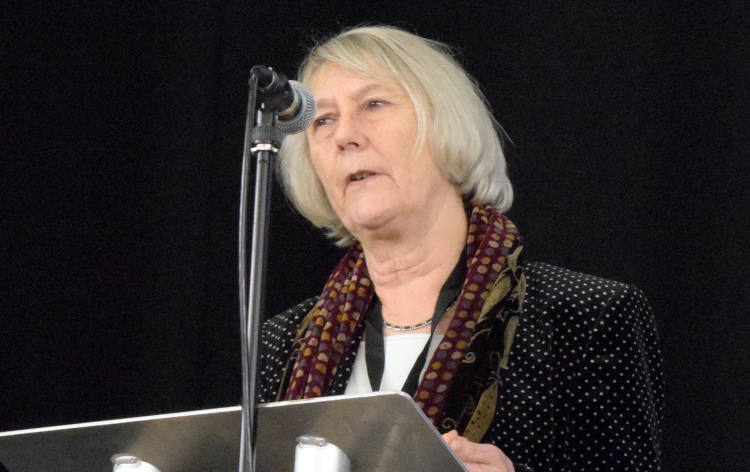
Dame Anne Owers, National Chair at Independent Monitoring Board
IMB Applications
Posters have been issued to be stuck onto IMB application boxes showing inmates the changes in dealing with their applications. One notable detail is this:
“We will still get daily updates from senior managers, so we know what is going on in the prison”
In other words, senior managers will tell IMB only what they want them to know.
IMB boxes will be emptied by IMB clerks (MoJ staff) or prison officers (MoJ staff). The IMB clerk or member of administrative staff will scan the application and email it to the prison’s IMB who will investigate concerns.
Responses may be emailed to the IMB clerk or member of administrative staff and delivered in an envelope or it may come direct from the IMB in an envelope. But not all Boards have access to a clerk.
Many members of the IMB may be in the high-risk category due to their age, others may have children to look after. Therefore, it is inevitable that changes will need to happen to safeguard prisoners, detainees, staff, and IMB members to minimise the risk of spreading infection.
Although the situation is changing daily, I think it’s safe to say:
All scrutiny of prisons is lost for the foreseeable future
The IMB has placed itself in an impossible position; the failure of the Secretariat to assure a sufficiently diverse membership is only one of a set of longstanding issues which the Covid-19 pandemic is exposing in the full glare of public attention.
IMB National Chair Dame Anne Owers, who holds ultimate responsibility for the organisation, must urgently rethink how the IMB is to fulfill its statutory obligation to provide monitoring of the prisons in England and Wales.
UPDATE 3rd April 2020
According to www.imb.org.uk. the message has now changed:
“Dame Anne Owers, IMB National Chair, has today (30 March) written to stakeholders to update them about monitoring of prison and immigration detention during the Coronavirus/COVID-19 epidemic:
Given the significant health risks for prisoners, detainees and staff during the current COVID-19 crisis, and following the Government advice issued this week, direct monitoring activity in prisons and immigration detention has inevitably been restricted.
Boards will be able to carry out some limited on-site work where it is safe and feasible to do so. However, we have also developed remote methods of providing some independent assurance at a time of heightened concern for prisoners and detainees. This is a fast-moving situation, but we have advised Boards as follows:..
With the ongoing COVID-19 pandemic affecting prisons, a change of direction such as this raises serious questions. How is it safer than a week ago for Board members?
~
Credits:
Photos of Dame Anne Owers by Paul Sullivan. Used with kind permission.

Recommendations are futile
People working within the Criminal Justice System will have noticed how writing or making recommendations carries little or no weight any longer. Defined as “a suggestion or proposal as to the best course of action, especially one put forward by an authoritative body”, a recommendation has few or no consequences for those delivering them or for those receiving them.
Yet those who write recommendations have no power to mandate them.
Prisons are bombarded with recommendations from the Prisons and Probation Ombudsman, HM Inspectorate of Prisons, the Independent Monitoring Boards, and a host of so-called arm’s length bodies.
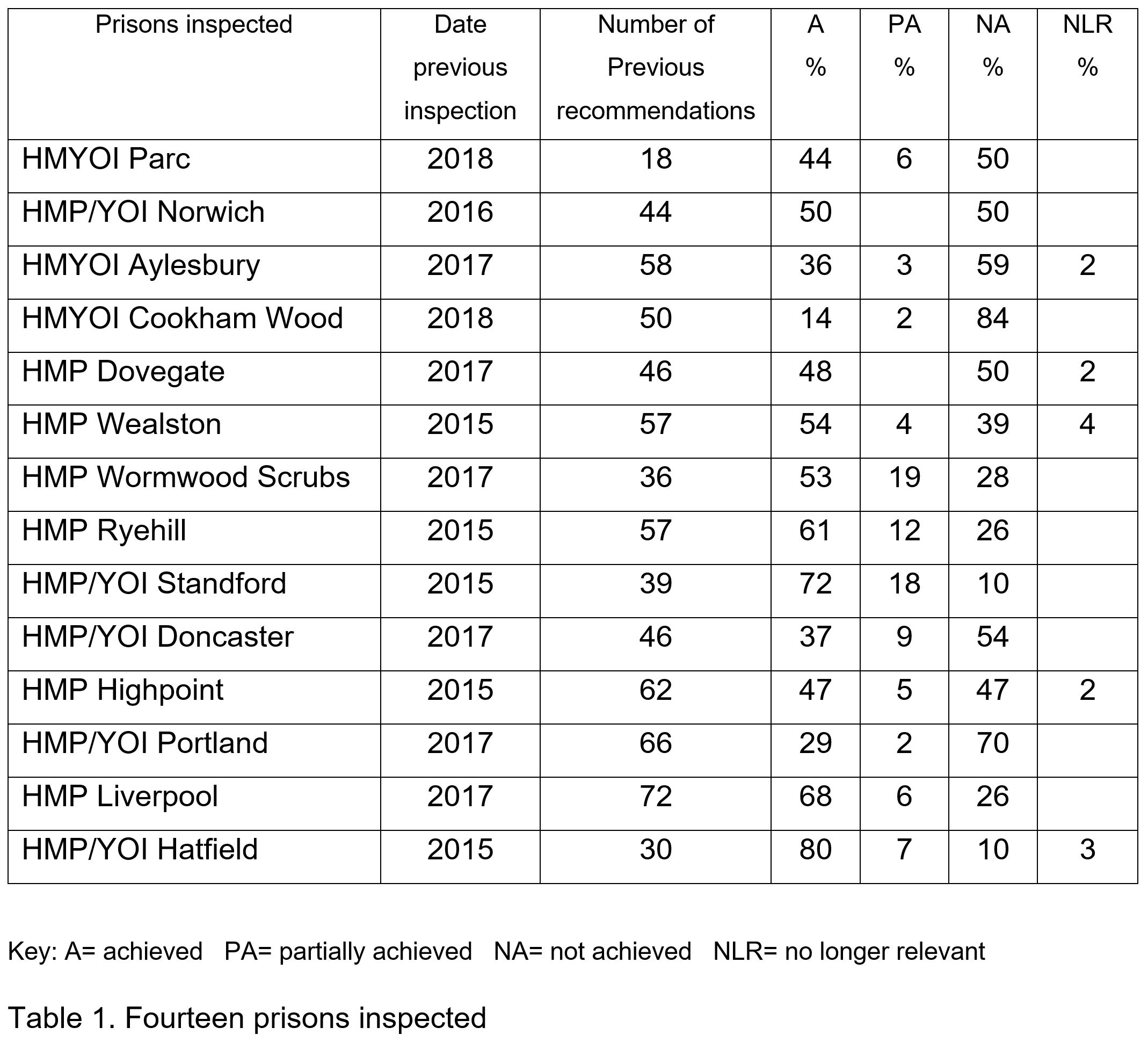
It is remarkable that their recommendations in reality are routinely ignored, albeit officially named differently as you will see in the table. Since there appears to be no recourse and no accountability, why continue to rely on this method of scrutiny which has become ineffective and, therefore, a waste of time, effort and money?
 Surely if all No 1 Governors were held personally accountable for enacting recommendations given to them then maybe there would be more action. Instead it is like a carousel, where certain Governors get away with the appearance of activity before being moved to another prison or a newly created role at HQ. After all, why work hard on recommendations when you can use a ‘Get Out of Jail Free’ card? Meanwhile, the mess they leave behind them is inherited by successive Governors.
On 25th February 2020, I attended the ‘Keeping Safe’ conference organised by the Independent Advisory Panel on Deaths in Custody (IAP). I’m telling you this because it perfectly illustrated to me how recommendations in and of themselves are futile.
For example, under the section on the agenda ‘Learning from reports and recommendations to prevent future death’ we heard from representatives from four prominent organisations, including Jonathan Tickner representing HM Inspectorate of Prisons who stated that in the last reporting period 14 prisons were inspected and none had been rated “good” in the safety aspect.
In each inspection recommendations are given. I decided to look at recommendations and to analyse how many were achieved. I chose those same 14 prisons inspected in 2019 and noticed huge variations which I’ve summed up in the table below:
Sue McAllister, Prison and Probation Ombudsman (PPO), raised some relevant points about policies not being good enough on their own and action plans not being good enough in response to PPO recommendations, like a tick box exercise. However, if there is no follow up on whether recommendations have been adhered to, or no consequences of not following up recommendations, then nothing has been achieved and the whole process is worthless.

Sue McAllister, Prison and Probation Ombudsman
In the 12 months to September 2019 there have been:
308 deaths in custody (6 every week)
90 self-inflicted deaths (1 every 4 days)
8 deaths in women’s prisons
We should be ashamed of ourselves. Those of us working in or for the Criminal Justice System must share a collective burden for the failure to keep people safe, sometimes from themselves.
According to ‘Deaths in prison: A national scandal‘ published January 2020 by Inquest:
This report identifies areas for the immediate reform within and outside of the prison system and concludes with recommendations to end deaths caused by unsafe systems of custody. (Inquest, 2020, p. 3)
As you can see, there is no shortage of recommendations.
Nobody knows which custodial sentence will become a death sentence.
The point is some do but none ever should.
Is it any wonder the MoJ has reformulated its mission statement from:
“Her Majesty’s Prison serves the public by keeping in custody those committed by the courts. Our duty is to look after them with humanity and help them lead law abiding and useful lives in custody and after release”
To how it reads today, portraying itself as a sterile, uncaring, faceless organisation.
“The Ministry of Justice is a major government department, at the heart of the justice system. We work to protect and advance the principles of justice. Our vision is to deliver a world-class justice system that works for everyone in society”
“The organisation works together and with other government departments and agencies to bring the principles of justice to life for everyone in society. From our civil courts, tribunals and family law hearings, to criminal justice, prison and probation services. We work to ensure that sentences are served, and offenders are encouraged to turn their lives around and become law-abiding citizens. We believe the principles of justice are pivotal and we are steadfast in our shared commitment to uphold them”
Source: https://www.gov.uk/government/organisations/ministry-of-justice/about
When you look long enough at failure rate of recommendations, you realise that the consequences of inaction have been dire. And will continue to worsen whilst we have nothing more compelling at our disposal than writing recommendations or making recommendations.
Recommendations have their place but there needs to be something else, something with teeth, something with gravitas way beyond a mere recommendation.

Rt Hon Robert Buckland QC MP, Lord Chancellor and Secretary of State for Justice
Show me a system where action is mandatory, where action has a named owner assigned to it, where action has a timeline attached to it, and where action is backed by empowerment to deliver it and I’ll show you a system which functions better than the one in operation today in the Criminal Justice System obsessed with recommendations.
Culture is what you do when no one is watching.
Integrity is doing the right thing even when nobody is looking.
I found it very telling that the most poignant part of the conference came with the stories and sadness from families who had lost loved ones and to learn that every 4 days a person takes their own life in custody. If the changes being recommended were changes being mandated, who knows how many deaths could have been averted?
Robert Buckland QC MP, Lord Chancellor and Secretary of State for Justice, arrived early enough to have heard from those family members. He talked about working together with shared humanity and wanting to be notified personally of all deaths and the circumstances surrounding each one, which of course he already is. In closing his speech Mr Buckland said:
“As we continue to work together during my tenure as the Secretary of State, please know that my door is always open to those who want to make a difference”
It’s time to put him to the test on that.
But don’t go in with recommendations; go in with a plan for action.
~
Credits:
Photos of Robert Buckland QC MP and Sue McAllister, both by Paul Sullivan. Used with kind permission.
Monopoly Board Game, 2006 Hasbro. Photo by the author.
 The Criminal Justice Blog