
Home » England and Wales (Page 2)
Category Archives: England and Wales

The paralysis of too many priorities.
Sat immediately behind the new Secretary of State at the Justice Select Committee (@CommonsJustice) on 07 September, I registered a lot of awkwardness that was beyond mere nervousness felt by many a new joiner.
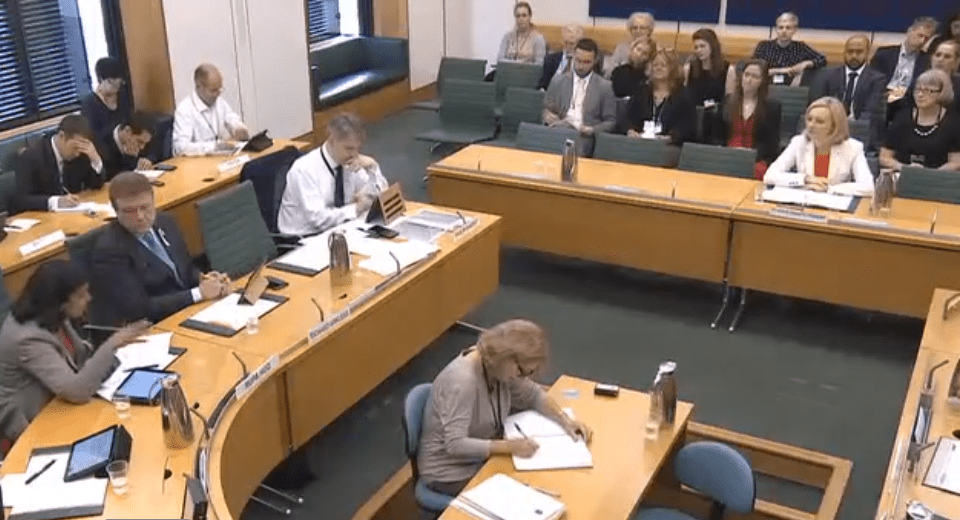
Thatcher Room, 07 Sept 2016
Just like Gove’s debut in front of the same Committee where he rattled on about “we’re reviewing it” (yes, I was there for that one too), Liz Truss (@trussliz) talked largely about the formulating of “plans” but on the day said nothing about tangible actions she will take.
How many more reviews do we need?
Has Truss inherited a poisoned chalice passed from one SoS to the next? Her department has a huge accumulated mess to sort out and doesn’t know what to do about it. Is she wondering what to tackle first? The paralysis of too many priorities?
Her critics say she’s doing things wrong. Look at it for yourself and you’ll see some of the priorities she is confronted with:
- Extremism and radicalisation in prison
- Violence against other offenders and against prison staff
- Over population
- Under staffing of prisons
- Death in custody
- Drugs and drones
- Education and purposeful activity
- Resettlement and homelessness on release
You would think her advisors would know what the order of priorities are. They don’t, or if they do, they obviously prefer the relative safety of “talking shop” over the tough task of taking concrete action on these priorities.
The key question people are asking is has she actually got the shoulders for the job; she has the high office and gilded robe of the Lord Chancellor but does she have the support of those working within the criminal justice system?
Soon after her appointment from Defra to Ministry of Justice, Liz Truss paid token visits to two prisons but cannot be expected to become an instant expert on the prison system.
What other mess does the SoS need to deal with?
The system of prison monitoring is in a mess. The IMB Secretariat is in utter disarray. They say they have policies and procedures but don’t always follow them themselves. For the most part, IMBs are doing their own thing. There’s no real accountability anymore. It’s a disgrace and it’s deplorable that it’s been allowed to get as bad as it has.

Faith Spear
For my critique of prison reform and Independent Monitor Boards, I’ve been put through two MOJ investigations. Each one takes away a little piece of me. But for me it’s always been about the issues. That’s why they can’t and won’t shut me up.
The message of prison reform has become urgent and has to get to the top. If no one else will step up and if it falls to me to take it then so be it.
No accountability anymore? Give me an example.
You want an example? Here’s one of many: At HMP Garth, the IMB Chair issued a Notice To Prisoners 048/2016 dated May 2016 without the authority to do so, and apparently without the Board agreeing it. The Chair acted unilaterally outside of governance. I found out about it because a copy of that prison notice was sent to me as it happened to be about the article “Whistle Blower Without a Whistle” that I’d written for The Prison Handbook 2016 that the IMB Garth Chair was pin-pointing, (accusing me of a “rant” whilst both his prison notice and covering letter were dripping with distain).
I’m still standing by all I said in my Whistleblower article even though writing it has been at a high personal cost. In all candour, any pride I may have had in writing it has been completely sucked away from me. It’s back to the bare metal. The inconvenient truth of what I wrote remains. Readers will find that my main themes also feature prominently in the findings of the report by Karen Page Associates, commissioned by the MOJ at a cost to the taxpayer of £18,500.
An invite I received from Brian Guthrie to the forthcoming AGM of Association of Members of IMB says it all. It read:
“From the Chair Christopher Padfield
AMIMB – the immediate future
IMB needs a voice. We believe that without AMIMB this voice will not be heard. AMIMB intends to raise its voice, but needs the support of our members.
An outline plan for the immediate future of AMIMB will be put up for discussion at the forthcoming AGM (11 October 2016 at 2 Temple Place). It aims to respond both to the main needs and opportunities, and to the practicalities of the current situation.The greatest need, as the executive committee of the AMIMB sees it, is to achieve a public voice for Independent Monitoring Boards – to let the British public know what we, as monitors, think about prison and immigration detention policy and practice in England and Wales and the impact this has on the men, women and children detained; to achieve some public recognition for the role of IMBs; in short to speak out about what we hear and see. We have urged the National Council to do this itself, but to no avail. In character, the NC propose as their contribution to the Parliamentary Justice Select Committee’s current consultation on Prison Reform, a response to a procedural question: ‘are existing mechanisms for … independent scrutiny of prisons fit for purpose?’ If the NC cannot or will not speak out, AMIMB should.”
Mr Padfield has served as IMB Chairman at HMP Bedford but to my knowledge has never been suspended pending investigation by the Prisons Minister like I was for speaking out on such things.
And therein lays the dilemma: whereas the official line is to encourage monitors to speak out, the reprisals levelled at you when you actually do are still shocking.
Is this what happens to women who use their voice?
People want you to get back in the box.
To shut up.
To go away.
The IMB doesn’t need a makeover; that would only hide most of the systemic problems behind filler and veneer. So rebranding clearly isn’t going to be the answer any more than putting lipstick on a pig.
People who think I want to abolish the IMB have totally misjudged me and the situation. I don’t want to abolish it. Far from it. I want the IMB to perform like it was set up to under OPCAT and to be all it should be as part of our NPM.
The clue is in the name: Independent. Monitoring. Board.
Have you noticed that the MOJ is haemorrhaging people at the moment?
Maybe Liz Truss could use that as an opportunity to enlist the help of those who do give a damn about the conditions in which people are held in custody and who do have a clue about strategies to stem radicalisation in prison, minimise violence, reduce prison over population, have the right staff and staffing levels, reduce death in custody, counter drones and drug misuse, revitalise education and purposeful activity, and last but not least, resettle and house people after their time in custody.
Join the conversation on Twitter @fmspear @trussliz @CommonsJustice #prisons #reform #IMB #AMIMB #SpeakUp
First published 17 Sept 2016.
Edited 18 Sept 2016.
~
We don’t just need a vision, we need a cause!

“She’s no rebel and she’s got a cause”
In the space of 6 weeks I have written an article which has been published in The Prisons Handbook 2016, just before the Prime Ministers speech. I have been interviewed by Ian Dunt with an article put on politics.co.uk, been in my local paper with a 2 page spread, had a front page article in Converse prison newspaper, had an interview with another newspaper with an article ready for the next months edition… If I can achieve all this in just 6 weeks, just imagine what could be achieved in 6 months or a year?. It’s all about going at pace.
It’s not always about what you have achieved in the past, although it does help. But it’s about what you can/will/want to do in the future.
Can’t abide being held back because of what I haven’t done yet. Especially when I’m at the start of something significant and have plenty of passion, energy and drive for what is to come.
And despite the knock backs, to keep a sense of humour.
Yes I have mainly worked with vulnerable adults and children before, but we all have a vulnerable side to us. Some are able to reveal it, others not, some it leads to being a victim and others it leads them into criminal activity.
Have you noticed how quick some people are to judge others, put you into boxes and to categorise? I hope you won’t judge my life by the chapter you just walked in on.
Prisons are no different.
Many problems arise when people enter the prison system and then leave in a worse state than when they arrived.
Why after all the money pumped into prisons is this happening?
Profits are made out of prisoners, we all know that.
How many reviews, reports can you count over the last say 10 years that involve prisoners?
There have been countless
How many organisations do you know that work hard to bring reform to prisons and prisoners?
There are countless
How much money has been spent on prison reform?
Countless
On 8th February, the Prime Minister set out a vision for prison reform. Mr Cameron said:
This system will be hard to change because it is, in some ways, still stuck in the dark ages – with old buildings, old thinking and old ways of doing things.
So I don’t want to go slow here – I want us to get on with proper, full-on prison reform.
Today, 27th May the Public Accounts Committee report warns that the criminal justice system is close to breaking point:
Report summary
- The criminal justice system is close to breaking point.
- Lack of shared accountability and resource pressures mean that costs are being shunted from one part of the system to another and the system suffers from too many delays and inefficiencies.
- There is insufficient focus on victims, who face a postcode lottery in their access to justice due to the significant variations in performance in different areas of the country.
Criminal justice system “already overstretched”
- The system is already overstretched and we consider that the Ministry of Justice has exhausted the scope to make more cuts without further detriment to performance.
- The Government is implementing reforms to improve the system but we are concerned that users of the system won’t see the full benefit for another four years.
- There are opportunities for the Ministry to make improvements before then, including better sharing of good practice and making sure that everyone is getting things right first time.
But what is the answer?
(If I had the answer I would be a very rich woman!)
Over the last few years I have visited every category of prison, YOI and Women’s. I have sat behind the Right hon. Michael Gove MP whilst he has been in front of the Justice Select Committee twice. I have attended meeting after meeting in Westminster, attended conferences, training courses, lectures, seminars etc. at my own cost.
Why?
I want to learn, I want to understand but most of all I want answers to the questions I have posed.
I also want to be a part of the change that is so desperately needed in our prisons.
We don’t just need a vision, we need a cause!
Vision is often personal, but a cause is bigger than any one individual
People don’t generally die for a vision, but they will die for a cause
Vision is something you possess, a cause possess you
Vision doesn’t eliminate the options; a cause leaves you without any options
A good vision may out live you, but a cause is eternal
Vision will generate excitement, but a cause generates power
[Adapted from Houston (2001)]
Houston, B. (2001) For this Cause: Finding the meaning of life and living a life of meaning. Castle Hill: Maximised Leadership Inc.
Getting personal about the cost of being a Whistleblower
When you feel so passionately about a subject or issue(s) it is very hard to keep quiet. This is what I have experienced recently:

It’s not about me. It’s about the issues I’ve raised.
I had to weigh up the risk of possibly causing offence versus the need to speak.
I decided to speak!
What happened next shocked me.
Suddenly people that I had respect for and worked so well with turned against me in the most brutal way. I didn’t expect everyone to agree with me but I certainly didn’t expect quite the fallout.
I was looking at the bigger picture and the wider issues but they were blinkered. Was I wrong to speak out?
NO.
I wanted to raise issues and put them firmly on the agenda of those that could or should actually do something about them.
Maybe the problem was that they didn’t expect someone like me to put their head above the parapet and voice my opinion. We all have a voice, we all have opinions and we should not feel that we have to suppress them. I did, I felt that I couldn’t really express myself, would anyone listen?
It was an important step for me to speak out and it has come at a great personal cost. I haven’t slept well or eaten properly since 19th April. I have felt under pressure, stressed out and really not myself. It has been an emotional roller-coaster.
I made the decision to stand up, I could have rolled over and played dead but I didn’t.
But people are listening, they are taking notice and they are supportive and above all they agree!
We all know the saying ‘action speaks louder than words’ but often you have to speak before any action can take place. So I’ve spoken and I expect results.
I’m not looking for a slice of the action, the last time I was in a newspaper was at the age of 10 having won an art competition with my sister and fellow classmates. Now the press come looking for me!
Prisons.org.uk (pdf)
Converse (pdf)
I have faced criticism like never before, I have been told that I am not fit to stand for the public office I occupy and that they could never forgive me for what I have done.
But really it’s not about me, or shouldn’t be about me; instead it should be about the issues I have raised.
Justice Select Committee part 3
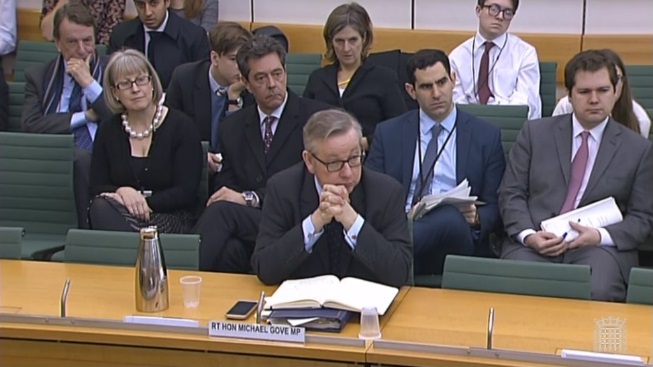
I seem to be making a habit of this; on Wednesday 16th March I attended the Justice Select Committee for the third time, again listening to the Rt Hon Michael Gove MP being questioned by a team of MP’s.
I sat behind Mr Gove and watched as he interacted with the committee. The meeting can be accessed from this link: http://parliamentlive.tv/Event/Index/e67772ca-8c75-4112-853a-0fbd80688389
The first question he was asked was “How would you encapsulate the overall purpose of the thrust of the Government’s prison policy”? Michael Gove replied “In a sentence, it is about turning prisoners from liabilities into assets”. Interesting use of language I thought.
He continued by stating that…”the critical thing is to make sure that during their time in prison there is purposeful activity…” I have come across some excellent forms of purposeful activity but to be honest there just isn’t enough going on. Is it all down to money? If millions can be found to build new prisons then surely purposeful activity has to be included.
The stories coming out of many of the prisons in England and Wales are appalling, locked up at least 22 hours a day, rat infested are but a few I have read this week.
When will we see real progress?
The most successful custodial establishment according to Nick Hardwick former chief inspector of prisons was the Military Corrective Training Centre (MCTC) in Colchester. However, in October 2015 there were 35 being held at the MCTC, hardly an example to compare. The ratio of staff to detainees is far higher than within the prison estate which is surely a factor along with greater governor autonomy that contributes to its success. I have visited it and was impressed by the order, cleanliness and regime. https://www.gov.uk/government/uploads/system/uploads/attachment_data/file/484448/Detainees_Military_Corrective_Training_Centre_Colchester.pdf
But how do you really measure success?
Michael Gove gave an example of Bronzefield prison as being a very successful female prison, yet this week one of the main stories I have read is about staff giving out sleeping bags to women released with no accommodation. It doesn’t add up!
I want to read more success stories, see real progress and watch as these “liabilities are turned into assets”
Volunteering in the Justice Sector
Today I read volunteering is good for your health as you tend to visit the doctor less!
This may be the case and I should know, I have worked as a volunteer for over 20 years and in the Justice sector for over 3 years
A big misconception is that a volunteer just makes tea!
After going to University as a mature student I received a BSc (Hons) in Criminology in Nov 2011. I then spent a year working with my local CAB and completed the course to become a Gateway Assessor as I was told you need to have voluntary work on your CV especially if you have changed direction. This was a real eye opener to the needs of people. After answering an advert in the paper to join the Independent Monitoring Board at HMP/YOI Hollesley Bay in 2013, I started on a very interesting journey. I am now the Chairman.
Apart from the IMB, I have been a group leader for Prison Fellowship England and Wales since 2012 involving managing a small team, all volunteers that deliver the Sycamore Tree victim awareness course in prisons. Meeting monthly and also speaking at various clubs, groups and churches on Restorative Justice and the work I do in prison. I have also been on the Steering Group for the Reclaim Justice Network for over 3 years, attending meetings, AGM’s and supporting events when I am able.
In addition I am a member of the Centre for Crime and Justice Studies (CCJS) and the Howard League. I have been invited to visit many prisons and events in the Justice sector and have been an observer at the Justice Select Committee. I have lost count of the number of conferences, lectures, wine receptions and exhibitions I have attended as I try and keep informed. I write a blog and am known on twitter!
I am passionate about wanting change within the prisons, purposeful activity and education are but a few of changes needed. I try to encourage those in prison and those that have been released.
But all of this is as a volunteer.
I have applied for many jobs since graduating but there have been two main problems. The first being the idea that volunteers make the tea and don’t have real input and so can be a bit clueless. The second being I cannot find a more interesting and at times rewarding line of work. I’m not someone to sit in front of a computer on a daily basis. My work is varied and I enjoy the interaction with prisoners, Governors, staff, my team and my many contacts. I like to be organised and punctual. I like tea, but don’t sit around drinking it all day.
Volunteering is rewarding, I recommend it as it’s an essential part of society but I’m ready for a change…!
Retribution or Restitution
Now that shamed MP Chris Huhne has submitted a guilty plea it is up to the judge to decide on sentencing appropriate to the charge Huhne faces of perverting the course of justice. Speculation is rife that he faces prison for certain, not the first MP to do so; MP’s were handed down prison terms for their part in the expenses scandal. But what do you think the judge should go for? Does Huhne necessarily deserve a custodial sentence or could the judge opt for some form of community sentencing combined perhaps with a restorative justice element?
According to the Telegraph, Mr Justice Sweeney told Huhne he should “have no illusions whatsoever” about the type of sentence he is likely to receive. The maximum penalty for the offence is life imprisonment.
Mr Justice Sweeney faces a perfect illustration of the pressure that many judges come under – a sentence that benefits the crime, in proportion and as short as possible verses all of the above plus an element of deterrent or setting an example for others.
In my opinion Chris Huhe should not be made an example just by virtue of the fact he is an MP and has held a high profile position in the Government. Surely the judge should disregard is job title in the same way that people not in the public eye. Otherwise we are descending into the “court of public opinion”.
This of course begs the question of the role that restorative justice could play if adopted into the mainstream of the criminal justice system of England and Wales. Time will only tell if members of the judiciary will have the courage to use it as part of their toolbox when determining appropriate sentencing.
Retribution or restitution what are we really seeking here?
Chris Huhne quits as he faces jail after pleading guilty to perverting course of justice (2013) The Telegraph 05 February 2013. [Online]. Available at http://www.telegraph.co.uk/news/politics/liberaldemocrats/9847152/Chris-Huhne-quits-as-he-faces-jail-after-pleading-guilty-to-perverting-course-of-justice.html [accessed] 05 February 2013.
Photo: The Telegraph
Steady on!
According to the Guardian, the justice secretary, Chris Grayling, has admitted his plans for the wholesale outsourcing of the probation service will not lead to an overnight reduction in stubbornly high reoffending rates but said he hoped it would lead to a “steady year-by-year decline”. Is he implying that the problem lies with the Probation Service, or is he throwing out the baby with the bath water? If private companies and voluntary sector organisations are invited to bid for these services then would it be a free for all, or would it be a post code lottery? http://www.guardian.co.uk/society/2013/jan/09/chris-grayling-probation-privatisation-reoffending
How much longer will this continue? Children detained in UK immigration removal centres
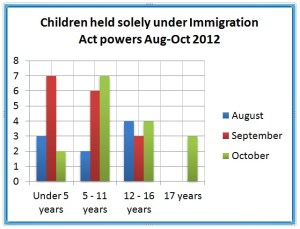
Table 1. (Home Office, 2012)
Every month, I receive the immigration statistics from the Home Office and am repeatedly drawn to the statistics on children detained under Immigration Act powers in immigration removal centres (IRC) such as Tinsley House a facility located on the perimeter road facing the main runway of Gatwick Airport.
These children are not in accommodation geared up for families. Some are detained in locations that originally were built to the same specification as Category B prison; cells as bedrooms and concrete yards as gardens are not environments for children.
I am reminded of the illustrations drawn by children who had experienced life in an immigration removal centre (Burnett, 2010).
The Coalition government had pledged to bring an end to the detention of children for immigration purposes back in May 2010 but clearly this has not been treated with any degree of priority.
How much longer will this continue?
References
Burnett, J. (2010) ‘Repatriation medicine’ Criminal Justice Matters. 82. December. pp. 26-28.
Home Office (2012) Immigration Statistics July – September. [Online]. Available at < http://www.homeoffice.gov.uk/publications/science-research-statistics/research-statistics/immigration-asylum-research/immigration-q3-2012/> [accessed 29 November 2012].
Don’t you think the person is more important than the policy?

More than 86,000 people behind bars in England and Wales
Last year I presented a poster session to cohort and faculty at my local university. The poster was the most visible infographic in the room. It acted as a magnet for attendees. Its immediacy communicated right to the heart of the issue and triggered some substantive discussion. And so it should. Latest figures available from Ministry of Justice shows that over 86,000 people in England and Wales are currently serving custodial sentences.
Frances Crook (@FrancesCrook), Chief Executive of The Howard League for Penal Reform said that many of these people should not be in prison at all; many offenders, particularly those serving short sentences, would be move effectively punished using community sentences.
She has a point. If offenders can be more effectively punished using a sentencing strategy which not only costs around one tenth of the cost of a prison place, but also controls prison population at the same time as being in the better long term interests of the offender, then it deserves serious consideration.
“It isn’t crime that puts people in prison – it is policy that puts people in prison.”
In my experience dealing with a range of offenders, I can see that sentencing strategy, in some cases, causes “penal excess”. This phrase means different things depending on your standpoint. For example, to a probation officer it may mean a harsh sentence behind bars. To a politician, it may mean “…it is the sentencers not the Government who are responsible for the prison population as it stands today” (said Jeremy Wright MP, 21st Nov 2012, speaking on the occasion of the AGM of The Howard League for Penal Reform).
Don’t you think the person is more important than the policy?
 The Criminal Justice Blog