Home » Criminal Justice System (Page 3)
Category Archives: Criminal Justice System

A conversation with: Lady Val Corbett, passionate about prison reform, empowerment of women and kindness in business
Lady Val Corbett, a feisty woman, with determination to rival most, striking red hair and a penchant for wearing bright scarves, is one way of introducing my latest “A conversation with…” Having known Lady Val for 6 years, I have found her to be compassionate, hilarious, focused and above all, a friend.

Her career in journalism started in Cape Town but with moving to the UK it was impossible to continue without being a member of the National Union of Journalists. Eventually she worked for the Sunday Express as a weekend reporter; a Features Editor of a noteworthy Furnishing Magazine; Editor of a magazine Woman’s Chronicle for the Spar customers and grocers which then led to becoming the consumer columnist on The Sun. With the birth of her daughter, Polly, she invented herself several times!
“I wrote a column for Cosmopolitan and for national papers and magazines plus scriptwriter for BBC TV then became one of the founder directors of an independent TV production company which sold programmes for major broadcasters – highlight was a six-part BBC1 series called Living with the Enemy on teenagers as I was struggling with mine at the time. I was a volunteer at the Hoxton Apprentice, a training restaurant for long term unemployed and saw how people could change direction. After that I co-wrote six novels with two friends and in between was an MP’s wife and later the PA for Lord Corbett of Castle Vale, when I regularly gave notice or got fired.”
That’s quite a résumé.
Val had a chance encounter on her first day as a features writer, which led to 42 years of happy marriage.
“On my first day I was having second thoughts about a new dress I had bought. Going to the canteen for lunch I paused at the door and asked my colleague: “Does this dress make me look dumpy?” To which an amused male voice said: “Yes it does.” I looked up – my 5ft 2” to his 6ft 3” – and thought he was the rudest man I’d ever met. He called me Dumpy for ages.”
Her husband, Lord Corbett of Castle Vale, sadly died on 19th February 2012.
Did you personally have an interest in politics?
Not for party politics. I knew apartheid was wrong, unfair, and cruel. My first time voting as a British citizen was in Fulham when I put my cross next to Major Wilmot-Seale whom I believed was the Liberal candidate (party allegiances were not then on ballot papers). He was the National Front candidate and garnered 45 votes of which mine was one. Robin never let me forget this. Over the years he became my political mentor because he thought going into politics was because you wanted to change the world. And goodness how he tried!
When Robin decided a cause was just, he was not swayed from the path, do you feel you have taken on that mantle?
I could have chosen from several of his crusades – his Private Members Bill which became law, granting lifetime anonymity for rape victims in courts and media was one but he was also active in prison reform during his 34-year parliamentary career. Chairing the All-Party Penal Affairs Group for 10 years until his death made him realist how much there was to do in the criminal justice system.
He used to say: “Prison isn’t full of bad people; it’s full of people who’ve done bad things and most need a chance to change direction.”
Was it a mantle you were willing to take on?
Yes, when I heard a man say on TV “All men die but some men live on.” I wanted Robin’s legacy in prison reform to live on. Though a novice in prison reform I immersed myself in prison reform in 2013 and though I am still learning now feel I am no longer a novice.
What makes you laugh?
I laugh a lot particularly at short jokes and always tell one or two at my professional women’s network events.
What makes you cry?
Anything concerning cruelty to children.

Since 2016, I have been part of Lady Val’s Professional Women’s Network consisting of female entrepreneurs, senior women in business, the arts, government, investment, HR, and many more diverse professions.

It’s a forum for women in business looking to further their careers by focusing on leadership skills, self-confidence, and other key areas of personal development. Meeting five times per year for lunch, each event starts with an icebreaker “How can I help you and how can you help me”, a simple formula which encourages meaningful connections. This is followed by an inspirational speaker, a leader in their field sharing business knowledge and expertise.
The professional networking lunches are all about business and not entertainment, how do you reflect that in your choice of speakers?
I choose keynote speakers with care. Most speakers have been leaders in their field of business: marketing, fin tech, green economy, Lloyds of London, Abbey Road Studios etc. We had Michael Palin and Jon Snow, both prison reform campaigners, also Prue Leith and Jeffrey Archer. They attracted large audiences, but the Network is a business one, not an entertainment one… So, we are going back to basics, with speakers appealing to businesswomen. I’m happy that through the contacts not only have networkers gained business contacts but also friends.
We are all in this together and if women don’t help each other, who will?
What in your opinion are some of the barriers for women to advance in their professional lives?
The main barrier is a lack of confidence. The glass ceiling is there to be smashed but few women want to. This is changing though not fast enough for me! I count myself not as a feminist but as an equalist and am proud that the wearethecity.com network voted me one of their 50 Trailblazers in gender equality.
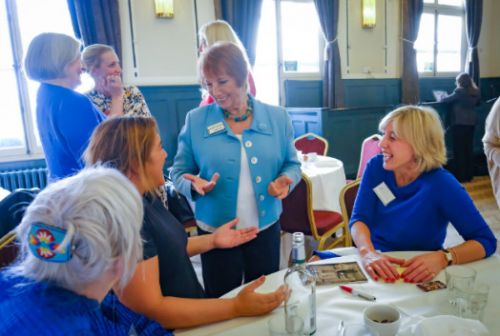
Face to face events are planned from April, are we all zoomed out after 2 years?
Zoom has become increasingly unpopular, and I hope we can go back to somewhere near our normal lives. I am worried that although the stats of Covid are decreasing, they are still worryingly high. On April 21st we are going back to Browns Courtrooms to restart our lunches with keynote speaker James Timpson who’ll be talking about kindness in business.
This network is not for ladies who lunch but ladies who work.
A donation comes from each booking going to our work on prison reform.
How did the Robin Corbett Award come about?
After a loved one dies, people gather around giving you sympathy and many cups of tea. A few weeks after the funeral they seem to think you will be able to manage but it is then that you are at your lowest. It was at this point that inspiration struck. As I mentioned before, the sentence I heard on TV: “All men die but some men live on.” was a eureka moment making me decide that I wanted Robin’s legacy to live on.

The Robin Corbett Award celebrates, supports, and rewards the best in prisoner re-integration programmes. Each year we donate funds to three charities, social enterprises or CICs whose mission is centred around giving returning citizens a chance to reintegrate back into society. The presentation is at the House of Lords.
The Robin Corbett Award for Prisoner Re-Integration was established by members of Lord Corbett’s family in conjunction with the Prison Reform Trust in 2013. It is now administered by The Corbett Foundation, a not-for-profit social enterprise.
What are the criteria to being a member of the Corbett Network?
The Corbett Network is a coalition of charities, social enterprises, community interest companies, non-profit organisations and businesses with a social mission who work with those in prison and after release. (Individuals are not eligible). These decision makers are dedicated to reducing re-offending by helping returning citizens find and keep a job. Some members offer mentoring, coaching, training or education.

How many members are there?
Currently there are 108 with four waiting to be introduced to their fellow members.
This network has expanded rapidly over the last few years, is this due to prison reform taking a greater platform?
Once the Robin Corbett Award was established, I kept on meeting people working in their own small pond, so to speak. I thought we could crusade better in a sea and invited them to join us. Since then, together we have created a powerful lobbying voice heard at the highest levels of government and recognized by those in the criminal justice sector as a force for change. I do sense that the media tend to focus on the problems.
Where do you see the Corbett Network positioned in the justice arena?
Peter Dawson, Director of the Prison Reform Trust told me that The Corbett Network is the only one of its kind in the UK. It sits alongside the Criminal Justice Alliance and Clinks which concentrate mainly on policing, courts, prisons, probation, and human rights. The Corbett Network are members of both these organisations.
What are your hopes for the future of this network?
To crusade effectively. To effect changes desperately needed in our prison system. To change public perception of people who have been inside – they are not sub- human. Since the Network started in 2017, we now have over 108 members, holding both face-to-face, virtual meetings, conferences and, crucially, encouraging greater collaboration across the work we collectively do. Together, we have created a powerful lobbying voice, heard at the highest levels of government, and recognised by those in the criminal justice sector as a force for change.
“Prisons should not be society’s revenge but a chance to change direction.” Robin Corbett
This interview was published to mark International Women’s Day 2022.
All photos courtesy of Lady Val Corbett. Used with permission.

Should inmates be given phones?
Offenders who maintain family ties are nearly 40% less likely to turn back to crime, according to the Ministry of Justice. With secure mobiles being rolled out in prisons we ask…
Should inmates be given phones?
This was a question posed to me back in November 2021 by Jenny Ackland, Senior Writer/Content Commissioner, Future for a “Real life debate” to be published in Woman’s Own January 10th 2022 edition.
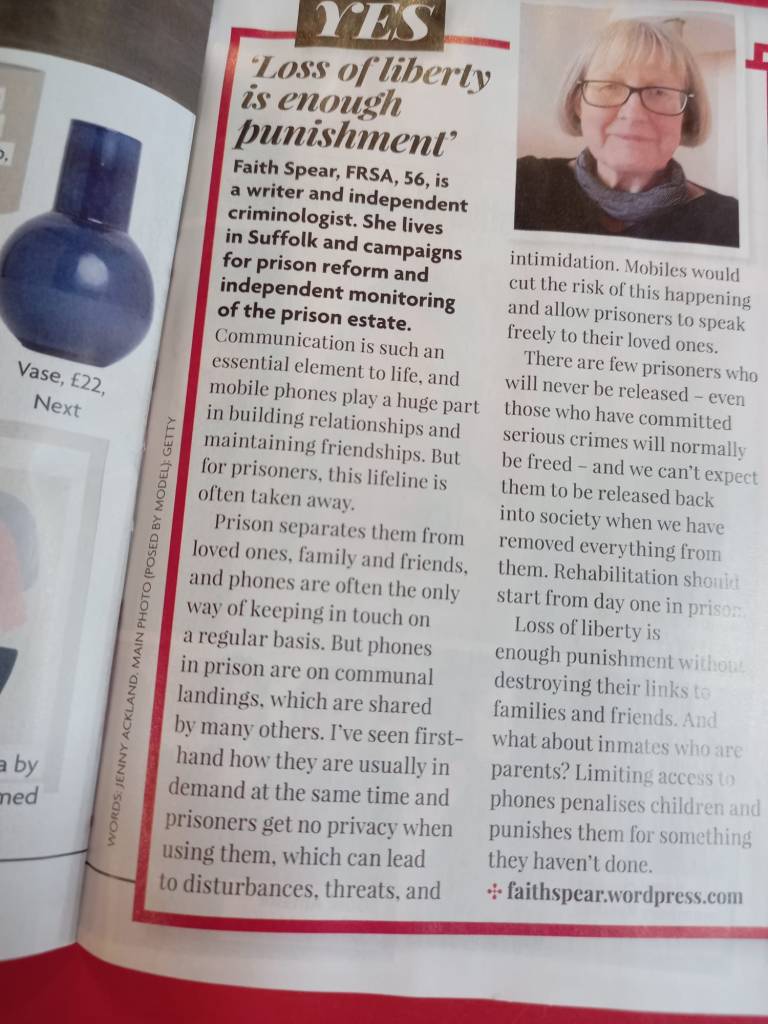

Below is the complete article, my comments were cut down slightly, as there was a limited word count and reworked into the magazine style.
Communication is an essential element to all our lives, but when it comes to those incarcerated in our prisons, there is suddenly a blockage.
Why is communication limited?
It is no surprise that mobile phones can serve as a means of continuing criminal activity with the outside world, as a weapon of manipulation, a bargaining tool, a means of bullying or intimidation.
But what many forget is that prison removes an individual from society as they know it, with high brick walls and barbed wire separating them from loved ones, family, and friends.
There is a PIN phone system where prisoners can speak with a limited number of pre-approved and validated contacts, but these phones are on the landings, are shared by many, usually in demand at the same time and where confidentiality is non-existent. This is when friction can lead to disturbances, threats, and intimidation.
Some prisons (approx 66%) do have in-cell telephony, with prescribed numbers, monitored calls and with no in-coming calls.
Why do some have a problem with this?
We live in an age of technology, and even now phones are seen as rewarding those in prison.
If we believe that communication is a vital element in maintaining relationships, why is there such opposition for prisoners?
In HM Chief Inspector of prisons Annual report for 2020, 71% of women and 47% of men reported they had mental health issues.
Phones are used as a coping mechanism to the harsh regimes, can assist in reducing stress, allay anxiety and prevent depression.
Let’s not punish further those in prison, prison should be the loss of liberty.
Even within a prison environment parents want to be able to make an active contribution to their children’s lives. Limiting access to phones penalises children and in so doing punishes them for something they haven’t done. They are still parents.

Art for arts sake/prison for prisons sake: Part 2
Emerging from the Westminster tube station, the blue sky is a welcome sight. Trees shedding their leaves by the chilly winter winds. Wrapped up against the elements I hastily head along Victoria Embankment and climb the steps to cross the Thames toward my chosen destination – The Southbank Centre and Koestler Arts exhibition. A celebration of Art, Music and Writing.
The ‘I and the We’, curated by Camille Walala and Sarah Ihler Meyer.
With the strapline: ‘Unlocking the talent inside the criminal justice system’
It’s a strapline I have often read, but how many truly believe it is possible?
Unlocking: who is unlocking and who is being unlocked?
Unlocked, unlock, unlocking…its endless, often words chosen by cjs charities and organisations.
But to unlock you need a key.
A key can be a person or an opportunity. Here it is both.
We write off so many due to their circumstances, but a bit of creative encouragement can achieve much.
I try not to over-analyse each exhibit, but it is tempting, with titles such as ‘Too Late‘ and ‘Perspective‘ it is a little hard not to be intrigued.
Talent: is there really talent within the criminal justice system?
This question is easy for me to answer, a resounding yes.
Others may think differently, usually from a position of ignorance in my view. The average person still knows so little about what is happening behind prison walls.
Art is a form of expressing what is happening within or without. In a nutshell a way of communicating to others in an illustrative way.
Art is not judgmental like right or wrong, nor is it binary like black or white.
I was attracted to a striking entry from HMP Garth called ‘God’s Words’. A simple graphic featuring biblical words applied using rudimentary materials; a marker pen and cardboard. Definitely makes you think.
Slowly moving through the room, many exhibits caught my eye, some making me feel rather sad and others bringing a smile to my face and even a laugh. But that is the beauty of Art.
Bold statements
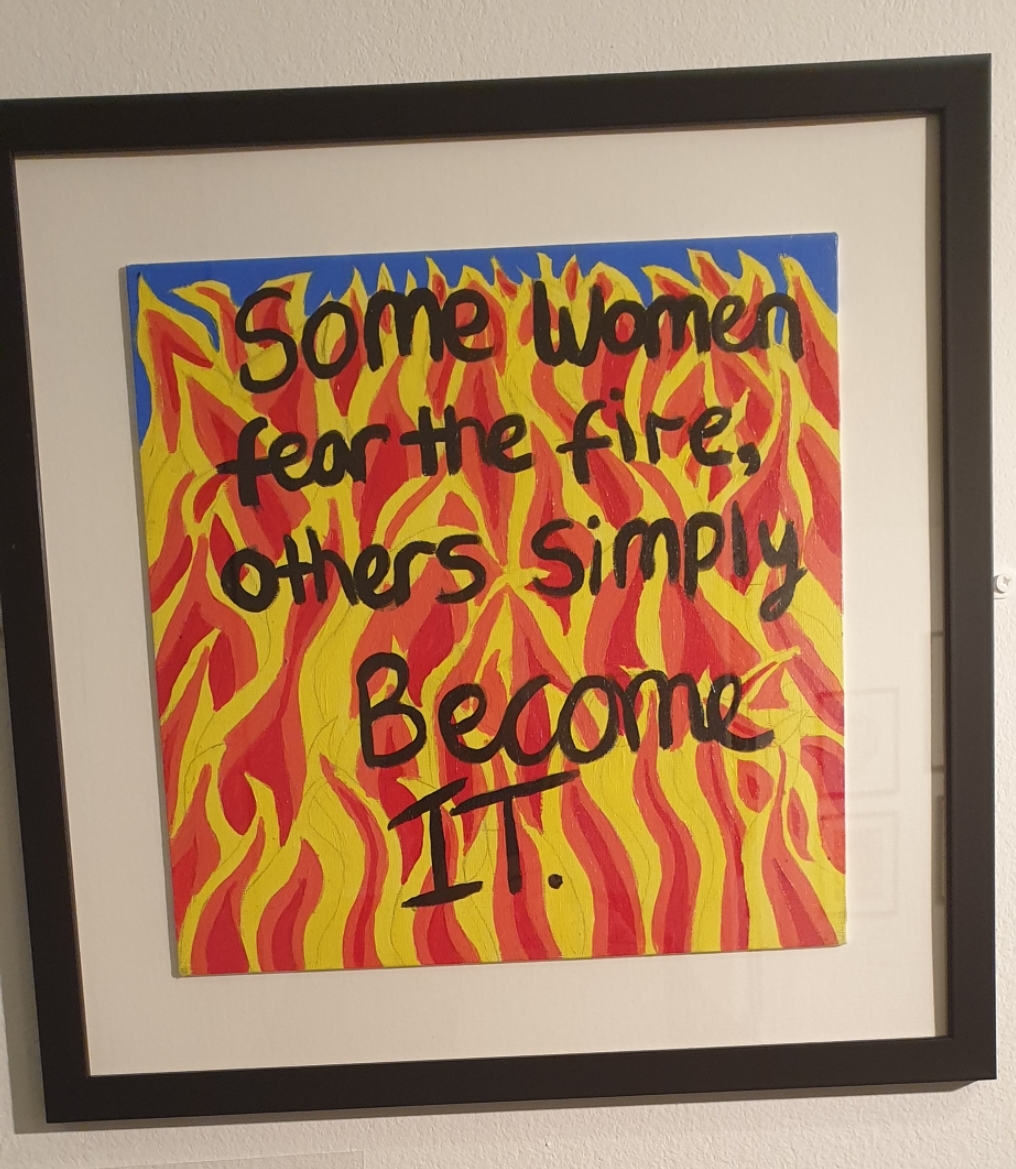
“Some Women fear the fire, others simply Become It” such poignant yet powerful words. I wonder what the story is behind it. All I know is someone called Jacqueline painted this acrylic on board from HMP Eastwood Park. No other words are really needed.
Wise words
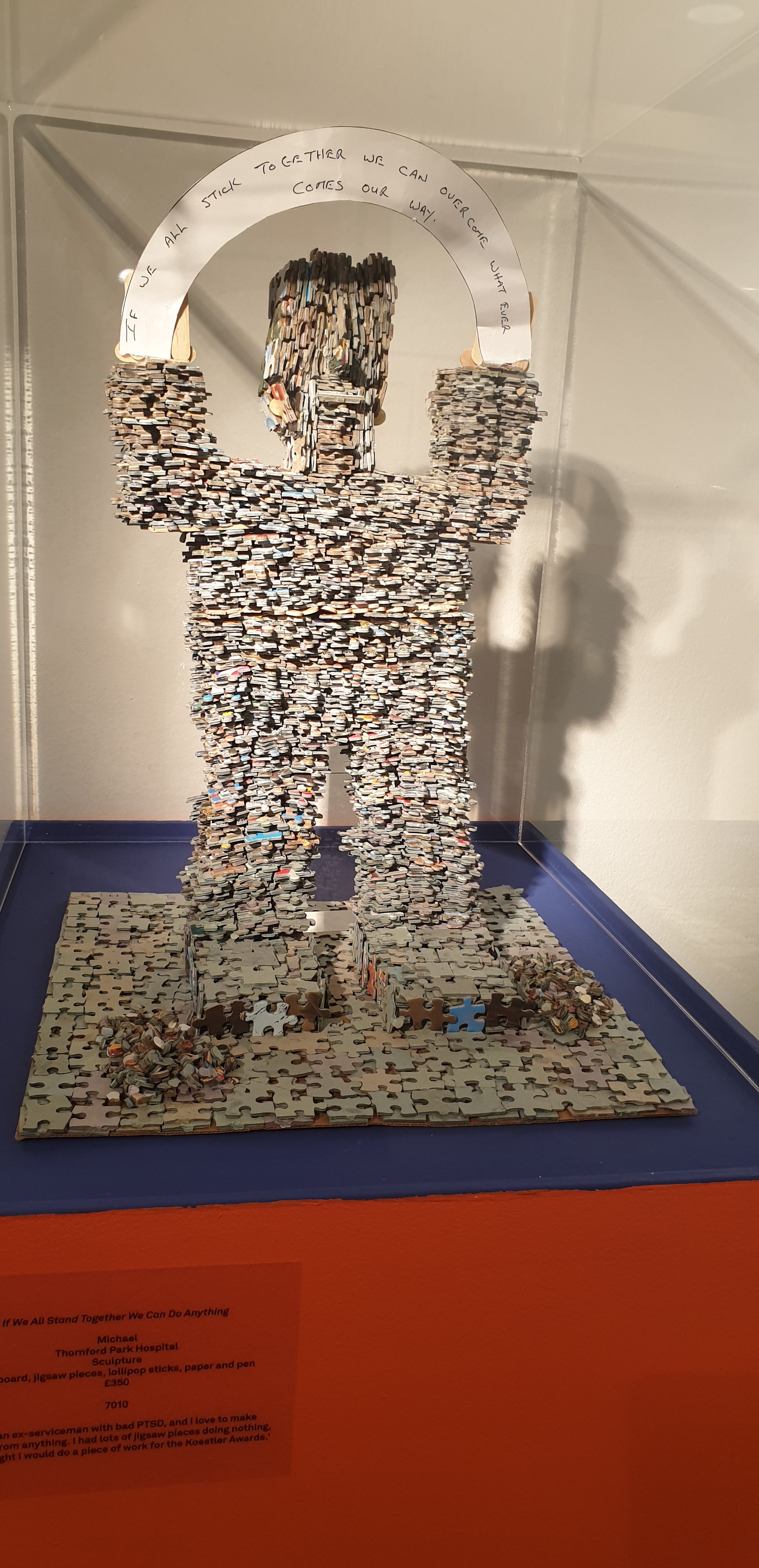
As I considered the work called ‘If We All Stand Together We Can Do Anything’ there is a sense of togetherness within this exhibition, maybe we can all learn from this simple sculpture. Thank you Michael.
Poetry

Walls
beyond these grilles
behind this door
and walls within my view
I’ve fought my demons
and done my time
ready to start anew.
I’ve used these bricks
to build new walls
and found something true
I’ll rise to freedom
And find my voice
Well beyond this view.
I sat on a bench in silent contemplation of these four verses, unmissable alongside other poems on the wall ahead of me.
It was well worth taking the time to read every carefully chosen word.
Here is talent. It has been unlocked.
~
‘The I and the We’ 2021 UK exhibition at Southbank Centre
Curated by Camille Walala and Sarah Ihler-Meyer
29 October – 5 December 2021. Mon – Wed 10am – 6pm, Thu – Sun 10am – 9pm*
Exhibition Space, Level 1, Royal Festival Hall, London
~

Who watches the Watchdog?
The website for the Independent Monitoring Board (IMB) states:
“Inside every prison, there is an Independent Monitoring Board (IMB) made up of members of the public from all walks of life doing an extraordinary job!
You’ll work as part of a team of IMB volunteers, who are the eyes and ears of the public, appointed by Ministers to perform a vital task: independent monitoring of prisons and places of immigration detention. It’s an opportunity to help make sure that prisoners are being treated fairly and given the opportunity and support to stop reoffending and rebuild their lives.”
Anyone can see this is a huge remit for a group of volunteers.
IMB’s about us page also states:
“Their role is to monitor the day-to-day life in their local prison or removal centre and ensure that prisoners and detainees are treated fairly and humanely”
Another huge remit.
For those who believe they can make a difference, and I have met a few who have, the joining process is quite lengthy.
Once you have completed the online application form, bearing in mind you can only apply to prisons which are running a recruiting campaign (that doesn’t mean to say there are no vacancies in others) the applicant is then invited for an interview and a tour of the prison.
So, what is wrong with that you may ask?
At this point NO security checks have been done, so literally anyone can get a tour of a prison, ask questions, and meet staff and prisoners.
This is surely a red flag.
And then there is the ‘interview’.
Two IMB members from the prison you have applied to and one from another prison take it turn in asking questions. It is basically a ‘tick box exercise’; I know this because I have been involved myself, sitting on both sides of the table.
It is based on scores, so if you are competent in interviews, you will do well. With IMB boards desperate for members it means that as long as your security check comes through as okay, you will have made it on to the IMB board.
However, no references are required to become a prison monitor. NONE.
A red flag too?
One of the main problems I encountered was that if the IMB board member comes from a managerial background they will want to manage. But the IMB role is about monitoring a prison and not managing it. I have seen where members and staff have clashed over this.
Well done, you made it on to the board, what next?
Back to the IMB website:
“You do not need any particular qualifications or experience, as we will provide all necessary training and support you need during a 12-month training and mentoring period”
The first year is the probationary year where you are mentored, accompanied, and trained. To be accompanied for this period is unrealistic, there are insufficient members having neither the time nor resources to get new members up to speed before they start monitoring.
In addition, induction training can be between 3-6 months after joining and can be said it is at best haphazard.
As reported Tuesday by Charles Hymas and others in The Telegraph newspaper, and citing a set-piece statement from the MOJ press office, “a spokesman said that although they had unrestricted access, they were given a comprehensive induction…”
I beg to differ; the induction for IMB board members is hardly comprehensive.
I believe this needs to change.
For such an essential role, basic training must take place before stepping into a prison. Yes, you can learn on the job but as we have seen recently, IMB members are not infallible.
Membership of the IMB is for up to 15 years which leads to culture of “we’ve always done it this way”, a phrase all too often heard, preventing new members from introducing fresh ideas.

What if something goes wrong?
Not all IMB members have a radio or even a whistle or any means of alerting others to a difficult situation or security risk. If for any reason you need support from the IMB Secretariat, don’t hold your breath.
The secretariat is composed of civil servants, MOJ employees, a fluctuating workforce, frequently with no monitoring experience themselves who offer little or no assistance. I know, I’ve been in that place of needing advice and support.
What support I received was pathetic. Even when I was required to attend an inquest in my capacity as a IMB board member no tangible help was provided and I was told that IMB’s so-called ‘care team’ had been disbanded.
From the moment you pick up your keys, you enter a prison environment that is unpredictable, volatile and changeable.
As we have seen this week, an IMB member at HMP Liverpool has been arrested and suspended after a police investigation where they were accused of smuggling drugs and phones into prison.
This is not surprising to me and may be the tip of the iceberg. IMB board members have unrestricted access to prisons and prisoners. As unpaid volunteers they are as susceptible to coercion as paid prison officers.
Radical change needs to be put in place to tighten up scrutiny of, and checks on, members of the IMB when they visit prisons either for their board meetings or their rota visits.
In 4 years of monitoring at HMP/YOI Hollesley Bay I was never searched, and neither was any bag I carried. In over 10 years of visiting prisons, I can count on one hand, with fingers to spare, the number of times I have been searched. When visiting a large scale prison such as HMP Berwyn I only had to show my driving licence and the barriers were opened.
Whilst the situation at HMP Liverpool is an ongoing investigation and whilst the outcome of the investigation is not yet known, I do urge Dame Anne Owers, the IMB’s national Chair, to look urgently at the IMB recruitment process, at the IMB training and at the provision of on-going support for IMB board members.
Complacency has no part in prisons monitoring.
~

Hidden Heroes: Why are they hidden and why are they heroes?
Today, 29 September 2021, is the second Hidden Heroes Day. An initiative of The Butler Trust it aims be “a National Day of Thanks for our #HiddenHeroes across the UK”. As well as Hidden Heroes Day, there is a dedicated website http://www.hiddenheroes.uk and social media account.
“While most media coverage of the sector focuses on the negative, the @HiddenHeroes_uk Twitter account is used to share positive stories about prisons, IRCs, probation and youth justice services, and the #HiddenHeroes who work in them.”
Why is it that our prisons, IRCs, probation, and youth justice services is apparently full of hidden heroes?
It is one thing calling them heroes, but why are they hidden?
Who has made them hidden and what is keeping them hidden?
Are they hiding and if so what from?
Are they hiding something or from something?
Are they hidden because they don’t want a fuss or hidden because they don’t want people to know?
In this day and age, why is the harsh reality of prisons so well hidden?
How can it be that the average person still knows so little about what is happening behind prison walls?
Direct experience
It has been more than 10 years since I first stepped into a prison. The unfamiliar surroundings can quickly intimidate and unsettle you, and the smell can be nauseating.

Back then, I had to hide my job role. Some of my thoughts on my way to do my monitoring rota at a prison once were: “I need to get petrol for the journey to work, so I had better put my belt and key chain in my bag this morning as I don’t think I am supposed to let anyone see it. No one has said anything, and I haven’t read any rules about it, but I’ve got a feeling that it should stay hidden until I get to the prison car park. That’s the thing about being a prison monitor, there seems to be so many unwritten rules and regulations.”
How many paid staff feel that they too must hide the job they do from others?
I remember visiting a high security prison, for an Independent Monitoring Board (IMB) tour of the prison. We walked together as a small group and headed into a workshop. It was an example of one of those mind-numbingly boring workshops found in nearly every prison where they perform so-called “purposeful activity”.
As we entered escorted by IMB volunteers I was told by a member of staff that within that large room there were two blind spots. In a hushed voice they said:
“We are not responsible for your safety if you walk into a blind spot.”
The problem was that they avoided telling us where the blind spots were, for fear of being overheard.
Is that what is meant by hidden?
Yes, it can be a dangerous for staff but so too for those living inside.
Prisoner-on-staff attacks are counted, and stats reported. And they should be. Prisoner-on-prisoner attacks are also counted, and stats reported and they should be too. But have you ever tried to get stats for staff-on-prisoner attacks?
Along with others, perhaps yourself included, I took the time to review the HM Chief Inspector of Prisons report in August 2021 on HMP Chelmsford. The report said:
“Almost half of the prisoners said they had been victimised by staff, and those with disabilities and mental health problems were significantly more negative.”
How can you call them hidden heroes when reading something like this?
Should that be hidden too?
Can those who do such things really be heroes?
Opinions differ
Whilst preparing this blog, I decided to ask people for their views on Hidden Heroes.
Dita Saliuka told me:
“Prison staff get the good coverage in the media most of the time anyway and the public praise them for ‘doing a difficult job’. It’s more the prisoners that are labelled all sorts whether they committed a horrendous crime or not people just say all sorts just because they are a prisoner. I hate the word ‘hidden heroes’ so much as PPO (Prison and Probation Ombudsman) and Inquest clearly state that most deaths are due to staff failures so how is that a heroic thing? It’s disrespectful to us families that have lost a loved one in prison due to their neglect, failures and staff abuse.”
Phil O’Brien, who has a 40-year career in the Prison system, told me:
“I think it’s an excellent initiative. It quite rightly concentrates on the positives. But sometimes doing the dirty stuff can be equally effective and necessary but can’t be ‘celebrated’ because it’s not as easy to explain, not as attractive or appealing.”
Tough at the top
We have probably all read in the media this past week that there is a new Secretary of State for Justice, Dominic Raab MP, appointed on 15 September in the reshuffle. But did you also see that he has been quite vocal on what he really thinks about prisons.
Mr. Raab has said: “We are not ashamed to say that prisons should be tough, unpleasant and uncomfortable places. That’s the point of them”
Compare that with the official line that Ministry of Justice takes: “We work to protect and advance the principles of justice. Our vision is to deliver a world-class justice system that works for everyone in society.” And, according to its 4 strategic priorities, “a prison and probation service that reforms offenders”
https://www.gov.uk/government/organisations/ministry-of-justice/about
We are yet to learn the full extent of who is hiding what from whom at Petty France.
Mr. Raab will have to confront a few bastions of power there which prefer things to be properly hidden.
End of the day
#HiddenHeroesDay will come and go. Some people burst with enthusiasm for it, raising lots of money for great causes and all that is, of course, to be commended.
But at the end of the day the fact remains that the enduring problem of the criminal justice system, and daily for frontline workers in particular, is the pervading culture which dictates that everything remains hidden.
If we are to celebrate anything, wouldn’t it be better to celebrate openness rather than that which is hidden?
But within the justice arena so many tragedies stay hidden. Too many lives ruined, too many suicides, too many people suffering with mental health issues. And it is worsening by the day. That is the stark reality. And the reason things are hidden.
The Butler Trust, in creating the initiative, no doubt has the best of intentions.
In celebrating Hidden Heroes Day are we not in fact perpetuating the very problem it is trying to solve?
~ ends ~

Guest blog: Being visible: Phil O’Brien
An interview with Phil O’Brien by John O’Brien
Phil O’Brien started his prison officer training in January 1970. His first posting, at HMDC Kirklevington, in April 1970. In a forty-year career, he also served at HMP Brixton, HMP Wakefield, HMYOI Castington, HMP Full Sutton, HMRC Low Newton and HMP Frankland. He moved through the ranks and finished his public sector career as Head of Operations at Frankland. In 2006, he moved into the private sector, where he worked for two years at HMP Forest Bank before taking up consultancy roles at Harmondsworth IRC, HMP Addiewell and HMP Bronzefield, where he carried out investigations and advised on training issues. Phil retired in 2011. In September 2018, he published Can I Have a Word, Boss?, a memoir of his time in the prison service.
John O’Brien holds a doctorate in English literature from the University of Leeds, where he specialised in autobiography studies.

You deal in the first two chapters of the book with training. How do you reflect upon your training now, and how do you feel it prepared you for a career in the service?
I believe that the training I received set me up for any success I might have had. I never forgot the basics I was taught on that initial course. On one level, we’re talking about practical things like conducting searches, monitoring visits, keeping keys out of the sight of prisoners. On another level, we’re talking about the development of more subtle skills like observing patterns of behaviour and developing an intimate knowledge of the prisoners in your charge, that is, getting to know them so well that you can predict what they are going to do before they do it. Put simply, we were taught how best to protect the public, which includes both prisoners and staff. Those basics were a constant for me.
Tell me about the importance of the provision of education and training for prisoners. Your book seems to suggest that Low Newton was particularly successful in this regard.
Many prisoners lack basic skills in reading, writing and arithmetic. For anyone leaving the prison system, reading and writing are crucial in terms of functioning effectively in society, even if it’s only in order to access the benefits available on release.
At Low Newton, a largely juvenile population, the education side of the regime was championed by two governing governors, Mitch Egan and Mike Kirby. In addition, we had a well-resourced and extremely committed set of teachers. I was Head of Inmate Activities at Low Newton and therefore had direct responsibility for education.
The importance of education and training is twofold:
Firstly, it gives people skills and better fits them for release.
Secondly, a regime that fully engages prisoners leaves less time for the nonsense often associated with jails: bullying, drug-dealing, escaping.
To what extent do you believe that the requirements of security, control and justice can be kept in balance?
Security, control, and justice are crucial to the health of any prison. If you keep these factors in balance, afford them equal attention and respect, you can’t be accused of bias one way or the other.
Security refers to your duty to have measures in place that prevent escapes – your duty to protect the public.
Control refers to your duty to create and maintain a safe environment for all.
Justice is about treating people with respect and providing them with the opportunities to address their offending behaviour. You can keep them in balance. It’s one of the fundamentals of the job. But you have to maintain an objective and informed view of how these factors interact and overlap. It comes with experience.

What changed most about the prison service in your time?
One of the major changes was Fresh Start in 1987/88, which got rid of overtime and the Chief Officer rank. Fresh Start made prison governors more budget aware and responsible. It was implemented more effectively at some places than others, so it wasn’t without its wrinkles.
Another was the Woolf report, which looked at the causes of the Strangeways riot. The Woolf report concentrated on refurbishment, decent living and working conditions, and full regimes for prisoners with all activities starting and ending on time. It also sought to enlarge the Cat D estate, which would allow prisoners to work in outside industry prior to release. Unfortunately, the latter hasn’t yet come to pass sufficiently. It’s an opportunity missed.
What about in terms of security?
When drugs replaced snout and hooch as currency in the 1980s, my security priorities changed in order to meet the new threat. I had to develop ways of disrupting drug networks, both inside and outside prison, and to find ways to mitigate targeted subversion of staff by drug gangs.
In my later years, in the high security estate, there was a real fear and expectation of organised criminals breaking into jails to affect someone’s escape, so we had to organise anti-helicopter defences.
The twenty-first century also brought a changed, and probably increased, threat of terrorism, which itself introduced new security challenges.
You worked in prisons of different categories. What differences and similarities did you find in terms of management in these different environments?
Right from becoming a senior officer, a first line manager at Wakefield, I adopted a modus operandi I never changed. I called it ‘managing by walking about’. It was about talking and listening, making sure I was there for staff when things got difficult. It’s crucial for a manager to be visible to prisoners and staff on a daily basis. It shows intent and respect.
I distinctly remember Phil Copple, when he was governor at Frankland, saying one day: “How do you find time to get around your areas of responsibility every day when other managers seem tied to their chairs?” I found that if I talked to all the staff, I was responsible for every day, it would prevent problems coming to my office later when I might be pushed for time. Really, it was a means of saving time.
The job is the same wherever you are. Whichever category of prison you are working in, you must get the basics right, be fair and face the task head on.
The concept of intelligence features prominently in the book. Can you talk a bit about intelligence, both in terms of security and management?
Successful intelligence has always depended on the collection of information.
The four stages in the intelligence cycle are: collation, analysis, dissemination and action. If you talk to people in the right way, they respond. I discovered this as soon as I joined the service, and it was particularly noticeable at Brixton.
Prisoners expect to be treated fairly, to get what they’re entitled to and to be included in the conversation. When this happens, they have a vested interest in keeping the peace. It’s easy to forget that prisoners are also members of the community, and they have the same problems as everyone else. That is, thinking about kids, schools, marriages, finances. Many are loyal and conservative. The majority don’t like seeing other people being treated unfairly, and this includes prisoner on prisoner interaction, bullying etc. If you tap into this facet of their character, they’ll often help you right the wrongs. That was my experience.
Intelligence used properly can be a lifesaver.
You refer to Kirklevington as an example of how prisons should work. What was so positive about their regime at the time?
It had vision and purpose and it delivered.
It was one of the few jails where I worked that consistently delivered what it was contracted to deliver. Every prisoner was given paid work opportunities prior to release, ensuring he could compete on equal terms when he got out. The regime had in place effective monitoring, robust assessments of risk, regular testing for substance abuse and sentence-planning meetings that included input from family and home probation officers.
Once passed out to work, each prisoner completed a period of unpaid work for the benefit of the local community – painting, decorating, gardening etc.
There was excellent communication.
The system just worked.
The right processes were in place.
To what extent do you feel you were good at your job because you understood the prisoners? That you were, in some way, the same?
I come from Ripleyville, in Bradford, a slum cleared in the 1950s. Though the majority of people were honest and hardworking, the area had its minority of ne’er-do-wells. I never pretended that I was any better than anyone else coming from this background.
Whilst a prisoner officer under training at Leeds, I came across a prisoner I’d known from childhood on my first day. When I went to Brixton, a prisoner from Bradford came up to me and said he recognised me and introduced himself. I’d only been there a couple of weeks. I don’t know if it was because of my background, but I took an interest in individual prisoners, trying to understand what made them tick, as soon as I joined the job.
I found that if I was fair and communicated with them, the vast majority would come half way and meet me on those terms. Obviously, my working in so many different kinds of establishments undoubtedly helped. It gave me a wide experience of different regimes and how prisoners react in those regimes.
How important was humour in the job? And, therefore, in the book?
Humour is crucial. Often black humour. If you note, a number of my ex-colleagues who have reviewed the book mention the importance of humour. It helps calm situations. Both staff and prisoners appreciate it. It can help normalise situations – potentially tense situations. Of course, if you use it, you’ve got to be able to take it, too.
What are the challenges, as you see them, for graduate management staff in prisons?
Credibility, possibly, at least at the beginning of their career. This was definitely a feature of my earlier years, where those in the junior governor ranks were seen as nobodies. The junior governors were usually attached to a wing with a PO, and the staff tended to look towards the PO for guidance. The department took steps to address this with the introduction of the accelerated promotion scheme, which saw graduate entrants spending time on the landing in junior uniform ranks before being fast-tracked to PO. They would be really tested in that rank.
There will always be criticism of management by uniform staff – it goes with the territory. A small minority of graduate staff failed to make sufficient progress at this stage and remained in the uniform ranks. This tended to cement the system’s credibility in the eyes of uniform staff.
Were there any other differences between graduate governors and governors who had come through the ranks?
The accelerated promotion grades tended to have a clearer career path and were closely mentored by a governor grade at HQ and by governing governors at their home establishments and had regular training. However, I lost count of the number of phone calls I received from people who were struggling with being newly promoted from the ranks to the governor grades. They often felt that they hadn’t been properly trained for their new role, particularly in relation to paperwork, which is a staple of governor grade jobs.
From the point of view of the early 21stC, what were the main differences between prisons in the public and private sectors?
There’s little difference now between public and private sector prisons. Initially, the public sector had a massive advantage in terms of the experience of staff across the ranks. Now, retention of staff seems to be a problem in both sectors. The conditions of service were better in the public sector in my time, but this advantage has been eroded. Wages are similar, retirement age is similar. The retirement age has risen substantially since I finished.
In my experience, private sector managers were better at managing budgets. As regards staff, basic grade staff in both sectors were equally keen and willing to learn. All that staff in either sector really needed was purpose, a coherent vision and support.
A couple of times towards the end of your book, you hint at the idea that your time might have passed. Does your approach belong to a particular historical moment?
I felt that all careers have to come to an end at some point and I could see that increasing administrative control would deprive my work of some of its pleasures. It was time to go before bitterness set in. Having said that, when I came back, I still found that the same old-fashioned skills were needed to deal with what I had been contracted to do. So, maybe I was a bit premature.
My approaches and methods were developed historically, over the entire period of my forty-year career. Everywhere I went, I tried to refine the basics that I had learned on that initial training course.
Thank you to John O’Brien for enabling Phil to share his experiences.

~

A Conversation with: Keith Fraser, Chair of the Youth Justice Board

In July 2020 you were appointed as a Commissioner to a new Commission on Race and Ethnic Disparities, what do you hope to bring to the table?
My professional and personal experiences, rooted in supporting many charities, being part and in and around the criminal justice system for just over 34 years, our independence of thinking and hopefully visionary approach which is not dependent on the support and expectations of others.
Young people’s pipeline to youth justice services – impact of words and actions, we have more power than we realise. Can you expand on this?
As my knowledge of people, children, adults, increases, I’m actually getting to understand the science better behind human relationships and also our development. The maturity of a person’s brain is not fully developed until the age of 24 years. Therefore, any interactions that we have with a person during that 24-year period, can have and does have a significant impact on their development and their actions. It’s possible to physically change the wiring of a person’s brain, when it’s in that developmental stage. Basically, people under the age of 25 are likely to be less risk averse, more impulsive, take risks and more easily influenced by their peers and their surroundings.
Children are children whether they are in the justice system, or not. Their vulnerabilities, education, keeping them safe and supporting them into a future life whether they feel part of society is important for all children.
Look for the potential, don’t judge young people by their sibling’s actions, there is a better way. A few points you recently raised with me. Can you give examples?
This is just as a result of people I have met who told me about many instances in which they have been judged because of the behaviour of their siblings. E.g., their sibling could be in and around the justice system and they get seen through the same lens as this sibling. I remember one individual who told me about how teachers judged him because of his brother and their expectations of him were reduced as a result. It was one teacher who showed that they cared which enabled him to go on and complete a degree, even though it appeared that the teachers in secondary school had written off.
What matters to you?
Family, friends, loyalty, trustworthiness and sticking up for those that others might overlook and seen the value in people.
Trust is especially important, you mentioned in a previous conversation that during our afternoon of talking and sharing together a level of trust was built up between us, can you expand on this?
Trust is important to me, it’s one of my values, being trustworthy. I have seen throughout my life how trust has helped to make things happen and the lack of trust or broken trust has made things happen slower or stop things from happening at all. This is true of my personal life and my professional life.
What drives you?
I have an absolute passion for life and for people.
I love people and am fascinated by the different outcomes for different people and what can be done to improve and change that. I’m a real people person which found this lockdown extremely difficult. Meeting people via video call is better than telephone conferencing but it has been difficult over the last year to reduce my level of face-to-face engagement with the different people I meet.
You appear to have a drive for order in your life, is that a true picture?
I don’t think I have a drive for order, my mind is just on fire and I’m excited about the possibilities and problem solving and making things better. It can be a little bit difficult for others to deal with and I feel that it is a central part of my dyslexic brain. I take ownership of my active mind and not try to curb it. Many people can’t deal with the number of ideas and things that I like to talk about or get involved in.
My personality type, using the Myers Briggs indicator is I NTJ, which is introverted – energised by quiet times alone (some might find that surprising) intuitive – sees patterns and possibilities, thinking prioritise logic and reason and judging – prefer structure and order.

How do you compartmentalise your life?
Since I left the police, I found it important to put more structure around how I interact with the world. I’ve had to create strategic bubbles and objectives so that I can understand what I am doing and why. Five years prior to leaving the police I created three strategic bubbles which I now use for the next chapter in my life.
1 – spend time doing the things I like doing such as family and friends, hobbies…
2 – I want to spend a certain amount of my time giving to others in whatever way I can provide benefit, whether it be through a charity, or supporting an individual…
3 – I’d also like to spend time in various paid roles or developing ideas but always ensuring that the things I get involved in sit with my values.
My dyslexic brain doesn’t really struggle with putting things into compartments if I ask it to. I don’t get too stressed out about having a lot of things on, in a certain way it excites me and stimulates me.
Your parents instilled values in you, how has that enabled you in life?
Not just by parents, when you have a loving upbringing and a loving extended family, it provides you with an inner strength and a strong sense of your own values. I was told on numerous occasions I love you by my aunties and sometimes my uncles. Even my cousins would say privately to me that they love me when someone says that to you and you are not expecting it, it is really powerful in a positive way.
Does your drive and determination also come from your parents?
The short answer is yes, although I didn’t realise it until later on in life. People kept on asking me what drives you, what keeps you so passionate, so positive and caring about others. When I was younger, I remember having a conversation with my father “you are going to have to work four times as hard as others to get on”, a conversation that has stayed with me. Once I joined the police, he would always tell people I was one rank above the rank I saw a sense of pride on his face and a little bit of mystery, but he helped drive my career in policing.
When I went for my interview as Superintendent, I wore my dad’s suit, which is older than me, and when I joined the Youth Justice Board and had my first official photograph, I wore one of my dad’s ties. I suppose it was a way of remembering him and keeping him near me although he isn’t physically with me, but up and definitely in heaven.
What obstacles did you encounter with your dream of being a police officer?
Not sure what obstacles I encountered; I was focused from an early age. I first wrote to the Home Office and sent in an application form when I was either 13 or 14. Some unknown civil servant took the time to write a letter to me personally, to encourage me to reapply when I was 18½ and send some information about joining the police. That was enough to continue and drive my passion and vision and becoming a police officer.
I suppose some of the barriers I had I failed getting into the police cadets and I didn’t get into the West Midlands police when I first applied. That is why I went to London. I loved my time in London and I have made really amazing friends. But 20 years later they recognised the error of their ways haha and accepted me as a Chief Inspector and I retired as Superintendent in my home region, where I was born and bred and that filled me with a sense of pride.
“Just get on with it and don’t make a fuss” is that your attitude?
I don’t realise that I have that attitude, but it’s when things are pointed out to you, you realise that’s what you are like.
I remember once during my lunch break, I was getting my car tax from the post office, I was in my civilian suit. Two men armed with a knife in the queue in front of me, attacked another man in an unprovoked and violent way. The post office was rammed with people, I dived at the person with the knife. It was quite a nasty struggle and I was on my own. The whole post office emptied with just one member of the public staying behind to help. When backup arrived, I went back to the office and continued with my work. It wasn’t until the criminal investigation department or CID rang to speak with me that my colleagues in the office found out what had happened. They were shocked that I calmly walked back into the office and got on with my work without saying anything. I was commended by the judge at court and by a senior police officer for my actions.
I suppose getting on with it without making a fuss has its pros and cons, it can lead to people overlooking you and not realising what you are capable of. It is not within my nature to make a fuss of publicity, it’s not my natural environment and I’m definitely not in my comfort zone.
Tell me about your fundraising ventures
I have created an informal organisation consisting of me and whoever I can get to partner with me – it’s called overcoming your challenges to achieve. We have raised, around £33 – £35,000 for different charities such as Sport Birmingham, Birmingham and Solihull women’s aid, Care of police survivors. All achieved through abseiling down one of Birmingham’s tallest buildings. I’m terrified of heights and it didn’t get easier the second time round; in fact, it was worse because I knew what to expect even though I was supported by an amazing para-athlete Christopher Skelley.
I have also been locked in cells overnight and completed Birmingham’s 13 peak challenge raising money for a young child with brain cancer.
Currently I am trying to raise, with others just over £3 million to build a Cenotaph to remember and say thank you to team 999 and all those who are part of our emergency services.

What makes you happy/laugh?
Now this is a hard one I do laugh a lot or smile a lot. I have a very dry and sarcastic sense of humour, which I must control, because it’s not everybody’s cup of tea.
Things that make me happy are celebrating family occasions such as birthdays, christenings, also the similar type of things with friends. I enjoy socialising chatting with friends, I love a good debate about current affairs and enjoy objective conversations about what makes the world tick, I think sometimes people find these conversations hard, because they often overlap people values and what they believe.
What makes you cry?
I have found as I get older that some of the injustices and suffering that I see on the news have made me cry, it never used to, but I see more and more how people suffer because of an accident at birth or where they live, rather than anything that they have done in their lives. Those that have made others suffer upset me, especially when you hear the back stories behind the faces you see on the news, I find that extremely difficult to deal with. I do also have tears of joy rather than sadness. I have only cried in work once and that was when I told my line manager, I was dyslexic, and the response floored me.
Who inspires you and how can you or do you inspire others?
People in general inspire me, not just those who have achieved a significant level of fame, but also ordinary people who deal with ordinary issues on a day-to-day basis. Many people I interacted with as a police officer have left a trace on me and supported my onward journey and development. These people have touched and strengthened my life. I might let you Faith answer that question about how I inspire others, I always find that quite difficult to answer, but people have said I’m inspirational and different and I have a positive impact on their lives, but I don’t realise it until people say it. So, it would be nice to hear what you Faith have seen in me and hopefully that doesn’t feel like a copout.

You seem to take all decisions carefully, retirement plans 5 years in advance, exit strategy, giving back, life split into strategic areas very upfront on what work/time you can commit to. If you reach saturation point you are no use to anyone. Is this a good summary of you?
I do think ahead, which is a benefit and a challenge. If I get behind the vision, I’m very passionate about achieving it, but I also have to be aware that my passion may put people off. I am constantly trying to reassure people that just because I’m passionate doesn’t mean I can’t change my mind… It has its downsides too, for example if my vision goes against the prevailing thinking. If it’s irrational and/or unfair I find it difficult to follow, even if it’s policy, law, et cetera. It does not mean that I would go against policies and laws without understand the consequences of them.
I’m not a maverick an organisation cannot trust, but I am prepared to stand up to things which are unfair.
‘The Grass Arena’ by John Healy
‘The Grass Arena’ by John Healy is a book centred round a world I thankfully have never ventured into – either by choice or circumstance. Drink, drugs, vagrancy, death, prostitution and money – the somewhat graphic portrayal of a life I can only describe as ‘brutal’.

A daily struggle for life itself, for the breath to breathe and the sustenance to give strength is a battle many start but then give up, as hurdles become visible, barriers are built and prejudice is rife. Drink becomes an obsession. I am sure we have all at some point tried to look through the window of others’ lives. We analyse their behaviour; we penalise whilst categorising them, we pity them. Not forgetting we compare their misfortune with our own accomplishments.
We read about them. Some use it as research to further their own life chances whilst disregarding the people involved. Some may find it entertaining; others as a measure of how they personally are doing, or how far they have failed. For myself, when reading about others there is an element of intrigue of course, but it’s more than that. I do not like small talk, its uncomfortable. I want facts and meaningful conversations. That is true communication.
This book communicates.
I frequently read about people’s journeys in life.
We all have a story to tell and I am eager to listen.
I have met many authors with fascinating quotes and anecdotes and maybe one day I will have the opportunity of meeting John. It was hard to put down this autobiography, an often harrowing account mirrored by the lines on my forehead, my furrowed brow. It is intense, it is absorbing yet thought provoking in a greater sense than most books on my shelves.
“Life was becoming more complicated. I was back in the old routine: stealing, drinking, fighting, my probation order, car insurance, detectives. I was pulling so many strokes for drink that I could not remember what I was doing…”
The stories of Fred, Dipper, Spikey and more carry merit, lives entwined with a common desire in life. Their struggles, contentions, crusades, rivalry and exploitations all add to the chart laid out in front of us.
“We look at people with only one thought. How can we get the price of a drink out of them? Looking, always looking, even when there is nothing to observe”.
An obsession leading to a lifestyle and a painful path trodden – alcohol picking you off one by one becomes a dangerous liaison. Yet seeing others fall is no way to interrupt the cycle, there is no end in sight, its continuous. I tried not to interpret my initial thoughts, the “if only”, “but” or even “what if” can become a distraction.
I just read. The shady doorways, the open green spaces, the derelict houses and the public houses all feed John’s obsession. Recovery from excess is quick and the thought of drink is always on his mind and he will do anything to take the constant battle, the weight on his shoulders and the voice in his ear, away.
This book is about a fight for survival, the many characters described within it are people trying to get through trauma, abuse and hopelessness. Many do not make it through.
Prison, I would not wish on anyone, I have visited enough to know they are not holiday camps, never have been and never will be. They are dangerous places. Here in ‘The Grass Arena’ they imitate the chaotic world that John is in. Familiar faces, familiar stories, and familiar issues to deal with.
Is it possible to escape from the grip of an obsession – even in prison? I read with impatience, asking that question many times.
Can John break free?
Does he want to break free?
Slowly but surely his obsession is substituted, by a game of chess. Yes chess, a game often associated with money, with brilliant minds; not a wino living each day for the dangerous toxic thrill of a drink.
A good book impacts you, challenges you, and this book is no exception, but it does leave the reader wanting more.
As I wrote earlier, it is a window into many lives and now the onus is on the reader to decide what to do next…
first published, Insidetime November 2020

2020 need I say more…
A retrospective of 2020
The author Peter Mayle once wrote “The year began with lunch…” which pretty much mirrored mine, although for me it started on Aldeburgh beach in the freezing cold, eating chips, and surrounded by family celebrating my birthday.
Cambridge is a favourite place of mine, having spent hours in libraries, museums and taking in the splendour of the architecture. So in February when I was invited to a seminar in the Institute of Criminology (IoC), I immediately responded. I have entered that building many times, studied in their library, attended seminars and even had tea in Professor Bottom’s office.
The subject was ‘Can Prisons Rehabilitate?’, delivered by Yvonne Jewkes. Rehabilitation is a subject I have thought long and hard about. Whilst awaiting the start, I received a very warm welcome from Rebecca L. Greene, Artist in Residence at IoC. It was good to catch up with those I hadn’t seen for a while, chat to Ben Crewe and have some interesting conversations with students who were keen to engage with me.
Months later Rebecca kindly invited me to take part in the digital exhibition Drawing Connections at the edges, Arts in Prison at the Museum of Cambridge following on from the Festival Of Ideas: Arts in Prisons, what changes can they bring? in 2019. The title to consider was “How did lockdown make you feel?” drawing on experiences of lockdown relating to the perception of my work with people within the Criminal Justice System. For my contribution I decided to write a poem:
Dare I compare my lockdown to theirs?
Can I not reach out to those in prison to manage my isolation and to draw on their resources to get through this challenging time?
Perhaps this has been a way to understand their hopes, fears and feelings too, leading to a breakdown of mental and spiritual barriers between us.
No longer is it just about reaching out to those in prison, instead it is an opportunity for us to be reached out to, from those within the prison walls.
Their voices illuminating
Their voices resonating
Their voices compelling
Are we not all part of society?
Has lockdown reinforced this?
Can freedom come from within and can freedom come from without?

I invited Rebecca to say a few words for inclusion in this retrospective and this is what she wrote:
“I was honoured to be asked by Faith Spear to write a short piece on how we met for her blog: as the year which has proved challenging and complex for everyone in myriad ways draws to a close, it seems hard to believe it was only in February of 2020. We met, when I welcomed her to a Public Seminar presented by Professor Yvonne Jewkes’ Can Prisons Rehabilitate?, hosted by the Institute of Criminology, my place of work. Faith’s ability to speak clearly and concisely has meant her work is something I have taken an interest in since my first engagement with the CJS through Learning Together in 2016. The material Faith shares on Justice and Social matters is done so, I feel, with fairness and truth and since our meeting this has been further enhanced through a shared love of the Arts and their restorative qualities.” (Rebecca L. Greene)
Poetry played a major role in my activities this last year. After being approached by Gerry Hamill, @FirstTimeInside, I became a panel member and part of a community for a Hidden Voices project with HMP Edinburgh. This was a poetry competition open to men and women entitled ‘Saughton Sonnets‘. The prisoners were asked to express their feelings on lockdown and Covid-19 and how they have been affected by this crisis. For 5 weeks a new batch of poems were sent to us to judge, score and comment on. Each weeks winners were then scored to find an overall winner. It was brilliant to work alongside other community members and to discover the amazing potential in those that are so often overlooked. The finale was to see these sonnets in print and to hear how those that had taken part had been encouraged to continue to write.
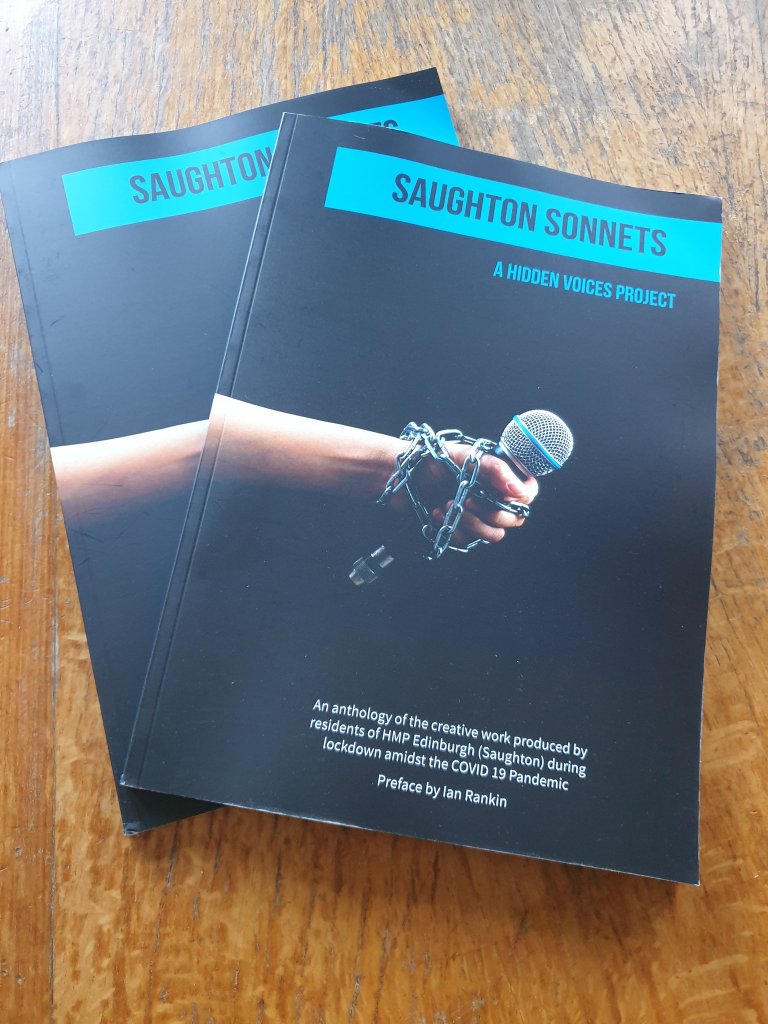
Writing is steadily becoming a passion for me, and I have been fortunate enough to have two book reviews printed in the InsideTime newspaper:
In June 2020 edition: ‘Can I have a word Boss’ written by Phil O’Brian after 40 years within Her Majesty’s Prison Service. His passion and drive come across in every chapter. Sadly, this kind of experience is now fading as his calibre is being replaced by those with little experience in the world, let alone within the justice arena. Is this a good thing? Only time will tell.
In November 2020 edition: ‘The Grass Arena‘ written by John Healy is a book centred round a world I thankfully have never ventured into – either by choice or circumstance. Drink, drugs, vagrancy, death, prostitution and money – the somewhat graphic portrayal of a life I can only describe as ‘brutal’. This book was recommended to me by Charlie Ryder after having read a blog I wrote the previous year “A Conversation with: Erwin James“.
Erwin kindly sent that review to John Healy and days later I received a supportive and positive response from John inviting me to keep in touch.
Sadly many conversations have not been face to face, with numerous events cancelled, meetings postponed and travelling almost non existent. Instead we have all embraced/tolerated/accepted, zoom, video calls and the old fashioned just picking up the phone to communicate. For example, I had a zoom call with Chris Daw QC, quizzing him on his new book ‘Justice on Trial‘ and trying to find the answers to so many questions I had.
During the year, I have written about two conversations with amazing individuals and their enthralling journeys in life.
The first was “A Conversation with: Phil Forder“, we chatted for hours, a remarkable man. When I asked “Who is Phil Forder?” the response was brilliant:
“My job title is community engagement manager at HMP Parc but as you so rightly said previously. ‘There is more to an individual than their job.’ I’m also a painter writer and woodcarver. LGBT rights supporter. Environmentalist Nature lover. Lecturer, etc.

But in a nutshell
“Just a bloke doing what I think is right and enjoy doing”
I asked Phil if he would like to say a few words for inclusion in this retrospective. This is Phil’s contribution:
“Over the years I had read so much about conditions in prisons on social media, most of it not good, that as a person who works in one I decided to launch my own account in 2017. Although a lot of what was being written about was true, I also knew there was another side to it where positive initiatives and positive people were striving to make a difference under increasingly difficult circumstances. So I put my head above the parapet, using my own name, and began to try and show another side to prison life, of which examples were daily. Twitter can be a pretty ugly place as I soon found out. There were times aplenty I was disheartened and tempted to stop as I began to receive flack from all directions but then I noticed it wasn’t all bad as a lady called Faith was following me and what’s more she had started retweeting my work and making constructive comments too. Although not alone in doing so, as there were others, that constant support was, and still is, invaluable in putting out the work that I do. As anyone who follows Faith will know, she is pretty fearless in her pursuit of Truth and not someone to take lightly. But what is so refreshing, especially on social media, is to hear a voice that is not only honest and always well-thought out but one that is objective and well-balanced too. Through her insights, Faith has proved herself, again and again, a valuable member of the prison community that we are lucky to have in such a complex prison system. And as for me personally, she continues to be a constant source of inspiration and support”
My second “A Conversation with Dr Sarah Lewis, Director of Penal Reform Solutions” was equally inspiring. I felt that her overall message was one of HOPE:
Sarah said: I believe in people
I don’t quite believe in the system yet.
I have hope in individuals.
I believe in them.
We need to be actively hopeful in people. Let them know “I believe in you”
I have hope in people.
We talked about rehabilitation, complexities within the prison estate, radical reforms and so much more. But the question to her that I received the most feedback on was: “Do we need more research on prisons, are there gaps or do we need to push for changes based on existing knowledge?”
Sarah’s reply:
“Yes to both. We know enough to know what works. The difficulty is how we apply that knowledge. Academia needs to move out of its ivory tower and on to the shop floor. There’s plenty of research, you need to create a growth environment (climate) and capture this impact with understanding. Research takes so long, from ethics approval to peer review to publication. More creativity is needed with research, capture stories, motivate staff.
Academic research needs creativity, inclusion, and we must learn from our mistakes”
As I have mentioned before, we all know the saying ‘action speaks louder than words’ yet often you have to speak before any action can take place. So this year I was pleased to work together with a number of charities in the justice sector to write a consultation submission to the Ministry of Justice. In addition, I have offered advice and encouragement, assisted in media articles, proof read books, edited web sites and also shared a bit more of my story for Female Leaders At 50 – Women Behind the Network Series.
But the cherry on the cake for me was to be invited to write the forward for a book. Phil Martin published in November ‘The People in Prison and their Potential: Insights into imprisonment and true stories of rehabilitation’. As I have discovered for myself, the potential in prisons is vast and this book highlights what can be achieved. We appeared to be on the same wavelength here. Those with convictions do have potential, deserve to be given opportunities and can be valuable members of society. Many are willing to change but are we willing to accept them?
This is just a snippet of what became a challenging year both personally and professionally. Yet I enter this new year 2021 with anticipation, a renewal of energy and a continued determination in speaking truth to power. I will not be on mute.
In the context of a blog like this, it’s possible to only mention a fraction of the workload, time and miles covered. For obvious reasons you will appreciate I’m unable to share the full extent of everyone I have met or all that has been done.
~

A Conversation with: Dr Sarah Lewis, Director of Penal Reform Solutions
In her Twitter bio it states: A passionate prison reformer. Interests: collaborative research, personal growth, creative action research, relationships, Nordic prisons, prison reform.
Just reading this I knew we would have a connection and a great conversation together.
What does it mean to you to be a prison reformer?
What I do has meaning, consumes me, its a purpose that is constantly in my blood and mind.
Collaboration matters to me, so does inclusion and having an unconditional regard for people. My inspiration comes from Elizabeth Fry, however, there are many with her passion. We need to work together to make a collective impact, not rely on one individual to drive change in prisons. I also believe that reform is not only situated in prisons, but in the community at large.
I don’t want to consistently bash the Criminal Justice System, but we need to be realistic about the problems whilst instilling hope. We need to meet people where they are at.
Prison reform needs to be a social movement in order to create a climate outside of raising awareness and drawing people together for a common purpose.
Prisons can be a transformative place.

Do we need any more research on prisons, are there gaps or do we just need to push for changes based on existing knowledge?
Yes to both.
We know enough to know what works. The difficulty is how we apply that knowledge. Academia needs to move out of its ivory tower and on to the shop floor. There’s plenty of research, you need to create a growth environment (climate) and capture this impact with understanding. Research takes so long, from ethics approval to peer review to publication. More creativity is needed with research, capture stories, motivate staff.
Academic research needs creativity, inclusion, and we must learn from our mistakes.
Do you see yourself as an academic?
Yes, but I’m a bit of an odd ball in academia, being an academic is part of my identity, but it doesn’t define me.
You mention personal growth, can you elaborate on this?
Growth for me is inclusion, growth in the community and families. People can reform, but you need to create hope and invest in unconditional relationships.
Growth, which includes love, acceptance and trust is also about unconditional support, nurturing and building relationships.
How important is it to establish relationships with prisoners/prison staff?
It’s everything
From determing the level of trust, to how people talk about their feeings, their fears and trauma. It’s the key to prison reform, desistance, cleanliness, safe environment, trust and many more…
What are some of the elements from the Nordic prisons that can be easily incorporated into prisons in England and Wales?
To never enter a prison and think people are broken with no hope.
Would you describe yourself as resilient?
I’m strong through stubbornness, but I am focused on what I want to achieve. Resilience means you bounce back, I’m susceptible to tiredness and pain due to health conditions, but this won’t stop me. I refuse to give in, so by overcoming obstacles I adapt to my environment.
Where does your strength come from?
My husband is my rock, my team, friends and importantly my sense of direction.
In an article in the InsideTime newspaper, June 2020, Sarah stated:
“My lifelong mission is to create a more humane system, which provides conditions where people can find meaning, have hope in the future and be happy”
In relation to this statement where do you see the prisons in England and Wales?
We are far away from that, further than we think. We have the ability to change, yet we underestimate the collaborative abilty of staff and prisoners alike. Culture and climate are important. A more humane system will not happen on its own, we need investment and training.
I have 100% hope in the future, that’s my logic.
We want people to live and not just survive.
With your work in schools, do you believe it is possible to instil meaning, hope and happiness into children’s lives?
Absolutely
From my experience it is easier to teach children than adults. The idea of the “Growth Project” at Guys Marsh was one of nurture, principle of growing and a purpose and peace in children. Divert them from prison by focusing on these building blocks around relationships, in order to protect them in later life.
You mentioned the “Growth Project”, how did this come about and how do you see it progressing?
The Norway Project took place in 3 Norwegian prisons and started as a photographic exhibition about how I captured collaboration. I spent 3 years researching Norwegian prisons and during the fieldwork I created a research team to understand their exceptional prison practices and priciples of growth. Out of this the Growth Project was born in England and Wales. We now have a collection of passionate people forming a steering group with prisoners and their families involved. We discuss issues such as diversity and inclusion in both prisons and society alike.
The aim of the “Connection Campaign” is to bring the inside and outside together, how are you managing to break down the walls to achieve this?
We are looking at where there is disconnection and the needs of young people. We magnify a voice that is quiet from various criminal justice areas. But we are not about blaming or shaming prisons. We wanted senior management to have conversations with prisoners families. Our strategy is to meet people where they are at and how to be a bit more compassionate, a critical friend.
Is rehabilitation possible within the current prison set up?
They need to be habilitated in the first place. Rehabilitation is a managerialistic term which often sets people up to fail. Like a game of trying to catch people out which is not conducive to change and no growth can happen. It can be harmful as no one wins.
Do we need radical reforms, if so what are the possibilities, if not, why not?
We need an authentic meaningful longterm investment in those principles that are encouraged in the Nordic model, applying the principles of growth in a meaningful way within our own context.
Irrespective of ideology, we want to strive for a just and humane system. This needs to happen, we need to change the narrative around prisons, prisoners and prison staff. But it must be sensitively executed. It’s not just about success stories.
Working within the prison estate can be rewarding but also can be disappointing, exhausting and demoralising. How do you deal personally with the complexities you face?
I see and hear a lot of stuff. However, I have such a strong mission.
Yes it is. Absolutely.
We have lost 2 growth members, 1 person through suicide after prison and 1 whilst he was in prison. It was a painful experience, I knew their families and the ripple effect was hard because their lives matter.
The question I really wanted to ask Sarah was: Is your underlying message of hope?
I believe in people.
I dont quite believe in the system yet.
I have hope in individuals.
I believe in them.
We need to be actively hopeful in people. Let them know “I believe in you”
I have hope in people.
 The Criminal Justice Blog