Home » crime and punishment (Page 2)
Category Archives: crime and punishment

HOPE FOR JUSTICE FOR IPP PRISONERS AS LABOUR LORDS BACK AMENDMENTS
BACKGROUND
IPP sentences were introduced in England and Wales by the New Labour government with the Criminal Justice Act 2003, as it sought to prove it was tough on law and order. They were put in place to detain indefinitely serious offenders who were perceived to be a risk to the public. However, they were also used against offenders who had committed low-level crimes.
Astonishingly, this sentence has led to some people spending 18 years in jail for trying to steal a coat or imprisoned for 11 years for stealing a mobile phone.
UNLAWFUL
In 2012, after widespread condemnation and a ruling by the European court of human rights that such sentences were, “arbitrary and therefore unlawful”, IPP terms were abolished by the Conservative government. But the measure was not retrospective, and thousands remain in prison.
Over 90 people serving sentences under the discredited IPP regime have sadly taken their own lives whilst in prison. In 2023 we saw the second year in a row of the highest number of self-inflicted deaths since the IPP sentence was introduced.
The former supreme court justice Lord Brown has called IPP sentences: “the greatest single stain on the justice system”. When Rt Hon Michael Gove MP was justice secretary, he recommended, “executive clemency” for IPP prisoners who had served terms much longer than their tariffs. But he didn’t act on it. Lord Blunkett, the Labour Home Secretary who introduced the sentences, regrets them, stating: “I got it wrong.” And more recently, Dr Alice Edwards, the UN rapporteur for torture has called IPP sentences an “egregious miscarriage of justice.” Even the Justice Secretary Rt Hon Alex Chalk KC MP has also called them a stain on the justice system, despite that, the Government has so far refused to implement the Justice Committees recommendation to re-sentence all prisoners subject to IPP sentences.
CAMPAIGN FOR SOCIAL JUSTICE
Campaign groups and their families have been fighting to end this tragic miscarriage of justice for more than a decade and now a film posted online by social media campaigner Peter Stefanovic, a lawyer and CEO of CAMPAIGN FOR SOCIAL JUSTICE has ignited a wider public storm on this tragic miscarriage of justice and has been viewed 14 million times. It is not surprising that the public reaction to this film has been one of shock, outrage, and disbelief.

PUBLIC SUPPORT
Stefanovic said:
“The public support for my film has been overwhelming and the comments it is getting are a testament to the public’s anger, outrage and disbelief at this tragic miscarriage of justice. If Labour step up and back the amendments supported in the Lords by both Lib Dem and Green Party peers we can end this tragedy now. It’s time to do what we all know is right before more lives are tragically lost.”
HOUSE OF LORDS DEBATE
His film was mentioned by Baroness Jones, Lord Moylan and Baroness Fox in the House of Lords debate on March 12.
HOPE FOR JUSTICE
Hope for justice at last now comes in the form of amendments tabled in the House of Lords to the Victims and Prisoners Bill, two of which are particularly significant – 161 by Lord Moylan and 167 by Baroness Fox which have the backing of the Lib Dems and Green Party peers, and which have wide cross bench support.
AMENDMENTS
Amendment 167 seeks to implement the Justice Committees recommendation to re-sentence all prisoners subject to IPP sentences.
Amendment 161 would require the state to demonstrate that a prisoner is still a risk to the public rather than, as at present, requiring the prisoner to prove the opposite.
Under the proposed amendment, they would be released unless the Parole Board “is satisfied that it remains necessary and proportionate for the protection of the public from serious harm that they should continue to be confined”.
Amendment 161 is supported by Lord Blunkett, Baroness Chakrabarti and the former deputy president of the Supreme Court Lord Hope of Craighead. It is also supported by the Bar Council, representing 17,000 barristers in England and Wales.
On amendment 161 Lord Ponsonby, leading for Labour, said in the debate which took place in the House of Lords on 12 March.
“Lord Moylan in his amendment 161 effectively reversing the burden of proof for IPP prisoners described it as a nudge to the parole board and discussed in his contribution how significant that nudge would be but it’s a welcome nudge nevertheless, and he has the historic credentials of being supported originally by Lord Brown. It’s a welcome amendment.”
Voting on the amendments will take place in the coming weeks. If Labour vote for them this is finally a real opportunity to put right an egregious miscarriage of justice.

Joe Outlaw, an IPP: In his own words. Part 2: A call to Action.
You may remember back in April 2023 a prisoner staged a 12-hour protest on the roof of Strangeways prison about the injustice of IPP prisoners. His name is Joe Outlaw, 37 years old and with 33 previous convictions. I was sent his story…this is part 2
A call to action
I feel like even though I have given you a lot of information on my life growing up and my opinions on what’s wrong with the IPP crisis, I haven’t really gone into the pains and sorrows of the things that I’ve had to endure. Reasons for this, I would say that it’s deep memories and wounds to revisit. I’m in a place of strength and resilience at the moment and use the support I’ve managed to generate through campaigning. This is what keeps me focused and faithful.
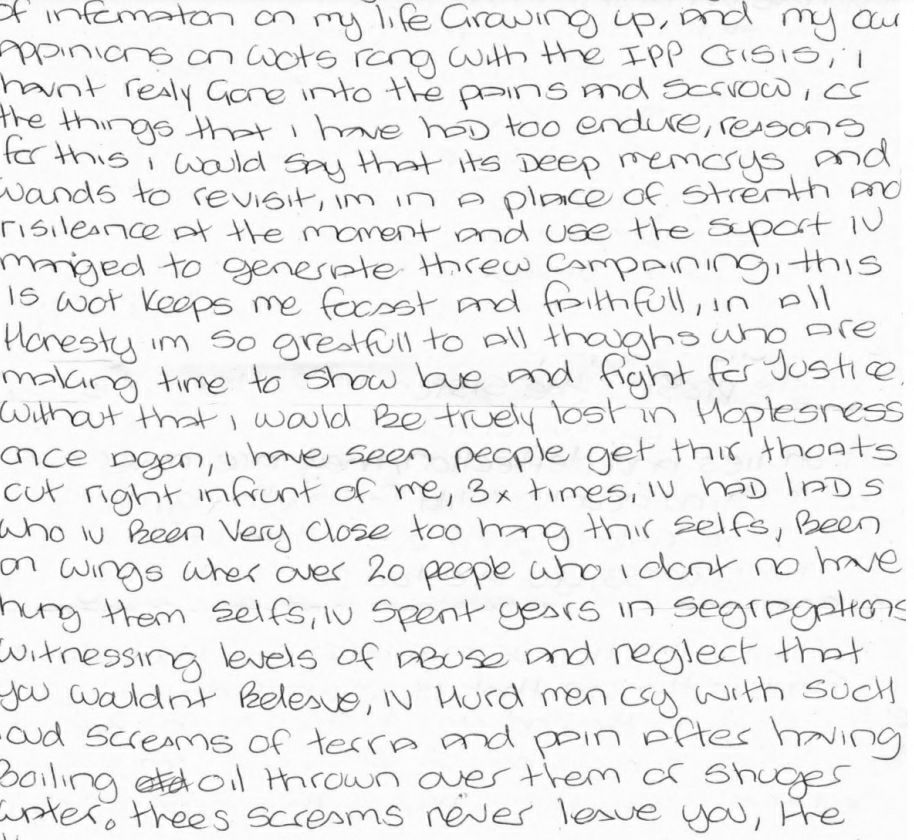
In all honesty, I am so grateful to all making time to show love and fight for justice. Without that I would be truly lost in hopelessness once again.
Three times I’ve had lads, who I have been very close hang themselves. I’ve been on wings were over 20 people who I don’t know have hung themselves. I’ve spent years in segregation witnessing levels of abuse and neglect that you wouldn’t believe. I’ve heard men cry with such loud screams of terror and pain after having boiling oil thrown over them or sugar water. These screams never leave you.
The things I have seen and witnessed stay with me in my dreams and have given me such darkness in my life.
So many people witnessed these things and feel what I feel but hide it all away. We are expected to just deal with it as normal prison life. When the truth is, over time embeds such levels of trauma that ultimately, we begin to slowly get PTSD and some of the violence blood and neglect, it’s not so different from a war zone. Some jails have a better handle than others, but the vast majority all hide the real problems from those who may have an opinion on what’s right or wrong. I’ve been at the depths of my despair countless times, tried to take my own life two times and have cried so many tears that I know cry no more. I’ve lost four family members in four years, all in the same week in December. My dad cancer, my granny heart attack, my sister pneumonia, my cousin brain aneurysm.
This IPP is destroying everyone it touches and people refuse to even try to admit the problems.
The system is broken.
It is not a place of change and rehabilitation; it is a place built on lies and deflection. They are never ever in the wrong, no accountability for anything. People over analyse risk to such levels that you feel lost and hopeless, you are told not to challenge and take responsibility. Yet you read and see reports that you know are lies or mistakes, but your view or input is the one that is always doubted or discredited.
In the end you just give up because the fight for honesty and truth is too much, it is soul destroying.
To go through this process every day, every year, every parole hearing, every single report, course after pointless course which studies have proven make no difference, anyway. Once you really learn about the system, live it, feel it, see its horrors and evil ways, you soon realise that you have no hope or trust in it at all and all you can do is try your best to not let it destroy the good in you.
As the IPP movement grows stronger and stronger, that is my only true hope that I can trust in.
Them people who see what I see and feel what I feel are my only salvation.
People grow and walk many different paths in life, but it is not a person’s mistakes that should define them, but their continued actions afterwards that would truly show one’s character. Please do not be quick to judge, then disregard those solely because they are in prison. Don’t be so naive to follow those who act as though they are perfect in their own actions. There are beautiful people in prison. People who have family and loved ones, people who are really capable of so much potential, but they are made to feel rejected. Hopeless. Trapped in an environment fuelled by drugs and violence.
We see and lose faith in politics on a daily basis, so much corruption and greed.
Lies are spoken by politicians so much that all this does not surprise us anymore. Well, the same lies are spoken when it comes to taking accountability for the prison crisis. There are 1000s of people illegally trapped in our own prisons in the UK, yet because these people made mistakes in life’s journey, society seems not to care. Please try to see clearer, look at what is happening to sons, dads, brothers and mums and so on. They are not so different from anyone else and they do not deserve to be tortured in a broken system for years on end.
Taxpayers pay millions a year for a criminal justice system under the impression that they are keeping people safe, rehabilitating people etc. It’s all a lie. Please believe me. I’ve seen and felt the disgusting treatment for too many years now. People are moulded into files on computers. That is not the person who is actually there, false information listed down until it builds an image of someone that is so off from reality. All totally avoidable.
IPPs are suffering souls that are sadly being destroyed day by day.
Who takes the responsibility for the violence that we see and endure. Who takes the responsibility for the damage and scars on people’s hearts and skin.
Do you all know every jail in the UK has got rid of countless education classes, the decline in courses within the prison system is shocking.

Drones bring drugs and weapons and phones in Windows nightly. I do believe that if you take someone’s life, you should be put in jail for life. Child Killers and women killers, etc should all rot in sorrow for their sins. But for someone who stole a mobile phone? How long should he get? Someone who was a drug addict and burgled a house. How long should they get? We all got 99 years a life sentence. How is that right? I am not evil I am not violent.
I made a mistake and now I’m being killed for that mistake mentally, physically, and emotionally killed.
Do what is right and join the fight to make a change, join the fight to make a difference. I can promise you that if you don’t already know about IPP prisoners, take 10 minutes that’s all, look it up and I have faith the people in this country will see the injustice and do what’s right.
You may think what can I do though, I’m not a politician.?
Doing something is better than doing nothing.
Join the movement to make a change for all the souls that have left this world through IPP, and for all the souls still suffering every day.
Kindness and love,
Joe Outlaw.
Video Igniting Public Storm On IPP Sentencing Scandal Hits 14 Million Views
A video that has been posted online by campaigner, lawyer and the CEO of Campaign for Social Justice Peter Stefanovic has ignited a public storm by bringing the issue of the IPP sentencing scandal to a wide audience.
Now on a staggering 14 million views the following are typical of the comments it is getting,
“Truly shocking”
“Absolutely horrifying”
“Unbelievable”
“Utterly awful”
“Madness”
“inconceivable”
“cruel”
There has been overwhelming public support for this film which has manifested in an online petition signed by thousands which has forced the Government to respond.
Peter Stefanovic, a social media sensation, said:
“The public support for my film has been overwhelming & the comments it is getting are a testament to the public’s anger, outrage & disbelief at this tragic miscarriage of justice. If Labour step up next week and back the amendments supported in the Lords by both Lib Dem and Green Party peers we can end this tragedy now. It’s time to do what we all know is right before more lives are tragically lost”
IPP sentences were introduced in England and Wales by the New Labour government with the Criminal Justice Act 2003, as it sought to prove it was tough on law and order. They were put in place to detain indefinitely serious offenders who were perceived to be a risk to the public. However, they were also used against offenders who had committed low-level crimes.
Astonishingly, this sentence has led to some people spending 18 years in jail for trying to steal a coat or imprisoned for 11 years for stealing a mobile phone.
In 2012, after widespread condemnation and a ruling by the European court of human rights that such sentences were, “arbitrary and therefore unlawful”, IPP terms were abolished by the Conservative government. But the measure was not retrospective, and thousands remain in prison.
90 people serving sentences under the discredited IPP regime have sadly taken their own lives whilst in prison. In 2023 we saw the second year in a row of the highest number of self-inflicted deaths since the IPP sentence was introduced.
The former supreme court justice Lord Brown has called IPP sentences: “the greatest single stain on the justice system”. When Rt Hon Michael Gove MP was justice secretary, he recommended, “executive clemency” for IPP prisoners who had served terms much longer than their tariffs.
But he didn’t act on it.
Lord Blunkett, the Labour home secretary who introduced the sentences, regrets them, stating: “I got it wrong.” And more recently, Dr Alice Edwards, the UN rapporteur for torture has called IPP sentences an “egregious miscarriage of justice.” Even the Justice Secretary Rt Hon Alex Chalk KC MP has also called them a stain on the justice system but the Government has so far refused to implement the Justice Committees recommendation to re-sentence all prisoners subject to IPP sentences.
CAMPAIGN FOR SOCIAL JUSTICE
Campaign groups & their families have been fighting to end this tragic miscarriage of justice for more than a decade and now the film posted online by Peter Stefanovic has ignited a wider public storm on this tragic miscarriage of justice. The public reaction to it his film has been one of shock, outrage, and disbelief.
HOPE FOR JUSTICE
Hope for justice at last now comes in the form of 2 amendments tabled in the House of Lords to the Victims & Prisoners Bill (161 & 167) by Lord Moylan which are backed by the Lib Dems and Green Party peers, and which have wide cross bench support.
Amendment 167 seeks to implement the Justice Committees recommendation to re-sentence all prisoners subject to IPP sentences. Amendment 161 would require the state to demonstrate that a prisoner is still a risk to the public rather than, as at present, requiring the prisoner to prove the opposite. Under the proposed amendment, they would be released unless the Parole Board “is satisfied that it remains necessary and proportionate for the protection of the public from serious harm that they should continue to be confined”.
Amendment is 161 is supported by Lord Blunkett, Baroness Chakrabarti & the former deputy president of the Supreme Court Lord Hope of Craighead. It’s also supported by the Bar Council, representing 17,000 barristers in England and Wales. The outpouring of public support generated by Stefanovic’s video adds further pressure on Keir Starmers Labour to step up and act by backing the amendments tabled by Lord Moylan that are supported by Lib Dem and Green Party peers.
With Labour support this stain on our justice system can finally be ended,
NOW.
The amendments above will be debated in the House of Lords on 12 March.
Let’s not wait for an ITV drama to do the right thing.
Let’s not sit by whilst more tragically lose their lives. We must act now & we must act URGENTLY.

IPP sentence: Risk of more suicides highlights urgent need for political parties to work together to end tragic miscarriage of justice.
It’s shocking when you realise that 90 people serving sentences under the discredited IPP regime have sadly taken their own lives whilst in prison. In 2023 we saw the second year in a row of the highest number of self-inflicted deaths since the IPP sentence was introduced.
But many have now been given renewed hope, not just by a film posted online by campaigner and CEO of Campaign for Social Justice Peter Stefanovic, which has ignited a storm by bringing the issue to wider public attention with over 13 million views online, but also by the groundswell of public support it has generated and the thousands who have signed a petition forcing the government to respond. Yet more importantly renewed hope has also come through the amendments now tabled in the House of Lords. We cannot not allow that hope to be lost, the risk of further tragedy is far too great.
HOPE FOR JUSTICE
Hope for justice at last now comes in the form of 2 amendments tabled in the House of Lords to the Victims & Prisoners Bill (161 & 167) by Lord Moylan which are backed by the Lib Dems and Green Party peers, and which have wide cross bench support.
Amendment 167 seeks to implement the Justice Committees recommendation to re-sentence all prisoners subject to IPP sentences.
Amendment 161 would require the state to demonstrate that a prisoner is still a risk to the public rather than, as at present, requiring the prisoner to prove the opposite.
Under the proposed amendment, they would be released unless the Parole Board “is satisfied that it remains necessary and proportionate for the protection of the public from serious harm that they should continue to be confined”.
Amendment is 161 is supported by Lord Blunkett, Baroness Chakrabarti & the former deputy president of the Supreme Court Lord Hope of Craighead. It’s also supported by the Bar Council, representing 17,000 barristers in England and Wales.
We must all urge Labour to back the amendments tabled by Lord Moylan that are supported by Lib Dem and Green Party peers. With Labour support we can end this stain on our justice system, NOW.
Let’s not wait for an ITV drama to do the right thing. Let’s not sit by whilst more lose their lives.
We must act now & we must act URGENTLY.

As IPP film hits 13 million views new figures scupper Government argument against resentencing.
IPP sentences were introduced in England and Wales by the New Labour government with the Criminal Justice Act 2003, as it sought to prove it was tough on law and order. They were put in place to detain indefinitely serious offenders who were perceived to be a risk to the public. However, they were also used against offenders who had committed low-level crimes.
Astonishingly, this sentence has led to some people spending 18 years in jail for trying to steal a coat or imprisoned for 11 years for stealing a mobile phone.
In 2012, after widespread condemnation and a ruling by the European court of human rights that such sentences were,
“arbitrary and therefore unlawful”,
IPP terms were abolished by the Conservative government. But the measure was not retrospective, and thousands remain in prison. Sadly, many have taken their own lives.
The former supreme court justice Lord Brown has called IPP sentences:
“the greatest single stain on the justice system”.
When Rt Hon Michael Gove MP was justice secretary, he recommended,
“executive clemency”
for IPP prisoners who had served terms much longer than their tariffs. But he didn’t act on it. Lord Blunkett, the Labour home secretary who introduced the sentences, regrets them, stating:
“I got it wrong.”
And more recently, Dr Alice Edwards, the UN rapporteur for torture has called IPP sentences an
“egregious miscarriage of justice.”
Even the Justice Secretary Rt Hon Alex Chalk KC MP has also called them a stain on the justice system but the Government has so far refused to implement the Justice Committees recommendation to re-sentence all prisoners subject to IPP sentences.
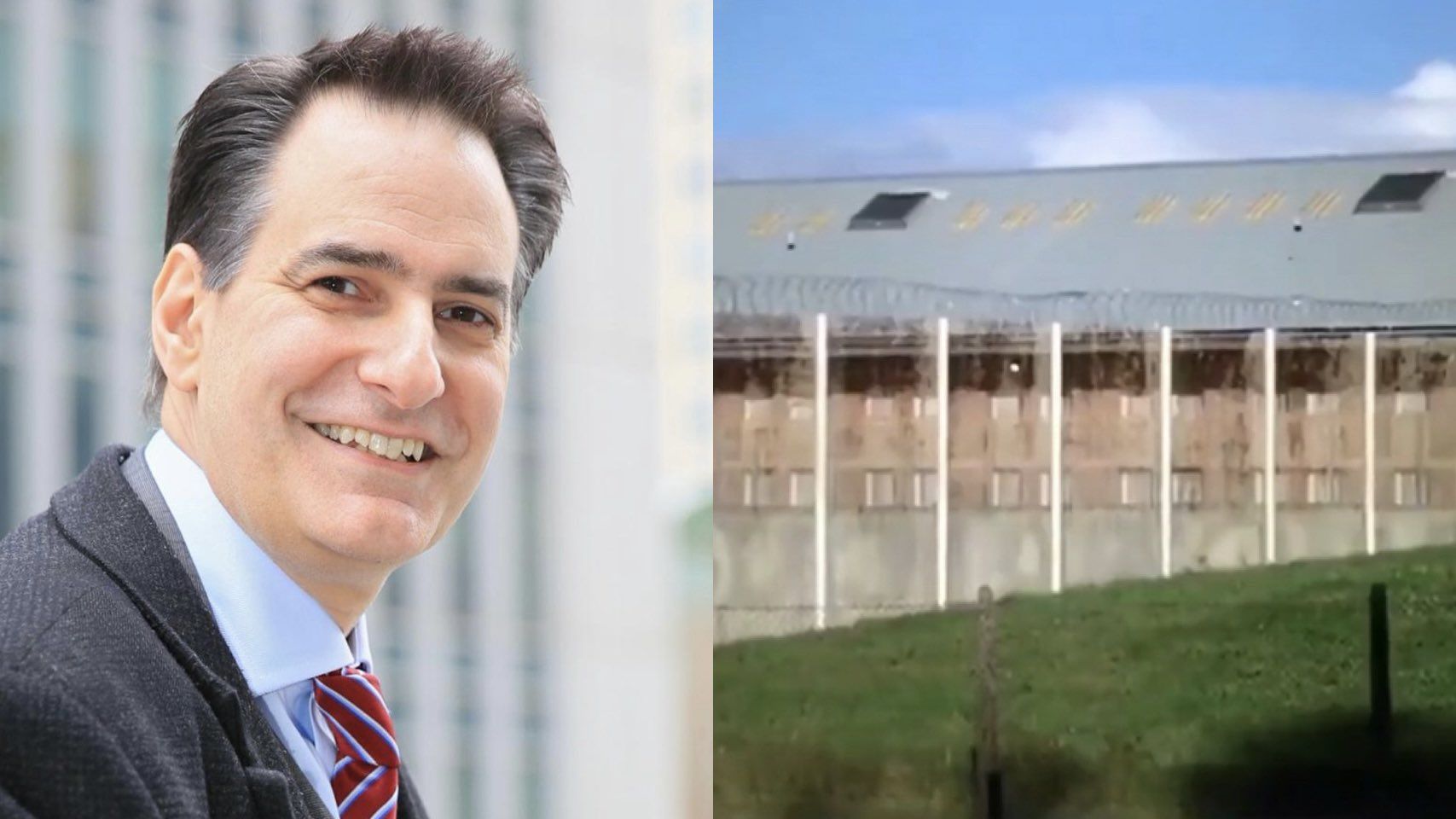
Campaign groups & their families have been fighting to end this tragic miscarriage of justice for more than a decade and now a film posted online by media sensation and CEO of Campaign for Social Justice Peter Stefanovic has ignited a storm by bringing the issue to wider public attention. It has already had over 13 million views online and the public’s reaction to it has been one of shock, outrage, and disbelief.
Despite calls from parliament’s own Justice Select Committee – which said the sentence was “irredeemably flawed” and had caused “acute harm” to those serving them – the government has resisted calls to resentence remaining IPP prisoners, citing concerns for public safety.
But new figures obtained by SKY News through a Freedom of Information (FOI) appear to scupper the Government’s argument against resentencing. The request shows only 83 IPP prisoners who have been released since 2012 have been convicted of a serious further offence (SFO) upon or after their release, including those who may have been released, recalled back to custody and rereleased.
The figure represents just 1.7% of the 4,776 IPP prisoners who have been released since the sentence was abolished, although the Ministry of Justice (MoJ) has said this does not account for those who have been recalled back into custody. The new figures appear to make a mockery of the government’s argument against implementing the primary recommendation of parliament’s own Justice Select Committee for re-sentencing those serving IPP sentences.
The Labour Party is still to clarify its position on this issue.
However, in a letter written by Kevin Brennan MP- now Shadow Minister for Victims and Sentencing and sent to the then Secretary of State for Justice, The Rt Hon Dominic Raab MP in March 2023 he outlines a meeting with Bernadette Emerson, a constituent of his, concerning her husband in prison under an IPP sentence. In the third paragraph, Kevin Brennan MP stated,
“It was the correct thing to do when the government abolished these sentences in 2012”, but as you will be aware there is a terrible legacy issue of injustice for those who are effectively serving a life sentence despite having been convicted of a crime that carried a fairly low tariff”.
Mr Brennan MP continued his letter:
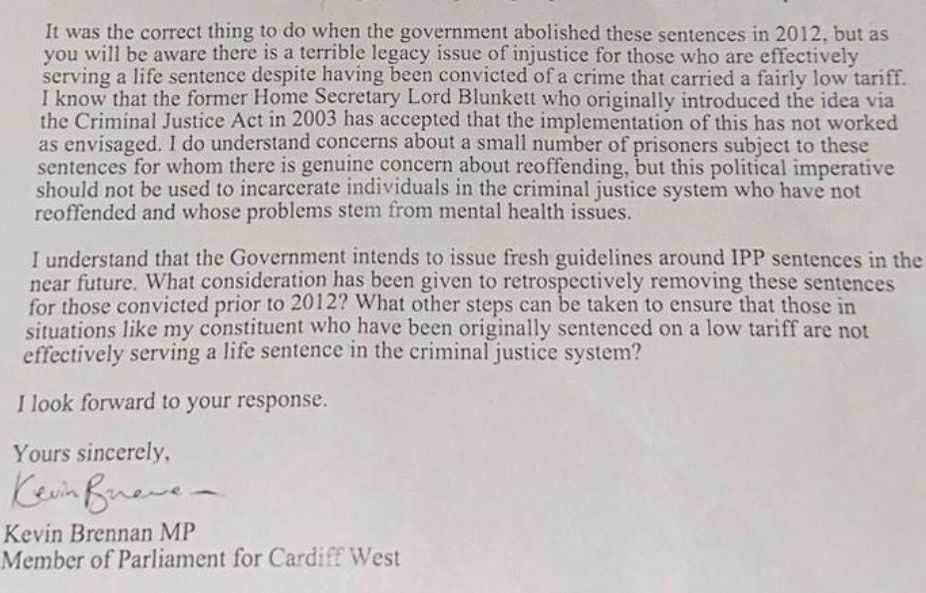
“I know that the former Home Secretary Lord Blunkett who originally introduced the idea via the Criminal Justice Act in 2003 has accepted that the implementation of this has not worked as envisaged. I do understand concerns about a small number of prisoners subject to these sentences for whom there is genuine concern about reoffending, but this political imperative should not be used to incarcerate individuals in the criminal Justice system who have not reoffended and whose problems stem from mental health issues.”
Mr Brennan MP goes on to ask the question,
“What consideration has been given to retrospectively removing these sentences for those convicted prior to 2012?”
What Mr Brennan MP says is both welcome and not surprising given this tragic miscarriage of justice has sadly already taken many lives.
But the position of the Labour Party on this egregious miscarriage of justice is now in question.
On 6th December, during the second reading in the House of Commons of the Victims and Sentencing Bill, Chair of the Justice Committee, Conservative MP Sir Bob Neill, proposed “new clause 1” which would add a resentencing exercise to the Bill in line with the Justice Committees long standing recommendation. Sir Neill’s proposed amendment would help to end this accepted miscarriage of justice.
However, Kevin Brennan MP, surprisingly, given his letter just a few months earlier, opposed the idea, saying:
“Unfortunately, given the impact of the Government’s effective destruction of the criminal justice system, we lack the infrastructure and resources to keep the public safe, should his new clause be implemented immediately. Our priority is, and always must be, the safety of the British public. We are concerned that if new clause 1 were enacted without provisioning for significant improvements in probation and parole, we would potentially significantly increase the risk to the public and to the prisoners themselves.”
However, the new data now obtained by SKY News will add pressure on Labour to get behind the Justice Committee recommendation for resentencing.
HOPE FOR JUSTICE
Hope for justice at last now comes in the form of 2 amendments tabled in the House of Lords to the Victims & Prisoners Bill (161 & 167) by Lord Moylan which are backed by the Lib Dems and Green Party peers, and which have wide cross bench support.
Amendment 167 seeks to implement the Justice Committees recommendation to re-sentence all prisoners subject to IPP sentences.
Amendment 161 would require the state to demonstrate that a prisoner is still a risk to the public rather than, as at present, requiring the prisoner to prove the opposite.
Under the proposed amendment, they would be released unless the Parole Board “is satisfied that it remains necessary and proportionate for the protection of the public from serious harm that they should continue to be confined”.
Amendment is 161 is supported by Lord Blunkett, Baroness Chakrabarti & the former deputy president of the Supreme Court Lord Hope of Craighead. It’s also supported by the Bar Council, representing 17,000 barristers in England and Wales.
This is finally a real opportunity to put right an egregious miscarriage of justice. But for the amendments, backed by both Lib Dem & Green Party peers (as well as many cross benchers) to succeed, Labour front bench support will be needed. Hopefully the new data obtained by SKY News will embolden Labour to do the right thing.
The question now is whether Keir Starmers Labour party will step up for justice or will we have to wait for ITV to produce another compelling drama series like Mr Bates vs The Post Office?

Is the IPP Prisoner scandal the next Mr. Bates vs the Post office?
IPP sentences were introduced in England and Wales by the New Labour government with the Criminal Justice Act 2003, as it sought to prove it was tough on law and order. They were put in place to detain indefinitely serious offenders who were perceived to be a risk to the public. However, they were also used against offenders who had committed low-level crimes.
Astonishingly, the sentence has led to some people spending 18 years in jail for trying to steal a coat or imprisoned for 11 years for stealing a mobile phone.
In 2012, after widespread condemnation and a ruling by the European court of human rights that such sentences were “arbitrary and therefore unlawful”, IPP terms were abolished by the Conservative government. But the measure was not retrospective, and thousands remain in prison. Sadly, many have taken their own lives.
The former supreme court justice Lord Brown has called IPP sentences “the greatest single stain on the justice system”. When Rt Hon Michael Gove MP was justice secretary, he recommended “executive clemency” for IPP prisoners who had served terms much longer than their tariffs. But he didn’t act on it. Lord Blunkett, the Labour home secretary who introduced the sentences, regrets them, stating: “I got it wrong.”
And more recently, Dr Alice Edwards, the UN rapporteur for torture has called IPP sentences an “egregious miscarriage of justice.”
Even the Justice Secretary Rt Hon Alex Chalk KC MP has also called them a stain on the justice system but the Government has so far refused to implement the Justice Committees recommendation to re-sentence all prisoners subject to IPP sentences.
CAMPAIGN FOR SOCIAL JUSTICE
Campaign groups & their families have been fighting to end this tragic miscarriage of justice for more than a decade and now a film posted online by campaigning lawyer and CEO of CAMPAIGN FOR SOCIAL JUSTICE Peter Stefanovic has ignited a storm by bringing the issue to wider public attention. It has already had over 12 million views online and the public’s reaction to it has been one of shock, outrage, and disbelief.

The Labour Party is still to clarify its position on this issue. However, in a letter written by Kevin Brennan MP- now Shadow Minister for Victims and Sentencing and sent to the then Secretary of State for Justice, The Rt Hon Dominic Raab MP in March 2023 he outlines a meeting with Bernadette Emerson, a constituent of his, concerning her husband in prison under an IPP sentence.
In the third paragraph, Kevin Brennan MP stated,
“It was the correct thing to do when the government abolished these sentences in 2012”, but as you will be aware there is a terrible legacy issue of injustice for those who are effectively serving a life sentence despite having been convicted of a crime that carried a fairly low tariff”.
Mr Brennan MP continued his letter:
“I know that the former Home Secretary Lord Blunkett who originally introduced the idea via the Criminal Justice Act in 2003 has accepted that the implementation of this has not worked as envisaged. I do understand concerns about a small number of prisoners subject to these sentences for whom there is genuine concern about reoffending, but this political imperative should not be used to incarcerate individuals in the criminal Justice system who have not reoffended and whose problems stem from mental health issues.”
Mr Brennan MP goes on to ask the question,
“What consideration has been given to retrospectively removing these sentences for those convicted prior to 2012?”
What Mr Brennan MP says is both welcome and not surprising given this tragic miscarriage of justice has sadly already taken many lives.
But the position of the Labour Party on this egregious miscarriage of justice is now in question.
On 6th December, during the second reading in the House of Commons of the Victims and Sentencing Bill, Chair of the Justice Committee, Conservative MP Sir Bob Neill, proposed “new clause 1” which would add a resentencing exercise to the Bill in line with the Justice Committees long standing recommendation. Sir Neill’s proposed amendment would help to end this accepted miscarriage of justice.
However, Kevin Brennan MP, surprisingly, given his letter just a few months earlier, opposed the idea, saying:
“Unfortunately, given the impact of the Government’s effective destruction of the criminal justice system, we lack the infrastructure and resources to keep the public safe, should his new clause be implemented immediately. Our priority is, and always must be, the safety of the British public. We are concerned that if new clause 1 were enacted without provisioning for significant improvements in probation and parole, we would potentially significantly increase the risk to the public and to the prisoners themselves.”
So where does Labour stand?
Surely the Labour Party can’t possibly be suggesting that “given the impact of the Government’s effective destruction of the criminal justice system” it plans to continue and perpetrate a gross miscarriage of justice? Was Mr Brennan perhaps referencing in December only the “small number of prisoners subject to these sentences for whom there is genuine concern about reoffending.”
HOPE FOR JUSTICE
Hope for justice at last now comes in the form of 2 amendments tabled in the House of Lords to the Victims & Prisoners Bill (161 & 167) by Lord Moylan which are backed by the Lib Dems and Green Party peers, and which have wide cross bench support.
Amendment 167 seeks to implement the Justice Committees recommendation to re-sentence all prisoners subject to IPP sentences.
Amendment 161 would require the state to demonstrate that a prisoner is still a risk to the public rather than, as at present, requiring the prisoner to prove the opposite.
Under the proposed amendment, they would be released unless the Parole Board “is satisfied that it remains necessary and proportionate for the protection of the public from serious harm that they should continue to be confined”.
Amendment is 161 is supported by Lord Blunkett, Baroness Chakrabarti & the former deputy president of the Supreme Court Lord Hope of Craighead. It’s also supported by the Bar Council, representing 17,000 barristers in England and Wales. This proposed amendment also appears to allay any concerns previously expressed by the Labour Party front bench.
This is finally a real opportunity to put right an egregious miscarriage of justice. But for the amendments, backed by both Lib Dem & Green Party peers (as well as many cross benchers) to succeed, Labour front bench support will be needed.
The question now is whether Keir Starmers Labour party will step up for justice and do the right thing or will we have to wait for ITV to produce another compelling drama series like Mr Bates vs The Post Office?

Joe Outlaw, an IPP: In his own words, part 1.
You may remember back in April 2023 a prisoner staged a 12-hour protest on the roof of Strangeways prison about the injustice of IPP prisoners. His name is Joe Outlaw, 37 years old and with 33 previous convictions. I was sent his story…
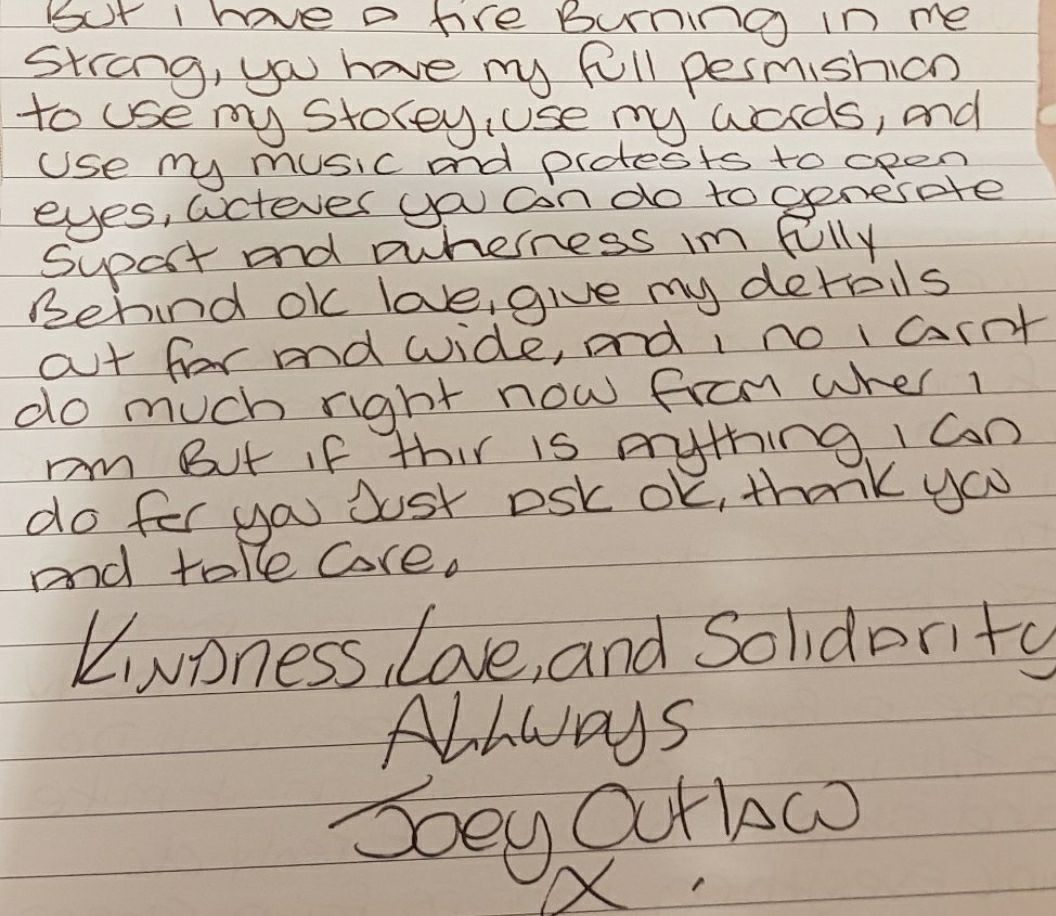
This is his story, in his own words
My story began in Bradford, Sunny West Yorkshire, and one of two children. The other being my sister Jill. At the start was a typical council estate life in the late 1980s. My Mom tried her best to bring us up as well as she could, but was cursed sadly by manic depression, what they now call bipolar. But this was not a fashion statement back then, it was dangerous and scary to witness. My Father was a gypsy from Hungary who never honoured his responsibilities as a father. Instead choosing to do a David Copperfield and disappear.
My sister was seven years older than me and would soon become my mum to be. By age three social services were involved and after one of my mom’s manic episodes, it was too dangerous for them to risk leaving us there. We were both placed on a full care order, which would cave the path years of painful memories I wish I could erase. Thankfully, they kept and Jill together in a wide range of foster parent, children’s homes and respite carers. Jill tried her best and I’m grateful for all the love she gave despite having to deal with her own sorrow as a young woman.
By the time she was 18 she had to leave me and that’s when I went off the rails. Constantly running away, and naively feeling more secure on the streets.
This stage of teenage growth embedded criminal dynamics to my survival and behaviour.
By fourteen social services basically gave up on me and I tell no lies when I say I was put in a B&B to live by myself, and no homes would take me. I was on a full care order until eighteen. Yet they lacked the support, guidance and interventions to raise me as expected. This happen twice, once in Shipley, West Yorkshire, and once in Wales at fifteen.
My criminality and reckless actions would continue for years.
I will say though, I was never a violent young offender. It was always nicking cars, motorbikes stealing etc. More a thief then a robber. I never sadly did manage to become rooted. I was always galivanting around the country, place to place. From twelve to nineteen life was an adventure, me a tent and a dog. Somehow, I always managed to pick up a stray for somewhere. I’ve always found animals and nature amazing. As a child I would find comfort and solace in beings alone in woods or on beaches. Just me and the pooch pondering life and all its confusions.
Well at age nineteen as destined, I get my first bit of proper jail.
Someone passed me an air rifle at a bus stop in the sticks in north Wales, and as he passed it to me, I generally shot him in the foot by mistake. I just grabbed the gun and the trigger was so sensitive, it popped and went off. I got three and a half years for that. But when I think back, I can barely remember it, it was just a life being in a children’s home, but I couldn’t run away and people were older, strange eh! Well to jump forward some years, by 23 I found love while I was travelling yet again. And for the first time in my life rooted in western-super-mare.
Despite being rooted my lifetime habits of survival were too deeply set.
To survive I sold weed, wheeling and dealing etc. and one night I was late in and my girlfriend at the time was arguing with me saying she was sick of me having my phone going off all the time, coming in late etc. She would take Valium on a night to sleep and said for me to take some and wind down, but I didn’t take any drugs like that back then. I had gone through all drug phases from young, except crack and heroin and by that time all I did was smoke weed. Well after some arguing, I just wanted to shut her up frankly, and I took three little blue tablets off her. Now little did I know that among the criminal knowledge, Valium are called Little Blue charge sheets, referring to their colour being blue, and the fact that people with criminal tendencies either wake up in cells, hence the charge sheet reference or they wake up surrounded by phones, money etc and not to have a clue how it all got there or what they had been up to obtain said items.
Needless to say, this inadvertently would be the little blue charge sheet that changed my life forever.
I do not remember a single thing of what I’m about to tell you and this is only what people have told me and information from statements etc. I took the tablets and drank some Southern Comfort, passed out, woke up and demanded more valium off my girlfriend. Once taken three more I then left the flat and went to a party. Where I stole a shotgun and shells, and then went into my local takeaway, where I went to every day by the way, and held it up at gunpoint. I left after being in this 60 seconds, and now rich with a grand sum of 200 pounds. Which by the way I would earn that in two hours selling weed etc. By the morning the police had come into my flat and arrested me. I woke up dazed and confused with a hangover from hell and realised I was in a police station. I had no idea how I had got there or why I was there. I got on the bell and ask them, and then I was told, I quote, you were brought in for armed robbery. I had no need to do what I did that night.
I cannot tell you why or what I did it for because I’ve been asking myself that for many years now.
I’m just glad I never hurt anyone that night. I’m trying to write to the shopkeeper through probation to ask for his forgiveness and do what I can to apologise. Any trauma I might have caused that night. Sadly, by the time I realised I needed to do this. It was too late. I was given an 18-year sentence for that on a guilty plea. So, the judge would have given me around 25 years for that. It was a determinate sentence without my guilty credit taken off. However, I was to become an IPP prisoner, so the 18 years would be halved, and a tariff would be put on it. I did appeal and got this taken to a 4½ year sentence. So, all I would have to do is keep my head down, do some courses and take the rehabilitation offered. I’d be out in four and a half, right?
I was like a lamb to the slaughter. Little did I know then the world of hate, pain, violence, despair, I will be thrown into.
On reflection now, it’s actually quite hard for me to put into words how I got to the place I’m at now physically and mentally. It’s not isolated to one place of fault or blame, there is so many different factors that contribute to the IPP crisis that I see today. Also, everyone is different, some can endure more than others. But the one thing that I am certain of is that it is the repetition of trauma that is most damaging. Trauma is trauma, we go through it and depending on what level of trauma one endures it’s about being able to deal with that, having the time, help, support and space to do so and heal.
The problem with the IPP is that every single thing needed to go through the healing process is not accessible and furthermore, over time we go through it again and again until we become a product of the environment, we can’t escape.
This trauma then becomes torture and the strangest thing of all is the people who create or enforce this way of life then take no responsibility for doing so. When a broken man sits in front of them they blame the man for indeed breaking.
Due to government cuts on prison staff, education, etc. wings are flooded with drugs, kilos coming in on drones on a nightly basis. An addict then comes to prison. But little does he know that he’s just swapping one drug house for another. And in this drug house, drugs are cheaper, and he hasn’t got to go shoplifting to get money to use. Then when he has a piss test, he is punished for using drugs. The prisoner estate covers everything up, they will portray that yeah, there is the problem, there always will be, but we’re working on it. When the truth is the whole system is burning with flame from hell, they have an obligation to provide criminals with drug free environments to progress, yet they will punish an addict for using drugs when it is the prison who has served it to them on a plate. It’s like telling an alcoholic not to drink but making him live and sleep in a bar. I’m sorry I’m digressing somewhat though. There is just so many systematic failures that contribute to the prison crisis that we live and see today.
As a normal prisoner, it is hard enough like I said at the start, but as an IPP is a soul-destroying environment to live in. Using a similar comparison as a drug addict, as IPPs we were told that under no circumstances can we get involved in violence. This is a big no no, yet the wings are some of the most violent places you have ever seen.
Do not let anyone fool you.
I have lived it and seen it for too long now. The things that I have witnessed are truly things of horror films. To be able to navigate yourself through this for years is so difficult. The social dynamics on wings is not the same as in the community. If faced with any confrontation, you only have three choices.
1. You submit and hope for the best, but now you are weak among your peers.
2. You stand your ground which can result in death or being slashed or stabbed.
3. Which is what the prison would expect you to do, go to staff and tell them. Now you’re a snitch and a target from everyone.
They are the only choice you have in an environment that is ever growing more violent and dangerous by the minute. I fear to see how things will be in years to come.
We as IPPs are put in impossible positions and as the years go by, the worse it gets.
And the more trauma we endure again and again. That in my opinion, is why so many IPPs now are suffering with PTSD, drug abuse, personality disorders, etc. The system has destroyed them and will continue to do so until people push for change.
There is only one resolution in my opinion, and that the Justice select committee had its spot on. Government needs to face facts and, on some level, admit what everyone else seems to know and that is that the system failed to rehabilitate them in the start, failed to rehabilitate during, and is failing to do so now 10 years after the abolition.
To the ones who remain that are sinking deeper and into hopelessness, freedom is indeed the only Saviour now.
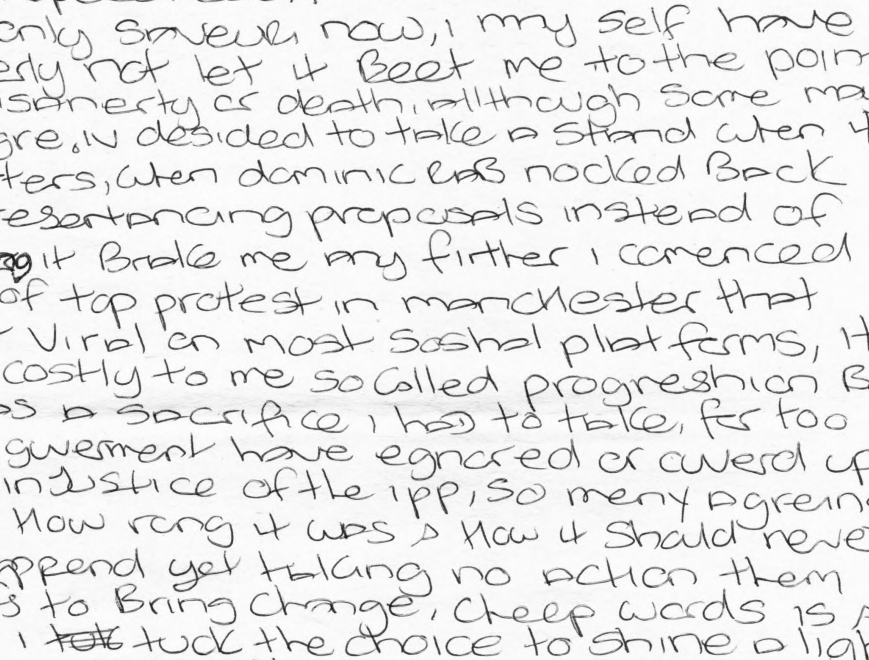
I myself have luckily not let it beat me to the point of insanity or death, although some may disagree.
I decided to take a stand when it matters, when Dominic Raab knocked back the resentencing proposals.
Instead of letting it break me any further,
I commenced a roof top protest in Manchester that went viral on most social platforms.
It was costly to my so-called progression, but it was a sacrifice I had to take.
For too long government have ignored or covered up the injustice of the IPP, so many agreeing with how wrong it was and how it should never have happened yet taking no action themselves to bring change. Cheap words is all.
Well, I took the choice to shine a light on it and not let them hide.
I did a 12-hour protest for not only myself and all those still on IPP, but for all them families of the 81 lost souls.
All them must be held accountable who contributed to the failures that led to them poor people taking them lives. Even if it is for 12 hours, the support and love that I have received since then, has been overwhelming, at times truly beautiful.
Well after that I was sent to HMP Frankland, where their intention to punish me for my activism was made clear by the foul things they did to me in that segregation. They refused to give me my special NHS diet that I had had for over four years due to my health, starved me, then one day while moving me cell, jumped on me and began assaulting me. I was stripped naked and placed in a box cell for hours on end. Right there and then, I decided, I was not going to take been treated this way. Days later I went out on the yard and managed to scale the wall. I then use a CCTV camera to break the cage roof and escape the seg, becoming the only man to ever escape a cat A segregation in the UK.
I then got my own back for the weeks of bully boy treatment and abuse by smashing the place to pieces. Then having a nice sunbathe in my boxers. This made the papers again, so now in eight weeks I’ve scaled 2 roofs and I’ve been in the press in countless papers. For this level of exposure,
I have now been sent to HMP Belmarsh unit segregation, where I stay totally isolated from everyone.
I get what I have done embarrass the prison state, but some would say it was a long time coming. I stand up for what I believe in and I know my values and principles. I should be proud of decency, respect, honesty, loyalty, humility, and dignity. It is the system that lacks in these principles, not me. In 13 years I have not once assaulted a member of staff yet I’ve been battered, stabbed, had my nose broken, lit split, teeth knocked out and that is just the physical abuse. Yet despite all this I shall keep my resolve.
My life now consists of exercise with four screws, a dog unit and I’m handcuffed and made to wear flip flops. Anyone would think I’m Bruce Lee. Some would say justified I’ll leave that up to you.
Since being here I’ve been subjected to over 170 full body strip searches in 14 weeks, sometimes four or more a day for three months. I was told all my visit rights had been stopped. Thankfully, they developed a change of heart and I now get visits. When will they let me back on the wings. I don’t know how long until I see a person’s face in this place that’s not a staff member, I also don’t know.
What I do know is that try as they might, my spirit will not be broken.
There is a movement out there that I am part of which gives me such strength and resolve. The other day I heard a man’s voice that I’ve never met being played to me down the phone by my girlfriend. This man spoke in a demo outside the prison about my story and all the IPPs, I love that, I felt through that voice I’ve never felt better. I was instantly elevated and overwhelmed. I used to feel lost, I used to feel lonely.
But now while I sit in the most lonely, isolated part of a prison system I am loved, I am supported, and I am strong.
But there are many, many more that sadly are not and for them I hope they find strength.
Kindness and love always.
Joe outlaw

The IPP sentence: At an Inflection Point?
I have followed the Imprisonment for public protection (IPP) issue for over 10 years and seen how political inertia has stifled any chance of reform. But things are now changing. We are at an inflection point. To learn more, I listened to all episodes of the ‘Trapped: The IPP Scandal’ podcast series.

On 25 July 2023 one of its producers, Melissa Fitzgerald, contacted me and invited me to meet their entire team. This led to conducting an interview with two members, Hank Rossi (Consultant) and Sam Asumadu (Investigative Reporter).
10 minute read.
Faith: To what degree have you noticed how the IPP sentence has emerged as a major issue, and could even be stated as a tragedy within our Criminal Justice System?
Sam: I absolutely agree it’s a tragedy in our criminal justice system. Once you’ve done your original tariff, you’re basically being detained on what you might do rather than what you have done. To me, that’s something for science fiction, not a functional society. Preventative detention should not have had any place in British jurisprudence. The IPP sentence was abolished in 2012 on human rights grounds. Because it wasn’t retrospectively abolished, it’s meant that there’s this legacy and hangover of a particular time in British history, from the New Labour government.
Faith: You spoke with Lord Blunkett, was he dismissive or contrite in any way or genuinely mortified by the suffering caused by not only those given an IPP sentence but their families too. Could he have foreseen how this sentence would be implemented?
Sam: It’s hard to comprehend that this is where we are, over 80 people serving an IPP sentence have died in prison taking their own lives, so many people have been broken by what’s happened. Lord Blunkett has been quite vocal about the IPP, he has been contrite, and he has apologised. He does seem to care about the issue, whether that’s a matter of him thinking about his legacy or if it’s completely genuine, I don’t know. I can’t judge what’s in a man’s heart. However, it doesn’t quite matter how contrite he is because it’s still happened and a lot of lives have been destroyed and are still being destroyed, in my opinion. I think he believes that initially, at least, the judges were over applying the sentence to many people. I think it was just very bad legislation on his part and the Ministry’s part. You have to look at what may go wrong, the worst-case scenarios in legislation, because once it is out, it becomes part of bureaucracy, and into people’s hands. People are fallible, especially when it comes to prisons.
Faith: There were alternatives already. He didn’t need to bring in this new legislation.
Sam: He didn’t, but it did look good at the time. It sounded good as well and it was attractive to the people in the government. Finally, we’ll deal with the underclass.
Faith: How do you get beyond any concerns that you may have that your reporting will fall on deaf ears?
Sam: The series is a permanent record of what is an incredible failure of society. I think the authorities can’t hide from it now. We can send questions to Alex Chalk and Damian Hinds to keep pressure up, making sure they know people are watching. They can’t hide from us.
Faith: We are bombarded with messages from the media, be it on social media or in the newspapers. How do you get an audience to not just listen but act too?
Sam: Ultimately, it’s in their hands. We want people to act. What we’ve done is to highlight stories of people who are campaigning family members. They have little to no resources. Listening to that, I hope it makes people feel incumbent that they can do something themselves to help end this horrific tragedy. This could have happened to their family members too.
Faith: As a professional journalist you have an acute sense of right and wrong and fact from fiction. But has the topic of IPP gripped you because of any reason other than justice v injustice?
Sam: I can’t believe that the state thinks that they can keep on saying it’s “a stain on the British justice”, “stain on the conscience of the British Justice” and not rectify it. The state has a duty to care for prisoners whether they like it or not. Yet people have died and are dying on their watch. And I think that there should be some sort of accountability for that.
Faith: I understand prior to these podcasts, you were involved in a piece of research around IPPs with the Centre for Crime and Justice Studies (CCJS). Can you outline the part you played?
Hank: I funded Zinc Productions and we’ve hired Steve, Melissa, and Samantha to do this work. We’ve worked with quite a lot of the families and friends of IPP’s and with a number of IPP sentenced individuals as well. I started a process with the researchers at the Centre for Crime and Justice Studies (CCJS) in 2020. I approached them, having approached a number of criminal justice reform charities about this issue to fund some research on the possibility of an independent tribunal on IPP. Every time I looked further into this, I got more concerned. I almost, you know, started to become unwell myself, thinking this can’t be real.
One of the processes that I thought might help, was a sort of tribunal inquiry when power cannot hold itself to account because of nefarious activities of those who have it. You can get a group of citizens together and hold your own inquiry. That’s what I thought might be a useful way to look at the problems of IPP. Richard Garside and Roger Grimshaw from CCJS sat around the table with me and we came up with a plan to research the idea for an independent People’s Tribunal on indeterminate detention in the UK. That led to a document I was signing to invest some money in their work to research this idea.
I was sort of feeling like we’d achieved something just by having a conversation when so many people, organisations, and people in power were unwilling to talk about it. Richard and Roger took this seriously at the CCJS and we signed an agreement. The very next day, out of the blue, the government was going to be put under the spotlight by the Justice Select Committee as they launched their inquiry into IPPs.
Faith: Do you believe we live in a punitive society, which has then led to one of the flaws in the IPP sentence as assessing the dangerousness of each offender?
Hank: The short answer is yes. We live in a far too punitive society. I’ve just come across a document published by the Prison Reform Trust in 2003 where the writers are looking at sentence length and they’re worried that they are getting longer. Since then, we’ve gone to this extraordinary place now where a whole life tariff is an everyday thing. I call it the punitive ratchet. We are now learning about the significant harm that prison does to an individual. That’s perhaps what I would say about the punitive concept of prison. The way that we engage with it in the United Kingdom is toxic and has become more and more toxic in the 20 years since the millennium.
Assessing Dangerousness is a complex and very difficult business. You could argue that the assessments tools are inherently problematic because of the nature of prediction. That is a fundamental flaw in the idea of the IPP legislation in the first place to think that there was a system that you could implement to usefully predicts people’s behaviour in the future. And initially the whole process of IPP sentencing circumvented assessment for many. They were just labelled as dangerous based on the offence.
Faith: If you talk about dangerousness, this has changed throughout the sentence.
Hank: This is what annoys me endlessly about the fall back of “Oh, well, this person was a dangerous individual”, no, they weren’t necessarily in many of the cases. There is no evidence to me that people can be predictably relied upon to do the same thing in the future. You can say what a statistical likelihood is but that is nowhere near the same as knowing what someone will do. And we know that from the statistics, less than 1% of people go on to commit a serious further offence when they’ve been out of prison.
Faith: Is the IPP sentence a systemic miscarriage of justice?
Hank: Yes, that’s the best short description of it. Some people would say this is not a miscarriage of justice because that requires an individual to have been completely misrepresented in the process. There’s a researcher who calls these sort of events “errors of justice”. In other words, they are less clear. And there’s truth that these people who committed an offence should be punished by a prison sentence. How long they spend in jail should be part of that process. The idea of indefinite detention, that’s a no no. In international law, we shouldn’t do that.
Faith: With the pressure mounting for Alex Chalk the Secretary of State for Justice to act, how hopeful are you that there will finally be a breakthrough?
Hank: I am hopeful. There is action that people are taking and movement in the system. It’s a systemic problem, and what I know about systems theory is that you might have to take multiple approaches to shift a problem in a system. Unfortunately, when people say, well, how do you fix that? they say, well, you have to go through the legislative body and that’s our parliament. And parliament is a complicated place.
Alex Chalk is in the hot seat right now, and I know he’s really feeling it. There are things he could do tomorrow through LASPO (Legal Aid, Sentencing and Punishment of Offenders Act 2012) to make this go away using executive powers. He’s chosen not to use those at this point. We’ll see if there’s continuing pressure from campaigners and from international bodies. Maybe he will be pushed to do more. But the problem is that under international law, this must be looked at on a case-by-case basis. Well, there’s 3000 people in prison to consider on a case-by-case basis. It’s a nightmare. So, we need some executive action. But I have a feeling that things will happen.
Following on from what Sam was saying, I agree this is the most egregious example of state violence I’ve come across in the UK in my lifetime. I’m over 50 years old. People have been persecuted in a way that I’ve never imagined in this country. The IPP sentence is toxic. It’s extraordinary that the system we have has not been able to rectify that. It leads me to believe that we have a very weak parliamentary democracy. Essentially the power of the executive to keep this going when it should not keep going, is too much. There’s something going wrong within the structure with the roles and the regulations of how parliament and our democracy work.
One thing that I’ve concluded is instrumental perhaps, and was talked about 15 years ago, was the merging of the role of the Lord Chancellor with the role of the Minister of Justice, When that job was boiled down into one, you end up with a problem of separation of powers, I think. And that’s a fundamental problem. So that’s something for us to think about in the future.
Faith: I had lunch recently with Shirley de’Bono where she shared with me her next step in her campaign for IPP prisoners being released, to go to the United Nations in Geneva to have discussions with Dr Alice Edwards, Special Rapporteur on torture. I believe you went along too.
Hank: I’ve been communicating and collaborating with quite a number of different people in different organisations, and I wasn’t expecting to be invited. In the week before a meeting was set up, I was invited to attend in Geneva with Dr. Alice Edwards and Shirley de’Bono and others, and the conversation was about what is going on and what might be done. Shirley presented several cases. I mean, just this is a horror show, isn’t it? You can’t make it up. I’m as worried about this as I have been about anything in my life. I lose sleep over this. And I think that this is an important moment. In Geneva more information was sought by the Special Rapporteur and indications were given that statements will be made in the future that perhaps will certainly shame the United Kingdom’s government on the international stage.
Faith: Do you think the UK government should take any notice of the United Nations, and if so, how much pressure should the United Nations place on the UK government?
Hank: The United Kingdom being a signatory to the Optional Protocol on the Convention against Torture and other Cruel, Inhuman or Degrading Treatment or Punishment (OPCAT) is a powerful thing. We’ve agreed to do certain things to honour certain international standards, and we’re not doing that. And the fact that this hasn’t been noticed for a decade is shocking. But going back to the torture problem, the United Nations has clear guidelines on this. We’re breaking many of them.
The United Nations doesn’t have legal or legislative making powers, but it has influence. On 30th of August the United Nations special rapporteur on torture made a statement condemning this situation. I believe they’ve sent a letter to our government and their response will have to have sent in before the 23rd of November, when we should hear what the letter said. We won’t know until then perhaps exactly what’s going on, but it’s all very useful in putting pressure on our government.
Faith: In your opinion, should the UK withdraw its signature from OPCAT because the very existence of an IPP sentence, which we know inflicts psychological harm, and psychological harm is a form of torture, does not align with its agreement to OPCAT?
Hank: I think we need to be part of this. And the whole point of mechanisms where someone can criticise you is useful. In some organisations you create a specific chain of responsibilities and it’s often known as “just culture” where whistleblowing is encouraged, and recriminations are not expected if someone highlights a concern. But in this system, we’ve have had the opposite, that the snuffing out of criticism and the silencing of objections has been part of why this has gone on so long. And that’s got to stop. The National Preventative Mechanism (NPM) has 21 agencies appointed by our government to fulfil the obligations under OPCAT. These agencies have certain powers and they’re not using them properly. Also, the independence of them is questionable. Is it time for a review of the NPM?
Three years ago, I introduced the idea of a people’s tribunal on indefinite detention to the Centre for Crime Justice Studies. We’ve weighed up whether there was any need for a tribunal process, if the Justice Committee made these very strong recommendations that change was needed, of course that’s very positive. But what we’ve found is that the government is not interested, and Parliament seems to have gone along with it. There are indications there’s going to be a bit of noise in Parliament about the Victims and Prisoners Bill. The international community are now waking up like a sleeping giant and the possibility of an independent process to hold government to account and to make a record of the situation is still an idea.
Using Disaster Incubation Theory, we can look at this crisis as an unfolding sequence of events, which was almost predictable. Baron Woolf, former Lord Chief Justice, made comments to Lord Blunkett before IPP legislation was enacted that this was a terrible idea. Blunkett claims not to remember the criticism of it, he went ahead and did it anyway. And look what happened. And you know, people have predicted this crisis.
However, one of the biggest problems of prediction is complexity and you can’t just keep people in prison because you think that something might happen in the future.
Faith: Initially an IPP sentence was to be imposed where a life sentence was inappropriate, so where did it go wrong?
Hank: Indefinite detention induces desperation; this is known from psychological research. Induced desperation is a form of psychological torture. There’s plenty of evidence to show that you don’t need more than a couple of weeks having desperation induced in you by this type of prison sentence to suffer mental health consequences. Suicidal ideation, depression, all of these things we hear about over and over again. It’s extraordinary that more people haven’t managed to take their own lives. So, imagine there’s a system which is inducing you to feel suicidal and then to sort of trap you in a suspended animation forever where you can’t kill yourself because they’ve taken away all of the facility for you to do that, but continue to indefinitely detain you. That is like a horror movie. We talk about the “psychological harms” of this, but it is absolutely punishing.
Faith: How has it got to this point where you’ve got so many people dying on a sentence? How has it been allowed?
Hank: It continues for political reasons. These are essentially political prisoners caught in a situation which is way beyond the norm and the political climate is such that it’s very difficult for someone to do something publicly about it. I suspect change may happen quietly in the near future, there will be moves to influence what happens at the parole board hearing, at the prison gate and what happens in various sorts of quiet corners of the system in order to expedite the release of these people while the international community waves its fist at us.
Faith: Bernadette’s story (Episode 6) highlights the ambiguous criteria for prisoners diagnosed with Offender Personality Disorder (OPD) and once on this pathway they are labelled. Why do you think this diagnosis is used against IPP prisoners rather than to help them?
Hank: This is an enormous abuse of power. What’s happened here is a shocking scandal. That’s why a tribunal process might be quite useful because since the invention of the Dangerous and Severe Personality Disorder (DSPD) twenty years ago they were constructing a diagnosis out of thin air for the purposes of managing people in a system, in this case processing them through a criminal justice system. The outcome of that is quite toxic, especially when we know that the incarceration of individuals has severe implications on their behaviour. The National Offender Management Service (NOMS) then implemented the Offender Personality Disorder Pathway (OPD) which might be seen again as a bogus system. It’s invented for management of people who are likely to be disruptive because of the nature of how human beings respond in a prison system.
Research by Robert Sapolsky on neuroendocrinology and research by Daniel Stokols, who is an environmental psychologist, suggests that people in prison systems are very likely to misbehave for many reasons if their circumstances result in a reduction of their agency. If you don’t have a strong identity or a strong sense of purpose, and you are subjected to many of the things that are happening currently in our prison system, you’re very likely to have people starting to suffer mental illness.
Sam: I think most IPP prisoners say I understand my original sentence and the original tariff. It’s what’s happened beyond there I can’t get to grips with and why I’m so distressed by it all. So, I don’t think it’s like shirking responsibility. They do say, okay, fine, I did what I did. Maybe I deserved custodial, but this is beyond what ever should happen to a human being.
Faith: As the OPD Pathway was originally designed for problematic prisoners, do you see any logic in 96% of all IPP’s are given this diagnosis?
Hank: It is cruelty beyond belief. Well, you’re going to be causing trouble if you feel you are being tortured, you’re going to become problematic.
Faith: With Bernadette’s partner, there seems to be little understanding or consideration of how he would struggle when medication for bipolar was withdrawn as a result of a new diagnosis of OPD. Do you see this as a cost-cutting exercise or something else more sinister? Where is the duty of care?
Sam: I think maybe they started with the intentions of cost cutting, this whole sort of merry go round of people being sent to psychiatric hospitals. They thought they could keep it inhouse and that they could label people with personality disorders and keep them inside these NHS units. But then what has happened is that it has become a tool to cage problematic prisoners which people on an IPP sentences will be just because of the nature of what’s happening to them. IPP related distress is not factored in with the OPD pathway, including at parole as we see.
I won’t use the word sinister, but it does feel like it was a way to preventively detain these people. By labelling them as having a personality disorder, or offender personality disorder, which we know is made up.
Faith: The provision of medication or the lack of medication should be a clinical decision and yet it is left to non-clinical staff to determine. Where do you think this failure originates and who is to blame?
Sam: I don’t know the answer to this question. I guess there’s a lot of bureaucracy that comes into this. I think it’s you who said to me that sometimes, prisoners move from prison to prison and their files don’t catch up with them. Then the prison staff don’t even know that they’re supposed to have medication at this time.
Hank: Clinical decisions should be made by doctors. The whole thing with, DSPD and the OPD where clinicians are left out, how can that make sense? Well, one of the reasons is there aren’t enough clinicians working in the system. This prison system creates mental health problems. It’s a double crisis.
Faith: Those in prison should get the same level of health care in prison.
Hank: Well, I have heard some anecdotal stories, some people have said that it’s hard to get mental health support outside prison, they have had better sort of conversations inside prison. It is hit and miss.
Someone who worked in a general hospital told me that the psychology services were downplaying people’s conditions because they knew they couldn’t provide resources to help them. Psychological assessments were being downgraded in the sense that if someone came in and they hadn’t actually tried to commit suicide, but were expressing suicidal thoughts, they were sent home because there was nothing that could be done. That’s extraordinary. That’s just out in the community. And we think the same things happen in prison.
Sam: I really don’t know where to lay the blame on this one. I think in some ways prison governors should have more discretion maybe to help how they deal with their prison.
Faith: In your pursuit of the truth about IPP it appears you have uncovered a further irregularity. In IPP Trapped podcast, Episode 6, Prof Graham Towl, previously Chief Psychologist at Ministry of Justice, says that Dangerous and Severe Personality Disorder (DSPD) was invented not by psychologists but by politicians. This is an astounding revelation.
Sam: The DSPD, a precursor to the IPP, was brought in, in the late nineties. The DSPD and eventually IPP was a way to preventively detain people that they didn’t know what to do with whether that was correct in terms of criminal justice or not.
Faith: Is resentencing the only way to ensure that no one spends the rest of their life in prison despite having not been convicted of an offence of gravity that would warrant life imprisonment or is there some other way?
Hank: The government has re-sentenced people before. Resentencing is the thing that works for justice, but it might be slow, and it may not work well for the emergency that I see. I think this is like a mass casualty situation and it is a crisis with significant humanitarian costs, and it needs to be sorted out quickly. You can’t keep torturing people once you know that that’s what you’re doing. There’s a sort of denial going on amongst the authorities. Re-sentencing is a part of the story, but it might be that there are other things in the nearer term that might be needed to expedite certain people’s recovery. But yes, it’s definitely part of the network of considerations.
Faith: In practical terms how hard is it to change IPP? Must it be legislative change or a judicial change, or a policy and practice change? But in the case of legislation to that end takes time, given the prevalence of self-harm and suicides amongst IPP’s, some don’t have that time.
Sam: I think James Daly MP, often says these people could be in prison 40 years down the line. It sounds incredible, but. Yeah. If nothing is done, it could be 40 years.
Faith: I read that 75% of recalls to prison were IPP’s, yet 73% of these recalls didn’t involve a further offence. Do you think the criteria for recall is too broad?
Hank: Absolutely. This is all about risk aversion. For some reason, IPP’s have been put in this network of problems where risk aversion is of the highest order. Essentially the system assumes that they are the most dangerous people on Earth, and they really aren’t.
The parole board is getting it wrong; the probation service is getting it wrong, the judiciary got it wrong, and the government is getting it wrong. I can’t see any point in the system where they’re getting it right. That’s a frightening thing. We can keep talking about it and we can keep hoping that they will change because the more we talk about it, the less likely they’ll get away with it.
Sam: With recall, there’s the human element of probation officers where they just get things wrong, they are overzealous. One story I heard was someone who had moved address, he’d spoken to his probation officer, and he thought it was approved. A week later, the police collected him from his new address, saying that he breached his license, giving the reason as his change of address. But how did they know the address if the probation officer didn’t tell them? This strange logic that seems to be that the first principle is send them back to prison rather than keeping them in the community and finding the best ways that they can work with them.
Faith: With probation as with prison officers so many have left the profession and you’re left with those with very little experience. You are left with a system run by inexperienced people. So, mistakes will happen.
Hank: Along with the punitive ratchet, the problems in probation are the biggest thing that’s happened in the last 20 years. Everyone’s overloaded. And it’s just a system that’s in crisis again. From the moment you’re arrested for an offence, the police are in crisis, the courts are in crisis, the prisons are in crisis, and the probation service is in crisis. This does not bode well for a quick answer to this. I think this topic should be at the front of the queue for fixing and sorting. The discrimination that someone on an IPP is suffering from where a person who’s committed the same offence, who’s in the same cell or next door who’s getting out after a fixed term, that is discriminatory.
Sam: That’s why they talk about violent offenders when they’re talking about IPP and don’t look at the individual cases. Most cases between 2005 and 2008, were not serious crimes.
Hank: The whole thing is bewildering. I hear myself say “I can’t believe this is happening in our country”, especially a country that used to pride itself on having one of the better criminal justice systems. Other countries model their justice systems on the British system, and it turns out we’ve got the most rotten system around.
Faith: The criminal justice system is in such disarray, isn’t it?
Hank: Despite all the independent monitoring that goes on, it’s very hard to imagine that there’s not a lot more going unreported.
Faith: In your opinion is the current Lord Chancellor and Secretary of State for Justice, Rt. Hon Alex Chalk KC MP, going fast enough to resolve IPP in his tenure or will he too run out of road before the next General Election is called and purdah prevents any further progress being made.
Hank: I do think that Alex Chalk is listening and we’re getting messages that he’s thinking about what else to do. Then there’s this interaction with the United Nations. And we also know that there are news stories in the pipeline in the next few weeks. The weight of pressure for change on the system is as strong as it’s ever been. The campaigners who’ve done things have done amazing work. MPs are now better informed than perhaps they have been for some time. It is a window of opportunity. It may be that there’s judicial processes that haven’t been thought of because if the United Nations have stated that this is a particular problem, then perhaps there is a legal route that hasn’t been considered before because the United Nations hadn’t made a statement. But now that they have, now that the light is shining on the topic in a way that it hasn’t for a while, I think perhaps, you know, judicial processes might come to bear that haven’t been used before.
Sam: There is also the Victims and Prisoners bill. I’m not sure what happens if a general election comes along, but I think that’s what Sir Bob Neill is counting on if behind the scenes they’re not able to persuade Alex Chalk about re-sentencing.
Hank: It is a good idea. And there’s another amendment proposing an IPP advocacy role for supporting individuals at the parole board and in other ways. But both of those things are slow in coming into force. If there was legislation, it will still take a year. When you’re talking about a few years for anything to come of that, it isn’t very hopeful, is it? We want things to happen now. I think executive action is more likely to solve the problem in the shorter term. But yeah, I fully support everyone doing everything they can in the legislative process.
Thank you for reading to the end of the interview. The topic has engaged you and, hopefully, informed you. But what now – what will you do with what you now know?
There are several things you can do:
1). Write to your MP
Everyone can write to their MP about what you think about IPP sentencing. If you don’t know who your MP is, you can search via the ‘Find You MP’ via this link [ https://members.parliament.uk/members/commons ]. Simply put in your postcode and the page will give you their name and contact details.
2). Social media
If you use a social media platform you can share your thoughts about the IPP sentence. If you want some ideas, you can share a link to the ‘Trapped’ podcast series, or share a link to this blog interview. Or both.
3). Support a campaigning group
You can find a group which campaigns for change in the IPP sentence. There are several. Why not start with the one called UNGRIPP. Their website is www.ungripp.com They are on Facebook and on X, formerly Twitter.
4). Above all, please don’t do nothing.

Prisons make more problems than they solve
Recently I watched again the movie ‘Erin Brockovich’ about a woman determined to get justice. My brain became filled with questions but instead of going to bed I decided to write and to capture what was in my head.
How many times will I have to read reports from the IMB, from the Inspectorate, from the PPO, all saying the same thing year after year?
How many more times will I have to read about the misery in prisons, the terrible food, the conditions that prisoners live in?
How much longer will I have to read about self-harm, deaths in custody, suicides and not just of prisoners?
How many more campaigns will I read about from organisations trying to better the system, yet very little ever changes?
Are there too many individuals and organisations wrapped up in “Prison works” and patting those on the back who are “heroes” or something. Meanwhile, watching this space carefully, it appears to me that senior members of HMPPS are beginning to jump ship.
Ministers come and ministers go but, looking at reality, I wonder what they are actually doing to bring to an end the misery and violence within our prisons. Yes, I say our prisons because our taxes pays for them. It’s like pouring money into a black hole.
Oh, and what about Rehabilitation?
What about Education?
Yet still we build more warehouses and more warehouses that don’t work, have never worked and I doubt will ever work in the future. And for what reason? Just this week the new Five Wells prison has come under scrutiny, missing the mark in many areas already just a year after it officially opened. Shortages of food, availability of drugs, turnover of staff, all this causing deficiencies reasoned away simply as “…considerable challenges that come with opening a new prison”.
We read about other prisons where those imprisoned for sexual offences have not had the opportunity to address their issues and their crimes are released back into society, homeless. Others who were given an IPP sentence languishing in their cells, not knowing when or if they will even be released. And also those imprisoned under joint enterprise.
We are making more problems, not solving them.
Despite what some people say, In the last 5 years I have visited many prisons. For example, I have delivered training to Custodial Managers and Prison Governors (Wandsworth), twice eaten at a restaurant in a prison (Brixton-Clink), attended an art exhibition in my local prison (Writer in Residence, Warren Hill), observed courses (Chrysalis, Oakwood), celebrated with prisoners on completion of their courses (Stand-Out, Wandsworth) and many more opportunities to talk with Governors. I have seen for myself some of the issues facing staff and prisoners.
Surely there is a better way.
If all we can do is build more prisons.
Prisons boast “we have in-cell technology” as though it’s like something from another planet.
Prisons boast “we have in-cell sanitation” as though it’s a gift when this should be standard.
Almost a year ago a Judge told me that even though they sentence people to custodial sentences, they had never set foot in a prison themselves. I sent a quick message there and then to put them in contact with someone I knew who could help change that.
Prison should be the last resort, and only for those that are a danger to society. Yet, there are people in prison who are there because it is deemed a safe place.
Prisons are not safe, not for prisoners and not for staff. If you don’t believe me then please do some research.
Overworked, underpaid and inexperienced staff working in difficult conditions.
Conditions deteriorate whilst the population increases.

In August 2019, I accepted an invitation from Rory Geoghegan to a speech on ‘Reducing Violent Crime’ hosted by the Centre for Social Justice. Rory gave me a copy of a paper he had co-authored with Ian Acheson called ‘Control, Order, Hope: A manifesto for prison safety and reform’, three things which in my opinion are severely lacking in our prisons. Rory had contacted me the previous September for my view on a key recommendation concerning IMB’s for this paper, as you can imagine I was pleased to read:
“Independent Monitoring Boards (IMBs) have a role to play, to “monitor the day-to-day life in their local prison or removal centre and ensure that proper standards of care and decency are maintained. In the wake of utterly unacceptable conditions across so many of our prisons, there must be questions about how effective IMB’s have been at ensuring standards of safety and decency have been met.”
Recommendation 59: Government to consult on the role and effectiveness of Independent Monitoring Boards (IMBs) to help ensure that they can play their vital role within the wider system of prison governance, early-warning, and accountability.
Source: page 64 and 65 https://www.centreforsocialjustice.org.uk/library/control-order-hope-a-manifesto-for-prison-safety-and-reform
As you can see here, and elsewhere in The Criminal Justice Blog, I have been consistently calling this out for years. The IMB has never been able to ensure anything; if it had then it has completely failed in its remit, as evidenced by the decline in the state of prisons in England and Wales.
Now the prison estate is running out of space, police station cells are on standby, not-so-temporary prison accommodation is being installed as ‘rapid deployment cells’.
Yet still we fill them.
What on earth are we doing?
When will a Secretary of State for Justice make a stand, be decisive and finally bring some control, order and hope into our prisons?
~

A Conversation With: Simon Israel: Giving People A Voice.
A couple of months ago, I travelled to Edinburgh to interview Simon Israel, Former Senior Home Affairs Correspondent at Channel 4 News.
I braced myself for the weather and arrived by train in a storm where an umbrella proved completely useless. Yet within half an hour a rainbow welcomed me to my stay at The Royal Scots Club. I invited Simon to join me there and what a wonderful opportunity we had to talk and have lunch together.

FS: How did it all start?
SI: I studied maths and logic at Aberdeen University. I hated it, but I did it. Whilst there I got involved in the student newspaper and I thought it was wonderful. No rules.
I came out of university and thought I’m going to be a broadcast journalist in radio. Commercial radio was booming, so there were loads of jobs out there. I did 3 months at the National Broadcasting School, Soho then started off in local radio. I then arrived in London LBC IRN and was there for an awful long time, maybe too long, probably. Working in local radio I really had a brilliant time. I went all over; India, South Africa, Bosnia during the war, Kenya, and various places in Europe. I did lots of things.
Then ended up at ITN – pissed off the editor in radio who suggested I might want to go to another department.
I went to Channel 4 and said, “I know nothing about TV.”
“Ok, we will take you,” they said.
I knew a lot about journalism and stayed at Channel 4 for more than 25 years. I loved the ethos of Channel 4 News, that is where I think I fitted better than anywhere else.
FS: When I have listened to your reporting, there are very few what I call Happy Stories.
SI: No, I don’t do happy stories, well, I’ve done one or two but not very many. I drifted into the area of Criminal Justice and Policing, and it is not a world of happy stories; it never is really.
FS: So, you have focused on injustice.
SI: I think that was a very key theme, it manifested itself in various ways.
I came back to this idea that of giving people a voice that would struggle to get one.
I dabbled in politics, but nothing in politics is secure for very long. Everything is a moveable feast in politics, and I found that difficult as I needed a set of actions that I can build on. That’s a fact, that’s a fact, that’s a fact. I cannot build on X has got an opinion, or X tells me this is what is going on.
FS: Does that prevent people accusing you of bias?
SI: They can accuse me of bias – I can only be biased if I skew things so much that I’ve distorted the story. I try very hard not to.
This is the world of entertainment – radio-television, so it is not the same as newspapers as its dependent on pictures. In radio I felt much more secure because you could tell things straight.
My idea was if the person stopped watching or listening within the first 5 or 10 seconds, however long the rest of the piece was, I would have lost the whole point of why I was doing it. So, I was conscious all of the time however long or short the report was, I had to keep their attention.
FS: I suppose it is like that with writing a book you have got to keep people’s attention.
SI: You have to keep them going to the end, they have got to be interested, outraged, sad or anything that can sustain their attention throughout the whole thing. It’s not about whether you liked it or not, might agree or disagree with it. I think you get to the end to allow a justifiable thought about whatever it was that I was reporting on.
Someone would say “I watched you, but I got distracted after a few minutes, then I failed didn’t I.
FS: Do you go back and listen?
SI: I could have gone back in post-mortem style.
Most of the stuff I do people were interested in, they are interested in grim stuff. I’ve been told by an editor:
“Make them cry in front of the camera.”
I said, “Excuse me.”
I can see where the editor is coming from, and you can learn to some extent. There is an element of manipulation sometimes because you know what sort of questions might produce, for example a tear. I know that sounds weak, you do try and avoid as there’s a tendency to say I am here because I am praying on your emotions, I’m not here to give you a voice or find out a different view to what’s happened.
So to that classic question “How do you feel?” How would I feel being asked the same question?
I interviewed Mina Smallman in her house. I broke the story along with Vikram Dodd, we both had different sources.
I had sat on the story for 2 or 3 days, because I couldn’t get a second source. There was a risk other people knew what I knew. I always have to have 2 sources; they might not necessarily know the same things, but they have to share the knowledge (some agreement in what they know) that something happened.
In the process, the Met Police behaved appallingly, they wouldn’t confirm or deny anything. They wouldn’t give us a statement until we said we are running this tonight and the Guardian are running it too. We will just say you refused to comment.
We turned up at her doorstep to deliver a letter saying what we knew and the person at the door said Martin Bashir was there with a camera and she is not talking at the moment. Mina Smallman knew Martin Bashir (Religious Correspondent editor) as she was in the clergy at Chelmsford Diocese.
It took me many months to persuade her to talk to me, partly because of what she was going through, losing her daughters, the way the Met Police had treated her and the trial etc. at that time the investigation was still live. God knows what was going through her mind.
FS: When you have to cover stories such as that, where does your strength come from, family, colleagues?
SI: No, no. I don’t know. It comes from 30 years of experience. I don’t know, I’ve never been asked that before. You just do it.
I like to think I am very sensitive to other people’s emotions. I realise that many of these interviews are not easy for them. Easy for me; I just ask the questions, pack up and leave. If they have agreed to do one then somehow, they manage to find the strength from somewhere.
FS: So, you give people a platform to be able to speak?
SI: Yes, I’ve watched interviews where some get others to speak in quick 20 second terms. But to engineer answers out of people to me is wrong. It’s not my job to tell people how to answer the questions. I’ve watched interviews where they have asked the interviewee to leave off bits.
I can’t do that.
I’m not here to try and engineer people into saying things that are convenient to me.
FS: When you interviewed me in 2017 that never came across. You asked the questions fairly sensitively, managed to get the main points over and it fitted with the story.
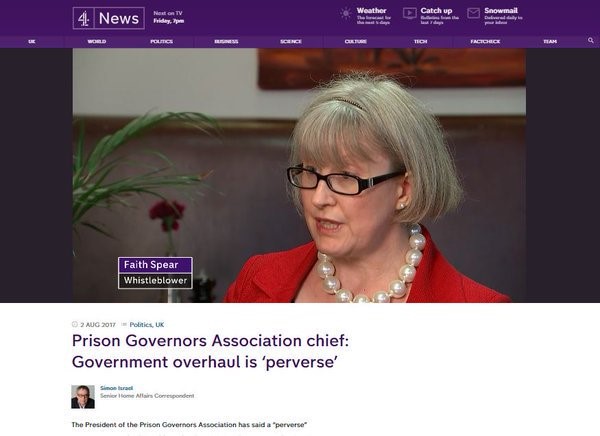
SI: You gave a very good interview, I didn’t tell you how to do it, I didn’t tell you how to answer the questions.
I did a story over a period of time on student suicides, that was really difficult as I have attended enough inquests to understand the utter vacuum created by someone who has killed themselves. The family find it nigh on impossible to come to grips with something like that.
When someone has been killed by another, there is a focus on the other person, trial – justice – truth. But in suicide it’s a completely different world and the self-blame and anguish constantly thinking “I should have done something”.
Families tend to throw themselves into campaigns, a way of managing their own conscience, I think.
FS: To try and raise the issue so that others can be prevented from going through the same?
SI: Yes, there are limited positive ways of moving on.
When you interview you can’t ask “how much do you blame yourselves for…” and even if you got an answer would it be a fair answer anyway?
Unless someone has left a note or have explained in detail why they got to the point they have, it doesn’t stop people thinking.
If I had known…
I would have made sure…
I would have done this…
Their own memory can become distorted because they did all those things anyway.
In reporting on efforts to get justice, you have to be minded that people see justice and tragedy in different ways, so they need to be handled in different ways.
You sub-consciously learn if I am really honest the ways to try and allow people to have the freedom to say what they want to say, yet make sure you are still independent. To be fair to a story is trying to figure out where in a vague sense the truth is – that sounds a bit worthy. You go for what you think or may come closest to the truth. That’s part of your role as a journalist. You may not find the truth; you would be naïve to think if you did. It you get closer to it, that’s as good as you can do really.
I have covered a lot of prison deaths where I found things utterly appalling and wandered off thinking “why can’t I get the public to care more about this than they do”. Gaining public sympathy is a real uphill struggle even when I have seen things that are so outrageous and I’m going, “why aren’t they the responsible all banged up?”
FS: Where’s the accountability?
SI: That’s my argument, it effects the system so much that they are so used to being too avoiding that the politician is the same “I’ll get no votes…”. Most of these people in prison will come out and end up being someone’s neighbour at some point… SO GET THEM READY.
I appreciate prisons have been in crisis for years, this isn’t new today. But we’ve done that classic thing where we park that world in a layby and just shrugged our shoulders.
FS: Do you believe we live in a punitive society?
SI: We live in a society full of cowards, utter cowards, can’t stand up and say “do you know what, this can’t happen anymore”
When you look at the Children’s Commissioner stand up because they know they will get an audience and so people will listen when they shout. But once someone is 18 and someone stands up and says exactly the same thing, people will stop listening and that’s ridiculous. It’s not rational really, it’s absolutely ridiculous.

FS: You are working with Frances Crook at the moment – a commission – what is this and what is its aim?
SI: Her background is essentially a Labour one. Frances took me to lunch and asked if I would like to be on this panel looking at the relationship between the Executive and the voter. Essentially the shape of democracy, but it was also designed to fit in with the end of the reign of Queen Elizabeth II, the start of a new monarch and the idea that, somehow or other, there had to be a better way of holding the Executive to account following the recriminations over Boris Johnson and his government, basically. So, because Britain doesn’t have a constitution in reality, it was designed to look at what a better system could have for holding the executive to account.
But how do you hold the executive to account when they go off piste and create all those walls you have to climb and moats you have to cross where you go “Drawbridge is up, you cannot come in”?
I get the point.
You come back to the journalism; the unelected part of the journalism is not really just to call people to account but to change things.
I was always trying to do stories to be a factor in trying to change the thing that wasn’t right. I have done that once or twice; I know I have. It’s not that I have moved mountains, but I’ve improved the lives of people of individuals, so that makes it worthwhile to me.
An example was the Cherry Groce case. I have to say legally, was accidently shot by a police officer in a raid on her home looking for one of her sons, who wasn’t there, this sparked the 1985 Brixton riots. She was paralyzed and ended up in a wheelchair for the rest of her life. In that room where she was shot was her son Lee aged 11 years.
A police officer was put on trial and was acquitted. After Cherry’s death, in 2011, the pathology report linked the shooting and the kidney failure that led to her death. This in turn triggered an inquest. Cherry had lived longer than what was expected, and the trial had never addressed the circumstances on how his mother came to die.
I was at Channel 4 at the time and received a tip off about the pending inquest. I contacted Lee to ask if he would be willing to talk. He said, “I’ll get back to you”. He never did, and I never saw any write up of this inquest.
About a year later he called me, “I think I need your help.”
“The police have a secret report which they won’t let me see, damming of the Met and I can’t get legal aid for the inquest, which has been delayed. All the other parties have QC’s, and they won’t give me legal aid.”
I said we are going to do a story, I did a piece which was well received. To force things to happen a petition was put up on change.org and once the story was out the signatures increased to 120,000. We had started the motion and the Lewisham MP got involved by banging on the door of the legal aid agency and managed to get Lee legal aid.
Lee got his unlawful killing verdict, the Met had to release the report and the man that shot Cherry came to give evidence.
Lee walked away saying “That was for my mum, I got it”.
The head of the Met apologised face to face and the family were paid compensation as the original money paid out was to cover only up to 10 years as that was the estimate of how long Cherry would live after being shot. She lived 16 more years with the financial burden on the family.
In 2020, Lee Lawrence won the Costa Biography Award for his book “The Louder I Will Sing: A story of racism, riots and redemption”.
In Brixton Square there is a huge structure put up by the Met Police to honour the life of Cherry Groce.
So I made a difference.
FS: What makes you laugh?
SI: Children make me laugh, I love children, their humour is instantaneous.
FS: What makes you cry?
SI: I’m not sure loss does, I lost my dad, but didn’t cry, quite a long time ago. Will I cry if my Mum died? Not so sure, not because I don’t love them or care about them.
I sometimes cry out of frustration and sometimes out of appreciating someone’s hurt. The sheer inhumanity of it all. I cried in Rwanda when we picked up a desperately injured child and took them to hospital. I think I cried out of the sheer chaos of everything, and this manifested itself on this poor child who had no control over anything. I had met them for half an hour max.
I manifest my emotions that are linked to other people’s emotions I think, whoever that might be rather than my own.
I’ve led a fairly happy life; I haven’t suffered really in any shape or form that I can say is relevant to anything.
I had a great childhood.
I had a great education.
I had a relatively great career, maybe I didn’t get all the way to the top, but that didn’t matter. I got to do what I wanted to do and still do.
You look back and say, “I can’t really grumble.”
~
Photographs used by kind permission of Simon Israel.
~
 The Criminal Justice Blog