Home » 2022
Yearly Archives: 2022

Penitence versus Redemption in the Criminal Justice System: Unedited
I once entered a cell of a high-profile prisoner; his crime had been blazoned on every national newspaper and was serving the last few months of his sentence as an education orderly. He sat on his raised bed, his legs dangling over the menial storage where he had meticulously and precisely arranged his pairs of trainers and invited me to sit on the only chair in the cell. During our 20-minute conversation, he was pensive and reflective, looking down all the while, except for when he raised his head, adjusted his glasses, then looked me straight in the eye.
“Don’t count the days, but make every day count,” he said, his voice monotone and hushed. Yet behind him, I noticed a calendar marked with neatly drawn crosses. He was clearly counting down his days, paying his penitence until his eventual release from prison.
As an independent criminologist, I have met many who feel a deep-seated obligation to “pay back” continuously in some way to society or a higher power. Those who are caught and convicted for committing a crime experience punishment in some form or other, but when should that punishment end? Is it once a sentence has been served or longer?
Over the last 12 years, I have visited every category of prison in England and Wales and monitored a Category D prison for four years. In all that time, I have encountered hundreds of inmates, many struggling with the punishment, not only that of the sentence given by the courts, but the continual punishment they experience as they serve it, as well as after release and beyond.
The Ministry of Justice proudly states on their website that their responsibility is to ensure that sentences are served, and offenders are encouraged to turn their lives around and become law-abiding citizens. Apparently, the Ministry has a vision of delivering a world-class justice system that works for everyone in society, and one of four of their strategic priorities is having a prison and probation service that reforms offenders.
But I am not at all convinced by this hyperbole. In my opinion, we must stop the madness of believing that we can change people and their behaviour by banging them up in warehouse conditions with little to do, not enough to eat, and sanitation from a previous century.
Penitence
If true reform is supposed to be achieved through time served, then a former inmate emerging from prison with a clean slate would be ready to contribute fully to society. Yet beyond prison gates people who have served their time all too often live under a cloud of penitence, suppressing a sense of guilt for their deeds.
Many of the formerly incarcerated insist on a daily act of penitence, a good deed, even raising money for a worthy cause. For onlookers, such acts carry an air of respectability, but it is important to understand what is really happening on the inside because some of those who engage in them do so as a form of self-punishment. The punishing of self both physically and mentally.
They sense they must compensate.
Their account never fully paid.
Lifelong indebtedness.
And of course there are those who appear to genuflect to the Ministry of Justice and the Criminal Justice System; a sign of respect or an act of worship to those always in a superior position.
On the balance of probabilities, it is more likely than not that some penal reform organisations and some individuals with lived experience approach the Ministry of Justice with such reverence showing their cursory act of respect.
The same act of penitence or faux reverence ingrained into them whilst they served their custodial sentence.
For others penitence is an act devoid of meaning or performed without knowledge.
According to the Oxford English Dictionary, the definition of penitence is “the action of feeling or showing sorrow and regret for having done wrong, repentance, a public display of penitence.” In addition to the formal punishment they endure, many prisoners engage in penitence both physically and mentally during and after serving their time, which keeps them from moving forward with their lives and is damaging to their sanity.
According to a 2021 report by the Centre for Mental Health, (page 24) “former prisoners…had significantly greater current mental health problems across the full spectrum of mental health diagnosis than the general public, alongside greater suicide risk, typically multiple mental health problems including dual diagnosis, and also lower verbal IQ…and greater current social problems.”
In my work, I have found that some people who have broken the law want others to know that they are sorry, whilst at the same time feel the pressure to prove this to themselves. In such cases, their penitence becomes a public display for families, caseworkers, and those in authority.
Witnesses to this display of penitence often think these people are a good example of someone who has turned their life around, but often, these former prisoners find themselves stuck in the act of penitence. Rather than turning their lives around, they are trapped forever in their guilt. In these cases, the act of atoning becomes all-consuming, an insatiable appetite to heed the voices in their soul that tell them, “you must do more and more, it’s not enough, I’m hungry.”
Redemption
When I speak to those who are serving a whole-life tariff, I know that their debt to society can never be repaid: they are resigned to a lifelong burden of irredeemable indebtedness. But many of those who are released from prison remain incarcerated by their own guilt, feeling as if they must hide any hint of happiness they may find in life after prison so as not to be judged.
For example, in 2019, I interviewed Erwin James, author, Guardian columnist and convicted murderer, who had just come out with his third book, Redeemable: a Memoir of Darkness and Hope. When I asked him, “What makes you happy?” he replied: “In the public, if I am laughing, I feel awful because there are people grieving because of me. Even in jail, I was scared to laugh sometimes because it looked like I didn’t care about anything.”
Just like I saw with the prisoner sat on his bed, I have witnessed a cloud hanging over many, especially when redemption, or the act of repaying the value of something lost, relates to acceptance and society’s opinion of you.
There are of course prisoners who have the intellectual capacity to learn from their mistakes, have the emotional capacity to adapt to their situations and – not forgetting – the spiritual capacity, a dimension that can lead to a voyage of self-discovery. But by no means all.
Unfortunately, in the UK, paying back to society can either be the light at the end of the tunnel, or a tunnel with no light.
I believe we live in a punitive society in which the continual punishment of those who have offended is tacitly endorsed. In so doing, society inadvertently encourages the penitentiaries of this world to hold offenders in an ever-tightening grip.
Even a sentence served in the community—a sentencing option all too often shunned by magistrates—can carry an arduous stigma. In a public show of humiliation, the words “Community Payback” are garishly emblasoned on the offenders’ brightly-coloured outerwear, announcing their status as a wrongdoer to all who see them. Basically, this is society’s way of saying, “we want you to be sorry, we want you to show you are sorry and we will not let you forget it.”
Statements such as “the loss of liberty is the punishment” become fictitious, enabling punishment in its various form to continue throughout the sentence served and even after release.
Let us no longer have this traditional stance, rather should we try to embolden others to move on from their actions?
And can groundless nimbyism be finally assigned to history?
I am mindful that pain and grief still abounds, that some crimes will not be erased from our minds, and that crimes will stubbornly continue. But surely, the answer cannot be to condemn those who have done wrong to a lifetime without forgiveness.
To move forward as a society, we need to discourage the continual need to offer an apology, and instead accept when former prisoners have paid their dues and served their sentences. Only then will we move from a vicious cycle of unending penitence to a world in which reform and redemption is truly possible.
~
An edited version of this article was first published on 28 February 2022 by New Thinking.
~

IMB Soap Opera
Is the IMB like liquid soap?
Not the wonderful clear stuff which has a beautiful fragrance and an antibacterial effect on everything it touches.
No, not that.
More like that gawd awful stuff you find in greasy dispensers at motorway service station toilets, where hygiene means tick boxing inspection sheets on the back of the door. Its colour an insipid artificial pink like slime from old boiled sweets left too long in the sun, and its smell nauseous like cat sick.
But it is its opacity that irks me.
Designed to deliberately obfuscate, smother and shroud all that has any proximity to it, you never truly know whether it has any cleansing properties at all.
I neither like nor trust opaque liquid soap.
I happily tolerate the clear stuff, so long as it really is clear and totally free of nasty microbeads, creaming additives and fake foam.
It would have been far better for the IMB if it had been a bar of soap. At least you know where you are with a bar of soap. Visible, tangible, relatable, practical, and likeable. A bar of soap has these and many other qualities about it which reassures me of its fitness for purpose.
From the moment it is unwrapped and placed at the side of the sink, its very presence reassures you. Sitting there unblemished and ready to serve, a fresh bar of soap exudes a sense of personalised attentiveness and an unwillingness to be corrupted by falling into the wrong person’s hands.
I don’t think it is too much to ask that a bar of soap is fresh and that I am the first person to use it. There are some things that are unacceptable to pass around.

Even if we were to believe all they tell us then, at best, IMB would resemble a remnant of used soap, cracked and old. Once so full of purpose, now degraded in the hands of multiple ministers and permanent secretaries. Put on the side, its usefulness expended but its stubborn existence more a token gesture of monitoring rather than an effective part of the hygiene of the justice system.
It is an exhausted specimen of uselessness despite what its National Chair, Secretariat, Management Board would have you believe. They justify their own sense of importance with the sort of job roles that place them on a pedestal. But in reality it all just smacks of self aggrandizement; as they say in Texas – “Big hat, no cattle.”
Where once I bought into this whole parade, now I see it for the parody that it is. Where once I was pleased to serve, now I call out the servitude that the system enforces on those who work within it.
Where once I would write the annual reports, now I challenge the pointlessness of recording observations and making recommendations, an utterly futile exercise because there was never any intention by the Ministry of Justice to do anything about them.
A fresh bar of soap has an impressive versatility about it. It can give you clean hands, yes, but it can go a lot further than that. It can be carved, shaped and fashioned into an object of extraordinary beauty.
Some people serving their time in prison surprise me when they produce such intricate objects crafted from something as humble as a fresh bar of soap; an allegory of their own lives, in some cases I have known. Arguably a work of art to be admired and cherished.
Whereas an old, cracked bar of soap has no such versatility or value, and does not merit being kept.
If you can’t wash your hands with it, you should wash your hands of it.
In its present form, the IMB needs to be replaced.
~

A conversation with: Lady Val Corbett, passionate about prison reform, empowerment of women and kindness in business
Lady Val Corbett, a feisty woman, with determination to rival most, striking red hair and a penchant for wearing bright scarves, is one way of introducing my latest “A conversation with…” Having known Lady Val for 6 years, I have found her to be compassionate, hilarious, focused and above all, a friend.

Her career in journalism started in Cape Town but with moving to the UK it was impossible to continue without being a member of the National Union of Journalists. Eventually she worked for the Sunday Express as a weekend reporter; a Features Editor of a noteworthy Furnishing Magazine; Editor of a magazine Woman’s Chronicle for the Spar customers and grocers which then led to becoming the consumer columnist on The Sun. With the birth of her daughter, Polly, she invented herself several times!
“I wrote a column for Cosmopolitan and for national papers and magazines plus scriptwriter for BBC TV then became one of the founder directors of an independent TV production company which sold programmes for major broadcasters – highlight was a six-part BBC1 series called Living with the Enemy on teenagers as I was struggling with mine at the time. I was a volunteer at the Hoxton Apprentice, a training restaurant for long term unemployed and saw how people could change direction. After that I co-wrote six novels with two friends and in between was an MP’s wife and later the PA for Lord Corbett of Castle Vale, when I regularly gave notice or got fired.”
That’s quite a résumé.
Val had a chance encounter on her first day as a features writer, which led to 42 years of happy marriage.
“On my first day I was having second thoughts about a new dress I had bought. Going to the canteen for lunch I paused at the door and asked my colleague: “Does this dress make me look dumpy?” To which an amused male voice said: “Yes it does.” I looked up – my 5ft 2” to his 6ft 3” – and thought he was the rudest man I’d ever met. He called me Dumpy for ages.”
Her husband, Lord Corbett of Castle Vale, sadly died on 19th February 2012.
Did you personally have an interest in politics?
Not for party politics. I knew apartheid was wrong, unfair, and cruel. My first time voting as a British citizen was in Fulham when I put my cross next to Major Wilmot-Seale whom I believed was the Liberal candidate (party allegiances were not then on ballot papers). He was the National Front candidate and garnered 45 votes of which mine was one. Robin never let me forget this. Over the years he became my political mentor because he thought going into politics was because you wanted to change the world. And goodness how he tried!
When Robin decided a cause was just, he was not swayed from the path, do you feel you have taken on that mantle?
I could have chosen from several of his crusades – his Private Members Bill which became law, granting lifetime anonymity for rape victims in courts and media was one but he was also active in prison reform during his 34-year parliamentary career. Chairing the All-Party Penal Affairs Group for 10 years until his death made him realist how much there was to do in the criminal justice system.
He used to say: “Prison isn’t full of bad people; it’s full of people who’ve done bad things and most need a chance to change direction.”
Was it a mantle you were willing to take on?
Yes, when I heard a man say on TV “All men die but some men live on.” I wanted Robin’s legacy in prison reform to live on. Though a novice in prison reform I immersed myself in prison reform in 2013 and though I am still learning now feel I am no longer a novice.
What makes you laugh?
I laugh a lot particularly at short jokes and always tell one or two at my professional women’s network events.
What makes you cry?
Anything concerning cruelty to children.

Since 2016, I have been part of Lady Val’s Professional Women’s Network consisting of female entrepreneurs, senior women in business, the arts, government, investment, HR, and many more diverse professions.

It’s a forum for women in business looking to further their careers by focusing on leadership skills, self-confidence, and other key areas of personal development. Meeting five times per year for lunch, each event starts with an icebreaker “How can I help you and how can you help me”, a simple formula which encourages meaningful connections. This is followed by an inspirational speaker, a leader in their field sharing business knowledge and expertise.
The professional networking lunches are all about business and not entertainment, how do you reflect that in your choice of speakers?
I choose keynote speakers with care. Most speakers have been leaders in their field of business: marketing, fin tech, green economy, Lloyds of London, Abbey Road Studios etc. We had Michael Palin and Jon Snow, both prison reform campaigners, also Prue Leith and Jeffrey Archer. They attracted large audiences, but the Network is a business one, not an entertainment one… So, we are going back to basics, with speakers appealing to businesswomen. I’m happy that through the contacts not only have networkers gained business contacts but also friends.
We are all in this together and if women don’t help each other, who will?
What in your opinion are some of the barriers for women to advance in their professional lives?
The main barrier is a lack of confidence. The glass ceiling is there to be smashed but few women want to. This is changing though not fast enough for me! I count myself not as a feminist but as an equalist and am proud that the wearethecity.com network voted me one of their 50 Trailblazers in gender equality.
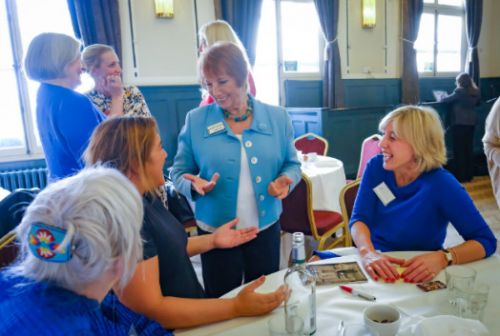
Face to face events are planned from April, are we all zoomed out after 2 years?
Zoom has become increasingly unpopular, and I hope we can go back to somewhere near our normal lives. I am worried that although the stats of Covid are decreasing, they are still worryingly high. On April 21st we are going back to Browns Courtrooms to restart our lunches with keynote speaker James Timpson who’ll be talking about kindness in business.
This network is not for ladies who lunch but ladies who work.
A donation comes from each booking going to our work on prison reform.
How did the Robin Corbett Award come about?
After a loved one dies, people gather around giving you sympathy and many cups of tea. A few weeks after the funeral they seem to think you will be able to manage but it is then that you are at your lowest. It was at this point that inspiration struck. As I mentioned before, the sentence I heard on TV: “All men die but some men live on.” was a eureka moment making me decide that I wanted Robin’s legacy to live on.

The Robin Corbett Award celebrates, supports, and rewards the best in prisoner re-integration programmes. Each year we donate funds to three charities, social enterprises or CICs whose mission is centred around giving returning citizens a chance to reintegrate back into society. The presentation is at the House of Lords.
The Robin Corbett Award for Prisoner Re-Integration was established by members of Lord Corbett’s family in conjunction with the Prison Reform Trust in 2013. It is now administered by The Corbett Foundation, a not-for-profit social enterprise.
What are the criteria to being a member of the Corbett Network?
The Corbett Network is a coalition of charities, social enterprises, community interest companies, non-profit organisations and businesses with a social mission who work with those in prison and after release. (Individuals are not eligible). These decision makers are dedicated to reducing re-offending by helping returning citizens find and keep a job. Some members offer mentoring, coaching, training or education.

How many members are there?
Currently there are 108 with four waiting to be introduced to their fellow members.
This network has expanded rapidly over the last few years, is this due to prison reform taking a greater platform?
Once the Robin Corbett Award was established, I kept on meeting people working in their own small pond, so to speak. I thought we could crusade better in a sea and invited them to join us. Since then, together we have created a powerful lobbying voice heard at the highest levels of government and recognized by those in the criminal justice sector as a force for change. I do sense that the media tend to focus on the problems.
Where do you see the Corbett Network positioned in the justice arena?
Peter Dawson, Director of the Prison Reform Trust told me that The Corbett Network is the only one of its kind in the UK. It sits alongside the Criminal Justice Alliance and Clinks which concentrate mainly on policing, courts, prisons, probation, and human rights. The Corbett Network are members of both these organisations.
What are your hopes for the future of this network?
To crusade effectively. To effect changes desperately needed in our prison system. To change public perception of people who have been inside – they are not sub- human. Since the Network started in 2017, we now have over 108 members, holding both face-to-face, virtual meetings, conferences and, crucially, encouraging greater collaboration across the work we collectively do. Together, we have created a powerful lobbying voice, heard at the highest levels of government, and recognised by those in the criminal justice sector as a force for change.
“Prisons should not be society’s revenge but a chance to change direction.” Robin Corbett
This interview was published to mark International Women’s Day 2022.
All photos courtesy of Lady Val Corbett. Used with permission.

Should inmates be given phones?
Offenders who maintain family ties are nearly 40% less likely to turn back to crime, according to the Ministry of Justice. With secure mobiles being rolled out in prisons we ask…
Should inmates be given phones?
This was a question posed to me back in November 2021 by Jenny Ackland, Senior Writer/Content Commissioner, Future for a “Real life debate” to be published in Woman’s Own January 10th 2022 edition.
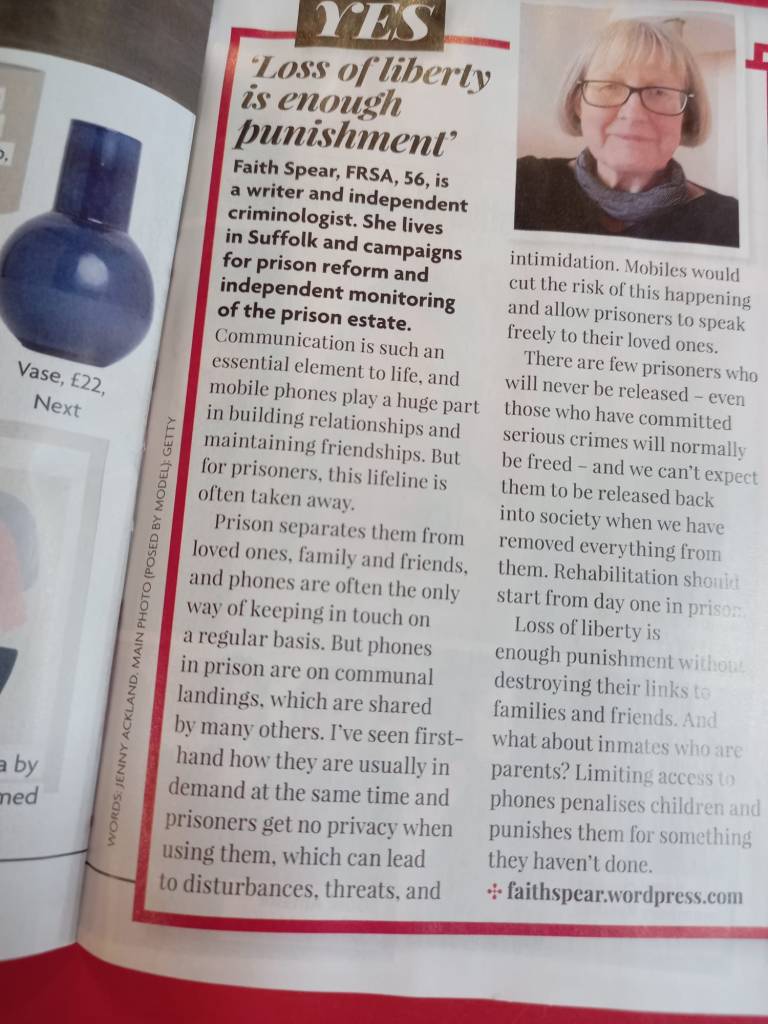

Below is the complete article, my comments were cut down slightly, as there was a limited word count and reworked into the magazine style.
Communication is an essential element to all our lives, but when it comes to those incarcerated in our prisons, there is suddenly a blockage.
Why is communication limited?
It is no surprise that mobile phones can serve as a means of continuing criminal activity with the outside world, as a weapon of manipulation, a bargaining tool, a means of bullying or intimidation.
But what many forget is that prison removes an individual from society as they know it, with high brick walls and barbed wire separating them from loved ones, family, and friends.
There is a PIN phone system where prisoners can speak with a limited number of pre-approved and validated contacts, but these phones are on the landings, are shared by many, usually in demand at the same time and where confidentiality is non-existent. This is when friction can lead to disturbances, threats, and intimidation.
Some prisons (approx 66%) do have in-cell telephony, with prescribed numbers, monitored calls and with no in-coming calls.
Why do some have a problem with this?
We live in an age of technology, and even now phones are seen as rewarding those in prison.
If we believe that communication is a vital element in maintaining relationships, why is there such opposition for prisoners?
In HM Chief Inspector of prisons Annual report for 2020, 71% of women and 47% of men reported they had mental health issues.
Phones are used as a coping mechanism to the harsh regimes, can assist in reducing stress, allay anxiety and prevent depression.
Let’s not punish further those in prison, prison should be the loss of liberty.
Even within a prison environment parents want to be able to make an active contribution to their children’s lives. Limiting access to phones penalises children and in so doing punishes them for something they haven’t done. They are still parents.
 The Criminal Justice Blog