Home » 2018 (Page 2)
Yearly Archives: 2018

The State of our Prisons: England

My general take on prisons are that they are warehouses for the vulnerable.
Whatever happens in society is transferred to prisons, so if there is a problem with drugs on the outside there will certainly be a drug problem in prison. High walls, barbed wire and security is no real barrier. Bullying through debt is rife and so is corruption.
If you mean state of prisons as the fabric of the prisons then many are in disrepair. Neglect has come from outsourcing the maintenance to private companies and backlog of jobs even minor ones have had a detrimental effect on those that reside and work within the prison walls. I have seen vermin, rubbish thrown out of cell windows and food left to rot there. I have seen fire doors that are rotten and would provide no safety in the case of a fire.
Prisons are badly maintained often outdated and can be a fire hazard. So why do we continually fill them up? We knowingly put people in conditions that are not fit for habitation.
Prisons create more homeless individuals, more poverty and more mental health issues and they breed criminality.
Prisons have been underfunded for years and with cut backs year on year situations are only going to get worse. But as we have seen recently in the government there is a constant change of Ministers responsible for our prisons. This movement does not bring stability.
I don’t believe the Government when they say that loss of liberty is the punishment. No, once in prison you are punished, crammed into a room with another for up to 22 hours or more, eating beside your toilet with often the bare necessities. Little or no contact with the outside world.
Slave labour, I witnessed dismantling of DVD’s and CD’s for hours on end (Whitemoor), sewing wash bags and towels (Norwich), assembling poppies (Ford) all mind numbing and boring. Lack of use of any skills that they already have or have acquired within is farcical.
Punishment in prisons was a physical punishment but now it has become a mental torture. Lack of purposeful activity has stripped many of any hope for the future. Short sightedness on behalf of the Government is bringing the whole prison estate to its knees. Benchmarking, loss of experienced staff, under-investment has all resulted in volatile prisons where safety and security for staff and inmates alike is compromised. It’s like a ticking time bomb.
Incidents in prisons are now almost common place, but are lessons being learnt?
Society puts people in prison and expects them to reintegrate after their sentence and not reoffend. But recidivism is high because often the root cause of offending is not addressed.
I saw many with mental health issues that were not dealt with, I saw young men frightened, I witnessed the bullying and intimidation. In various prisons, I sat in on SMT meetings, case meetings, adjudications, equality meetings, security meetings etc. I listened to the way some Governors and Custodial Managers spoke about those in their prisons and wondered how they got to their positions.
There is a lot of unrest
Prisoners complained about:
- discrimination and equality
- unhelpful staff with even the most basic request
- not enough food, especially amongst the young men
- boredom
- too far away from their family for visits
- restricted regimes
- missing property when transferred from one prison to another (this is a very big issue)
- being bullied and getting into debt
- loss of hope
I want to try to bring some sort of balance
I have visited prisons with excellent initiatives for example I have been to Thameside prison twice, the first time with a former prisoner, now author and an actor from Eastenders. The second time was with Sir Lenny Henry. Both these events were organised by Neil Barclay a friend of mine who is the Librarian & Learning Lead and a Butler Trust winner. He plans these guests to help inspire the men.
I have been to HMP Oakwood and spent a day observing the Chrysalis Programme designed to provide a guide for change that goes beyond rehabilitation, and into engagement and re-integration. It is a Personal Leadership and Effectiveness Development Programme aiming to stimulate inmates thinking, attitude, social capability, and capacity.
Family days at HMP/YOI Hollesley Bay were fantastic with staff providing food and activities for children and adults. Team games, craft and sports were all laid on bringing much needed family time.
~

The State of our Prisons: WALES Overcrowded. Understaffed. Underfunded.
Mr David TC Davies (Twitter @DavidTCDavies), Conservative MP for Monmouth and chair of the Welsh Affairs Committee, has launched an inquiry into prison provision in Wales. At the moment, there are no facilities for women yet there are proposals for another “Titan” prison in South Wales at Baglan.
Let’s look briefly at the record
HMP Swansea, HMP Parc and HMP Cardiff rank amongst the worst prisons in the UK.
All have serious problems with prisoner-on-prisoner assaults, suicides, overcrowding and drugs. Here are some statistics:
Swansea: 80% of prisoners are in overcrowded cells. On arrival at the prison 53% have a drug problem and 32% have an alcohol problem.
Parc: this prison is ranked 111th place out of 117 in England and Wales. In 2017 there were 881 prisoner-on-prisoner assaults and 1451 incidents of self-harm.
Cardiff: 64.5% of prisoners are in overcrowded cells. There were 220 prisoner-on-prisoner assaults in 2017.
Usk/Prescoed: There is no full-time health care provision at either prison, concern by IMB of frequency of ‘lie downs’
If South Wales is serious about a new super prison it should first take a long look at what’s happened in North Wales:
Berwyn, the flagship of the MoJ which opened in February 2017.
Despite being Europe’s second biggest prison, with a capacity of more than 2,100, up to July of last year the £212m facility was less than a quarter full – with just over 500 inmates being catered for. By November there were 800 men.
Digging a little deeper, we find:
- HMP Berwyn received 319 complaints from prisoners February to September 2017.
- There were 219 complaints about the living quarters in the first seven months and 31 complaints about the quality of the food.
- There were 4 complaints about prisoner-on-prisoner violence or assault compared to 50 lodged by prisoners alleging abuse or assault by prison officers.
- Five of the alleged assaults were passed to North Wales Police for investigation, no action was taken over any of them.
- Ministry of Justice revealed that 376 items were confiscated from prisoners between its opening in February and October last year.
- 30 unspecified weapons, 56 items relating to drug paraphernalia and 34 mobile phones were among the items found in the possession of prisoners.
- Other items confiscated include 21 debt list items, 66 lighters, 17 USBs, 26 vaping objects and 10 chargers.
- There were also a number of items described as “miscellaneous” that were confiscated by prison officers.
So, whether prisons are new, old, Victorian, large, average size, have highly respected Governors or frankly those that should not be there (believe me I’ve met both!), it makes no difference as they all have similar issues to contend with:
Overcrowded. Understaffed. Underfunded.
To alleviate this prison crisis, we need fresh approaches in order to:
REDUCE the population: send fewer people to prison for non-violent offences
INCREASE the use of community orders
CUT the number of recalls
DEAL with indefinite sentences IPP’s convert to fixed length sentences?
FACILITATE prison release, therefore reduce self-inflicted deaths and reduce self-harm
REFORM prison estate and ensure all facilities are decent
SHARE best practice
INVEST in the long term and DELIVER in the short term
ADD more mental health facilities
The list can be endless and will depend on whether we see the purpose of prison as punishment, rehabilitation, both of these or a form of social cleansing.
Only last September, Lord McNally said in the House of Lords debate on prison overcrowding:
“We therefore have to understand the debate today which will be overwhelming in favour of sensible reform still has to pass that test of how we get a Secretary of State, a Prisons Minister and a Prime Minister who are willing to drive through reforms”
But that’s not the end of the story
We need a change in public attitude and that can only come from being informed and educated and not continually having issues covered up and hidden, the brushing under the carpet syndrome. There must be transparency.
We then need investment in life after prison in the provision of a home, a place of work, training or education and a reduction of the stigma in having a criminal record.
~

It’s been quite a year but not a quiet one. A retrospective on 2017
My year opened memorably
In January, the Prisons Minister, Sam Gymiah, wrote to sack me from my role as a Chairman of the Independent Monitoring Board (IMB) at HMP/YOI Hollesley Bay and to ban me for 5 years from IMB membership. I spoke out in the public interest for prison reform, highlighting key weaknesses I found in the MoJ. They shot the messenger.
I’ve written extensively on the reasons for this as those of you kind enough to have followed the story will know only too well.

No doubt the MoJ and IMB hoped they had heard the last from me.
I have not shut up and I have not gone away
In fact, if anything, as a direct result of media interest from radio, tv and the local and national press, my voice became heard more widely. I was given many chances to raise important issues on the state of prisons in England and Wales and I took them.
In April, I learned that I had been nominated for The Contrarian Prize 2017. It is a prestigious prize for those who have shown independence, courage and sacrifice. Those who nominated me liked the fact that I was unafraid to speak the truth to those in power, talking about the criminal justice system in the public interest. They recognised that doing so came at a huge personal cost including a face-off with the ‘goliath’ of the Ministry of Justice.

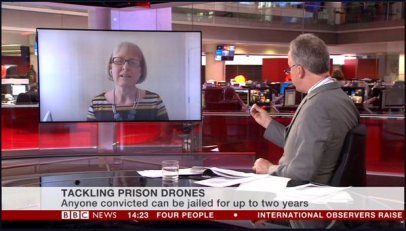
Also in April, producers at the BBC brought me onto a live link on BBC News Channel to talk about the problem of drones bringing in banned items into prisons. When presenter Julian Worricker asked for my take on it, I was able to outline the context of the issue and that it was impossible for all the drugs, phones etc within a prison to have been delivered via drones and that the new task force to be set up by the MoJ may have limited results. After working within the prison system for several years I was convinced that visitors and staff were likely routes in for contraband, yet security continued to be somewhat limited.
In May, I was delighted to join Lady Val Corbett, at her invitation, to attend the first of three ladies executive networking lunches. Each one inspired me and brought me into contact with remarkable women. Nicola McCalliog and Jo Apparicio are two women who I met through the lunches and who I especially admire; I look forward to the opportunity of working with them in the coming year. I have been amazed by the interest that was expressed in my own story and experience.
In my opinion, Lady Val has such determination, persistence, and guts! I thank her for accepting me into the Corbett Network as an associate member, it’s great to play an active part of something so vibrant.

In July, an article by Laurence Cawley was published on the BBC website. Here, the journalist wanted to explore in greater depth my experience with the IMB and the MoJ. The editorial team expected the article would get around 200,000 unique views. In fact, it reached 690,000 unique views on the first day and am told it was ranked the 8th most read article that day globally on the BBC. It was then I realised that there was a thirst by the public for coverage on justice matters.
In its mission statement, her Majesty’s Prison Service for England and Wales states that it:
“serves the public by keeping in custody those committed by the courts. Our duty is to look after them with humanity and help them lead law-abiding and useful lives in custody and after release.”
But it is shameful that HMPPS has fallen so short of its own mission statement. The situation in our prisons is worsening and really has become a humanitarian issue.

Also in July, I was invited to appear live on BBC News, this time in the studio, for an interview with Ben Brown about young people and children caught in the vagaries of the Criminal Justice System, highlighting the lack of care for these vulnerable individuals. This coverage proved a valuable opportunity to remind the public about the issue.
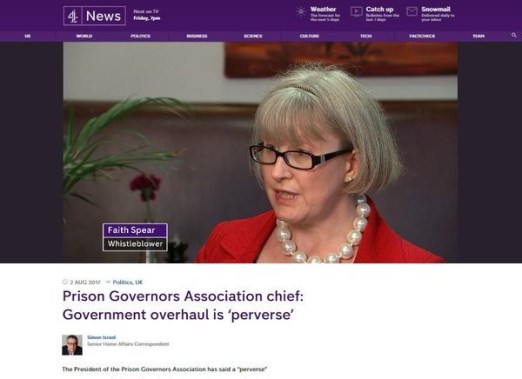
In August, I was invited to London to be interviewed by leading journalist, Simon Israel, who wanted to discuss the treatment I had encountered with the MoJ which tried to prevent me from speaking the truth concerning the prison crisis.
The interview went out on Channel 4 News causing quite a stir.
In the Autumn, I was part of one of the most important documentaries to be screened throughout the country. Here the theme was injustice and involved those from various angles within the Justice system. I was so delighted to meet those that had supported me over the last 18 months and together our voices were heard. There are more screenings planned for 2018.

This year new friendships were formed including Jane Gould (Clean Sheet) who works tirelessly in providing jobs for those that have been within the system and are often overlooked and penalised for having a criminal record. I joined her at the House of Lords for a tea reception.
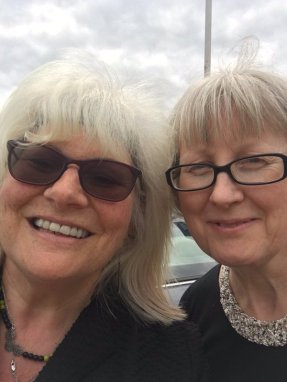
My coffee and cake buddy Justin Williams has been a great friend. He has been a sounding board and has supported me when I have come under attack from those who have disagreed with my stand for prison reform.

On a lighter note, I was invited to the Opening Concert for Malta’s Presidency of the Council of the European Union by my friend Trevor Peel. Other invitations included ‘Why me’ evening at Clifford Chance with Peter Woolf and Mel Giedroyc; Probation Institute launch of Probation Services for Armed Forces Veterans under Supervision; ‘Fighting for Prison Reform’ at UCL and Robin Corbett Awards.
I have also taken up my usual seat at the Justice Select Committee on numerous occasions, the most memorable being when the IMB and AMIMB were in front of the committee. I listened carefully and made copious notes when the IMB President John Thornhill gave evidence. This man had caused so much harm to me and yet he was unaware that I was sitting right behind him. When he was informed who I was his face was like a rabbit in headlights. His plan to get rid of me had backfired, I was still there!
There were so many other events, meetings, coffee and cake times with those that have walked with me through 2017. I thank them all.
Richard Rowley, Daniel, Cranni, Jonathan Robinson, Jonathan Aitken, Unsound Robin, Charlotte, Khatuna, Chris Moore, Michael Irwin, Tracy Edwards…and more.
I started 2018 by celebrating with my twin sister our birthdays.
This year represents a year of great opportunity.
I intend to seize it with both hands.
 The Criminal Justice Blog