
Sorry, can you speak up?
The Independent Monitoring Boards (IMB) and the Association of Members of the Independent Monitor Boards (AMIMB) have been invited to give oral evidence to the Justice Select Committee on Tuesday 31st January 2017.
We will all watch with interest.
Especially since neither IMB or AMIMB have a voice.
The two bodies have not conducted themselves well in my opinion and in my experience. And have been ‘at loggerheads’ with each other for years.
Lack of support they show for their members is as shocking as it is lamentable.
It’s clear that I’m far from alone in thinking this; many others know it to be true but are, for the moment anyway, unable to vocalise it publicly for fear of reprisals, similar to those dished out to me.
UPDATED Wed 1st Feb
Well, did you attend or watch online?
In your opinion, how did they do?
~

Never be afraid to speak the truth to those in power*
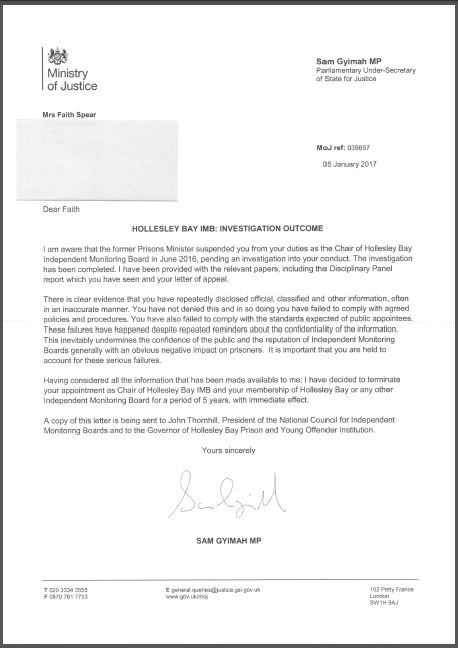
A letter from the Ministry of Justice landed on my doormat yesterday morning. I was expecting it and with trepidation it was opened and carefully read.
To download and read, please click here.
I shed a few tears. And then I replied!
To download and read, please click here.

9 months after I wrote an article in The Prisons Handbook 2016 the curtain has fallen on my time in the Independent Monitoring Board (IMB). I am dismissed with immediate effect for a period of 5 years.
I kept my word and saw this sorry episode through to the end. There are no winners or losers.
What I now know through personal experience is that if you level criticism about the Criminal Justice System you can guarantee the weight of the system will be upon you. In my case I faced an investigation by the MoJ that was biased to begin with and full of lies.
Paperwork from the start shows this was a deliberate and prejudicial character assassination designed to shut me up in the hope I would give up go away and to discredit me. I have the evidence and so does the MoJ but they have been selective with it.
But I am stronger than that and I have done my best to stand up to everything that has been thrown at me. Reports that I have read about myself written by the MoJ bear no resemblance to me and yet they have been used against me and yes, the Prisons Minister Sam Gyimah has taken them on board and made his decision.
I cannot change this decision. I have appealed and my voice may have been ignored by him but my voice has traveled far.
So, what now?
I am already on the record as saying “The Ministry of Justice has left me with no alternative than to take more robust action in the public interest” and that is exactly what I will do.
This doesn’t mean I will retaliate and seek retribution. However, since I am not gagged anymore I could reveal considerably more information about dishonesty and real misconduct I have encountered.
The IMB Secretariat, current and former IMB members, MoJ wonks and HMP/YOI Hollesley Bay staff including Governors should reflect carefully on their own behaviour before shouting down a volunteer monitor who decides to write about what they have seen and heard.
They chose to make it personal whereas I wrote about the issues.
Throughout this last year, I have kept my integrity and I have been truthful about what happened. I have never sought to elevate myself.
I am passionate about the issues I have raised for prison reform and I have no intention on being quiet or giving up, no not for one moment.
As many readers will know my motto has become #notshuttingup #notgoingaway and that is how it will continue.
Our prisons are in crisis and reform is taking too long.
~
* acknowledgements to Sir Ivan Rogers‘ email

Why our prisons need to be reformed
First published 05 January 2017 in East Anglian Daily Times under the headline ‘Prison reform is taking too long, say ex-Hollesley Bay IMB chairman and former inmate’
Had the authorities listened to the Independent Monitoring Board (IMB) at HMP Birmingham the riot on 16 December maybe could have been prevented. In their annual report the IMB wrote:
“the increasingly difficult behaviour of individual prisoners coupled with staff resource constraints give the Board cause for concern… Many staff are now concerned for their personal safety as well as for the safety of the prisoners… A solution is required urgently.”
Instead what happened was described by the Prison Officers Association as the biggest prison riot since Strangeways in 1990.
So why have prisoners behaved in this way?
Toxic combination
Sentencing guidelines have placed more people in prison for longer periods of time and has, therefore, inflated the prison population to record numbers. This in turn has given rise to overcrowding, and together with under-staffing and the emergence of psychoactive substances also known as “legal highs”, our prisons have become places of deprivation on a record scale. It’s a toxic combination.

Faith Spear
Less well publicised factors such as restricted access to education, to facilities, and the right of association with one another add to the frustration felt by those living inside. People being locked in their cell for 23 hours every day or sometimes for days on end during “lock down” creates a volatile atmosphere.
A high number of people in custody suffer from genuine mental health issues. They are imprisoned sometimes to protect society. But those are in the minority. Many people in prison with mental health issues are only there because the courts have no idea what else to do with them. For their sake and for the sake of society in which we all live, it is entirely the wrong place to send them.
IPP is defunct
Others are in prison under the now defunct rules on Imprisonment for Public Protection, known simply as “IPP”. These people don’t have a release date. Many prisoners today under IPP have already served time far beyond the normal tariff They are left to languish until the parole board decides it is safe to let them out.
I’m not saying we should open the prison doors and let everyone walk out. That would be reckless and irresponsible. But I am saying it is time to speed up the process of evaluation to make sure that those who don’t pose any risk to the public be allowed to go home as soon as possible.
What concerns me most is the utter boredom that so many of people in custody must endure. They are invariably portrayed as having a low IQ, a high percentage with a reading age of an 11year old; many have been in care and come from seriously complex situations. What isn’t realised is that many people in custody are intelligent, well-educated and have skills that could benefit other prisoners and need something worthwhile to do.
In other words, purposeful activity whilst in prison must be a priority. Lives are wasted here; I see it all the time.
So many organisations are involved in the ‘prison industrial complex’. Big money is made from those who find themselves on the wrong side of the law. Everyone wants a slice of the profits, but too little is re-invested in the prisoners and in the conditions in which they are held.
There are not enough links with the outside community, with colleges and University. Too few businesses are willing to give prisoners another chance, but without a fresh start it is impossible for them to be reintegrated back into society.
Beyond the Gate
I have seen the crushing stigma that ex-prisoners live under on release; the failure of a system that is meant to be there for them beyond the gate, the lack of accommodation, the difficulties of finding work, the list goes on.
It’s time for society to think differently towards people who find themselves in prison.
“Our prisons are in crisis and prison reform is taking too long.”
 The Criminal Justice Blog