Why is it that so many prisoners have very little to do whilst serving their custodial sentence?
Surely it cannot help their mental health that is often quite fragile anyway when they spend hours upon hours in their cells with nothing to do. With access to workshops, education and the library dependent on the number of staff on duty, prisoners are just locked away.
Prisoners need meaningful activities that serve a purpose not a mind numbing repetitive exercise. I remember having a tour of HMP Whitemoor after a meeting, one of the workshops was dismantling CD’s. Talk about repetitive. Prisoners removed the plastic film, took apart the case, removed the paper inside, and took out the CD for hours and hours on end. Come on I’m sure the prison service can do better than that. Recently I visited HMP Norwich; here they have a fantastic facility for training prisoners in sewing skills using industrial machines. They made prison issue towels and wash bags, however, all the material used was bland off-white no pattern no bright colour. Now I like sewing but staring at the same colour days on end would drive me potty! Why these machines can’t be used for something more stimulating I wonder? The equipment is available, the workforce is trained so…!
In society there are those that are not particularly academic but are very creative, it’s the same in prison.
Many prisoners seem to be placed in prison then spat out at the end of their sentence with not much to show for the time inside. This needs to change, how can prisoners be rehabilitated and not reoffend if they have often no job or education to go to afterward? It’s then a spiral downwards, what a waste of time, money and more importantly the lives of those that have been incarcerated.
There is so much un-tapped potential in prison!
Last weekend I travelled to Tymperley’s in Colchester to see an exhibition and sale of textiles such as cushions, bed-runners and Christmas decorations all produced by prisoners trained through Fine Cell work.
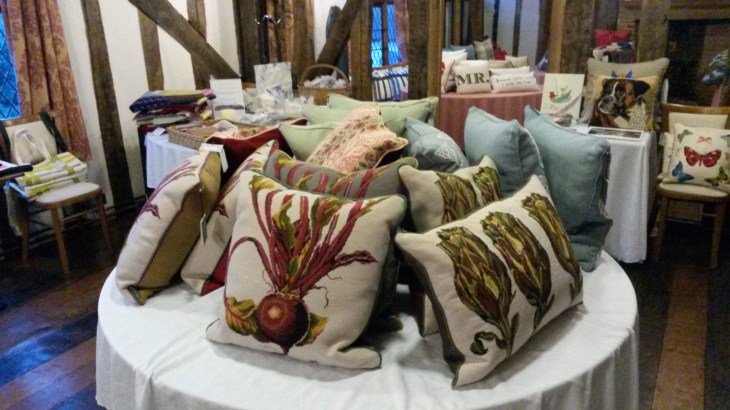 There I met I met a very enthusiastic Lucy Baile, fundraising and administrative assistant.
It was so refreshing to see work produced to such a high standard and it certainly was one of the best examples of purposeful activity I have seen.
Lucy explained that there were around 270 volunteers giving up their time to teach needlework skills both to male and female prisoners so that the many hours spent in their cells are not time wasted.
Why can’t there be more schemes like this?
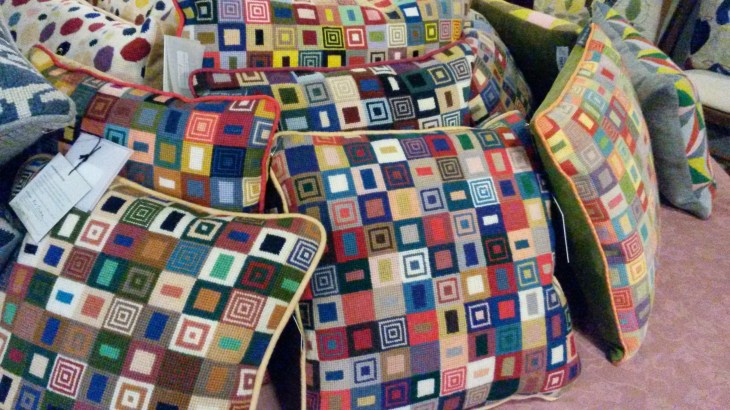
Buying a piece is an investment not just in a beautiful object but in people’s lives, to me worth every penny
This is what they say on their website:
OUR MISSION
STITCHING A FUTURE
Fine Cell Work trains prisoners in paid, skilled, creative needlework undertaken in the long hours spent in their cells to foster hope, discipline and self esteem. This helps them to connect to society and to leave prison with the confidence and financial means to stop offending.
OUR VISION
We wish to build Fine Cell Work as a sustainable charity with the prisoners as stakeholders in the enterprise. We are aiming to become more embedded in the prison system and to guide prisoners towards formal work training and qualifications and to match them up with organisations that can provide support or employment on release.
OUR VALUES
- Listening and Respect: Inclusiveness, equality and empathy with each other. We are non judgemental and accepting of our difference.
- Creating Opportunites: We believe in second chances and people’s ability to unlock their potential in a safe, creative environment.
- Giving back to Society: Not just us, but prisoners and volunteers too.
- Collaboration: We have a “can do approach”, we believe in clear boundaries, open, honest communication and in staff, volunteers and prisoners working together to create solutions.
- Creativity and Enterprise: We take pride in creating products of high value.



 The Criminal Justice Blog
Very interesting reading your blog, in particular the section on textile production at Norwich prison. I was featured in the video on Twitter which can be found online. I myself have been incarcerated at the prison three times on recalls and am due to return on the 15th of this month. The machines we were using were breaking down daily. The endless re-threading was enough to drive anyone mad. I was informed that after the visit from an MP that there was going to be investment in new equipment. I assume by now this has been implemented? I worked as a supervisor in the textiles department that you are speaking of, I knew Paul Choke the manager very well. He was the best thing in that prison for C wing. That is not exaggeration, there was literally nothing else on the wing for anyone. The materials we worked with were unfortunately standard prison colours. Orange blankets, sickly-green coloured pillow cases and bedsheets. I myself worked on the discharge bags for the most part which in my opinion was almost a waste of resources when you consider how much use they will receive and should be recycled back into the system. After I left prison I worked as a sewing machinist for a local manufacturer and gained significant experience that I was craving for inside the prison. Unfortunately the industry is so thin in this country now it requires an individual to move home to find those kind of jobs. For those on C wing with a genuine interest in this work links and connections need to be established prior to prisoners completing there sentences.