
How much longer will this continue? Children detained in UK immigration removal centres
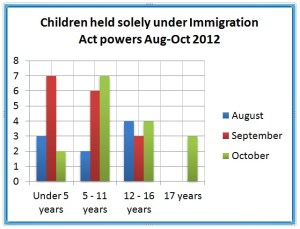
Table 1. (Home Office, 2012)
Every month, I receive the immigration statistics from the Home Office and am repeatedly drawn to the statistics on children detained under Immigration Act powers in immigration removal centres (IRC) such as Tinsley House a facility located on the perimeter road facing the main runway of Gatwick Airport.
These children are not in accommodation geared up for families. Some are detained in locations that originally were built to the same specification as Category B prison; cells as bedrooms and concrete yards as gardens are not environments for children.
I am reminded of the illustrations drawn by children who had experienced life in an immigration removal centre (Burnett, 2010).
The Coalition government had pledged to bring an end to the detention of children for immigration purposes back in May 2010 but clearly this has not been treated with any degree of priority.
How much longer will this continue?
References
Burnett, J. (2010) ‘Repatriation medicine’ Criminal Justice Matters. 82. December. pp. 26-28.
Home Office (2012) Immigration Statistics July – September. [Online]. Available at < http://www.homeoffice.gov.uk/publications/science-research-statistics/research-statistics/immigration-asylum-research/immigration-q3-2012/> [accessed 29 November 2012].
Why should we concentrate on making the prison system cheaper not smaller, Mr Grayling?
A theme that is close to my heart is the reduction of the prison population, unfortunately the Government has other ideas. Chris Grayling MP in his speech to the Centre for Social Justice on 20th November stated the five priorities that he has given to the Ministry of Justice for the remainder of this Parliament, priority three included
“We have to focus on making the prison system cheaper not smaller”.
In addition Jeremy Wright MP at the AGM for the Howard League for Penal Reform on Wednesday 21st November 2012 said that the Government has no plans to reduce the prison population and it is the sentencers not the Government who are responsible for the prison population as it stands today.
Maybe we should look at simplifying the Criminal Justice System by reviewing historical scholars. In On Crimes and Punishment and Other Writings (1764), Cesare Beccaria critically challenges the current thinking of the 18th Century by putting forward his theory of Criminal Justice from an enlightened perspective as he himself searched for truth (Bellamy, 1995). He concluded that:
“In order that punishment should not be an act of violence perpetrated by one or many upon a private citizen, it is essential that it should be public, speedy, necessary, the minimum possible in the given circumstances, proportionate to the crime, and determined by the law”
What is clear is that the objectives of sentencing have changed over time, with different priorities being given by different policy makers. The criminal justice system has been reduced to a managerial system rather than improving on a punitive system. In other words, policy makers are more interested in assuring that the system works than assuring that the punishment works, which totally misses the point of crime and punishment as Beccaria saw it.
References
Bellamy, R. (ed.) (1995) Beccaria: On Crimes and Punishments and Other Writings. Cambridge: Cambridge University Press.
Related Links
‘Prisons: cheaper not smaller’ by Richard Garside. UK Justice Policy Review. 20 Nov 2012. click here
‘An open letter to Chris Grayling from an ‘old lag’ ‘Downsizing Criminal Justice. 28 Nov 2012. click here
Don’t you think the person is more important than the policy?

More than 86,000 people behind bars in England and Wales
Last year I presented a poster session to cohort and faculty at my local university. The poster was the most visible infographic in the room. It acted as a magnet for attendees. Its immediacy communicated right to the heart of the issue and triggered some substantive discussion. And so it should. Latest figures available from Ministry of Justice shows that over 86,000 people in England and Wales are currently serving custodial sentences.
Frances Crook (@FrancesCrook), Chief Executive of The Howard League for Penal Reform said that many of these people should not be in prison at all; many offenders, particularly those serving short sentences, would be move effectively punished using community sentences.
She has a point. If offenders can be more effectively punished using a sentencing strategy which not only costs around one tenth of the cost of a prison place, but also controls prison population at the same time as being in the better long term interests of the offender, then it deserves serious consideration.
“It isn’t crime that puts people in prison – it is policy that puts people in prison.”
In my experience dealing with a range of offenders, I can see that sentencing strategy, in some cases, causes “penal excess”. This phrase means different things depending on your standpoint. For example, to a probation officer it may mean a harsh sentence behind bars. To a politician, it may mean “…it is the sentencers not the Government who are responsible for the prison population as it stands today” (said Jeremy Wright MP, 21st Nov 2012, speaking on the occasion of the AGM of The Howard League for Penal Reform).
Don’t you think the person is more important than the policy?
 The Criminal Justice Blog